
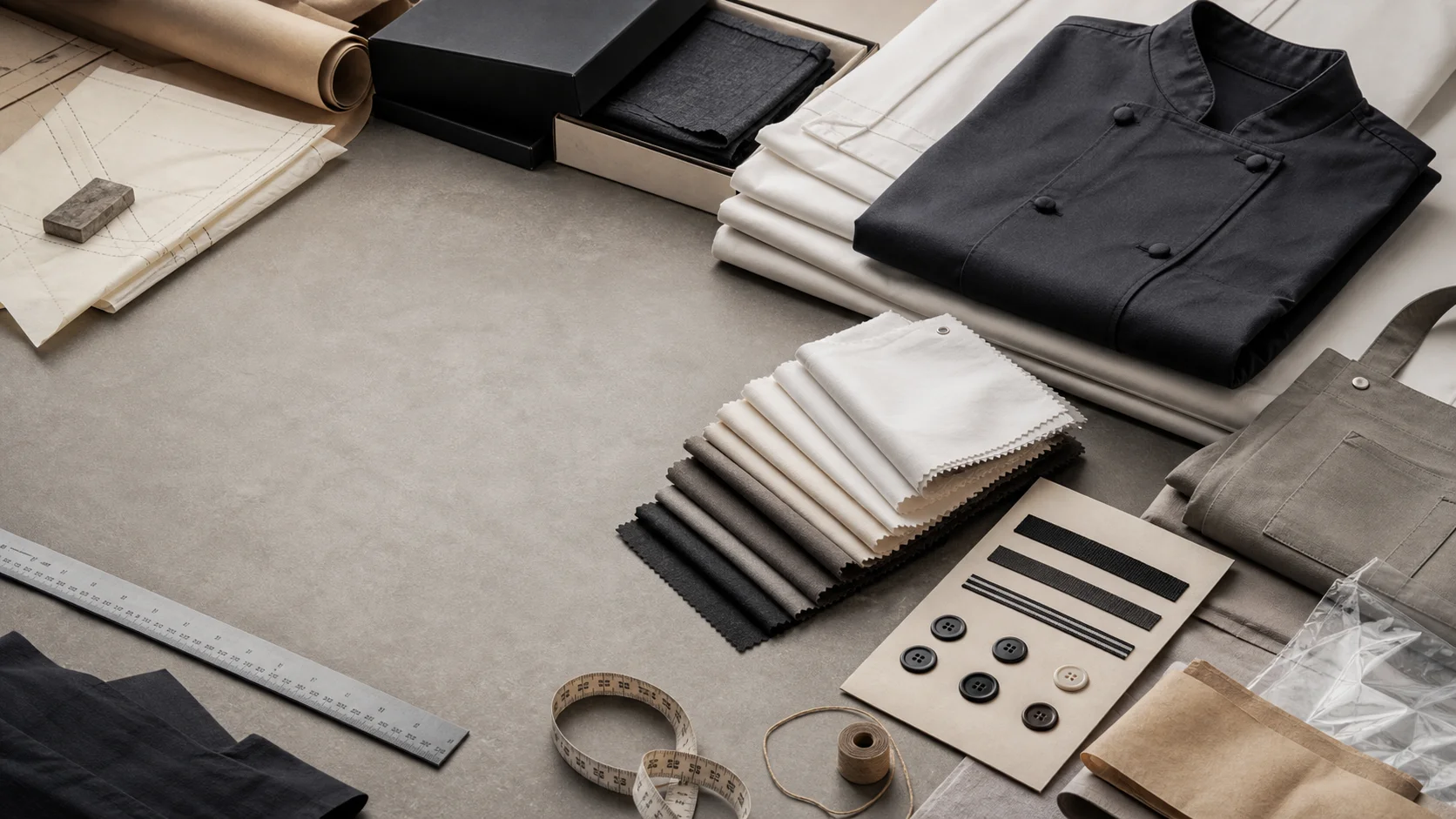
Custom Tracksuit Manufacturer for Brands compared by sample evidence, fabric or trim specs, MOQ, AQL terms, cost lines, delivery timing, and rework...
Fast answer: Custom Tracksuit Manufacturer for Brands: Sample Fit, Trim, AQL, and Delivery Risk should be judged by production evidence, not by a generic sourcing promise. The buyer needs sample proof, cost breakdowns, QC checkpoints, and delivery buffers in writing.
Ask for recent sample photos, measurement tolerances, fabric or print test assumptions, decoration test notes, packing examples, and a named inspection checkpoint. These details show whether the team can repeat an approved sample at bulk volume.
Separate garment cost, decoration, labels, packaging, sampling, testing, freight, and rush charges. Clear cost lines make it easier to reduce colorways, adjust size depth, or reserve more time for sampling.
Tracksuits stopped being background basics a while ago. For brands looking to scale, a custom tracksuit manufacturer for brands can be the quickest route to a product that moves across retail, DTC, and wholesale without losing its shape or its appeal. In the last 12 months, the strongest-selling sets I reviewed landed in a narrow but telling band: premium labels at $180-$320 a set, mid-market brands at $95-$140, and budget players at $38-$62. The surprise was not the retail pricing. It was how often the higher-priced option delivered better economics anyway. I’ve seen a custom tracksuit manufacturer for brands quote the same silhouette at $14.80 FOB in Turkey, $9.40 in China, $11.20 in Portugal, and $6.70 in Bangladesh, with fabric and trim specs nearly identical on paper.
That spread matters because tracksuits work harder than most categories. They sell across genders, across three seasons, and across channels that used to behave very differently. A brushed fleece set can sit in a women’s lifestyle edit, move through men’s streetwear drops, and clear in travel apparel bundles on DTC sites. I’ve visited factories that shipped 60,000 sets for a value chain and 8,000 sets for a premium capsule, and the difference was not only price. The premium order had tighter shade control, a 2.5 cm tolerance on the pant inseam, and a lower return rate, which changed the economics in a way spreadsheets often miss.
Factory floors tell a less glamorous story. The buyer who thinks tracksuits are easy basics usually underestimates the number of decisions hiding in plain sight: 280 GSM versus 320 GSM fleece, YKK zipper versus no-name coil, flatlock versus overlock, rib cuff recovery, and wash consistency after five cycles. In Turkey, many mills can turn around fabric in 10-14 days. In Bangladesh, a vertically integrated mill-factory setup may offer a lower cut-and-sew price but longer fabric booking windows of 18-28 days. China often wins on speed for repeat runs, especially when the line already knows the pattern and the trims are in stock.
The thing nobody tells you is simple: a higher FOB can still improve margin if rejection rates fall from 8% to 2% and sell-through rises from 68% to 84%. I’ve seen brands chase a $1.60 per set saving, then absorb $3.20 in rework, freight delays, and markdowns. That is not efficiency. That is a slow leak.
A real factory partner does far more than sew two pieces together. A custom tracksuit manufacturer for brands typically manages the full production chain, from tech pack review and fabric sourcing to pattern development, grading, sample making, bulk cutting, sewing, finishing, inspection, and packing. On a solid program, I expect a response within 24-72 hours on tech pack questions, a first sample in 7-21 days depending on fabric availability, and bulk production after fit approval. If a supplier cannot explain those steps clearly, I treat that as a warning sign, not a minor communication gap.
There are three common models. OEM means the factory makes to your specs and your brand owns the design. ODM means the factory offers a base style you modify with color, trim, or a logo. Fully custom production gives you control over pattern, fabric, labeling, and finishing, but it also demands tighter approval discipline. For a tracksuit, that difference shows up in the hood shape, pocket depth, waistband recovery, and how the jacket hem sits after wash. A supplier that also handles custom bra manufacturing may be highly precise on fit and stretch recovery, which matters more than people expect when working with fleece and knit waistbands.
Sampling and grading are where weak factories expose themselves. A pattern may look fine in size M, then pull at the crotch in XL or twist at the side seam in XS. Good factories grade from a base size with 1-2 cm rules that are documented and repeatable. Bad ones “adjust by eye,” which usually means your size run becomes inconsistent by the time it reaches bulk.
Trims and embellishment are not small details. Custom zipper pulls can add $0.18-$0.65 per set. Woven labels, hangtags, polybags, and carton specs can add another $0.40-$1.20. Embroidery density changes cost too: a 5,000-stitch chest logo is one thing; a 14,000-stitch back mark on heavyweight French terry is another. In practice, the quality of the fabric mill, the trim vendor, and the sewing line shape consistency across sizes and colorways more than most brand decks admit. That is why I often connect apparel brands to private label clothing programs only after we define whether the product should stay standard or become truly custom.
Compliance and sustainability matter too. Many brands now ask whether their custom tracksuit manufacturer for brands can support recycled fibers, traceability, or certified chemicals management. If that is part of your roadmap, resources from Textile Exchange and Trade.gov can help you understand fiber sourcing and import planning before production begins.
Start with a hard checklist, not a sales pitch. Ask for MOQ, lead time, lab test access, sample accuracy, communication speed, and proof of prior wash testing. For a small brand, MOQ can be 100-300 sets in some Turkish or Portuguese factories, 300-500 in China, 500-1,000 in Pakistan, and 800-1,500 in Bangladesh depending on fabric and color. If a supplier hides MOQ behind vague language like “flexible,” I dig deeper. Flexible for whom, and at what price?
Factory behavior differs sharply by region. In lower-cost hubs, I often see faster willingness to quote, but slower discipline on revisions. A factory in Dhaka might reply in 6 hours, yet miss a changed cuff width by 1.5 cm because the revision never reached the right line supervisor. A Portuguese factory may quote 15%-30% higher, but the sampling file is cleaner, the approvals are documented, and the response on fabric testing is usually more precise. In Turkey, the sweet spot is often speed plus stronger communication, though the best mills and ateliers are selective about volume.
Red flags are rarely subtle. Vague pricing that lumps fabric, sewing, trims, and packing into one number. No wash test history. No clear size grading sheet. Stitching that changes density between sample one and sample two. I’ve audited factories where the sample looked polished under showroom lights, then failed after three cold washes because the rib collar relaxed 11% and the pant leg twisted. That is not a minor adjustment. That is a product return waiting to happen.
Here’s what most people miss: the cheapest quote can become the highest landed cost once delays, defects, air freight, and rework are counted. I’ve watched a $8.10 FOB quote land above a $10.40 FOB quote after 7% defects, two sample rounds, and a missed delivery window that forced emergency shipping. A good supplier protects margin by reducing friction, not only by lowering unit price.
Pricing moves in layers. At 100 sets, the factory is charging for disruption, not just labor. At 500 sets, you begin to see the real manufacturing cost. At 2,000 sets, efficiencies from fabric booking, marker yield, and line setup start to show. For a custom tracksuit manufacturer for brands, the same brushed fleece set can vary sharply by region: China often sits around $9.20-$15.50 FOB at 500 sets, Turkey around $11.80-$18.90, Portugal around $13.50-$22.00, Pakistan around $7.80-$13.20, and Bangladesh around $6.50-$11.40, depending on construction and finishing.
Fabric weight changes the bill fast. A 260 GSM poly-cotton brushed fleece may cost $1.80-$2.60 per meter, while a 320 GSM version can rise to $2.70-$4.10. French terry 320 GSM usually costs more than loopback terry because the face yarn and finishing are more controlled. If you add enzyme wash, the cost may rise by $0.35-$0.90 per set; stone wash can add more and increase shrinkage risk. Embroidery is another swing factor. A small left-chest logo may cost $0.25-$0.60, while dense back embroidery can add $1.20-$3.80 depending on stitch count and thread coverage.
MOQ affects unit economics more than most buyers expect. At 100 sets, a factory may absorb setup across very few units, so the same tracksuit can land at $18-$30 before freight. At 500 sets, that can drop to $10-$18. At 2,000 sets, it may fall to $7.50-$14 if fabric is standardized and trims are stocked. Low-volume brands should not panic at the sticker price; they should calculate whether a tighter launch with fewer colorways protects cash and reduces dead inventory. That is especially true for wholesale and bulk programs, where over-ordering can hurt margin quickly.
Landed cost matters more than FOB. Add $0.80-$2.50 for freight depending on volume and routing, $0.40-$1.20 for duty in some markets, $0.15-$0.40 for compliance testing spread across units, and a defect allowance of 2%-5%. A $12.00 FOB set can land at $14.20-$17.10 once everything is counted. A $9.50 FOB set can land at $14.00 if rework is ugly. That is why I always ask a custom tracksuit manufacturer for brands to quote fabric composition, sewing cost, trim pack, packing method, and test requirements separately. If they cannot, the quote is incomplete.
Most tracksuit programs need 4-10 weeks from tech pack to first bulk-ready sample, then another 3-8 weeks for production depending on region, fabric, and embellishment. A basic poly-cotton set in China can move from tech pack to first sample in 7-14 days, while a premium French terry set in Portugal may need 14-21 days because mills, trims, and wash approvals are stricter. When I visited factories in Turkey, the fastest teams were not the loudest. They were the ones who locked the pattern room early and only reopened it once.
The timeline usually breaks into five checkpoints: tech pack review, first sample, SMS revision, size set approval, and bulk production. Fabric dyeing or knitting can add 7-18 days. Lab dips can take 3-10 days. Embroidery approvals often add 2-5 days, especially if the thread palette is custom. Trim sourcing can be the hidden delay, particularly for branded zipper pulls, specialty cords, or recycled polybags. If a factory says all materials are available, I ask for names, item codes, and stock quantities.
Brands cut weeks by making one strong decision set instead of three weak ones. Approve the fabric weight, the fit block, and the logo placement together. If you change the cuff width after size set approval, you are almost always buying another round. I have seen brands lose 21 days because they wanted to tweak pocket depth after the first sample looked almost right. Almost right is expensive.
For most launches, a controlled schedule beats an aggressive one. A simple order with one color, one fabric, and one logo can ship in 35-45 days from approved sample. A premium, multi-color program with contrast panels, woven trims, and custom wash can stretch to 60-90 days. That is still manageable if the buyer plans the calendar honestly and does not promise a retail date before approvals are locked.
Good QC is measurable. For tracksuits, I look at stitch density, seam slippage, shrinkage, pilling, twist, shade banding, and colorfastness. A jacket panel that twists 2-3 cm after wash may pass in value retail. In premium ranges, it is a rejection. Shrinkage should usually stay under 3%-5% depending on fabric and spec; anything beyond that needs a correction before bulk. Seam slippage and pilling should be backed by test reports, not verbal assurances.
Ask for inline inspection records and pre-shipment AQL results. I want to see the factory catch issues before they become pallet problems. According to OEKO-TEX, chemical safety and material checks matter just as much as visual finish for many apparel categories, especially if the garment sits close to skin and will be washed frequently. That matters in brushed fleece, where surface handfeel can hide dye or finishing weakness.
I’ve audited a set that looked excellent on the rack, then failed after wash because the rib waistband lost recovery and the logo cracked at the edges. Another factory sample passed fit but failed colorfastness after one detergent cycle. Premium brands reject more units in bulk than value brands because their tolerances are tighter, not because they are fussy. A 1 cm shade difference might be invisible in a discount bin and unacceptable in a $180 set. If sustainability certification is part of your brief, compare factory claims against the standards listed by OEKO-TEX before you approve bulk production.
Good factories own the test file. Weak ones ask you to trust the sample room. I trust data, not theater.
Send a clean tech pack first. Include fabric reference, size chart, target price, annual volume forecast, logo artwork, packing spec, and a delivery window. If you can, add a washed sample or a detailed reference garment. The more precise the brief, the less time the factory spends guessing. I’ve seen quote turnaround drop from five days to 48 hours when the buyer sent one complete pack instead of scattered emails.
Compare quotes line by line. Separate fabric, sewing, trims, testing, packing, and freight assumptions. A supplier that quotes $11.20 with clear details may be stronger than one quoting $9.90 with no trim breakdown. For outerwear-adjacent programs or more technical seams, a factory that understands get a free quote workflows usually responds faster once the product spec is locked. That speed matters when your launch calendar is already tight.
Shortlist factories on four things: communication quality, sampling speed, compliance, and pricing logic. Not charm. Not the prettiest showroom. Then start with a limited launch: one or two colorways, one fit block, a controlled size range, and a sales window you can actually support. If the first run performs, expand on data, not optimism.
I’ve walked enough sewing floors to know this category rewards discipline. The brands that win with tracksuits are usually the ones that specify more, guess less, and treat manufacturing as a numbers business. If you want your next launch to hold up in the wild, work with a custom tracksuit manufacturer for brands who can prove it on paper and on the line.
At 500 sets, typical FOB prices run about $6.50-$18.90 depending on region, fabric weight, and trim complexity. At 100 sets, expect a much higher unit cost because setup is spread over fewer pieces. Landed cost usually rises by another $1.50-$4.50 after freight, duty, testing, and defect allowance.
Basic programs can move from approved tech pack to shipment in 35-45 days. Premium or highly customized sets usually take 60-90 days, especially if you need custom fabric, wash treatment, or embroidery approvals. Sampling alone can take 7-21 days before bulk begins.
MOQs vary by region. Portugal and Turkey may accept 100-300 sets on simpler styles, China often starts around 300-500, and Pakistan or Bangladesh may ask for 500-1,000 or more. Fabric type, color count, and trim customization can push the MOQ higher.
Compare fabric spec, sewing construction, trims, testing, packing, and delivery terms separately. A lower quote can hide extra charges for custom zipper pulls, wash testing, or packaging. Ask each factory to confirm lead time, defect policy, and what happens if a sample needs revision.
China is often strongest on speed and scale, Turkey on communication and shorter lead times, Portugal on tighter quality control, and Pakistan or Bangladesh on lower labor cost. The best choice depends on your price target, MOQ, and how much complexity your tracksuit needs.