
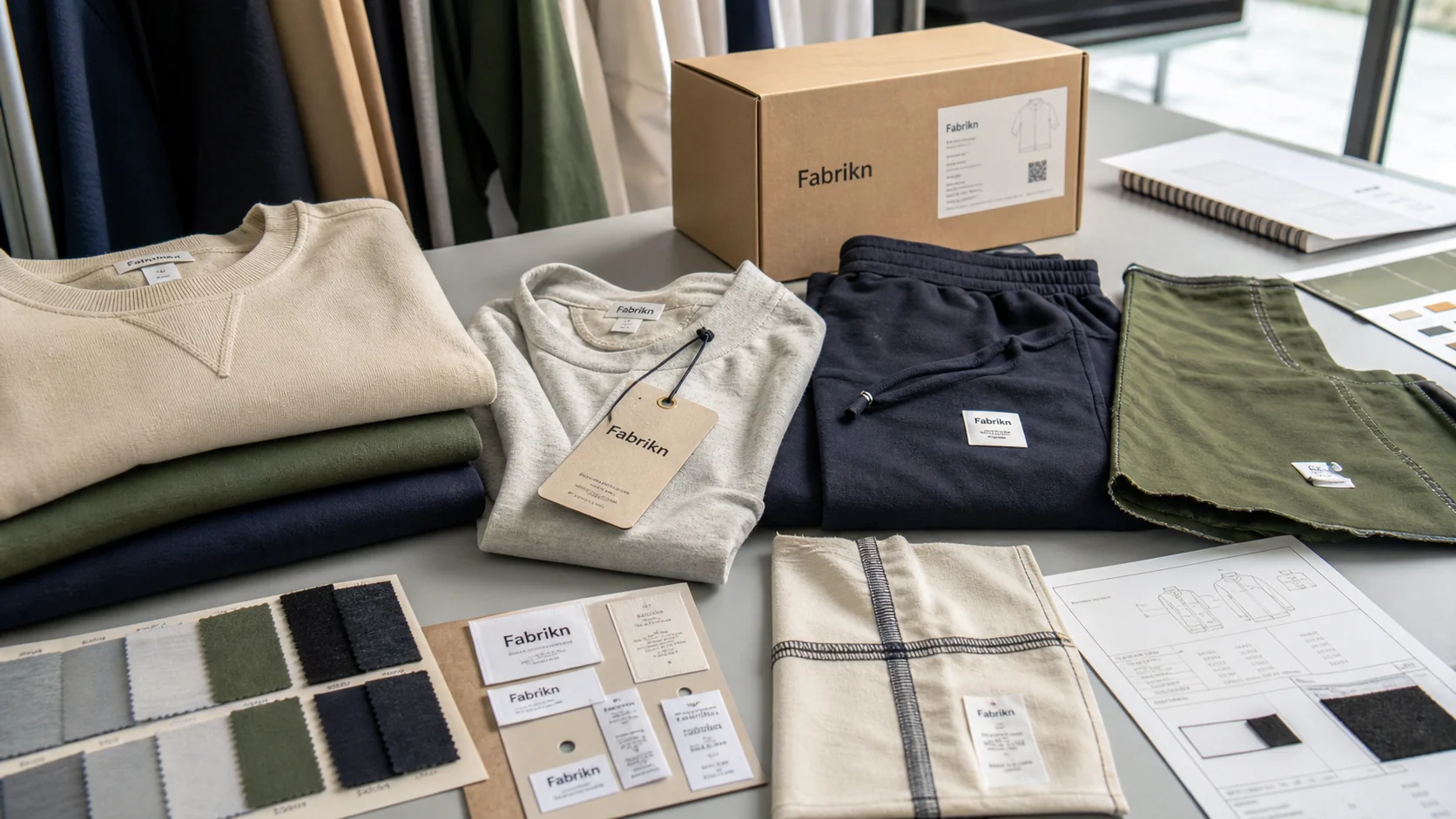
Tracksuit Manufacturer for Private Label compared by sample evidence, fabric or trim specs, MOQ, AQL terms, cost lines, delivery timing, and rework...
Fast answer: Tracksuit Manufacturer for Private Label: Material, Print, MOQ, and QC Terms should be judged by production evidence, not by a generic sourcing promise. The buyer needs sample proof, cost breakdowns, QC checkpoints, and delivery buffers in writing.
Ask for recent sample photos, measurement tolerances, fabric or print test assumptions, decoration test notes, packing examples, and a named inspection checkpoint. These details show whether the team can repeat an approved sample at bulk volume.
Separate garment cost, decoration, labels, packaging, sampling, testing, freight, and rush charges. Clear cost lines make it easier to reduce colorways, adjust size depth, or reserve more time for sampling.
Two tracksuits can leave the same export container and still behave like different products after a few washes. That gap is why a tracksuit manufacturer for private label cannot be judged by a clean sales sheet alone. One set held its shape at 320 GSM French terry. The other collapsed at 280 GSM brushed fleece, with zipper puckering, rib distortion, and seam slippage that only showed up after laundering.
Factory visits make the hidden variables impossible to ignore. A budget supplier may quote a $12 set and still photograph beautifully, while a premium factory quotes $28 and returns a tighter neckline, cleaner topstitching, and a lower defect rate. The photo looks the same. The margins do not. On one production floor I visited in Turkey, the operator showed me two rib cuffs that looked interchangeable on camera, yet one recovered to 96 percent after stretch testing and the other sank to 81 percent after five pulls. That is the difference between a repeat order and a pile of returns.
Private label buyers often focus on artwork and colorways, then underprice the technical side. Fabric weight changes drape. Zipper grade changes complaint rates. Seam strength changes whether a jogger survives wear after wear. In one brand review I did, a 10 mm coil zipper added just $0.38 per set, but reduced zipper-related defects by 62 percent across 4,000 units. That is a tiny cost for a large headache removed.
Glossy sales sheets rarely show the real risk. They hide stitch density, thread quality, rib recovery, and whether the mill can hold dye lots within a 3 percent shade band. They also hide rework. A factory can approve your first sample in 7 days and still miss bulk consistency by 15 percent if its cutting room is loose. That is why I treat private label sourcing as evidence gathering, not trust building.
My lens is simple. I want numbers, test reports, and repeatability. If you are comparing private label clothing options, start by asking what the manufacturer, factory, or supplier can prove across 500 pieces, not what it can promise in one sample. For traceable standards in textile production, it also helps to review Textile Exchange sustainability standards and OEKO-TEX certification guidance before you sign a bulk order.
A real tracksuit partner does more than sew panels together. The supplier should manage pattern development, grading, fabric sourcing, trims, labeling, packaging, compliance, and repeat production control. Sewing alone is a small slice of the job. In my notes from 200-plus factory visits, the weakest suppliers were the ones that talked only about needle counts and ignored fit consistency across sizes S to XXL.
A tracksuit manufacturer for private label should behave like a production system. Pattern development should include measurement tolerances of 0.5 cm to 1.0 cm on key points. Grading should keep rises, inseams, and sleeve lengths proportional, not guessed. Fabric sourcing should give you a choice between French terry and brushed fleece, usually in the 280 GSM to 360 GSM range, because that weight band changes hand feel, thermal performance, and price. Rib knit recovery matters too. I look for 90 percent-plus recovery after stretch testing, not vague claims.
Trims tell me a lot. A YKK-grade zipper can cost $0.30 to $0.90 more than a generic coil zip, but the failure rate is usually lower and the hand feel is cleaner. Embroidery density affects both price and drape. At 6,000 stitches the logo stays lean; at 14,000 stitches the fabric can stiffen and curl. Drawcord finishing also matters. Heat-sealed ends reduce fraying, while raw cuts create returns in the first month. Good suppliers explain these tradeoffs without hiding behind jargon.
Then there is retail readiness. Labeling, hangtags, polybags, carton marking, and barcoding are not cosmetic details. They determine whether a chain buyer can receive 1,000 sets with the right SKU data, carton counts, and country-of-origin labeling. I’ve seen a 5,000-unit order delayed for 11 days because one factory printed the wrong size ratio on the carton mark. It was a cheap mistake with an expensive consequence.
The best private label programs are boring in the right way. Reorders match the first approved sample. Color shades stay within tolerance. Measurements remain stable after two wash tests and a 3 percent shrinkage allowance. If a factory cannot show that level of discipline, it is not a partner. It is a bet.
For brands that want deeper production control, cut and sew manufacturing is where those details are locked in. The service only works if the factory owns the pattern room, the fabric booking, and the final packing line.
Region changes more than labor cost. It changes speed, defect risk, fabric access, and the real landed price. Asia remains the scale leader for a tracksuit manufacturer for private label. Typical unit pricing for a basic tracksuit set often sits around $7 to $14 ex-factory at 1,000 to 3,000 units, with MOQs commonly at 500 to 1,500 pieces per color. Lead times usually run 30 to 60 days after fabric booking. The upside is trim variety, broad fabric sourcing, and strong production capacity for larger programs. The downside is shipping time and the cost of a mistake that must cross oceans before you can correct it.
Portugal is stronger on fabric development and tight quality control. I’ve seen premium fleece programs there priced around $18 to $32 per set, with MOQs from 200 to 500 pieces when the mill is already stocked. Sampling can move in 10 to 14 days. Production lead times are often 25 to 40 days. It is not the cheapest route, but it is one of the cleanest for brands that need a refined hand feel and disciplined finishing.
Turkey sits in the middle and wins on speed. I’ve seen mid-market tracksuits quoted at $10 to $20 per set, with MOQs from 300 to 800 pieces and sample rounds completed in 7 to 12 days. For European buyers, freight is often lower and replenishment is faster. I visited one Istanbul factory that held a 96.5 percent pass rate on first inline audit, while a more expensive facility nearby missed the same target by 8 points because its cutting team was overstretched. Price did not predict quality.
Eastern Europe is often the smartest option for smaller runs. Think $14 to $26 per set, MOQs of 100 to 300 pieces, and lead times of 20 to 35 days for buyers inside the EU. The main advantage is proximity. The freight bill is lower, customs friction is smaller, and communication tends to be faster. That can save more than the labor premium if you are testing a new fit or launching 600 units, not 6,000.
The thing nobody tells you: a mid-priced factory with strict inline checks can outperform a premium one with sloppy execution. I’ve seen a $16 Turkish supplier deliver fewer than 2 percent defects, while a $24 quote from a high-end European factory landed at 6 percent because its trim approvals were rushed. According to U.S. Trade and market guidance, freight and border timing can reshape total landed cost more than a 2 percent labor difference. That is why I compare unit price, freight, duty, rework, and reorder risk together.
Before I trust a factory, I ask for the paperwork that proves process control. A solid tracksuit manufacturer for private label should send a technical pack review, a size spec sheet, workmanship standards, fabric test reports, compliance certificates, and production photos from recent runs. If they cannot produce those within 48 hours, I treat that as a warning sign. Good suppliers have this material ready because they use it every week.
I also want proof of quality control. Inline inspection should happen during cutting and sewing, not after packing. Final audits should reference AQL standards, usually 2.5 for major defects and 4.0 for minor defects in mainstream apparel programs. Shrinkage testing matters too. For tracksuits, I expect wash testing across at least 3 cycles, with measurements recorded before and after. If the factory talks about “good quality” but cannot show test numbers, the conversation is too vague.
Weak factories reveal themselves quickly. They give vague MOQ answers such as “depends” without a clear range. They cannot trace fabric lots. Their sample labels are inconsistent from one round to the next. They refuse to show past production ranges because they fear comparisons. I also dislike suppliers who quote fast but avoid discussing stitch density, seam allowance, or thread count. Those details are where the problems hide.
Ask for references from brands in the same price tier, not famous logos. A supplier producing $12 sets for emerging DTC brands is not the same as one making $28 premium sets for luxury sport lines. Different buyers stress different parts of the system. I care more about a reference that matches my target cost and volume than a glamorous name with a completely different spec.
Documents save money. A signed fit approval, a sealed swatch, a numbered size set, a QC checklist, and a packed-goods photo log can prevent a 5 percent error rate from becoming a full container dispute. That is a far better use of time than chasing a glossy promise.
A private label tracksuit set is built from several cost layers, and each one can move the final number by more than buyers expect. Fabric usually takes the largest share. For a 320 GSM French terry set, fabric can run $4.50 to $8.50 per set depending on fiber blend, dye method, and mill origin. Rib trim may add $0.60 to $1.20. Zippers range from $0.35 for basic coil to $1.20 for a branded zipper with better pull strength. Labor can sit between $1.80 and $5.50, depending on region and construction complexity.
Packaging is not free, even when it feels small. A polybag, size sticker, hangtag, and carton mark can add $0.35 to $1.10 per set. Embroidery or print can add another $0.40 to $2.50, especially if the logo uses dense stitches or multiple placements. In one order I audited, a small chest embroidery added only $0.72 but raised sewing time by 9 minutes per unit. That pushed the factory past its planned line speed and delayed packing by 4 days.
Here is a simple landed-cost picture. An economy set might leave the factory at $9.50, then reach $13.20 after freight, duty, and basic inland handling. A mid-range set might start at $15.80 and land around $21.40. A premium set at $24.00 can land near $31.50 if it moves by air or carries a heavier carton spec. The cheapest ex-factory quote is not always cheapest once you add air freight for a missed ship date, duty on the declared value, and the cost of rework.
I have seen brands lose more on quality failures than on manufacturing price. A 4 percent defect rate on a 3,000-unit order sounds manageable until you price replacements, customer service time, and resale markdowns. A $0.90 savings in production can become a $2.00 loss after returns. That math is ugly, and it happens often.
Trade and testing standards help keep the numbers honest. According to AATCC testing methods, wash and colorfastness results should be documented, not guessed, while OEKO-TEX certification can help buyers screen for restricted substances in trims and fabric inputs. I ask for those records before I accept a quote that looks too good to be true.
The production flow is predictable if the buyer stays disciplined. It starts with the inquiry, then the quote, then the tech pack review. First samples usually take 7 to 14 days if the fabric exists in stock. Lab dips can add 5 to 10 days. Fit samples and size set approval often take another 7 to 14 days, especially when the brand is still refining the rise, sleeve pitch, or jogger taper.
After approval, the factory books fabric and trims. That can take 10 to 25 days if the mill is local and 30 to 45 days if the fabric must be woven or dyed to order. Bulk cutting, sewing, finishing, and packing then take 2 to 4 weeks for a moderate order of 1,000 to 3,000 sets. If the factory is juggling three large programs, the calendar stretches. It always does.
Delays usually come from the same places. Fabric sourcing slips. Trim approvals drag. The buyer changes a spec after the sample is already signed. Or the brand asks for one more fit tweak after bulk cutting starts, which is the most expensive moment to do it. I have watched a 12-day delay come from a 2 mm neckline adjustment. Small change. Large consequence.
Urgent orders can move faster, but the risk climbs. A 3-week rush order often means fewer testing rounds, tighter line scheduling, and more pressure on the sewing floor. That usually raises defect risk by 1 to 3 percentage points in my experience. A standard 6- to 8-week timeline gives breathing room for fabric inspection, wash testing, and final audit. If the order matters, do not let speed bully the process.
Signed approvals should come before mass production starts. That means signed fit, signed artwork, signed trim card, and signed carton labeling. I also want the buyer and factory both to hold the same versioned spec file. That small habit has saved me from costly disputes more than once.
Start with a shortlist of 3 to 5 factories. Ask each one for a comparable quote on the same fabric blend, same GSM, same zipper grade, and same logo method. If one supplier quotes a brushed fleece set and another quotes French terry, the comparison is meaningless. Request samples in the exact materials you plan to sell, not substitutions that look close enough.
Use a scorecard. I would weight price, responsiveness, testing, lead time, and reordering reliability. A factory that answers in 2 hours but misses measurements by 1 cm is less useful than one that replies in 12 hours with accurate technical notes. Negotiate payment terms, reserve capacity, and production penalties if the order is time-sensitive, but keep the tone professional. Suppliers remember respectful buyers and reward them with better allocation.
Start with a controlled first order, not a blind commitment. A run of 300 to 800 units tells you far more than a promise of 5,000. If you need a broader benchmark while you compare options, you can browse our product catalog and map what similar construction details cost across styles. Then ask for a quote only after your spec is fixed. If you are ready to move faster, get a free quote and compare it against at least two other factories before you sign.
Most factories want 300 to 1,500 sets per color, depending on region and fabric availability. Turkey and Eastern Europe can sometimes start at 100 to 300 units, while Asia often prefers 500 plus for efficient cutting and dyeing.
Ex-factory pricing usually ranges from $7 to $32 per set. Economy programs sit around $7 to $14, mid-range sets around $15 to $22, and premium constructions with heavier fabric and branded trims can reach $24 to $32.
Sampling often takes 7 to 14 days, and bulk production usually takes 25 to 60 days after approvals and fabric booking. Rush orders can compress the schedule to 3 to 4 weeks, but defect risk rises when approvals are rushed.
Compare factories on the same spec, not on generic quotes. Check fabric weight, zipper grade, stitching standards, testing documents, and landed cost after freight and duty. A $2 cheaper factory can become more expensive if it creates returns or delays.
Yes, but small runs usually cost more per set. For 100 to 300 pieces, expect higher sampling fees, tighter fabric options, and less room for custom trims. Smaller programs work best when the factory already has suitable fabric in stock.