
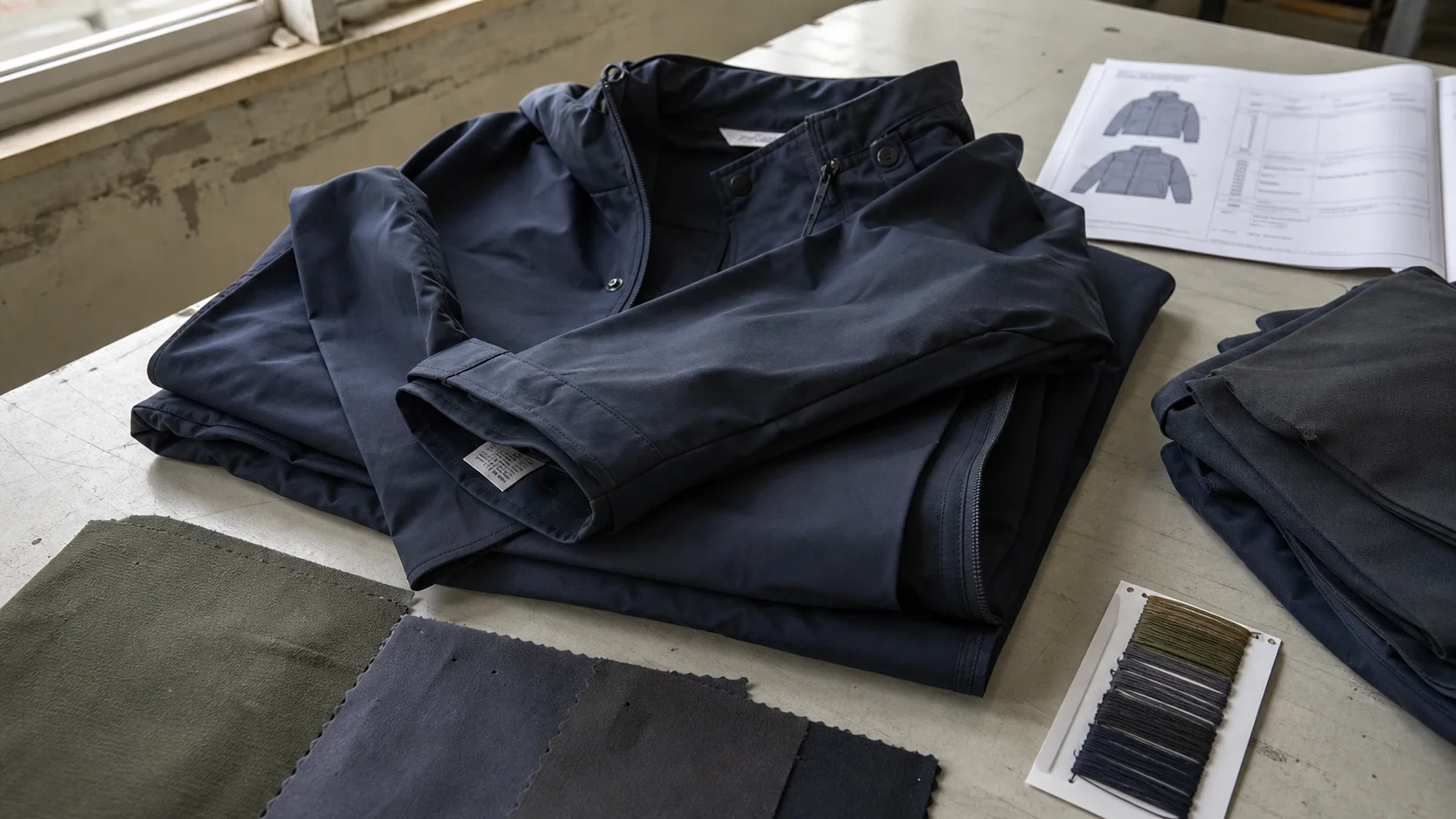
A 2500-word SEO outline for distributor buyers on building a shrinkage control plan for custom travel coats, covering fabric risk, wash testing, pattern...
Travel Coat Shrinkage Plan for Distributor Buyers - Outerwear & Jackets manufacturing guide
Distributor buyers do not need a vague promise that a travel coat is “pre-shrunk.” They need a shrinkage control plan that protects sell-through, size consistency, repeat orders, and chargeback exposure. Travel coats are especially sensitive because they often combine shell fabric, lining, interlining, seam tape, padding, elastic, drawcords, zipper tapes, and branded trims. Each component can react differently to washing, steaming, pressing, packing, and long-distance shipping.
A custom travel coat shrinkage control plan for distributor buyers should start before bulk fabric is cut. The plan should define acceptable shrinkage limits, test methods, sample approval steps, fabric and trim requirements, production controls, inspection checkpoints, and corrective action rules. If these items are not written into the tech pack and purchase order, the buyer usually has little leverage when the bulk garments arrive short in body length, twisted at the placket, tight across the chest, or uneven between colors.
This guide is written for distributor buyers sourcing outerwear and jackets from apparel manufacturers. It focuses on practical purchasing decisions: what to specify, what to test, what to approve, and where to push back before bulk production. For broader sourcing support, buyers can review Fabrikn’s manufacturing capabilities through apparel production services, learn more about the company background on the about us page, or request project guidance through contact us.
Travel coats sit between functional outerwear and easy-care lifestyle apparel. Buyers expect them to pack well, resist wrinkles, fit over layers, and maintain appearance after consumer care. Shrinkage control is not just a laboratory issue. It affects how the garment hangs, how the zipper closes, how sleeve length feels, and whether the coat still matches the size label after washing or cleaning.
For distributor buyers, shrinkage problems are expensive because the fault may not appear during incoming inspection. A coat can pass visual review and carton count, then fail after retailer wash testing or end-user care. Once the problem reaches stores or corporate uniform programs, the buyer may face returns, replacements, markdowns, or damage to account relationships.
The risk increases when a travel coat uses mixed materials. A polyester shell may have low dimensional change, while cotton rib cuffs may shrink more. A nylon-spandex panel may relax after steam. A woven lining may pull at the hem if it shrinks differently from the shell. Zipper tape, fusible interlining, hood drawcords, and seam reinforcement can also create distortion if they do not behave consistently with the main fabric.
The purchasing rule is simple: shrinkage tolerance must be managed by component and by garment, not by shell fabric alone.
A realistic shrinkage plan protects both the buyer and the manufacturer. It gives the factory measurable standards, reduces arguments after production, and helps the buyer compare quotes more accurately. A lower unit price is not always cheaper if the supplier has not included fabric relaxation, pre-shrink treatment, lab testing, or extra sampling in the schedule.
Distributor buyers usually operate under tighter commercial pressure than fashion brands. They may be selling to retailers, corporate clients, promotional channels, travel brands, resort operators, or regional wholesalers. Their customers often need reliable sizing across multiple shipments rather than experimental design details. This makes shrinkage consistency a commercial requirement.
The biggest risk is not always extreme shrinkage. A coat that shrinks 2% may still be acceptable if the tolerance was planned and the spec allowed for it. The more dangerous issue is inconsistent shrinkage: one color shrinks 1%, another shrinks 4%, the lining shrinks differently from the shell, or the bulk fabric behaves differently from the approved sample fabric.
Distributor programs also face repeat-order risk. A buyer may approve the first shipment, then reorder three months later. If the supplier changes fabric mill, dye lot, coating, lining source, zipper tape, or finishing process without buyer approval, the second shipment may not match the first. The shrinkage plan should therefore cover both initial production and replenishment production.
These issues are preventable when the buyer sets clear approval gates. They are much harder to solve once fabric has been cut or garments have been packed.
The shrinkage control plan should begin with measurable standards. A distributor buyer should not accept general wording such as “industry standard shrinkage” or “normal tolerance.” The tech pack should state the test method, care method, measurement points, acceptable percentage change, and action required if results fail.
For travel coats, shrinkage tolerances depend on fiber content, construction, coating, and end use. Fully synthetic woven shells often target lower shrinkage than cotton-blend casual coats. Stretch woven fabrics need special attention because relaxation and recovery can affect measurements even when true shrinkage is limited.
Garment Area Typical Target Tolerance Purchasing Note Body length 0% to 3% after approved care method Keep tighter limits for uniform or corporate programs. Chest width 0% to 3% Allow enough wearing ease for layering if slight shrinkage is expected. Sleeve length 0% to 3% Consumer complaints are common when sleeves shorten noticeably. Lining length Must remain compatible with shell Do not test lining only; check finished garment balance. Rib cuff or knit panel Usually wider tolerance, often 3% to 5% Must recover without twisting or pulling seams. Zipper area No visible waviness or panel distortion Dimensional change must be judged visually and by measurement.These ranges are general purchasing references, not universal rules. A rain-resistant travel coat with coated polyester fabric may need stricter dimensional stability. A garment-dyed cotton travel coat may require more generous tolerances and stronger buyer approval before bulk production. The key is to match tolerance to product type and customer expectations.
Buyers can specify recognized test methods where appropriate, such as AATCC, ISO, or retailer-specific protocols. The exact method should match the care label and sales market. A machine-washable travel coat should not be approved only through dry-clean testing. A packable coat promoted as easy-care should be tested under realistic consumer care conditions.
At minimum, the buyer should define:
Do not rely only on fabric supplier certificates. Fabric reports are useful, but finished garment construction can create additional shrinkage, tension, or distortion. The finished coat must be tested as a complete product.
Fabric choice drives most shrinkage outcomes. For travel coats, buyers commonly use polyester, nylon, cotton blends, polyester-cotton, nylon-spandex, mechanical stretch polyester, recycled polyester, coated woven fabrics, softshell laminates, or lightweight twill. Each option has different shrinkage behavior and sourcing tradeoffs.
Polyester and nylon woven fabrics usually offer good dimensional stability, but they are not risk-free. Heat setting, coating, calendaring, dyeing, and finishing can affect relaxation. A fabric that looks stable in roll form may still change after steam, pressing, or consumer drying. Recycled polyester may also vary by yarn source and finishing control, so buyers should not assume it performs exactly like virgin polyester.
Cotton and cotton-blend travel coats need more caution. Cotton can shrink during washing, especially if the fabric has not been sanforized or compacted properly. Cotton-rich fabrics may also skew, twist, or pucker at seams. If the distributor wants a natural hand feel, the buyer should budget for additional fabric testing and possibly pre-shrink finishing.
Stretch fabrics require a separate judgment. Spandex content can improve comfort, but it can also create measurement instability if the fabric is stretched during cutting, sewing, fusing, or pressing. For travel coats, stretch panels are often used at the side body, back yoke, elbows, or underarms. These panels must be relaxed before cutting and handled without excessive tension during sewing.
A lower fabric cost can be acceptable if performance is proven. It becomes a poor purchase when the supplier cannot provide consistent mill reports, roll inspection, or bulk test records. Distributor buyers should require lab dips, handloom or strike-off approval where relevant, and bulk fabric test approval before cutting.
Many travel coat shrinkage failures come from components rather than the main fabric. A buyer may approve the shell material but overlook the lining, zipper tape, seam binding, fusible interlining, elastic, labels, drawcords, stoppers, rib cuffs, or pocket bags. These items can shrink, relax, melt, pucker, bleed, or pull against the shell.
Trim compatibility should be tested in the finished garment or in a constructed panel, not only as loose trim. A zipper tape may pass a simple shrinkage test but still create waviness if the front panel shrinks at a different rate. A fusible interlining may stabilize one area too strongly while surrounding fabric relaxes, creating bubbling after cleaning.
Component Shrinkage or Distortion Risk Control Action Lining Pulling, tightness, hem imbalance Test lining with shell and check garment after care. Zipper tape Wavy front, uneven placket length Specify tape quality and test after wash or steam. Fusible interlining Bubbling, delamination, stiff patches Approve fusing temperature, pressure, and dwell time. Elastic Loss of recovery or excessive tightening Test recovery and dimensional change after care. Rib cuffs Shortening, torque, seam pulling Set separate tolerance and recovery standard. Drawcords Channel puckering or cord shortening Pre-test cord shrinkage and colorfastness.Buyers should also control trim substitution. A manufacturer may change a zipper supplier or lining fabric to meet delivery pressure. That can be acceptable only if the replacement component is submitted, tested, and approved before use. The purchase order should state that unapproved component substitution is not allowed.
A strong sample process is the most practical way to reduce shrinkage risk before bulk production. Distributor buyers should avoid jumping from a fit sample directly to bulk approval if the coat uses new fabric, new trims, bonded materials, stretch panels, garment washing, or a new care label.
The sample process does not need to be complicated, but it should be disciplined. Each sample should answer a specific question. A fit sample checks pattern and construction. A wash or care test sample checks dimensional stability. A pre-production sample confirms that bulk fabric, bulk trims, construction method, labeling, and measurements are all aligned before cutting the full order.
Each sample round affects lead time. A buyer who compresses the approval calendar may save two weeks upfront but accept a higher chance of bulk claims. The practical compromise is to identify the highest-risk items and test those early. For example, a plain polyester shell with standard lining may need fewer rounds than a cotton-blend coat with garment wash, bonded lining, and rib cuffs.
Sample approval should include measured before-and-after results. The supplier should submit a measurement chart showing original sample measurements, post-care measurements, percentage change, and visual comments. Photos are useful for puckering, zipper waviness, seam twisting, and lining pull, but they do not replace numeric measurement records.
Once sampling is approved, the shrinkage plan moves into production control. Most problems at this stage come from fabric handling, cutting tension, fusing, pressing, sewing tension, and inconsistent steam use. A good manufacturer should understand these controls, but the buyer still needs to specify checkpoints and records.
Many woven and stretch fabrics need relaxation before cutting. Rolls may carry tension from weaving, finishing, rolling, or transport. If fabric is spread and cut immediately, panels can shrink or relax after cutting, causing mismatched parts and measurement problems. The required relaxation time depends on fabric type. Some stable synthetics may need limited relaxation, while stretch fabrics, knits, and bonded fabrics often need longer conditioning.
Buyers should ask the manufacturer to define fabric relaxation practice before production. This may include unrolling fabric, laying it flat, controlling humidity, and recording relaxation time. The purchase order can state that bulk fabric must be relaxed according to approved factory procedure before cutting.
Do not assume every roll behaves like the sample yardage. Bulk fabric should be checked by roll or lot, especially for high-volume distributor programs. If one roll has higher shrinkage or shade variation, it can create inconsistent garments within the same shipment. Roll inspection should cover shade, width, defects, hand feel, coating condition, and dimensional stability where required.
Cutting accuracy matters because shrinkage tolerance is calculated against finished measurements. If panels are cut under tension or mixed between fabric lots, the garment may fail even if the fabric itself is acceptable. Bundles should be controlled by size, shade lot, and component set. Lining and shell parts should match properly to avoid imbalance after sewing.
Fusing can create shrinkage, especially on front panels, collars, plackets, pocket flaps, and storm flaps. Incorrect temperature, pressure, or dwell time may shrink the fabric, distort the panel, or cause bubbling later. Steam pressing can also relax fabric unevenly. The factory should approve fusing parameters during sampling and use the same settings in bulk.
Seam puckering after wash is often linked to thread tension, stitch density, needle selection, and differential shrinkage between layers. Travel coats with topstitching, binding, seam tape, or multiple fabric layers need careful sewing setup. Buyers should include seam appearance requirements in the approval standard, not only finished measurements.
Inspection should not wait until final packed goods. A shrinkage control plan works better when it includes incoming material checks, in-line checks, top of production review, final inspection, and random care testing where needed. The goal is to catch problems before they multiply across the full order.
For distributor buyers, the inspection plan should be proportionate to order value and risk. A reorder of a proven polyester travel coat may need standard final inspection plus random measurement checks. A first production run in a new fabric should include stronger testing and earlier approval gates.
Inspection risks should be clearly understood. Final inspection may catch measurement failures, but it may not reveal future shrinkage unless garments are tested after care. AQL inspection is useful for visual and measurement sampling, but shrinkage control needs laboratory or controlled wash testing. Buyers should not treat these as the same thing.
Inspection Stage What It Can Catch What It May Miss Incoming fabric inspection Shade, width, visible defects, some shrinkage data Finished garment distortion after sewing In-line inspection Cutting, fusing, zipper, seam issues Post-wash dimensional change unless tested Final inspection Measurements, appearance, packing, labeling Consumer-care shrinkage if no wash test is done Garment wash testing True dimensional change after care Full shipment consistency unless sampling is adequateShrinkage control has commercial implications. Testing, pre-shrinking, fabric relaxation, and extra sampling can affect MOQ, lead time, and unit price. Distributor buyers should ask suppliers to price the program honestly instead of hiding these controls inside vague production assumptions.
Typical MOQ ranges vary by supplier, fabric, trim customization, and color count. For custom travel coats, small trial orders may start around 300 to 500 pieces per style if stock fabric and standard trims are used. More common custom production ranges are 800 to 1,500 pieces per style, especially when the buyer needs custom color, private label trims, or size grading. Fabric-mill-driven orders may require 1,000 to 3,000 pieces or more depending on fabric MOQ, dye lot requirements, and color minimums.
Lower MOQs can be useful for market testing, but they often limit fabric choice and trim customization. Higher MOQs can support better pricing and custom development, but they increase exposure if shrinkage testing is weak. Distributor buyers should treat the first order as a controlled production launch, not just a price negotiation.
These are typical planning ranges, not fixed promises. Lead time can expand if fabric fails shrinkage testing, lab dips are rejected, trims are delayed, or the buyer changes measurements after sample approval. The best purchasing approach is to build shrinkage testing into the critical path from the start.
A buyer should not automatically choose the lowest quote. If one supplier includes garment wash testing, roll inspection, and pre-production sample approval while another does not, the two prices are not equivalent. The cheaper route may shift risk back to the distributor.
The purchase order should turn the shrinkage control plan into enforceable commercial terms. A good PO does not need excessive legal language, but it should clearly state the approved standard and the buyer’s rights if production deviates from it.
Care label accuracy is part of shrinkage control. A coat that can only pass dry-clean testing should not be labeled as machine washable. A garment that tolerates washing but not tumble drying should state that clearly. Distributor buyers must align marketing claims with tested care performance.
Packing also matters. Travel coats are often promoted as packable, but long compression in cartons can create creases, distorted seams, or crushed insulation. If the coat includes padding, bonded fabric, or shaped hood components, packing trials should be reviewed during sampling. The carton method should protect the garment through shipping and storage, not only look neat at factory packing.
A practical custom travel coat shrinkage control plan should be built around risk level. Not every coat needs the same intensity of testing. A basic synthetic shell coat with stable lining has a different risk profile from a cotton-rich washed travel coat with rib cuffs and contrast panels.
Risk Level Product Example Recommended Control Level Low Polyester woven travel coat, standard lining, no garment wash Fabric report, fit sample, PP sample, final measurement inspection Medium Nylon-spandex coat, contrast panels, adjustable hood Fabric shrinkage test, trim compatibility review, care test sample, TOP sample High Cotton-blend washed coat, rib cuffs, fusible placket, custom lining Full fabric and trim testing, pre-shrink validation, garment care testing, stronger in-line inspection Very High Corporate uniform travel coat with strict repeat-order sizing Locked material sources, retained samples, lot testing, reorder control, final audit and wash testThis framework helps buyers decide where to spend time and money. The goal is not to over-test every style. The goal is to identify where shrinkage can damage the program and control those points before production scales.
The strongest purchasing judgment is often to simplify. A distributor buyer can reduce shrinkage risk by choosing a stable synthetic shell, compatible lining, standard trims, and a care label that matches real-world use. More design complexity can be justified when the margin, customer requirement, or brand positioning supports the added risk and testing cost.
Failures should be handled before they become shipment-wide problems. The shrinkage plan should define what happens when fabric or garments fail testing. Without a corrective action process, production teams may continue cutting while waiting for buyer feedback.
If bulk fabric fails before cutting, the supplier can reject the roll, request mill re-finishing, adjust pattern allowances if acceptable, or replace the fabric. Pattern adjustment is risky and should be used carefully. It may compensate for predictable shrinkage, but it cannot solve twisting, puckering, color variation, or component incompatibility.
If a pre-production sample fails after care testing, the buyer should pause bulk cutting. Possible fixes include changing lining, adjusting fusing, modifying sewing tension, pre-shrinking fabric, changing care label, or selecting another fabric. The right decision depends on the failure mode. A small and predictable length shrinkage may be manageable. A wavy zipper or twisted body usually indicates a deeper compatibility issue.
If final goods fail after production, options become limited. The buyer may negotiate rework, discount, replacement, sorting, or rejection depending on the PO terms and severity. Rework can help with loose threads, labels, or pressing defects. It rarely solves true shrinkage failure across a full shipment.
Do not approve shipment based only on urgency if the garment fails the agreed shrinkage standard. Late delivery is difficult; defective delivery can be worse.
Documentation is not paperwork for its own sake. It protects the buyer during repeat orders and supplier discussions. A distributor buyer should keep the approved tech pack, sample comments, test reports, fabric specifications, trim cards, pre-production sample photos, measurement records, and final inspection reports.
Retained samples are especially important. The buyer and supplier should each keep an approved pre-production sample. For repeat orders, this sample becomes the physical benchmark for hand feel, fit, trim, shade direction, construction, and overall appearance. It also helps prevent quiet substitutions.
For distributor programs, the repeat-order file should be treated as part of the product. If the buyer changes supplier, sales channel, target price, or fabric source, the shrinkage plan should be reviewed again rather than copied blindly.
A custom travel coat shrinkage control plan is not a luxury step. It is a basic buying discipline for outerwear and jackets. The plan should start with clear standards, continue through material selection and sample approval, and remain active during bulk production and inspection.
Distributor buyers should be cautious with any supplier that resists testing, avoids written tolerances, or asks for bulk approval before fabric and trims are confirmed. A capable supplier should be able to discuss fabric behavior, trim compatibility, sample stages, testing requirements, and production controls in practical terms.
The best sourcing decision balances cost, speed, and risk. Stable fabrics, compatible trims, realistic MOQs, approved samples, and written test standards usually produce fewer surprises than rushed development and loose specifications. Buyers who control shrinkage early protect margin later.
For distributor buyers developing custom travel coats, the practical next step is to prepare a tech pack with clear fabric requirements, care expectations, measurement tolerances, and approval stages. A manufacturing partner can then quote the program with the right controls included rather than treating shrinkage as an afterthought.
Get a free quote from Fabrikn — your trusted B2B clothing manufacturer with 10+ years of experience. MOQ as low as 200 pieces.
Get a Free Quote →Many travel coats target 0% to 3% shrinkage on key measurements such as body length, chest, and sleeve length after the approved care method. The right tolerance depends on fabric type, construction, care label, and customer requirements. Uniform and corporate programs usually need tighter control than casual promotional outerwear.
Both are useful, but finished garment testing is more important for final approval. Fabric testing shows material stability before cutting, while garment testing reveals how shell, lining, trims, seams, fusing, and pressing behave together after care.
Only in limited cases. Pressing or rework may improve appearance, but true dimensional shrinkage across a shipment is difficult to correct. The better approach is to test fabric, trims, and pre-production samples before bulk cutting.
Typical custom travel coat MOQs may range from 300 to 500 pieces for stock fabric programs, 800 to 1,500 pieces for more standard custom production, and 1,000 to 3,000 pieces or more when custom fabric, dyeing, or trims are required. Actual MOQ depends on supplier setup, material minimums, color count, and customization level.
Synthetic woven fabrics such as polyester and nylon usually provide better dimensional stability than cotton-rich fabrics, but finishing, coating, heat setting, and stretch content still matter. Cotton blends, garment-washed fabrics, rib trims, and spandex panels require stronger testing and handling controls.
The tech pack should include fabric specifications, trim specifications, care label, measurement chart, tolerances, test methods, sample approval steps, construction details, and inspection requirements. It should also state that material substitutions need written buyer approval.
No. Pre-shrunk fabric reduces risk but does not eliminate all shrinkage or distortion. Sewing tension, fusing, lining compatibility, zipper tape, steam pressing, and consumer care can still affect the finished coat.
Testing should happen before bulk cutting whenever possible. Buyers should review fabric test results, trim compatibility, and care-tested sample measurements before approving the pre-production sample. Final random testing may also be used for higher-risk programs.
Linings can shrink or relax at a different rate than the shell fabric. When this happens, the coat may pull at the hem, feel tight inside, or hang unevenly. Buyers should test lining and shell compatibility in the finished garment.
Choose stable stock fabrics, avoid garment washing, limit stretch or cotton-rich components, use standard trims, and keep the construction simple. Urgent programs should still include at least basic fabric review, pre-production sample approval, and final measurement inspection.