
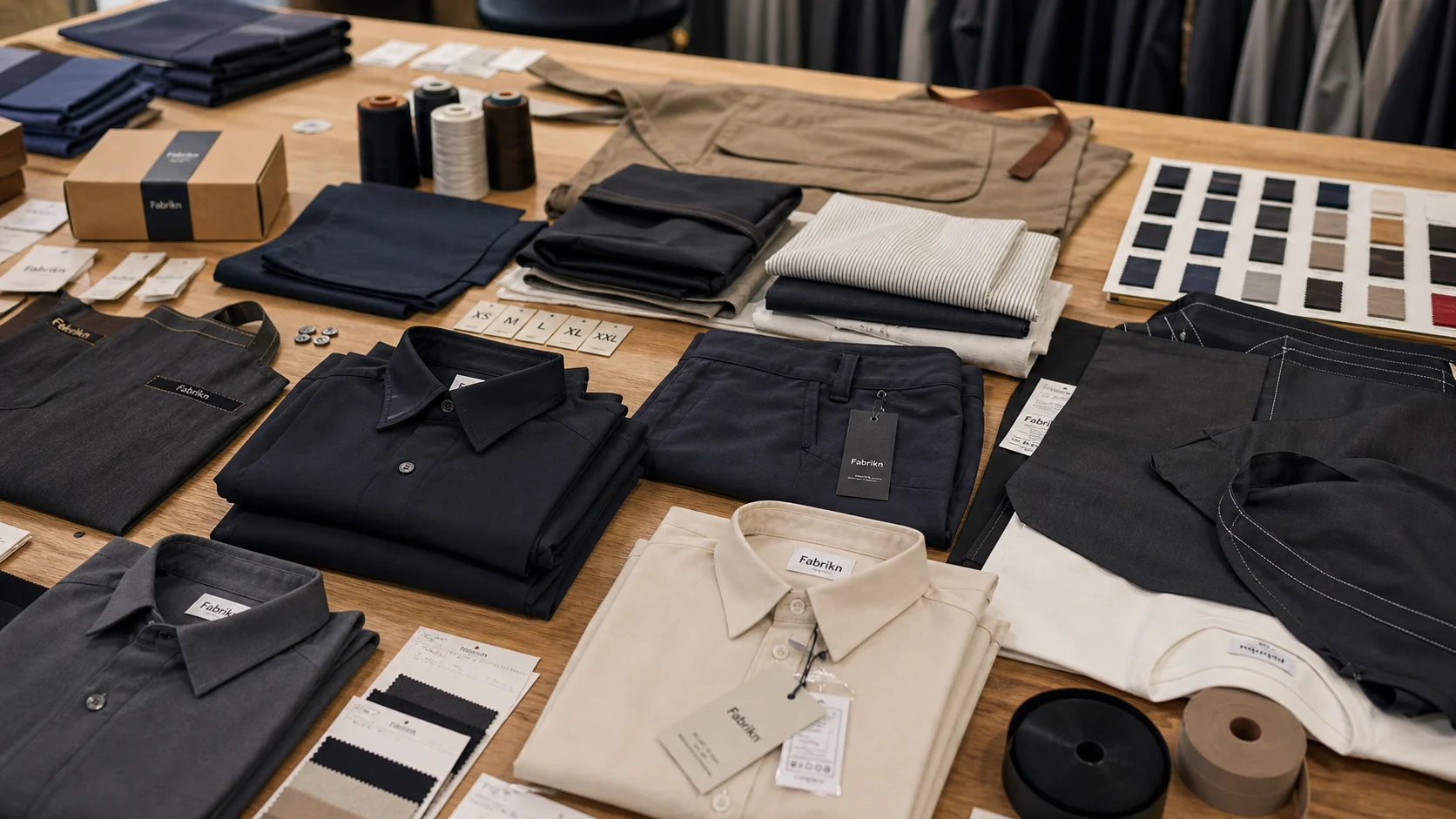
A detailed outline for corporate apparel resellers evaluating custom uniforms with seam strength testing, covering garment risk points, test methods, production specs, documentation, and buyer-focused quoting considerations.
Custom Uniforms With Seam Strength Testing for Resellers - Fabrikn production reference
For corporate apparel resellers, uniforms are not a casual fashion buy. They are working garments expected to hold shape, resist seam failure, and survive repeated industrial or home laundering. That makes seam strength testing a practical sourcing requirement, not just a technical add-on.
Custom uniforms with seam strength testing give resellers a more reliable basis for quoting programs, reducing returns, and protecting account relationships. When a hotel, facility management company, logistics team, clinic group, or retail chain places a branded uniform order, they usually care less about trend language and more about wear life. If seams split at stress points, the reseller absorbs the commercial damage first.
In private label apparel, seam failure is one of the most common reasons a garment looks acceptable at packing but performs poorly in use. A uniform can pass visual inspection, have neat embroidery, and still fail after a short wear cycle if the stitch density, seam construction, thread quality, or fabric compatibility were not controlled properly.
That is why resellers sourcing custom uniforms should treat seam strength as part of the product specification stage. It belongs alongside fabric weight, colorfastness, shrinkage tolerance, trim quality, and branding placement. If the manufacturer cannot explain how seam performance is developed, tested, and checked in bulk production, the risk shifts back to the buyer.
For buyers comparing suppliers, it is useful to review not only decoration options and price breaks, but also production support and testing discipline. A capable development partner should be able to discuss construction standards, fabric suitability, and approval flow in clear terms. Fabrik’s broader services page is a useful reference point for the type of end-to-end apparel manufacturing support resellers often look for when building private label uniform programs.
Seam strength testing measures how much force a stitched seam can withstand before it breaks or the fabric tears at the seam. In plain buying terms, it helps assess whether the garment is built for real use rather than showroom appearance.
Testing can focus on several related issues:
The exact method depends on garment category, fabric structure, and buyer requirement. Woven shirts, stretch-blend trousers, work jackets, tunics, and housekeeping uniforms do not all behave the same way under stress. A lightweight poplin shirt may need close review for seam slippage, while a heavier twill trouser may be judged more on seam break resistance and reinforcement at crotch, inseam, and pocket joins.
Resellers do not always need to manage lab protocols line by line, but they do need to ask the right commercial questions:
A supplier that treats seam testing as a document-only exercise is not enough. The point is to align construction with end use. A front desk uniform and a warehouse service trouser can both be branded uniforms, but the performance expectations are different. Testing only matters if it is tied to the actual working conditions of the garment.
Corporate apparel resellers sit between manufacturer capability and end-customer expectation. That position creates exposure. If a national account experiences seam failures across even a small percentage of units, the reseller usually handles complaints, replacement coordination, and margin erosion.
Seam strength testing helps in four specific ways.
Uniform accounts often move in phases rather than single buys. A client may open with a pilot order, then roll out regionally, then reorder seasonally. If the initial program develops seam issues, the reseller can lose the longer contract opportunity. Early testing improves confidence before scale increases.
Not every buyer needs the heaviest-duty construction. Some programs are image-driven, low-strain, and budget sensitive. Others involve bending, lifting, long wear hours, and frequent washing. Seam data helps the reseller place the right garment tier in front of the right account instead of overselling a light-duty build.
In private label apparel, the brand on the neck label belongs to the reseller or the reseller’s client. The manufacturing source stays invisible, but the brand receives the blame. Stronger seam control is one of the quieter ways to protect label credibility.
When seam performance is written into the tech pack or purchase specification, the buyer has a clearer basis for rejecting weak construction before bulk shipment. Without that, many disagreements become subjective and harder to resolve.
This matters most for resellers serving structured accounts such as hospitality groups, healthcare distributors, facility service providers, transport teams, schools, and retail chains. These buyers often evaluate suppliers on durability, consistency, and replacement rates as much as on design and logo execution.
Seam strength matters across most uniform categories, but the risk level changes by use case.
Shirts may look simple, but failure often shows at armholes, side seams, sleeve plackets, and across the back yoke if the fit is too tight or the fabric is unstable. Lightweight woven fabrics can present seam slippage risk, especially with low seam allowance or aggressive cost-down stitching.
This is one of the highest-risk categories. Inseams, crotch seams, seat seams, belt loops, and pocket attachments take repeated strain. Resellers buying service trousers for cleaning teams, technicians, drivers, or warehouse staff should look closely at reinforcement methods and thread quality, not only fabric GSM.
Frequent laundering, movement, and abrasion put pressure on side seams, sleeve joins, and pocket corners. If the garment will be commercially laundered, construction standards should be reviewed more carefully because repeated wash-and-dry cycles can expose weak seam assembly fast.
Kitchen garments face heat, repeated laundering, and active movement. Underarm seams, side panels, apron attachments, and pocket joins need dependable construction. A polished appearance is still important, but durability should not be traded away for a softer hand feel or lighter fabric without understanding the consequence.
Medical and care environments often require lightweight comfort, but garments still need dependable seam performance due to long shifts and frequent washing. Stretch components improve mobility, yet they also demand correct stitch type and balanced thread/fabric compatibility.
Softshell jackets, lightweight utility jackets, and fleece layers may need seam review at shoulders, armholes, pockets, and zip installations. Decorative branding can distract from weak construction around high-stress functional areas.
Custom uniform development usually follows a fairly predictable path, though lead times can shift depending on fabric sourcing, embellishment, and approval speed.
The reseller defines garment type, target end use, branding method, size range, price target, fabric direction, and expected order volume. This is the stage where seam strength expectations should be stated. If the requirement is left vague until after fit approval, the supplier may default to standard construction that is acceptable visually but not robust enough for the program.
A strong tech pack should include:
If a reseller does not have an internal technical team, that gap should be addressed early with the manufacturer. General sourcing support and development communication often matter as much as sewing capacity, which is one reason buyers commonly review a supplier’s background through pages such as about us before moving into a longer-term private label discussion.
The first sample checks style interpretation and basic construction approach. Seam strength testing is not always finalized at this stage, especially if final fabric or trim is not yet locked, but obvious risk points should already be visible.
The fit sample confirms size balance and wearing ease. This stage matters for seam performance because overly tight grading can cause failure even when sewing quality is acceptable. Buyers sometimes blame production for split seams that are actually linked to under-allowanced fit or unrealistic body mapping across the size run.
The PPS should reflect bulk-ready fabric, trims, branding, and construction. This is the most practical checkpoint for confirming seam build, wash behavior, and overall workmanship before production starts.
Bulk consistency depends on line setup, operator handling, machine settings, needle choice, and thread control. A good sample can still turn into weak bulk output if production changes are made without buyer visibility.
Buyers often focus heavily on fabric and logo execution, but seam performance is tied to a wider package of technical choices.
Fiber content alone is not enough. Resellers should ask about weave or knit structure, GSM, stretch behavior, and finish. For example:
Cheap thread can undercut an otherwise acceptable garment. Thread ticket size, fiber type, and seam compatibility should match the fabric weight and end use. Resellers do not need every machine setting, but they should know whether the construction is being built to last or simply to meet target price.
Low SPI can reduce seam integrity. Excessively tight stitching can also create puckering or fabric stress. The best choice depends on fabric and garment area. Critical stress zones may justify double-needle seams, safety stitch construction, or bartack reinforcement.
Too little allowance is a repeat cause of seam issues, especially in woven uniforms. This is a quiet cost-saving area in some factories, so buyers should not assume it is controlled unless it is written into the specification.
If the uniform program is likely to go through industrial laundering, the reseller should state that upfront. A garment intended for light office wear and domestic wash may require a different build than one used in food service or housekeeping.
Corporate apparel resellers often need flexibility, but custom manufacturing works best when expectations are realistic.
MOQ depends on fabric customisation, dyeing, trim complexity, and style count. As a practical market range:
These are not fixed rules, but they are useful planning ranges. Very low MOQ requests usually increase unit cost, limit fabric choice, or reduce willingness to customize seam construction beyond a standard template.
A disciplined approval path usually includes:
Skipping stages saves time only on paper. In reality, rushing from sketch to bulk is where many uniform programs develop avoidable durability claims.
Typical lead time can range from 45 to 90 days after final approval for many uniform programs, though it may run shorter with stock fabrics or longer with custom mills and complex branding. The biggest variables are:
Resellers should be cautious about suppliers promising aggressive timelines without linking them to material readiness and approval closure. Fast commitments can hide later delays.
Seam strength testing is valuable, but it should not be treated as a substitute for inspection. Testing validates performance benchmarks. Inspection checks whether bulk production is actually following the approved standard.
In custom uniforms, inspection should pay particular attention to:
A buyer should also ask whether the factory conducts inline checks, end-line checks, and final random inspection. One final inspection at packed stage is useful, but it is less effective than catching seam problems earlier during sewing.
Not every apparel supplier is a good fit for corporate uniform resale. Some are strong in fashion sampling but weaker in repeatable workwear construction. Others are efficient at commodity basics but struggle with branding detail or account-level consistency.
When evaluating a manufacturer for custom uniforms with seam strength testing, resellers should look for balanced capability in the following areas:
Price still matters. Yet in uniform sourcing, the lowest quote can become expensive if seam failures trigger claims, credits, and replacement freight. Resellers usually get better long-term results by balancing cost against durability, approval discipline, and communication reliability.
For teams preparing a new private label uniform range or reviewing a current supplier base, direct discussion is often the fastest way to test whether a manufacturer understands these requirements in commercial terms. Buyers who want to review program needs, development flow, or sourcing support can start that conversation through contact us.
The main tradeoff in custom uniforms is rarely fashion versus function. It is usually cost versus consistency.
A lighter fabric can improve comfort and lower price, but it may require better seam engineering to avoid slippage or breakage. A low MOQ can make account entry easier, but it may narrow custom fabric and trim choices. Faster lead times may be possible with stock-supported materials, though that can limit exact brand matching. Heavy reinforcement can improve durability, but if applied without care it may affect drape, comfort, or appearance in client-facing roles.
That is why resellers should not buy seam strength testing as a stand-alone claim. They should buy a complete product decision: appropriate fabric, suitable construction, realistic grading, controlled sampling, and inspection discipline. Those elements work together. If one is missing, the test result alone will not protect the program.
For most corporate apparel resellers, the best sourcing approach is straightforward. Define the end use clearly. Lock the stress points in the spec. Approve samples in the right order. Ask how bulk consistency will be controlled. Treat seam performance as part of total garment quality, not as a last-minute checkbox.
Done properly, custom uniforms with seam strength testing are easier to resell, easier to reorder, and less likely to generate avoidable after-sales problems. In private label apparel, that kind of reliability is what helps turn one program into a stable account base.
Get a free quote from Fabrikn — your trusted B2B clothing manufacturer with 10+ years of experience. MOQ as low as 200 pieces.
Get a Free Quote →It is a test used to evaluate how much force a stitched seam can withstand before the seam breaks, slips, or damages the surrounding fabric. In uniform sourcing, it helps confirm that the garment construction matches the intended work environment.
It helps reduce return risk, supports more accurate product selection, and protects private label reputation. Resellers are usually the first point of complaint when uniforms fail in wear, so early testing adds practical protection.
Trousers, cargo pants, tunics, work shirts, chefwear, scrubs, and service jackets are common priorities. Any garment exposed to movement, repeated laundering, or daily wear can benefit from seam performance review.
Many programs start around 100-300 pieces for stock-supported customization, 300-800 pieces for cut-and-sew private label uniforms, and 1,000 pieces or more for deeper custom fabric developments. Actual MOQ depends on fabric, colors, trims, and branding complexity.
Many orders run about 45 to 90 days after final sample approval, though timing depends on fabric availability, trim development, branding processes, testing needs, and factory capacity.
Yes. That is a common sourcing risk. Bulk output can change if stitch settings, thread quality, seam allowance, or operator handling differ from the approved sample. Inline and final inspections are still important even when development samples look strong.
At minimum: fabric composition and weight, seam types, stitch density expectations, seam allowances, reinforcement points, trim list, size tolerances, wash requirements, and any testing standards required before shipment.