
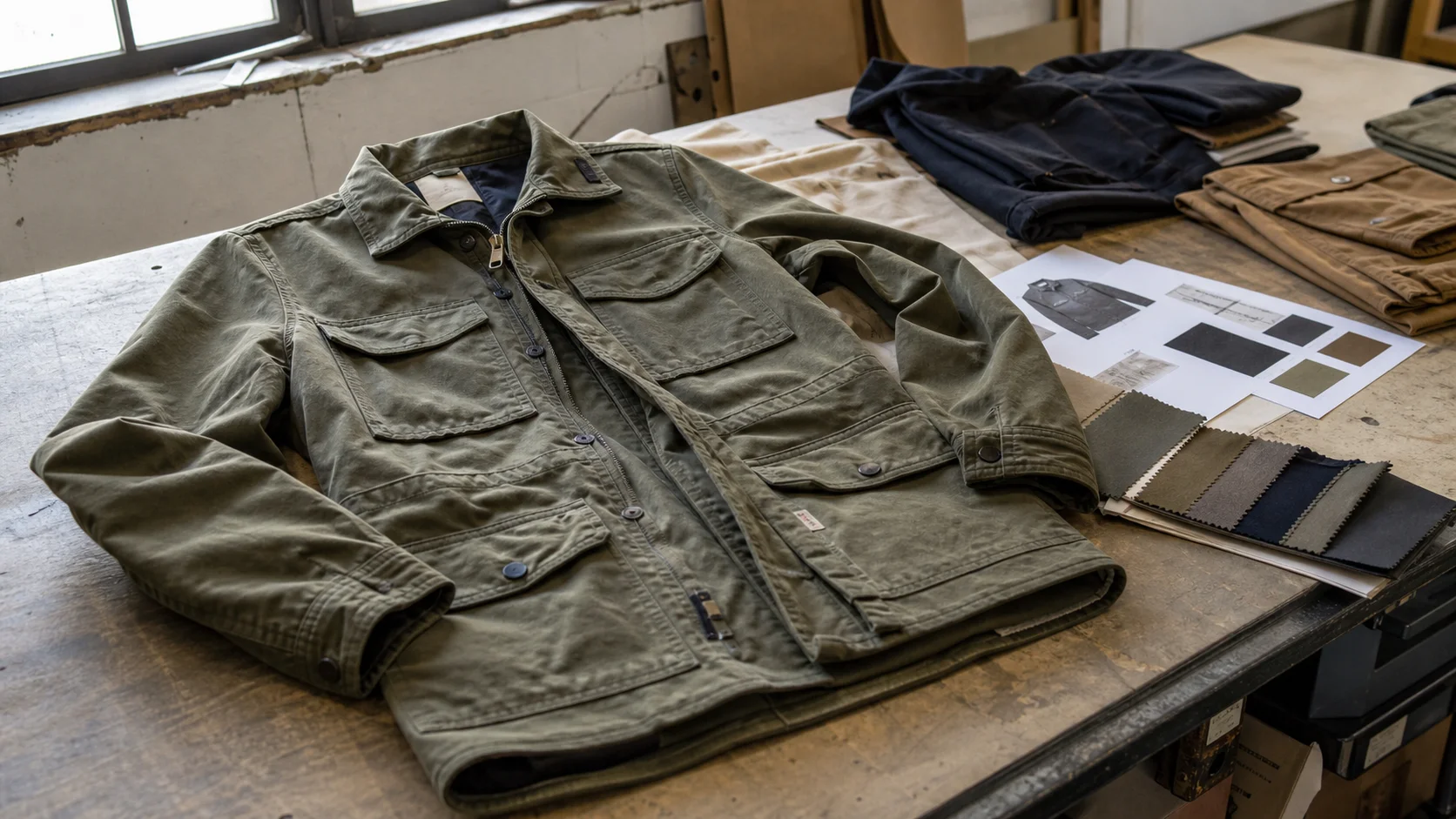
A 2500-word SEO outline for distributor buyers managing custom utility coat factory releases, with checkpoints for specs, trims, decoration, testing,...
Utility Coat Release Checklist for Buyers - Outerwear & Jackets manufacturing guide
Buying custom utility coats at distributor scale is not a simple “approve the sample and wait for shipment” process. A utility coat carries more construction risk than a basic woven jacket because it often combines heavier shell fabrics, multiple pocket systems, reinforced seams, lining options, drawcords, snaps, zippers, storm flaps, and sometimes wash or coating requirements. Each of those details can affect price, production speed, inspection results, and customer returns.
For distributor buyers, the release stage is where most preventable problems should be caught. This is the point after sampling and before bulk cutting, when the factory needs a clear green light to move into production. A strong custom utility coat factory release checklist protects both sides: the buyer gets a product that matches the purchase order, and the manufacturer gets fewer last-minute changes, fewer claims, and cleaner shipping documentation.
This guide is written for B2B buyers sourcing utility coats for wholesale, private label, promotional, corporate uniform, outdoor lifestyle, and retail distribution programs. It covers the practical checkpoints that should be confirmed before releasing a custom utility coat order to bulk production.
A utility coat is usually bought for durability, function, and everyday wear. Buyers expect the garment to look structured without feeling stiff, carry weight without seam failure, and offer pocket utility without looking overbuilt. That balance is not automatic. It has to be engineered through fabric choice, pattern work, seam construction, trims, and final finishing.
The release checklist matters because the factory will treat approved information as production instruction. If the buyer approves a sample with one pocket position but later sends comments about moving the pocket after bulk cutting, the issue becomes expensive. If the buyer confirms a zipper without testing the puller color, plating, and slider strength, the issue may appear only during final inspection or after delivery.
Distributor buyers also face a second layer of risk: they often sell to downstream retailers, uniform accounts, corporate clients, or regional resellers. A factory mistake can become a customer service problem across multiple accounts. One incorrect care label, one carton marking error, or one inconsistent shade between size runs can affect sell-through and reorder confidence.
The release stage should not be treated as paperwork. It is the last controlled point to stop unclear specifications from becoming bulk inventory.
A practical release checklist gives the buyer a structured way to verify that the order is ready for production. It should cover product details, commercial terms, quality requirements, compliance, packaging, and shipment expectations. A good factory can support this process, but the buyer still needs to make clear decisions before authorizing bulk work.
Before releasing a custom utility coat order, buyers should confirm the intended market position. A coat made for promotional distribution will not need the same build level as a retail outdoor-inspired utility jacket. A corporate uniform coat may prioritize color continuity and logo placement. A fashion utility coat may prioritize silhouette, hand feel, and finishing details.
This positioning affects almost every production decision. If the target is a mid-market distributor program, a cotton-poly twill shell with polyester lining and standard metal snaps may be enough. If the target is premium retail, buyers may need a better hand-feel fabric, cleaner internal binding, branded trims, tighter shade control, and more developed fit blocks.
Buyers should define the following before factory release:
The purchasing judgment is direct: do not pay for premium construction that the customer will not value, but do not underbuild a coat that will be judged on durability. Utility coats invite functional use. Weak pocket bags, poor snap attachment, thin drawcords, and unstable fabric coatings tend to create more complaints than a basic T-shirt or sweatshirt.
For buyers who are still defining the production pathway, the apparel manufacturing overview at fabrikn.com/services/ can help frame the broader service requirements before a custom outerwear order is released.
The tech pack is the main production document. If it is incomplete, the factory has to interpret details. That can be acceptable for a rough prototype, but it is not acceptable for bulk release. Distributor buyers should release only after the technical information has been consolidated into one current version.
A utility coat tech pack should include clear front, back, side, and inside views. It should identify every pocket, seam, closure, panel, stitch line, reinforcement, lining component, and branding position. The bill of materials should show shell fabric, lining, pocketing, interlining, zipper, snaps, buttons, cord, eyelets, labels, hangtags, packaging, and any specialty trims.
The spec sheet should include garment measurements for each size, tolerance rules, point-of-measure diagrams, and graded measurements. Common points of measure include chest width, shoulder width, body length, sleeve length, sleeve opening, cuff width, sweep, armhole, bicep, collar height, pocket dimensions, and hood measurements if applicable.
A factory release should not rely on scattered email comments. Buyers should merge approved changes into the latest tech pack and mark older files as obsolete. If the purchase order, sample comments, and tech pack disagree, the factory may follow the wrong reference.
For utility coats, pocket details deserve special attention. Buyers should confirm pocket opening width, depth, flap size, button or snap placement, bartack positions, pocket bag material, and whether the pocket is functional or decorative. Pocket errors are highly visible and can also affect comfort when the garment is worn.
Fabric is one of the biggest cost and quality drivers in utility coat manufacturing. A good fabric choice can make a simple coat feel commercial. A poor fabric choice can make even a well-constructed coat look cheap or fail after washing.
Common shell fabrics for utility coats include cotton twill, cotton canvas, cotton-poly twill, nylon-cotton blends, polyester microfiber, ripstop, peach-finish twill, and coated woven fabrics. GSM can vary widely depending on market position. Lightweight transitional utility coats may use roughly 160–220 GSM shell fabric, while sturdier canvas or workwear-inspired coats may use 240–350 GSM or more. Heavier is not always better. A heavy shell can increase shipping cost, reduce comfort, and slow sewing if the factory is not prepared for thick seam intersections.
Fabric specification should include fiber content, weave, weight, color reference, finish, shrinkage, colorfastness, and any functional performance target. If water resistance is required, buyers should state the test method or at least the expected performance level. Terms like “waterproof look” or “outdoor feel” are not production specifications.
Lab dips are important, but buyers should not treat a tiny fabric color swatch as a full production guarantee. Bulk fabric may still show shade variation between rolls. The release checklist should require roll shade control, especially for dark navy, black, olive, khaki, and garment-dyed colors. Olive and khaki are particularly sensitive because small undertone differences can look obvious under retail lighting.
If the coat will be garment washed, pigment dyed, or enzyme washed, buyers should expect more variation. Washed utility coats can look more premium and casual, but the tradeoff is looser color control, more shrinkage management, and higher risk of puckering or seam abrasion. A buyer choosing washed effects should approve a bulk-like wash standard before production, not only a showroom sample.
Utility coats often use more trims than simpler outerwear. Zippers, snaps, buttons, drawcords, cord stoppers, eyelets, Velcro, elastic, labels, patches, zipper pullers, and lining tapes can all influence the final product. Trim problems are common because they may be sourced from multiple suppliers with different lead times.
Buyers should approve trim cards before release. The trim card should include physical examples or confirmed references for each item. It should identify size, color, finish, material, logo detail, attachment method, and placement. For branded hardware, buyers should confirm mold charges, development time, minimum order requirements, and whether the same trim can be reordered later.
Metal hardware deserves caution. Antique brass, gunmetal, matte black, nickel, and painted finishes can vary by supplier. Plating consistency should be checked, especially when snaps and zippers are visible close together. Painted snaps may chip if the coating quality is poor. Matte black hardware can look premium, but it often needs better testing for abrasion and color rub.
Branding should be treated as a controlled production element, not a decoration added at the end. Logo size, thread color, patch backing, heat-transfer temperature, placement tolerance, and wash durability should be confirmed before bulk release. For embroidered utility coats, buyers should approve stitch count, backing, thread color, and the effect on fabric puckering.
A practical tradeoff is worth noting: fully custom hardware improves brand identity but can increase MOQ, tooling cost, and lead time. Stock hardware is usually faster and safer for smaller distributor programs. Buyers planning repeat seasonal orders may justify custom hardware. Buyers testing a new market often should keep trims commercial and easy to reorder.
Fit is one of the most expensive problems to fix after production. Utility coats are often worn over T-shirts, shirts, hoodies, or light sweaters. If the buyer does not define layering expectations, the coat may feel too tight even when the measurement chart is technically followed.
Before release, buyers should confirm the base size and fit intent. A utility coat can be regular fit, relaxed fit, oversized, boxy, workwear fit, or tailored. Each direction needs different ease around the chest, bicep, armhole, and sweep. Sleeve length and shoulder slope also affect comfort more than many buyers expect.
Grading should be checked carefully. A sample in size medium may look good, but size XXL can become too long, too wide at the sweep, or too deep in the armhole if grading is not balanced. Smaller sizes may lose pocket proportion or have overcrowded front details. For distributor programs with broad size ranges, grading review is not optional.
Buyers should also confirm whether the coat is unisex, men’s, women’s, or youth. A unisex utility coat can work for promotional and workwear distribution, but it may not satisfy retail customers expecting a gender-specific silhouette. Women’s utility coats often need different waist shaping, hip allowance, sleeve proportion, and pocket placement.
The direct purchasing view is simple: do not approve bulk production from a sample that has not been tried on the intended body type or fit model. A flat measurement chart is necessary, but it does not show sleeve rotation, shoulder comfort, or how the coat hangs when pockets are loaded.
Sampling should move from concept to production readiness in a controlled sequence. Not every order needs every sample stage, but distributor buyers should understand what each stage protects.
A prototype sample checks style direction and construction approach. A fit sample checks measurements, shape, comfort, and proportion. A salesman sample or pre-production presentation sample may be used for buyer meetings or account selling. A pre-production sample is the most important release sample because it should reflect bulk fabric, approved trims, final measurements, final branding, final wash or finish, and final construction.
Buyers should not release bulk production based only on a rough prototype unless the order is extremely simple and the risk is accepted. For custom utility coats, a pre-production sample is strongly recommended.
Sample approval comments should be specific. “Make it better” or “improve pocket” does not give a factory enough instruction. A better comment would state: “Move lower patch pocket 2 cm toward center front, keep pocket opening width unchanged, update pattern and confirm on pre-production sample.”
Buyers should approve samples with a signed document or written confirmation. The approval should state whether the sample is approved as submitted, approved with comments, or rejected and requiring resubmission. If approved with comments, the comments must be realistic for bulk production. Major changes after pre-production approval can disrupt cutting, trim ordering, and delivery.
Sample lead times vary. A simple development sample may take 7–14 days after materials are ready. A more complex utility coat with custom trims, wash testing, or special fabric may take 2–4 weeks or longer. Branded hardware, lab dips, print strike-offs, and revised samples can extend the schedule. Buyers should build sampling time into launch planning, not treat it as separate from production lead time.
Minimum order quantity depends on fabric availability, trim customization, production line setup, color count, size range, and factory capacity. For custom utility coats, typical MOQ ranges may start around 300–500 pieces per style for simpler designs using available fabrics and stock trims. More common distributor-level production may fall around 500–1,000 pieces per style or color. Highly customized fabric, special dyeing, branded hardware, or multiple colorways can push practical MOQs higher, sometimes 1,000–3,000 pieces or more depending on material suppliers.
These ranges are not universal. A factory may accept lower quantities for sampling, trial orders, or premium pricing. Fabric mills and trim suppliers may still impose their own minimums, even if the sewing factory is flexible. Buyers should ask whether the MOQ is driven by cutting efficiency, fabric dye lot, trim order, or production economics.
Pricing should be checked against the full specification. A utility coat price can change quickly if the buyer adds lining, increases fabric weight, switches to metal zippers, adds garment washing, or requests branded snaps. Freight cost should also be considered because heavier coats increase carton weight and volume.
Order structure is another risk area. A 1,000-piece order split across five colors and eight sizes may create inefficient cutting and leftover fabric. A 1,000-piece order in one color with a balanced size ratio is much easier. Buyers should avoid too many colorways at low quantities unless they accept higher unit cost and more shade control risk.
The purchasing judgment is clear: if the first order is a market test, keep the design tight, reduce trim customization, and limit colors. If the style is a confirmed reorder program, invest in stronger branded details and better fabric commitments.
Lead time should be confirmed after all materials, samples, and approvals are understood. A factory cannot give a reliable bulk delivery date if fabric is not approved, trims are not ordered, or the pre-production sample is still pending.
Typical bulk lead times for custom utility coats may range from 45–90 days after deposit, final sample approval, and material confirmation. Simpler coats with available fabrics may move faster. Custom fabric weaving, dyeing, coating, washing, branded hardware, or large size assortments can extend the timeline. Peak season capacity can also affect schedule, especially for outerwear programs planned before autumn and winter selling periods.
Buyers should separate the timeline into stages instead of accepting one broad date. Useful milestones include lab dip approval, bulk fabric order, trim order, pre-production sample completion, bulk fabric arrival, cutting start, sewing start, inline inspection, finishing, final inspection, packing, and shipment booking.
Late buyer approvals are one of the most common causes of schedule pressure. If a buyer takes ten days to approve a lab dip, that delay may not be recoverable later. Factories can sometimes compress production, but rushing outerwear increases the risk of missed stitching, poor pressing, wrong trims, and weak final inspection results.
For time-sensitive launches, buyers should confirm the latest safe release date. This is the point at which all approvals must be complete to meet the delivery window. Any release after that date should be treated as a revised schedule, not as a normal order.
Quality expectations must be written before production. A factory cannot reliably inspect against a standard that was never defined. Utility coats need inspection controls for measurements, stitching, fabric defects, hardware function, labeling, packing, and overall appearance.
Many distributor buyers use AQL inspection standards for final random inspection. Common AQL levels vary by buyer and product category, but a general garment inspection may use critical defects not allowed, major defects around AQL 2.5, and minor defects around AQL 4.0. Buyers should confirm their required inspection level, sample size, defect classifications, and whether third-party inspection is required.
Inspection should not happen only at the end. Inline inspection can catch construction problems before the entire order is completed. Utility coats benefit from early checking because pocket construction, zipper setting, snap attachment, and lining attachment can create repeated defects if not corrected quickly.
Snap testing is especially important. A utility coat often uses snaps on storm flaps, cuffs, pockets, or plackets. If the fabric is too thin, too loosely woven, or not reinforced, snaps can pull out. If the snap machine pressure is wrong, hardware can crack, loosen, or sit unevenly. Buyers should confirm reinforcement requirements at snap points and ask for pull strength testing where relevant.
Seam strength should also match the intended use. Decorative styling is not enough for a coat that will carry phones, tools, keys, or outdoor accessories in pockets. Pocket bags should be durable enough for the expected load. Lightweight pocketing can reduce cost, but it may not be suitable for a true utility product.
Care testing should be aligned with the customer’s expectations. If the coat is machine washable, buyers should confirm shrinkage, colorfastness, seam puckering, and hardware performance after washing. If the coat is dry clean only, that must be acceptable for the market. Many utility coat customers expect easy care, so a dry-clean-only label may reduce commercial appeal.
Packing is often treated as a back-end task, but it affects receiving, resale, and customer experience. Distributor buyers need accurate carton contents, scannable labels, correct barcodes, clear size markings, and consistent folding. A good coat can still create warehouse problems if the carton markings are wrong.
Before release, buyers should confirm whether garments are flat packed, hanger packed, individually polybagged, bundled by size, or packed by pre-assorted ratio. They should specify whether each polybag needs a suffocation warning, barcode sticker, size sticker, or customer SKU label. Retail distribution may require more detailed labeling than bulk wholesale delivery.
Carton strength should match the weight of outerwear. Utility coats can be heavy, and weak cartons may collapse during transport. Buyers should confirm carton dimensions, gross weight limits, carton marking format, carton numbering, and packing ratio.
Shipping method should be agreed early. Air freight may rescue a late program, but utility coats are bulky and expensive to ship by air. Sea freight is usually more economical for larger distributor orders, but it requires longer planning. Rail, truck, express, or mixed shipping may apply depending on origin and destination.
Buyers should also confirm who is responsible for booking, insurance, customs documents, and delivery to the final warehouse. Incoterms matter. A low unit price can become less attractive if the buyer has not calculated freight, duty, clearance, local trucking, and storage costs.
The following checklist can be used as a working release tool before authorizing bulk production. Buyers should adapt it to their own internal approval process and customer requirements.
Release Area Buyer Checkpoint Risk if Missed Release Decision Purchase Order Confirm style, quantity, color, size ratio, price, delivery date, and Incoterms. Wrong quantity, commercial disputes, shipment delays. Release only after PO matches final quote and tech pack. Tech Pack Use one current approved version with all construction and BOM details. Factory follows outdated comments or incomplete specifications. Lock the file before bulk material ordering. Fabric Approve shell, lining, pocketing, GSM, color, finish, and shrinkage. Shade variation, hand-feel mismatch, shrinkage claims. Release after lab dip and bulk fabric standard are approved. Trims Approve zipper, snaps, buttons, labels, drawcords, patches, and packaging trims. Incorrect hardware, trim shortages, delayed production. Release after trim card approval and supplier lead times are confirmed. Fit Confirm base size, grading, layering allowance, and measurement tolerances. Poor wearability, size claims, customer returns. Release after fit sample or size set is approved. Pre-Production Sample Check final fabric, trims, branding, measurements, construction, and finish. Bulk production repeats unresolved sample issues. Release only with written approval and clear comments. Testing Confirm required colorfastness, shrinkage, seam strength, snap strength, and care tests. Failed compliance checks or post-delivery quality claims. Release after required tests are passed or risk is accepted in writing. Inspection Define AQL level, defect categories, measurement tolerance, and inspection timing. Disagreement during final inspection or shipment hold. Release after inspection standard is shared with factory. Packing Approve polybag, hangtag, barcode, carton ratio, and carton marks. Warehouse receiving issues and relabeling cost. Release after packing sample or packing instruction is approved. Shipping Confirm booking plan, documents, delivery address, and shipment mode. Missed delivery window, unexpected freight cost. Release after production calendar and shipment plan are aligned.A release checklist is not only about preventing errors. It also helps buyers make commercial decisions. Every added feature has a cost, lead-time, and risk effect. Distributor buyers should decide which features matter to the customer and which only complicate production.
Lining is a good example. A lined utility coat feels more finished and may improve comfort over heavier shirts. It also adds cost, sewing time, measurement complexity, and inspection risk. An unlined coat can be more breathable and easier to produce, but internal seams must still be clean enough for the price point.
Fabric coating is another tradeoff. A water-resistant finish can improve selling points, yet it may affect breathability, hand feel, wash durability, and testing requirements. If the buyer only needs light drizzle protection, a moderate DWR finish may be enough. If the product is marketed as rainwear, the buyer needs stronger performance claims, better seam planning, and more careful testing.
Custom branding should match order confidence. Custom snaps, custom zipper pullers, woven patches, and special labels can make a utility coat more ownable. They can also create MOQ pressure and delay release. For a first run, a clean woven label, standard hardware, and a well-placed patch may be the better purchasing decision.
Color range should be disciplined. Olive, black, navy, khaki, and stone are common utility coat colors because they are wearable and commercially familiar. Trend colors can work, but they are harder to reorder and may increase shade control risk. Buyers should avoid launching too many colors unless sales history supports the decision.
Size range also needs commercial logic. Extended sizing can increase market reach, but it requires better grading and sometimes adjusted pattern blocks. If the buyer orders very low quantities in extended sizes, the cost per unit and inventory risk may rise. The right decision depends on the distributor’s customer base and reorder data.
Buyers working with a new manufacturing partner should keep the first release controlled. A simpler style with clear specifications is usually a better test than a complex coat with custom hardware, special wash, multiple linings, and narrow delivery timing. A successful first production run builds the foundation for more advanced development later.
For companies evaluating a manufacturing partner, the background information at fabrikn.com/about-us/ can support supplier qualification discussions. Buyers ready to review a specific utility coat program can also use fabrikn.com/contact-us/ to start a more detailed production conversation.
A strong release workflow should be simple enough for buyers, merchandisers, sourcing teams, and factories to follow. It should not depend on memory or informal chat history. The goal is to make the final release decision traceable.
Confirm quantity, size ratio, color split, delivery date, payment terms, and Incoterms. Check that the purchase order matches the latest quotation. If the order is not commercially frozen, the factory may hesitate to order materials or reserve capacity.
Update the tech pack with all approved comments. Remove outdated sketches, old measurement charts, and superseded BOM details. Share the final version with the factory and request written confirmation that it is the production reference.
Approve fabric, lining, trims, labels, and packaging materials. Confirm any pending lab dips, strike-offs, or trim cards. If a material is still pending, identify whether production can safely proceed or whether the order must wait.
Review the sample against the tech pack, not only against visual impression. Measure it, check pocket symmetry, test hardware, review label placement, inspect seam quality, and compare color against the approved standard. Record all comments in writing.
Clarify which tests are required before cutting, during production, or before shipment. Define who pays for testing and who receives the reports. Share the inspection checklist and AQL standard before production starts.
Issue a written release that states the approved sample reference, approved tech pack version, purchase order number, and any remaining controlled comments. The release should be clear enough that the factory can begin bulk work without interpretation.
Ask for milestone updates at fabric arrival, cutting, first output, inline inspection, finishing, packing, and final inspection. Utility coats have enough construction detail that waiting until final inspection is too late for many corrections.
Some items should not be released on assumption. If the factory says a trim will be “similar,” buyers should request a sample or clear reference. If a fabric color is “close,” buyers should decide whether close is commercially acceptable. If a fit comment is “noted,” buyers should verify that the pattern was actually corrected.
Bulk cutting should not begin if the approved fabric is not confirmed. Branded trim production should not begin if the logo artwork is not final. Packaging printing should not begin if barcode numbers or legal label details are still pending. Each early release may save a few days, but it can create larger cost if the information changes.
There are times when a buyer may choose to release with open points. That decision should be documented. For example, a buyer may release bulk shell cutting while care label artwork is still being finalized, if the care label can be inserted later and does not affect garment construction. That is a managed risk. Releasing production while fit, fabric, or main trim is unresolved is a much larger risk.
Distributor buyers should keep a clean record for every custom utility coat order. This is useful for quality claims, reorders, internal reviews, and future development. A well-maintained file also helps if staff changes occur between sampling and delivery.
These records are especially important for reorders. Without a controlled file, a reorder may drift in fabric shade, trim finish, measurement, or construction. Utility coats are often seasonal repeat items, so maintaining consistency can be more valuable than chasing small cost reductions each season.
A custom utility coat factory release checklist is a commercial protection tool. It helps distributor buyers control quality, cost, timing, and customer expectations before the factory commits to bulk production. The most important checkpoints are not complicated: lock the tech pack, approve materials, verify fit, confirm trims, define inspection standards, and document the release.
The real discipline is refusing to release an order when key details are still vague. Utility coats leave little room for careless production because visible hardware, pocket placement, fabric behavior, and fit all affect the final customer’s judgment. A controlled release process may take more time at the front end, but it is usually cheaper than fixing bulk mistakes later.
Buyers should use the checklist as a working document for every order, not just for new styles. Even repeat orders need confirmation because fabric lots, trim suppliers, factory capacity, and packing rules can change. The best release decision is the one that gives the factory clear instructions and gives the buyer a defensible standard for inspection and delivery.
Get a free quote from Fabrikn — your trusted B2B clothing manufacturer with 10+ years of experience. MOQ as low as 200 pieces.
Get a Free Quote →A utility coat release checklist is a buyer-side approval tool used before bulk production starts. It confirms the purchase order, tech pack, fabric, trims, fit, sample approval, inspection standard, packing, and shipping requirements. Its purpose is to reduce production errors and make the factory release decision traceable.
Buyers should release the order after the final tech pack, purchase order, fabric, trims, pre-production sample, and key quality requirements are approved. If fit, shell fabric, main hardware, or branding is still uncertain, bulk production should usually wait.
Typical MOQs may start around 300–500 pieces per style for simpler coats using available materials, while many distributor programs fall around 500–1,000 pieces. Custom fabrics, special dyeing, branded hardware, or multiple colors can push practical MOQs to 1,000–3,000 pieces or more. The real MOQ depends on fabric mills, trim suppliers, and factory setup.
Bulk production often takes about 45–90 days after deposit, final sample approval, and material confirmation. Sampling, lab dips, custom trims, testing, and shipping time should be planned separately. More complex outerwear programs can take longer, especially during peak season.
The pre-production sample is the most important release sample. It should represent final fabric, trims, branding, measurements, construction, finish, and packing direction as closely as possible. Buyers should approve it in writing before bulk cutting begins.
Common risks include uneven pocket placement, weak snap attachment, poor zipper setting, shade variation, seam puckering, incorrect measurements, weak pocket bags, lining pull, wrong labels, and poor carton packing. These risks should be included in the inspection checklist before production starts.
Custom hardware can improve brand value, especially for repeat programs or premium retail coats. It also increases MOQ, tooling cost, approval time, and reorder complexity. For first orders or market tests, stock hardware with strong quality control is often the safer purchasing choice.
The release email should reference the approved purchase order, final tech pack version, approved pre-production sample, approved material references, inspection requirements, packing instructions, delivery date, and any remaining approved comments. It should clearly state that the factory is authorized to begin bulk production.