
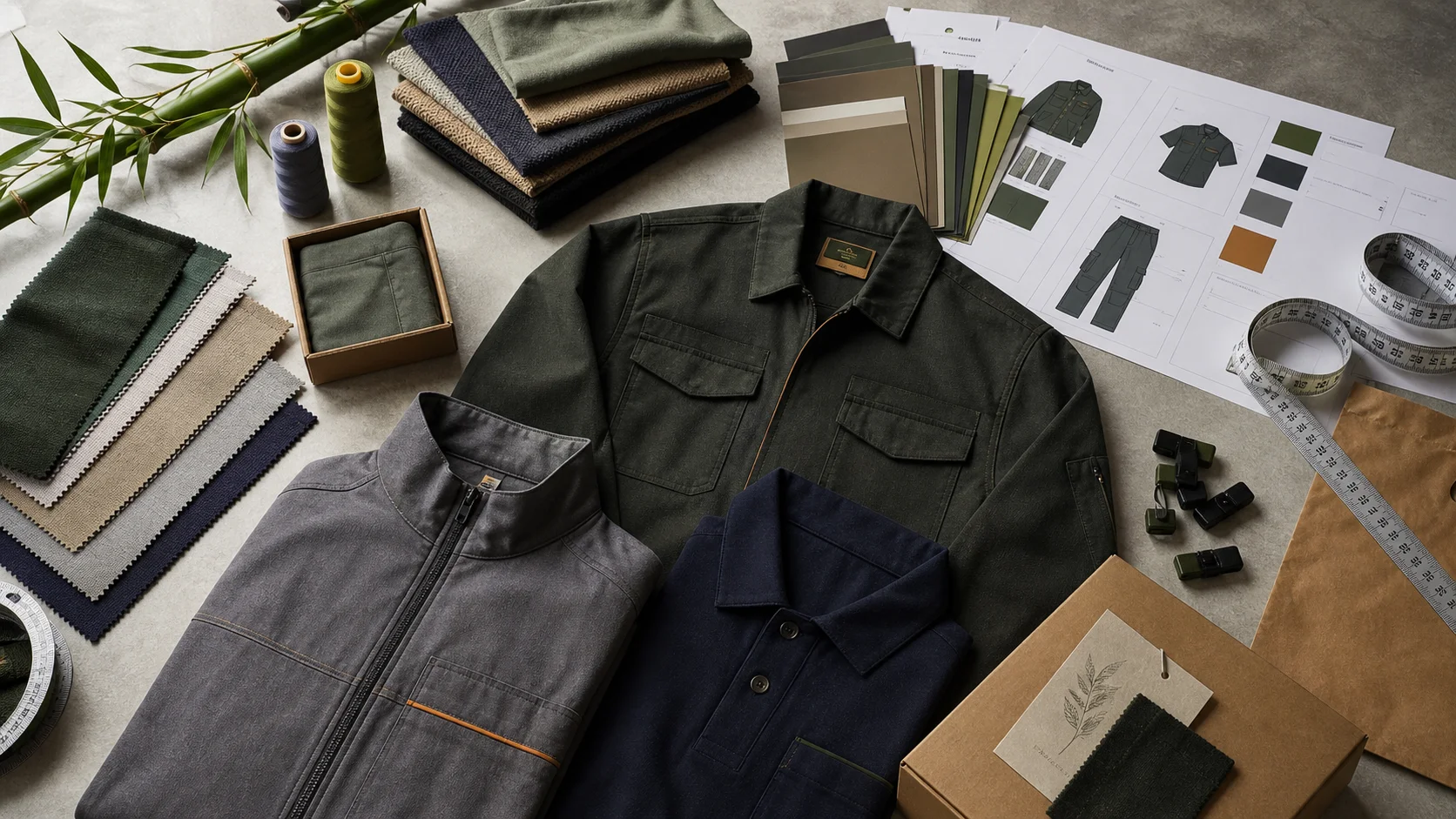
Custom Vest Manufacturer Low MOQ with checks for samples, fit, MOQ, QC evidence, pricing terms, and delivery risk.
Fast answer: Custom Vest Manufacturer Low MOQ: Fabric, Fit, Trim, and Sampling should be judged by production evidence, not by a generic sourcing promise. The buyer needs sample proof, cost breakdowns, QC checkpoints, and delivery buffers in writing.
Ask for recent sample photos, measurement tolerances, fabric or print test assumptions, decoration test notes, packing examples, and a named inspection checkpoint. These details show whether the team can repeat an approved sample at bulk volume.
Separate garment cost, decoration, labels, packaging, sampling, testing, freight, and rush charges. When every cost line is visible, it becomes easier to reduce colorways, adjust size depth, or reserve more time for sampling.
One rack held 500 quilted vests waiting for a buyer; another held a 60-piece test run for a DTC brand that wanted proof, not promises. That’s the new reality for a custom vest manufacturer low minimum order buyer. Many mills and cut-and-sew floors still prefer 300 to 1,000 units because their cutting tables, dye lots, and packing lines run cleaner at scale. Yet startups, niche labels, and corporate buyers are asking for 30 to 150 units, sometimes 200 if the price is right. I have seen factories where the cutting room lights stay on past midnight because a designer insisted on tweaking a pocket detail (true story). In Guangzhou’s Nansha district, an export desk told me a boutique fit sample takes 18-22 business days because engineers need to dial in the Gerber AccuMark, servo-electric spreader, and ultrasonic sealing machine before they can cut a new 210T ripstop shell, OEKO-TEX Standard 100 certified lining, and GOTS-approved recycled poly fill batch. The sticker even lists which WRAP-audited dye house and GRS-certified batting will feed each size, proving that low MOQ doesn’t mean low oversight.
Inventory turns are tighter. Return rates show up in 2 weeks, not 2 seasons. A brand can no longer sit on 800 nylon puffer vests in one color and hope wholesale will rescue the decision. I’ve seen smaller labels use 50 to 100 pieces to test fit, then reorder in 3 to 4 weeks once sell-through looks healthy. In Dhaka, a sourcing team told me they leveraged a weaving mill with BSCI oversight to get the first 30-unit batch woven, dyed, and inspected for event merch in under a month before ordering the next 250-piece run with new logo placements.
Factory visits reveal a gap between promise and practice. Sales teams may advertise flexible MOQ, but the sewing line can tell a different story once you ask for two logo placements, a custom zipper pull, and contrast lining. In Ho Chi Minh City, I watched a crew lock in a run of 90 units only after the buyer agreed to use stock polyester shell pieces, standard brass snaps, and laser-etched trims, because the computerized Juki DDL-8700 machines on that line couldn’t pivot to four colors without losing throughput. In Istanbul, a mid-sized workshop quoted 120 units for a padded vest, then added a setup charge that erased the savings because the bonded seams required a new ultrasonic welder calibration.
That tension matters because low minimums lower risk while pushing unit cost higher. A 75-piece order can protect cash and speed testing, but the price per vest may sit 18% to 35% above a 200-piece run, especially when the line needs custom jacquard trim or molded pulls. Buyers need to decide which pain they prefer: paying more per piece now, or carrying too much inventory later. I’ve seen both mistakes, and the second one is usually more expensive. It’s mildly funny (and mildly soul-sapping) when a factory claims to champion low MOQs but charges you for oxygen just to cover the extras, while another Guangzhou facility advertises $2.50-4.00 per unit at 500 MOQ for a plain polyester utility vest shipped in bulk via container if you’re willing to go that large.
A MOQ is not one number. It is a stack of numbers. Shell fabric, lining, fill, trim, and decoration each create their own threshold, and the highest-risk component usually sets the floor. A lightweight twill vest with a printed chest logo may only need 50 units if the fabric is in stock. The same shape in 380T nylon with recycled padding, custom metal snaps, and a woven badge can jump to 200 or 300 units because every extra material needs sourcing, approval, and scheduling. In Ho Chi Minh City, any mention of thermo-bonded panels or heat-pressed tape forces the planner to factor in the ultrasonic welding machine downtime and the need for a second set of molds, especially when working with GRS-certified recycled polyester fill.
Across regions, the pattern is consistent. Small workshops in India or Bangladesh may accept 30 to 80 units, but they often charge more for pattern time and handwork. Mid-size export factories in China, Vietnam, or Turkey usually sit around 100 to 300 units for low-risk constructions. Larger contract manufacturers often start at 500 units and above, especially if the vest includes bonded seams, internal quilting, or branded hardware. ISO-based quality systems help some factories stabilize production, and standards references from ISO show why repeatability is favored over improvisation. When the line needs custom jacquard elastic produced on a Stoll flat knitting machine or a new colorway printed on an EFI digital textile printer, the MOQ creeps upward because it touches sourcing, printing, and finishing calendars.
Details raise the floor fast. Custom zippers need a supplier run, and branded snaps often require 1,000-piece hardware minimums even if the vest order itself is only 120 units. A special dye lot can add 2 to 4 weeks before cutting. Woven labels and printed care labels are usually easy; custom jacquard elastic, molded pulls, and contrast binding are not. I’ve seen a factory approve 100 vests, then discover the buyer wanted four shade-specific zipper tapes and a new tape width, forcing procurement to turn on the Lectra cutting table for another run. The order promptly became a 250-unit conversation. In my experience, if you raise your hand and ask exactly what the zipper tension rating will be, the production manager relaxes because you aren’t about to send back 100 misaligned teeth.
There is also a split between true low-MOQ production and quote padding. Some factories advertise 50-piece minimums, then attach a $120 pattern fee, a $75 grading charge, and a $0.80 per piece handling fee that quietly turns the order into a margin exercise. Others bundle these costs into the unit price and appear expensive, though the total may be cleaner. That is why I prefer to ask for a line-by-line quote and compare it to custom cut and sew manufacturing services I already know. A low MOQ only helps if the math is honest.
The quote you get is rarely the cost you pay. For a 50-unit run, I’ve seen a basic work vest land at $13.50 to $18.00 per piece, while a 200-unit run of the same spec drops closer to $9.20 to $13.00. That gap is not inflation. It is spread: pattern work, marker efficiency, cutting waste, and the simple fact that a factory cannot absorb setup costs across enough units when the order is tiny. In fact, in a Guangzhou export line the same polyester shell that cost $14.80 per piece in 90 units drops to $2.50-4.00 per unit at 500 MOQ once the cutting charge, nesting time on the Gerber cutter, and shuttle sewing run are dialed in.
Price tier changes everything. A plain polyester utility vest with screen print may sit at $6.50 to $10.00 at 200 pieces. A padded fashion vest with 120 GSM fill, nylon shell, and branded zipper can land at $14.00 to $24.00 in a 100-piece run. A technical outdoor vest with water-repellent coating, laminated panels, and sealed pockets often starts around $22.00 and can move past $35.00 when the order is only 50 pieces. In Ho Chi Minh City, a supplier will hand you a price ladder that includes the pumped-up cost of using a thermal laminator and laser-cut pocket openings, especially since those steps eat up operator time on the Atlas machines.
Hidden charges are where small orders get punished. Tech pack development can run $75 to $300. Pattern making may cost $60 to $150 per style. Grading across 5 sizes can add another $80 to $250. Embroidery digitizing is often $25 to $100, depending on stitch count and complexity. Packaging is its own line item; a custom printed polybag may add $0.15 to $0.45, and a branded hangtag can cost $0.08 to $0.30. If the factory is sourcing recycled fills or certified fabrics, expect a premium of 5% to 15%. I once audited a Dhaka production where the grade and tech pack pair added $320 to a 90-unit lot because the buyer insisted on laser-cut edge binding and a custom polar fleece lining.
Here’s what most people miss: the factory quote is only half the story. The real number is landed cost. That means product cost, freight, duties, inspection, and any rework tied to missed specs. A 75-piece vest order at $15.80 each can become $19.10 landed once you add $220 air freight, $85 inspection, and a $140 labeling correction. I tell buyers to compare landed cost, not sticker price, before they approve a run. For a clean first pass, many brands use request a custom vest quote from Fabrikn only after they have a target ceiling and a backup ceiling. For sustainability benchmarks, see Textile Exchange.
Low MOQ does not always mean fast. A domestic factory can sample in 5 to 10 days and bulk in 2 to 4 weeks if the fabric is already in stock. Nearshore production, such as Mexico or Central America for North American buyers, often needs 3 to 5 weeks for bulk and 1 to 2 weeks for sampling. Offshore production in China, Vietnam, or Bangladesh can be 4 to 8 weeks for bulk once approvals are final, with sampling taking 7 to 14 days. Trade data from trade.gov reinforces how freight lanes and sourcing depth affect turnaround. Guangzhou workshops typically add 18-22 business days to the lead time when a run requires custom dyeing, because the jet dye machine cycles and lab dip approvals must align before the computerized spreader spins up.
Small orders move fast only when four things are ready: fabric is on hand, artwork is final, trims are standard, and size specs do not need revision. If any one of those shifts, the clock slips. Lab dips can cost 3 to 7 days. Shade approval adds another 2 to 3 days when you demand matched trim, and a rejected mock-up pulls the Gerber cutter off the next job. Quilting, ultrasonic bonding, or laser-etched branding require additional setup time on the SMT machines, especially when you introduce new configuration files. In Istanbul, a 120-unit padded vest took nearly 6 weeks because the heat-bonded pocket had to run through the ATR ultrasonic welder twice after the first sample failed tension testing.
Freight cadence matters too. Air freight from Guangzhou via Shenzhen can land in New York in 7 days, but a consolidated container from Ho Chi Minh City to Rotterdam may take 28 days, and door-to-door service from Dhaka to Toronto often averages 33 days once customs clearances and C-TPAT paperwork finish. Plan those numbers into your re-order rhythm so you aren’t waiting for a second low-MOQ batch when your event needs the vests tomorrow.
Quality is measurable when you bring the right certifications, machines, and checks to the table. I look for partners that can show active GOTS, OEKO-TEX Standard 100, WRAP, BSCI, and GRS certificates, especially if sustainability or traceability is part of the story. That means the shell fabric is tracked from fiber to finish and the fill is at least 50% recycled polyester certified by a third party. Visiting the factory, you want to see a Tinius Olsen tensile tester, a Q-Lab color fastness booth, and calibrated walking-foot machines to verify seam strength. The production manager should walk you through the inspection table, showing you how they use Juki AMS feeders for consistent thread tension, whether they run double-needle chainstitch or coverstitch machines, and how they capture defects in real time.
I pay close attention to processes such as ultrasonic welding for bonded seams, laser cutting for edge-to-edge accuracy, and automated spreaders that keep nap direction and grain consistent. A genuine low-MOQ partner will have standard operating procedures for each of those steps and can share data on past runs. Ask for a sample pack that includes a tear-down: show me the internal quilting, the branded zipper, the heat-pressed label, the D-ring reinforcement. Then ask for the test certificates proving the torso fill meets ASTM D3778 and the water repellent meets AATCC 22. When they can produce WRAP and BSCI audit reports, it means labor compliance is monitored as closely as stitch density.
First, define the margin you can live with: what’s your target landed cost, and what’s the ceiling where you’d rather wait for more volume? Then build a sample spec that includes fabrics, trims, and decorations with fallback options. Ask for production-ready drawings and confirm which machines—Gerber cutters, Lectra spreaders, ultrasonic sealers—are available on the line. Third, verify certifications by requesting scanned certificates for GOTS, OEKO-TEX Standard 100, WRAP, BSCI, or GRS depending on your sustainability language. Fourth, lock in logistics by asking for quotes from Guangzhou, Ho Chi Minh City, Dhaka, and Istanbul so you can compare 20-foot container vs. air freight timelines and fees. Finally, schedule a pre-production meeting to review the first few samples and sign off on marking instructions before any fabric hits the spreaders.
Brands launching seasonal capsules, event organizers needing branded merch, teams experimenting with uniform tweaks, and pilot programs testing new technologies all benefit from low MOQs. DTC labels can sample 30 pieces and use the data to inform a 500-unit reorder. Apparel labs run 15-piece functional prototypes with high-tech layers—laminated wind panels, moisture-wicking mesh, and bonded piping—before scaling. Even corporate procurement teams use 150-piece runs out of Ho Chi Minh City or Istanbul when they want quick-turn polos for a roadshow without locking into 1,000-piece runs. Low MOQ partners should still be transparent about when they can reuse dies, digital prints, or master patterns, so you can plan the next iteration without guessing.
Expect 18-22 business days for a full-size sample if the fabric needs to go through lab dips, automated spreading, and Gerber cutting, but you can trim that down to 10 business days if you use in-stock OEKO-TEX Standard 100 nylon and keep decoration simple.
Custom metal zippers often require 1,000-piece runs from the supplier, meaning your factory may ask you to cover the cost even if your vest order is only 120 units. For low MOQs, consider stock zippers or inject a surcharge into the price to cover the hardware lot.
Reputable partners will provide copies of GOTS, OEKO-TEX Standard 100, WRAP, BSCI, and GRS certificates and let you audit the process. If they cannot produce those, ask why, and be willing to walk away rather than risk a headline about fake claims.
Add the per-piece quote, pattern/prototype fees, packaging, inspection, freight, duties, and any rework. A 75-unit order at $15.80 can move to $19.10 landed after $220 air freight, $85 inspection, and a $140 trim correction, so build those contingencies into your budget before the contract is signed.