
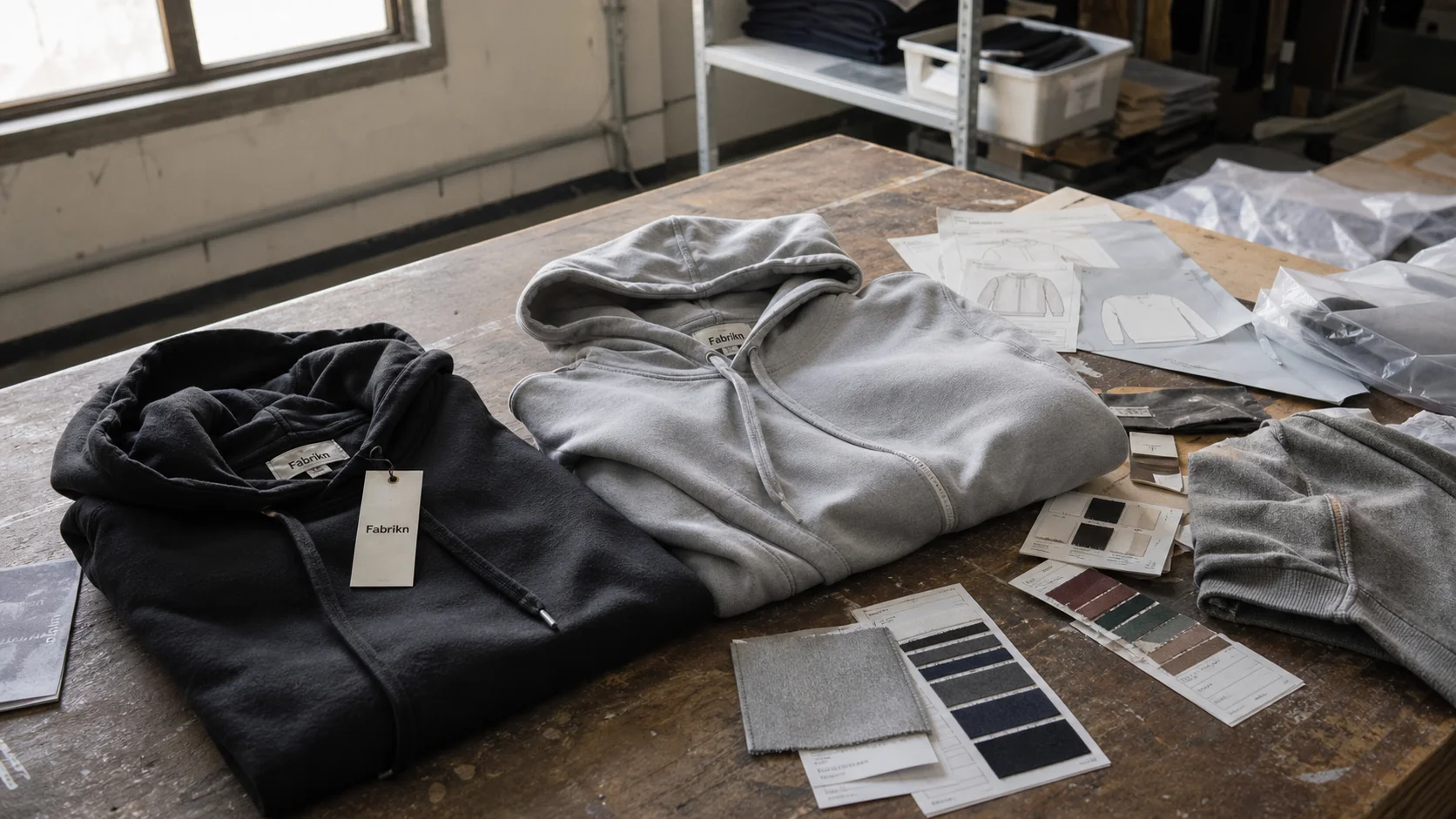
Low-MOQ Tracksuit Manufacturer with checks for samples, fit, MOQ, QC evidence, pricing terms, and delivery risk.
Fast answer: Low-MOQ Tracksuit Manufacturer: Fabric, Size Runs, Logo, and Cost should be judged by production evidence, not by a generic sourcing promise. The buyer needs sample proof, cost breakdowns, QC checkpoints, and delivery buffers in writing.
Ask for recent sample photos, measurement tolerances, fabric or print test assumptions, decoration test notes, packing examples, and a named inspection checkpoint. These details show whether the team can repeat an approved sample at bulk volume.
Separate garment cost, decoration, labels, packaging, sampling, testing, freight, and rush charges. When every cost line is visible, it becomes easier to reduce colorways, adjust size depth, or reserve more time for sampling.
Factory owners used to dismiss 100-piece track suit orders. I heard that in Guangzhou, Istanbul, and Porto. Now many of those same factories quote 50 to 150 sets for the right buyer, because the old volume model stopped working. Inventory got expensive. Retail demand tightened. Direct-to-consumer brands wanted proof before they locked up cash. A track suit manufacturer low minimum order is no longer a curiosity. It is a survival tactic.
For new brands, the appeal is simple: a track suit manufacturer low minimum order lets you test fit, fabric, and pricing without tying up too much cash. Across eight countries, the same pattern kept showing up: smaller orders forced buyers to be precise about fabric, trims, and fit. A Turkish cut-and-sew shop once showed me a 72-piece run in 380 GSM brushed fleece, priced at $18.40 per set, because the client accepted one color, one zipper spec, and no custom rib. That same factory needed 300 units for custom-dyed fleece. Slower work. Sharper attention. Fewer machines, more hands, less waste.
Region matters too. Portugal and Turkey often quote lower MOQs than big-volume mills in China or Bangladesh, but they do not always carry the same fabric stock or lead-time flexibility. Vietnam sits in the middle for sportswear capacity, especially when technical finishes or bonded fleece are on the table. China still leads on trim variety, zippers, labels, and fabric sourcing depth. For a premium fleece tracksuit priced at $85 to $140 retail, a small-run surcharge is easier to absorb than it is on a $29.99 poly set where every dollar bites.
The economics are blunt. Premium buyers can live with a $3.50 to $7.00 surcharge per set if the product sells through in 30 days. Budget buyers cannot. So brands test track suits in 50, 100, or 150 units before they scale to 500 or 1,000. Better information for the factory. Real sales data for the brand. One less chance to overbuy 800 sets in the wrong shade of heather grey.
MOQ is never just one number. Hidden inside the quote are fabric, trims, labels, and packaging minimums. A factory may say 50 sets, while the fabric mill wants 200 meters, the zipper supplier wants 300 pieces, and the woven label vendor only prices well at 500 units. That is where buyers get tripped up. The headline looks small; the components do not.
For a basic two-piece tracksuit, I usually see four production tiers. Sample rooms may take 10 to 20 sets, but the cost is high and the fit is not meant for selling. Boutique cut-and-sew factories often sit at 30 to 80 sets per style. Mid-size export factories tend to land around 100 to 300 sets, depending on fabric and trim. Stock-service suppliers can sometimes build from ready goods at 20 to 50 sets, though color and branding choices stay narrow.
Ready fabric and custom fabric are different animals. If the mill already has 320 GSM French terry in black, navy, or oatmeal, the factory can move quickly. Ask for custom dyeing, and the effective threshold can jump by 200 to 500 units because the mill wants a larger lot to justify the dye bath and lab dips. I have seen brands pay $1.20 more per set just to dodge a 400-piece custom color minimum. Sometimes that trade makes sense. Sometimes it does not.
Low MOQ does not mean loose standards. It usually means tighter discipline. One Turkish factory I visited took 60 sets only because the buyer approved a single fit block, a single logo placement, and a fixed rib composition. The factory refused to budge on tolerance. Waistband stretch had to recover to within 10% after 30 minutes. Shrinkage could not exceed 3%. Stricter than some larger plants. Small orders buy focus, not freedom.
If you want broader brand architecture around this kind of sourcing, I often point buyers to private label clothing services because the real challenge is not only production, but also how each product line fits a retail identity.
The cheapest quote is rarely the cheapest order. I have watched brands chase a $14.90 unit price and land at $23.70 after embroidery setup, extra labels, split freight, and a second sample round. Start with the full stack: unit price, pattern charge, sample cost, embroidery setup, packaging, freight, duties. Only then does the quote mean anything.
Here is a simple framework I use. Quote A: 100 sets at $16.80 each, pattern charge $120, samples $85, embroidery setup $60, packaging $0.65 per set, freight minimum $480, duties 9%. Quote B: 100 sets at $18.90 each, pattern charge waived, samples $40, embroidery setup $35, packaging $0.40 per set, freight $260, duties 9%. Quote A looks cheaper. Then the order lands. Then the math flips.
China often wins on unit price, especially when you need zippers, drawcord tips, heat-transfer logos, and multiple color trims. Turkey can look a little higher on paper, yet faster delivery and cleaner communication reduce error risk. I have seen a China factory quote 28 to 35 days for bulk, but freight plus customs pushed landed cost above a Turkish supplier who delivered in 22 days to a European warehouse with fewer revisions. That mattered because the buyer had only 60 days of cash runway.
Timeline is part of cost. Samples usually take 7 to 14 days. Bulk production runs 20 to 45 days. Low MOQ can shorten that if the factory has stock fabric, and it can also drag if they need to reserve mill yardage or wait for trims. A 90-piece order in ready fleece may ship faster than a 300-piece order in custom-dyed French terry. Size runs matter too. Five sizes and three colorways? Every delay multiplies.
I push buyers to compare risk, not just price. If a factory stays vague about fabric availability, refuses to itemize surcharges, or will not say whether the MOQ applies to style, color, or total order, I walk away. For technical execution, cut and sew manufacturing is where clear costing and repeatable spec control separate a workable supplier from a costly guess.
For sourcing benchmarks and compliance context, it also helps to review U.S. trade data and export guidance, because freight, tariffs, and market access can change your landed cost more than the quote itself.
According to WTO trade data, apparel pricing still bends under freight, regional tariffs, and order size. Small runs can look cheap until the hidden charges show up.
China remains the most versatile option for a low-MOQ track suit manufacturer. Strong trim variety. Deep fabric sourcing. Easy switching between brushed fleece, French terry, and poly-spandex blends without rebuilding the supply chain. Vietnam is solid for sportswear capability and cleaner export processes on certain technical items. Turkey brings faster replenishment into Europe, often two to three weeks quicker than Asian sourcing once materials are on hand.
Portugal surprised me the most. Smaller factories there often accept 30 to 75 units, sometimes even 25 if the buyer is organized, but their fabric libraries are narrower and their pricing is built for premium positioning. I have seen Portuguese factories quote €19 to €29 per track suit pant on small orders, where an Asian factory might be half that. Excellent quality. Tight palette choices.
The United States is fast and expensive. For short lead times, 10 to 20 day cut-and-sew production can be valuable, especially for domestic brands that need speed over margin. Labor costs push unit prices up sharply, and lower-MOQ production often comes with fewer fabric choices unless the factory already stocks yardage. Entry-level tracksuits usually belong in Asia. Premium athleisure can make Europe work if the retail price supports it.
Here is what most people miss: smaller European factories often accept lower MOQs than buyers expect, but they are less forgiving on design indecision. I once saw a buyer request four colorways, two zipper finishes, and three logo treatments on a 60-piece order. The factory quoted it, then padded the price by 31% because the complexity killed efficiency. One colorway. One shell fabric. One trim package. That is the difference between a feasible small run and a vanity project.
For a buyer wanting fast browsing before shortlisting suppliers, it helps to browse our product catalog and compare silhouettes, fabric weights, and finishing levels before sending requests.
Compliance and communication matter more at low volume because mistakes cannot be diluted across 5,000 units. If a 100-piece order misses the fit by 1.5 cm at the hip, the loss hits immediately. Data from ISO standards shows why process control matters even for small batches: consistency comes from repeatable measurement, not wishful thinking.
When sustainability claims matter, buyers should also check Textile Exchange standards and preferred fiber guidance and OEKO-TEX certification information to understand how fabric claims and chemical safety documentation are handled by the supplier.
A low MOQ factory should still behave like a serious manufacturer. Ask for the business license, audit reports, export records, fabric certifications, and references from customers who bought at similar volumes. If they made 50 pieces for a fashion influencer but cannot show a 100-piece repeat order, that is a warning sign. Small orders do not excuse weak records.
Request real production samples, not just polished showroom pieces. I want to see the inner seams, the overlock quality, the topstitch spacing, and the inside of the waistband. A showroom sample can hide poor finishing under perfect lighting. A production sample tells the truth. If the factory will not let you inspect stitch lines or refuses to discuss shrinkage and pilling, walk out. Those are not minor details. They are the product.
Quality risk jumps fast when the order is small. A 3% defect rate on 50 sets means 1.5 bad units. On 100 sets it means 3 units, and if your margin is only $8 per set, that is real money gone. Check seam strength, zipper action, waistband recovery, rib elasticity, and shade consistency across pieces. A good factory knows its tolerance range. A weak one guesses.
I always ask the same floor questions. What is the shrinkage after wash at 30 degrees? Does the French terry pill after 5 cycles or 20? Is the zipper coil YKK, SBS, or an unbranded substitute? How many grams of elastic sit inside the waistband, and what is the recovery target? These details matter more than showroom promises. They show whether the factory understands sportswear or only general sewing.
If the supplier can quote you on the spot, then inspect a hanging sample, then explain how the 2-needle coverstitch differs from the overlock seam, you are probably dealing with a real production partner. If not, you are paying for optimism.
Start with a complete inquiry packet. Send a tech pack, measurement chart, artwork files, target price, delivery date, target MOQ, and the exact fabric you want. If you do not have a full tech pack, send a reference garment with measurements, fabric weight, and trim notes. Clean requests save 2 to 3 days of back-and-forth and prevent expensive misunderstandings.
I ask factories to quote three tiers: 50 units, 100 units, and 300 units. That shows how much the unit price drops as the run grows, and it reveals where the real pain point sits. Sometimes the 50-to-100 drop is sharp because the factory is covering setup. Sometimes the 100-to-300 drop barely moves because the fabric cost dominates. Either way, a tiered quote tells you more than a single number ever will.
Before bulk cut begins, lock the trims, color standards, and packaging. Approve a lab dip or fabric swatch under natural light. Confirm rib width, drawcord length, logo placement, and label content. If embroidery is involved, approve stitch count and backing material. If the order includes a zipper garage or reflective piping, get those details in writing. Define what happens if one component arrives late. Delay clauses save small brands from chaos.
Payment terms are negotiable, even at low volume. I have secured 30/70 terms, 40/60 terms, and once 20/80 after a factory saw repeat potential. If cash flow is tight, ask for a smaller deposit on the first 50-piece run and a faster balance release after mid-production photos. Good factories want payment certainty, but they also value repeat buyers who communicate clearly and pay on time.
If you want a quote quickly, you can get a free quote after you assemble the packet. Better documents leave less room for avoidable cost creep.
For reference, buyers often use fabric weights like 280 GSM French terry for lighter sets or 320 GSM brushed fleece for premium winter styles. That one choice can shift the retail story by $8 to $15 per set.
A first run of 50 to 100 units should be treated as a test cycle, not a tiny victory lap. If sell-through reaches 70% in the first cycle, that is a meaningful signal. If it stays under 40%, the problem may be price, fit, color, or channel. I have seen brands blame production when the real issue was a weak size curve. The data usually tells the truth if you actually measure it.
Once demand is proven, use the reorder to renegotiate. Ask for a lower unit price, cheaper trim substitutions, or reserved production slots. A factory that took 50 units at $19.80 may agree to 300 units at $16.20 if you can repeat the style with the same fabric and one or two color changes. Reorders are where margin comes back. The first run is usually the expensive lesson.
Margin protection comes from discipline. Fewer colorways reduce mill minimums. Shared patterns across joggers and hoodies reduce pattern-making fees. Standardized fabrics make reorders faster. A black 320 GSM French terry set and a navy one can often share the same block with only a label change. That is how small brands avoid death by variation. One style. One fit. One story. Then expand.
At 300 units, trim buying power improves. Inspection costs become easier to spread out. Freight gets more efficient because cartons fill pallets more cleanly. At 1,000 units, the factory can often schedule more predictably, and that reduces rush charges. But a bigger order helps only if the style already sold. I have watched founders order 1,200 sets after one strong weekend and carry inventory for nine months. Production scale is not the same as business scale.
The smartest small brands I have seen treat low MOQ as a test lab, not a permanent constraint. They use the first run to learn fit, pricing, and sell-through, then they convert those numbers into better factory terms on the second and third orders. That is how a track suit manufacturer low minimum order relationship becomes a growth tool instead of a compromise. A good track suit manufacturer low minimum order partner makes the second order easier than the first, and that is the real sign you have chosen well.
Most low-MOQ factories quote 50 to 150 sets, but the real minimum often depends on fabric, trims, and colorways. Ready fabric can stay near 50 units, while custom dyeing may push the effective threshold up by 200 to 500 units.
Budget poly sets can land around $12 to $20 per set at small volume, while premium fleece or French terry runs often land between $18 and $35 before freight and duties. Setup, samples, and packaging can add $200 to $800 to a first order.
Sampling usually takes 7 to 14 days. Bulk production typically takes 20 to 45 days, depending on fabric stock and trim availability. If the factory is sourcing custom-dyed fabric or special zippers, add 1 to 3 extra weeks.
Yes, but branding choices are often limited at low volume. Screen print, heat transfer, woven labels, and simple embroidery are common, while complex multi-location decoration can raise the MOQ or add $0.50 to $3.00 per set.
Portugal and Turkey are strong for premium small runs, especially if your retail price sits above $70. China still offers the broadest trim options, while the US is faster but usually much more expensive. Match the region to your target margin, not just the quote.