
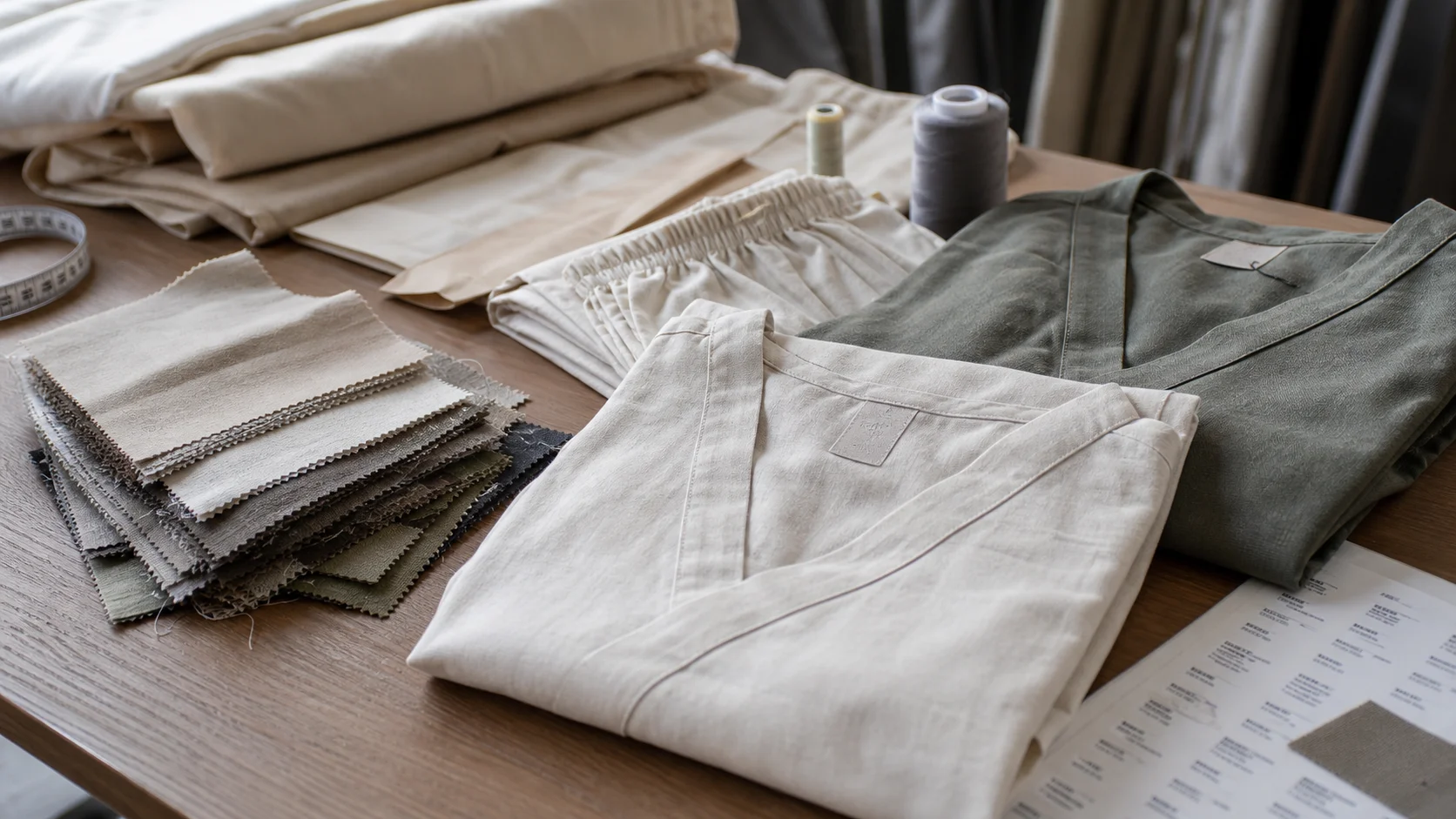
A practical outline for logistics buyers evaluating custom warehouse uniforms with shrinkage testing, focusing on fabric performance, test methods, and...
Custom Warehouse Uniforms Shrinkage Testing Buyers Guide - Fabrikn production reference
Custom warehouse uniforms do a hard job. They are worn through long shifts, repeated laundering, friction from pallets and cartons, and constant movement in hot, cold, and mixed-temperature environments. For logistics companies, shrinkage testing is not a lab-only topic. It is a purchasing control point that affects fit consistency, staff comfort, replacement rates, and whether a bulk order actually performs as expected after the first few wash cycles.
This guide explains how to evaluate custom warehouse uniforms shrinkage testing for logistics companies, what to ask suppliers, which fabrics are usually more stable, and where the real risk sits in production and wash performance. The goal is straightforward: reduce surprises before bulk order approval and avoid uniforms that tighten, twist, or lose their intended size after laundering.
Warehouse uniforms are not fashion items. They must keep the same size, shape, and range of motion after repeated wash cycles. A shirt that shrinks one size category can become too tight in the chest or sleeves. Trousers can rise at the ankle or bind at the thigh. For logistics teams, that can create a practical problem faster than a visual one. Workers may stop wearing the issued garment, request replacements early, or size up during reorder planning, which complicates inventory control.
Shrinkage testing is especially important for custom uniforms because the garment is usually developed around a specific use case: warehouse ops, dispatch, picking, packing, forklift work, or cold-chain handling. The fit is often engineered with allowances for layering, stretch, reflective tape placement, or pockets. If the fabric shrinks beyond the target range, those design choices stop working as intended.
Good buyers treat shrinkage as part of product validation, not an afterthought. That means checking the fabric behavior, the garment construction, the wash standard being used, and the acceptable tolerance before signing off on bulk production.
Shrinkage does not always show up as a simple reduction in length. A uniform can also distort in the shoulder, torque after washing, or lose sleeve balance. Different fabrics fail in different ways.
Buyers should distinguish between fabric shrinkage and garment shrinkage. Fabric testing alone is useful, but it does not capture the full behavior of the finished piece. Sewing tension, interlining, printed logos, reflective trims, and reinforcement tapes all affect final dimensional stability.
A uniform can pass a fabric test and still fail in garment use if the stitching, finishing, or washing protocol changes the final fit. Buyers should ask for both fabric and finished-garment measurements after laundering.
For warehouse uniforms, sourcing usually balances durability, comfort, and price. Shrinkage performance sits inside that tradeoff. Lower-cost fabric can be acceptable if the garment is well specified and the wash tolerance is realistic. The mistake is assuming any fabric labeled “workwear” will hold size without proof.
Direct purchasing judgment: for logistics uniforms, a stable poly-cotton woven often gives the best total value. Pure cotton may feel better initially, but if the program cannot tolerate size drift, the apparent savings disappear in replacement cost and sizing complaints.
Testing should be built into the sample approval process. Waiting until bulk goods arrive is too late. A supplier should be able to show the testing method, the tolerance range, and the result on the exact fabric or finished garment you are buying.
Ask for a lab dip or bulk fabric swatch, then confirm the base fabric composition, weight, and finish. Typical workwear weights may sit around 180-260 gsm for knits and 180-300 gsm for woven uniforms, depending on the garment type and climate. The exact GSM matters because heavier fabrics can behave differently in washing and drying.
Check these points before moving forward:
Finished-garment wash testing is the meaningful check for buyers. The garment should be measured before and after a defined wash protocol. Ask the supplier to state the standard used, such as an internal wash test, ISO-based method, or AATCC-style approach. The key is consistency. A test report only helps if the method matches your use case.
For warehouse uniforms, the most useful questions are:
Do not approve shrinkage only on one sample size. A size M shirt may behave differently from XXL because of grading, panel length, and sewing load. For bulk programs with multiple sizes, it is sensible to test at least one middle size and one upper size. If the garment includes pockets, reflective tape, or stretch inserts, inspect those features too because they can affect distortion after washing.
Set a practical tolerance before production starts. Many buyers accept a small shrinkage allowance if the garment still fits the intended wearer after laundering. The tolerance should be documented by dimension, not just by a general statement like “minimal shrinkage.”
A clear acceptance note might cover chest width, body length, sleeve length, inseam, and waist. The supplier should know which measurements are critical and which are secondary.
A weak spec sheet is one of the fastest ways to lose control of shrinkage. The more exact the document, the easier it is to argue a quality issue later if the bulk shipment misses the mark.
Do not leave trim out of the discussion. Poor-quality elastic can relax, shrink, or twist. Heat-transfer logos can crack or curl if the wash and dry process is too aggressive. Reflective tape can pull against the base fabric and change the way the panel behaves after laundering.
That sequence sounds slow, but it is cheaper than fixing a 3,000-piece order that fits differently after the first wash round. For a uniform program, a small delay in sampling usually beats a larger delay in claim handling.
MOQ depends on garment complexity, fabric availability, and whether the supplier is cutting from stock material or producing custom-dyed fabric. Typical MOQs for custom warehouse uniforms can range from 300 to 1,000 pieces per style or color, with some factories asking for higher quantities when several trims or fabric variations are involved. Custom logos and special color matching may raise the minimum further.
Sampling usually takes multiple steps. A first proto sample might take 7-14 days. A revised fit sample can take another 7-10 days. Wash testing and corrections can extend the timeline. Buyers should assume that a custom workwear program rarely moves in a single round if shrinkage control matters.
Lead time depends on several variables:
For logistics companies, the mistake is underestimating approval time. A supplier can only move fast if the buyer returns sample comments quickly and confirms the wash method without ambiguity.
For broader sourcing support, the service overview on Fabrikn services is a useful starting point, while the company background at about us helps buyers understand the manufacturing approach. For direct project discussion, use the contact page.
Inspection should not focus only on stitching and shade matching. Shrinkage-related defects can hide in otherwise acceptable goods. A factory may pass visual inspection and still deliver an order with uneven wash behavior.
During inspection, it is worth checking whether the factory uses the same lot for all bulk units. Mixed lots can create a scattered size result even if each batch technically passed a basic check. Buyers should also ask whether the production line used the same fabric roll orientation, because grain direction can affect the way a garment settles after washing.
A uniform program can absorb small variation. It cannot absorb uncontrolled variation across lots, trims, or wash behavior. That is where most disputes begin.
When sourcing custom warehouse uniforms, use a checklist that links product design to operational use. A garment for a light-picking team in a temperate warehouse may not need the same fabric or shrink tolerance as a cold-storage distribution team.
If the program is large or multi-site, keep a master spec and do not let each reorder drift. Small changes in fabric supplier, GSM, or trim supplier can change shrink performance enough to trigger complaints later.
The best buying decision is not always the cheapest garment or the softest one. For warehouse uniforms, stability usually matters more than luxury handfeel. A slightly firmer fabric with better shrink control often creates fewer problems over the life of the program. That matters because uniform programs are judged on wearability after repeated wash cycles, not on the first unboxed impression.
When comparing suppliers, favor the one that can explain the test method, show repeatable results, and accept measurement-based acceptance criteria. Be cautious with vague claims such as “no shrinkage” or “premium quality” unless they are backed by clear numbers. Good procurement practice is boring in the right way. It reduces replacement orders, stops sizing disputes, and keeps the uniform program aligned with operations.
Get a free quote from Fabrikn — your trusted B2B clothing manufacturer with 10+ years of experience. MOQ as low as 200 pieces.
Get a Free Quote →It depends on the fabric and garment type, but buyers commonly tolerate a low single-digit shrinkage range if the final fit remains functional. The important point is to define the acceptable limit by measurement point before production.
Both, but finished-garment testing is the more useful buying control. Fabric testing shows material behavior, while garment testing captures sewing, construction, and trim effects.
Polyester-cotton blends and properly heat-set knits usually offer better dimensional stability than untreated cotton-rich fabrics. The exact result depends on finishing quality and wash conditions.
At minimum, one pre-production sample should be checked for fit and construction, then wash-tested before bulk approval. Large or high-risk programs may need a revision sample if the first round fails tolerance.
Many suppliers quote roughly 300 to 1,000 pieces per style or color, though the number varies with fabric, trims, and customization level. Special dyeing or complex branding can increase the MOQ.
The main risk is uneven post-wash behavior across sizes, lots, or garment panels. A uniform may look fine at packing stage and still fail after the first wash if dimensional control was weak.
For logistics companies, shrinkage testing is not a technical side note. It is part of the buying decision. The right fabric, the right wash test, and the right approval process make the difference between a uniform program that holds up and one that keeps generating avoidable replacements.