
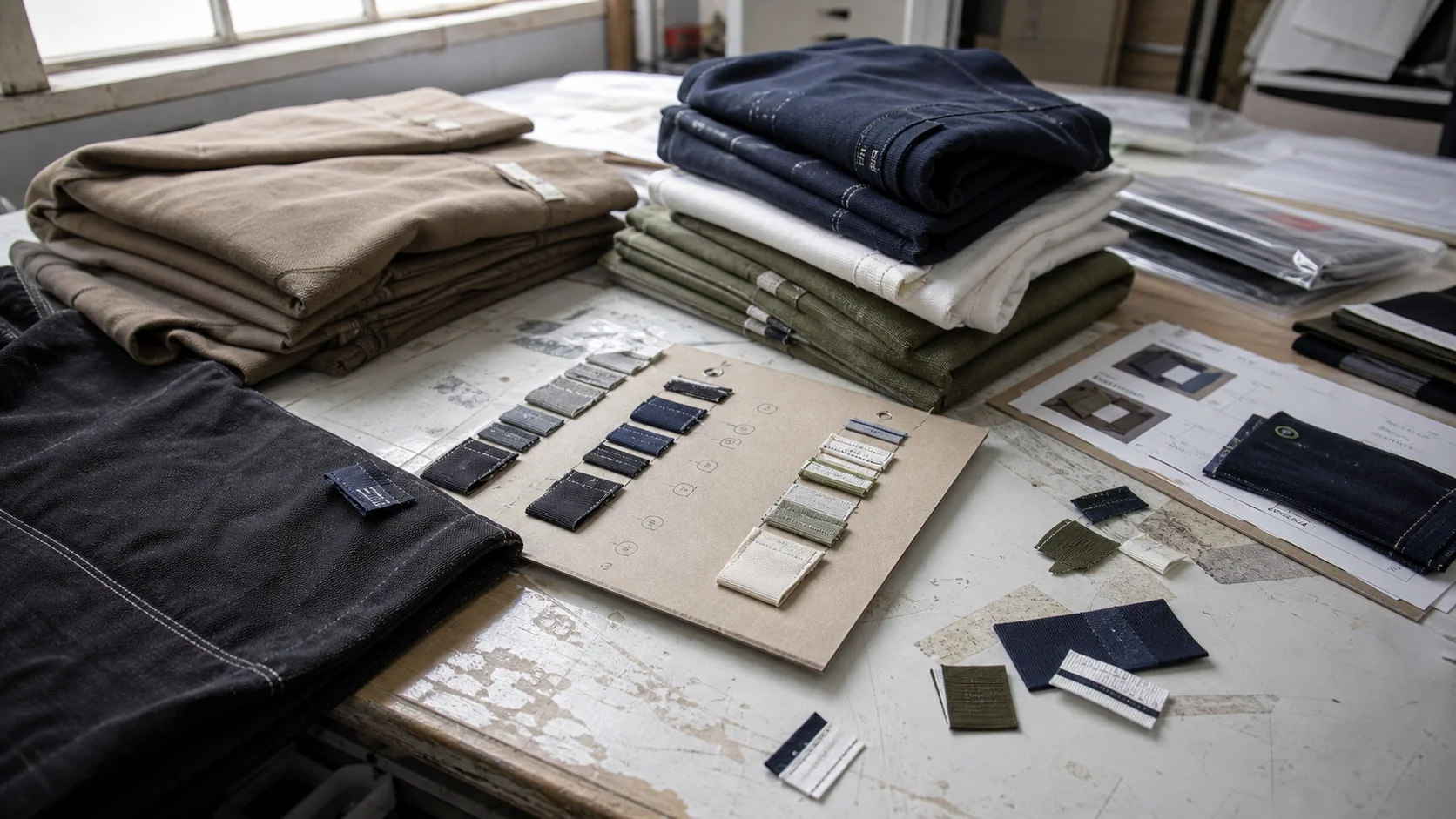
A facilities-focused outline for reviewing custom woven origin tab size grading, covering dimensions, placement, readability, compliance, sampling, and...
Woven Origin Tab Size Grading Review for Buyers - Decoration & Printing manufacturing guide
Category: Decoration & Printing
Custom woven origin tabs look small on a garment, bag, towel, cap, or facility uniform, but they carry a large amount of sourcing risk. A tab that is 2 mm too short can disappear into a seam. A tab that is too wide can distort during folding. A tab with weak edge stability can fray after laundering. For facilities managers buying uniforms, workwear, reusable textile assets, hospitality goods, or safety-adjacent apparel, origin tab size grading should be reviewed before bulk production, not after finished goods arrive.
This guide explains how buyers should evaluate woven origin tab sizes, grade rules, fold types, artwork constraints, fabric compatibility, and inspection checkpoints. It is written for purchasing teams, facilities managers, operations leads, and branded apparel buyers who need practical decisions rather than decorative theory.
A woven origin tab is a small textile label, usually folded and sewn into a seam, that identifies origin, brand, product line, size group, facility ownership, or compliance-related information. It may show text such as “Made in USA,” “Made in Vietnam,” “Property of,” “Recycled Program,” or a brand mark. In facilities management, these tabs are often used on uniforms, linens, reusable bags, PPE-adjacent garments, locker-room textiles, maintenance apparel, and staff-issued workwear.
The term “origin tab” can refer to country-of-origin marking, internal asset tracking, or a branded location identifier. Buyers should define the exact purpose before approving size. A compliance tab has different legibility requirements than a decorative side-seam flag. A facilities identification tab used for asset control may need stronger contrast, larger text, or a more visible placement.
Most woven tabs are made with polyester yarns because polyester offers color consistency, durability, and wash resistance at a reasonable cost. Premium labels may use damask weaving for fine detail, satin weave for sheen, or taffeta-style construction for a flatter budget option. The correct choice depends on how much detail is required and how the tab will be sewn into the product.
Facilities managers usually buy textile products for function first. Uniforms must survive laundering. Linens must cycle through industrial wash. Staff garments must be comfortable enough for daily wear. A woven origin tab seems minor until it creates complaints, compliance gaps, or rework.
Size grading is the process of adjusting tab dimensions across product types, garment sizes, or placement requirements while maintaining visual consistency. A single tab size may not suit every item. The same 25 mm x 25 mm center-fold tab that works on a canvas tote may look bulky on a lightweight polo shirt. A narrow loop-fold tab that fits a side seam may not provide enough space for a two-line origin statement.
For facilities programs, size grading matters for five practical reasons:
Buyers should not treat a woven origin tab as a generic trim. It is a small component with direct impact on finished product quality, especially when multiple facilities, departments, or garment categories are involved.
The first decision is the tab format. The fold style affects finished size, sew-in allowance, legibility, and cost. Buyers should review the finished visible size and the total cut size, because these are not the same.
A center-fold tab is folded in half, with the fold visible outside the seam and both raw ends captured inside the seam. This format is common for side seams, bottom hems, towels, and small brand markers.
Center-fold tabs are efficient and durable when the seam allowance is sufficient. The tradeoff is limited artwork space. If the visible area is 20 mm x 15 mm, the actual woven piece may be 20 mm x 30 mm before folding, plus tolerances. Small text can become crowded.
An end-fold tab has the left and right ends folded under, then stitched onto the surface or inserted at an edge. This is useful when the label is applied flat rather than captured inside a seam.
End-fold tabs give a cleaner look on exposed placements, but they require more sewing accuracy. They are less forgiving on stretchy knits because the fabric may ripple if the tab is stiff.
A loop-fold tab creates a loop that can be inserted into a seam, waistband, cuff, or accessory edge. It is useful for hanging indicators, size grouping, color-coded asset programs, and small origin markers.
The main risk is twist. During sewing, a narrow loop may rotate unless the operator aligns it carefully. Buyers should request a sewn sample, not just a loose label sample.
Straight-cut labels have no fold and are often heat-cut to seal edges. They can be sewn flat onto the product or inserted into seams with a specified allowance. They are cost-effective for simple asset labels but may feel sharper at the edge if yarn and cutting quality are poor.
There is no universal woven origin tab size. The right dimension depends on placement, fabric weight, seam construction, wash method, and the amount of information needed. The table below gives practical starting ranges for buyer review.
Application Common Finished Visible Size Suggested Fold Type Buyer Notes Side-seam brand or origin tab on polo shirts 18 mm x 15 mm to 25 mm x 20 mm Center-fold or loop-fold Keep text minimal. Confirm comfort and seam bulk on lightweight knits. Workwear jacket or overshirt tab 25 mm x 20 mm to 35 mm x 25 mm Center-fold or end-fold Heavier fabrics can support a larger tab. Check abrasion and edge stability. Towels, linens, and hospitality textiles 25 mm x 20 mm to 40 mm x 30 mm Center-fold Industrial laundering requires strong yarn, stable color, and secure seam capture. Reusable bags and facility totes 30 mm x 25 mm to 50 mm x 35 mm Center-fold or straight-cut Larger tabs can work well, but placement must avoid handle stress points. Neck or inner collar origin label 25 mm x 30 mm to 45 mm x 50 mm End-fold or straight-cut Comfort is critical. Soft edges and fine yarn matter more than decoration. Small asset-control tab 15 mm x 15 mm to 25 mm x 15 mm Loop-fold or center-fold Use color or simple codes. Avoid long copy.Buyers should request measurements in both finished and unfolded dimensions. A spec that says “25 mm label” is incomplete. It should state width, visible height, total cut length, fold type, seam allowance, tolerance, yarn colors, and placement.
A proper grading review starts with the product family. Facilities managers often buy several garment types in one program: polos, outerwear, pants, aprons, caps, towels, and bags. A single tab design may be requested for all items, but this is not always practical.
The review should answer four questions:
Placement drives size. A side-seam tab on a polo is usually smaller than a tab on a tote bag. A tab near the neck should be softer and less bulky. A tab at a hem must not interfere with hemming equipment. Buyers should ask for a placement diagram with distance from seam, fold direction, and visible face orientation.
Many woven tab issues happen because the tab is approved loose, then partially swallowed by the seam during production. If a 20 mm visible tab needs 8 mm inside the seam, the total label must be planned accordingly. For most apparel applications, a captured allowance of 6 mm to 10 mm is common, but the exact requirement depends on fabric, seam type, and factory sewing method.
Garment sizes can affect how a tab looks. A 35 mm tab may look balanced on a 3XL work jacket but oversized on an XS polo. Facilities programs that cover broad staff size ranges should check the smallest and largest garment sizes during sample approval.
The safest approach is often to keep one tab size per product category rather than one size across the entire program. That creates slightly more trim management work, but it improves finished quality.
Woven labels are small, so tolerances matter. A typical tolerance may be around 1 mm to 2 mm for small labels, depending on weaving and cutting method. Buyers should define whether tolerance applies to total cut size or finished folded size. Finished visible size is the measurement that matters most for appearance.
Woven origin tabs are specified through more than length and width. The buyer should review the construction details before issuing a purchase order or bulk trim approval.
Polyester is the standard choice for most commercial woven tabs. It holds color well, resists shrinkage, and performs reliably in wash. Recycled polyester may be available, but buyers should confirm certification requirements and color limitations before building claims into the artwork.
Cotton-look woven labels can suit heritage branding, but cotton yarns can shrink, fade, or fray more easily depending on construction. For facility laundering, polyester is usually the safer option.
Damask woven labels are preferred for fine details and smaller text. They produce a smoother hand and better definition. Taffeta labels are usually less expensive, but they may not hold detailed logos or small origin wording as clearly.
Satin weave can provide shine, though it may look too decorative for workwear or industrial uniforms. The best choice depends on the end use. Facilities buyers usually benefit from clarity and durability over shine.
Common edge finishes include heat cut, ultrasonic cut, woven edge, and folded edge. Heat-cut edges are economical but can feel sharp if the label sits against skin. Ultrasonic cutting can produce a cleaner sealed edge on synthetic yarns. Woven edges are smoother but may increase cost and minimums.
For neck labels or tabs near the body, edge feel should be checked by hand. For outer seams, edge comfort is less critical, but fraying resistance remains important.
Origin tabs on uniforms and facility textiles may face repeated washing, detergents, disinfectants, sunlight, and abrasion. Buyers should request colorfastness expectations, especially for dark tabs on light garments or bright brand colors on white textiles.
Color migration is a real risk when dark yarns sit against white or pale fabrics. It is more likely under heat, moisture, and pressure. A lab dip or yarn color approval does not fully replace wash testing on the actual garment fabric.
A label that looks crisp on a desk may feel stiff after it is sewn into a lightweight shirt. Fine damask construction usually gives a softer hand than coarser labels. Dense weaving improves logo clarity but can increase stiffness.
Buyers should balance readability with comfort. For facilities uniforms worn for long shifts, an uncomfortable tab can create avoidable complaints.
Artwork must be simplified for woven production. Woven tabs do not reproduce artwork the same way printed labels do. Fine gradients, tiny serifs, complex seals, thin lines, and small registered symbols may not weave cleanly at tab scale.
For small origin tabs, buyers should apply these rules:
If the tab must carry compliance-related information, do not approve a decorative size that makes the wording unreadable. Buyers should check local marking requirements with qualified compliance support. A trim supplier can advise on feasibility, but regulatory responsibility remains with the brand or importer.
Purchasing judgment: if the tab needs to communicate origin clearly, choose readability over minimalism. A smaller tab may look cleaner, but it can fail its practical purpose once sewn into the product.
A strong approval process prevents most woven tab problems. Buyers should avoid approving only a digital mockup. A digital proof is useful for layout, but it cannot confirm weave clarity, edge feel, color, folding accuracy, or sewn appearance.
The first proof should show artwork size, yarn colors, fold lines, cut lines, and finished visible dimensions. Ask for both flat and folded views. If the tab has front and back artwork, confirm orientation after folding.
Yarn colors should be matched to Pantone or approved color references where possible. Exact Pantone matching in woven yarn has limits. Buyers should expect close matching, not print-level precision. Dark navy, black, charcoal, and white are usually easier to manage than unusual neons or muted specialty tones.
The strike-off is the first physical woven sample. Review text sharpness, logo definition, density, edge finish, and fold accuracy. Measure several pieces, not just one. Small-label variation is easier to miss when only a single sample is checked.
This is the most important step for facilities buyers. The tab should be sewn into the actual fabric or a representative fabric. Check how much of the tab remains visible, whether it twists, whether it causes seam puckering, and whether it feels acceptable against the body.
For uniforms, linens, towels, and reusable facility goods, wash testing is sensible. Even a simple internal wash review can reveal curling, shrinkage, color bleed, or edge irritation. Industrial laundry programs should use more rigorous testing because heat, chemicals, and mechanical action are harsher than home laundering.
If a production schedule is tight, buyers may be tempted to skip sewn sample approval. That is a poor tradeoff for large programs. Loose trim approval does not prove finished product success.
Minimum order quantities vary by supplier, weave type, label size, yarn colors, and whether the label is custom or part of a standard program. For custom woven origin tabs, typical MOQs often start around 500 to 1,000 pieces for simpler labels, with more efficient pricing at 3,000 to 10,000 pieces. Some suppliers may require higher MOQs for custom yarns, specialty finishes, recycled claims, or multiple size grades.
Facilities managers should think in annual usage, not just first order quantity. A low MOQ may help with a pilot program, but the unit cost can be high. A larger trim order can reduce cost per piece, but it creates inventory risk if the logo, origin wording, garment supplier, or compliance requirement changes.
Lead times depend on artwork readiness, sampling rounds, yarn availability, production capacity, freight method, and the buyer’s approval speed. As a general planning range:
These ranges are planning estimates, not guarantees. Urgent orders may be possible, but rush production can limit sampling time and increase the risk of errors.
Woven origin tab cost is influenced by several details:
Buyers can often reduce cost by simplifying artwork, limiting color count, using one tab size per product category, and ordering forecasted replenishment quantities. Cost should not be reduced by shrinking the tab below legibility requirements or removing necessary sample steps.
For buyers comparing broader production options, fabrikn.com’s services page can be a useful starting point for understanding apparel manufacturing and customization support. Teams that need supplier discussion or project scoping can use the contact page to outline product type, quantity, and decoration requirements.
Woven tabs should be inspected as trim before sewing and again after they are attached to the product. Many issues are easier to fix at the trim stage than after finished goods are packed.
Before production, check the labels against the approved sample. Important points include:
AQL inspection can be applied, but very small labels are often checked through spot measurement and visual review. Buyers should define major and minor defects. For example, unreadable origin text should be treated as major. Slight variation in non-critical background texture may be minor if it does not affect appearance or durability.
During sewing, inspectors should check placement early. Once operators sew hundreds of garments incorrectly, rework becomes expensive. In-line checks should confirm:
Final inspection should include tab appearance on multiple sizes and colors. Dark tabs on dark garments may lose visibility. Light tabs on heavily washed garments may soil or discolor. Placement should be checked on the smallest and largest garment sizes in the order.
For facility uniform programs, it is wise to retain an approved sealed sample. This sample becomes the reference for reorders, dispute resolution, and inspection training.
The best woven origin tab is not always the smallest, cheapest, or most detailed option. Buyers need to decide what the tab must achieve and where compromise is acceptable.
A smaller tab works when the purpose is subtle branding, color coding, or simple origin marking with very short text. It is suitable for lightweight shirts, side seams, and discreet facility apparel. The tradeoff is reduced legibility and less artwork flexibility.
A larger tab is better when the label carries more information, needs to be read quickly, or will be used on heavier products like jackets, towels, totes, and workwear. The tradeoff is more seam bulk and a higher chance the tab feels intrusive on light garments.
Multiple size grades make sense when one program includes very different product types. For example, a 20 mm side-seam tab for polos and a 35 mm tab for facility towels may preserve a consistent design without forcing one compromised size across both products.
The downside is inventory complexity. Each size grade needs its own SKU, approval, storage, and reorder control. Buyers should use multiple grades only where the finished product clearly benefits.
Printed labels can reproduce small text, QR codes, care instructions, and detailed graphics more easily than woven labels. If the origin tab must include dense information, a printed satin or heat-transfer label may be more practical.
Woven tabs are stronger for texture, perceived durability, and long-term brand presentation. Printing is stronger for fine data. Facilities managers should match the method to the information requirement rather than defaulting to one decoration type.
A complete purchase specification for custom woven origin tabs should include the following details:
Clear specifications reduce disputes. They also help purchasing teams compare quotations properly. A low quote may not include the same weave density, folding, packaging, or testing as a higher quote.
Buyers should send suppliers enough information to quote and sample accurately. A vague request such as “small woven origin tab for uniforms” will produce inconsistent recommendations. A better request includes product type, fabric weight, placement, expected wash conditions, quantity, logo artwork, and whether the tab has a compliance purpose.
When asking for a quote, include these questions:
Buyers who want to understand the manufacturing partner behind a program can review fabrikn.com’s about page. The main value in early communication is not a long presentation; it is getting the technical requirements in writing before artwork is woven.
Facilities managers should treat woven origin tabs as part of the uniform or textile asset system. The review should involve purchasing, operations, compliance if applicable, and the garment supplier. If the program includes multiple sites, confirm whether all locations need the same origin wording or asset identification.
A practical review sequence is:
This approach takes more effort than approving a loose trim card, but it prevents common failures. It is especially important for uniforms and linens that will be reordered over several seasons.
For custom woven origin tab size grading, the safest buying decision is to approve the tab in context. Loose labels can look correct while failing on the finished product. Facilities managers should require finished visible dimensions, seam allowance, fold type, yarn colors, weave quality, and sewn placement approval before bulk production.
A single size may work for a narrow program, such as one polo shirt style in a limited size range. Broader facility programs usually benefit from two or three graded tab sizes by product category. Keep the artwork consistent, but adjust the physical tab to suit the garment or textile.
Do not shrink the tab simply to reduce cost if it carries important origin or ownership information. Do not enlarge it for branding if it creates discomfort or sewing distortion. The right tab is the one that stays readable, durable, comfortable, and consistent through production and use.
Get a free quote from Fabrikn — your trusted B2B clothing manufacturer with 10+ years of experience. MOQ as low as 200 pieces.
Get a Free Quote →The best size depends on placement and content. Small side-seam tabs often fall around 18 mm x 15 mm to 25 mm x 20 mm finished visible size. Larger tabs for towels, bags, and workwear may range from 30 mm x 25 mm to 50 mm x 35 mm. Buyers should approve the size after seeing it sewn into the actual product.
Typical custom woven tab MOQs often start around 500 to 1,000 pieces for simple designs. Better pricing usually appears at 3,000 to 10,000 pieces. Specialty yarns, multiple size grades, recycled materials, or complex designs may require higher minimums.
A practical planning range is 1 to 3 business days for a digital proof, 5 to 10 business days for a woven strike-off, and 7 to 20 business days for bulk production after approval. Lead time depends on artwork, quantity, supplier capacity, yarn availability, and shipping method.
Woven tabs are strong for durability, texture, and premium appearance. Printed labels are better for fine text, dense information, QR codes, and detailed graphics. If the tab must carry small compliance wording, printing may be more legible. If it needs long-term brand durability, weaving is often preferred.
Center-fold tabs are very common for side seams, towels, bags, and hems because both raw ends are secured inside the seam. End-fold and loop-fold options may be better for specific placements. Buyers should specify both the fold type and finished visible size.
A loose woven sample does not show how much of the tab will be hidden in the seam, whether it will twist, or whether it will cause puckering. A sewn sample confirms placement, comfort, durability, and finished appearance before bulk production.
Common risks include wrong size, poor fold alignment, unreadable text, color mismatch, rough edges, fraying, twisting during sewing, insufficient seam capture, and incorrect placement. These issues should be checked during incoming trim inspection, in-line sewing inspection, and final product inspection.
One size can work for a simple program with similar garments and placements. Mixed programs with polos, jackets, towels, bags, and aprons usually need more than one size grade. Using a few controlled size grades often improves appearance and function without creating excessive trim complexity.