
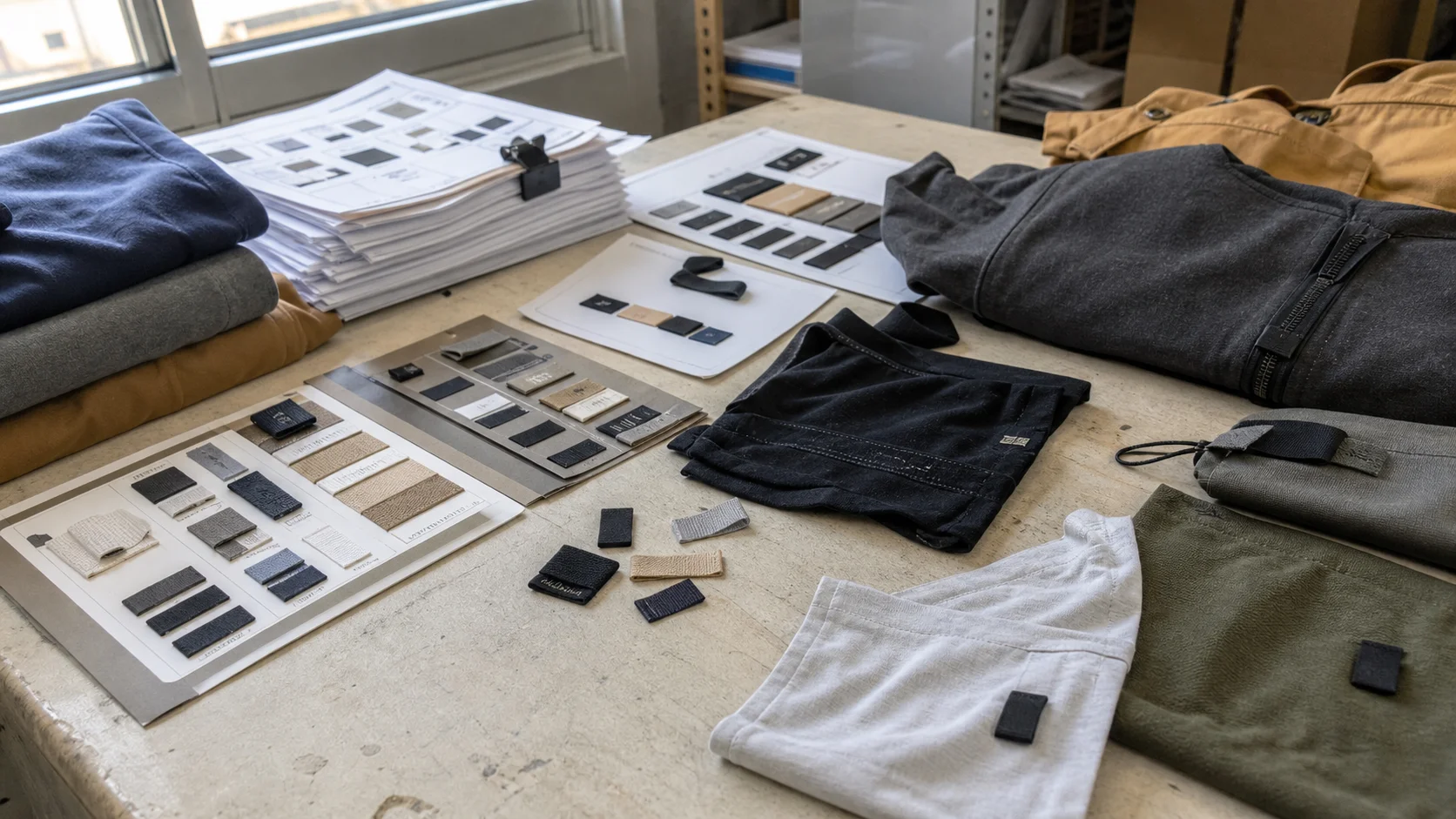
A product-specific SEO outline for warehouse safety teams evaluating custom woven origin tab suppliers, with scorecard criteria tied to compliance...
Woven Origin Tab Supplier Scorecard for Safety Teams - Decoration & Printing manufacturing guide
Warehouse safety teams usually do not buy woven origin tabs for decoration alone. They need small textile labels that stay readable, survive handling, support sorting and identification, and do not create new hazards on uniforms, PPE-adjacent garments, storage bags, or operational apparel. A custom woven origin tab supplier scorecard gives safety, procurement, and operations teams a shared way to compare vendors before placing production orders.
This guide focuses on custom woven origin tabs used in warehouse environments, including garment side tabs, hem tabs, origin tabs, brand tabs, size or country-of-origin tabs, and small woven identifiers attached to workwear, vests, aprons, tool pouches, bags, and facility-issued apparel. It is written for B2B buyers who need practical sourcing criteria, not a generic label-buying checklist.
Purchasing judgment: the lowest tab price is rarely the safest buying decision if the supplier cannot control yarn quality, cut edges, colorfastness, attachment compatibility, and carton labeling. A scorecard should reward suppliers that prevent rework and inspection failure, not just those quoting the cheapest piece rate.
Warehouse safety teams work in a different buying environment than retail merchandising teams. A brand team may focus on appearance first. A safety team has to consider visibility, snag risk, wash durability, worker comfort, label placement, and whether a small trim can interfere with the function of a garment or bag. That does not mean every woven tab is safety-critical. It does mean the tab supplier should be evaluated with operational discipline.
Origin tabs are often small, but they can carry important signals: country of origin, department color coding, internal equipment ownership, garment program identification, shift designation, or brand confirmation. If the tab frays, curls, bleeds, scratches the skin, detaches in laundering, or is applied inconsistently, it creates avoidable confusion and waste.
A scorecard is especially useful when several departments are involved. Safety may care about snag exposure and laundering. Procurement may focus on unit price and MOQ. Operations may need carton-level sorting. Compliance may need clear origin marking. Apparel manufacturing teams may need seam allowance and attachment compatibility. Without a scorecard, vendors are compared on incomplete quotes.
For buyers developing a broader decoration and trim program, it is worth reviewing service capabilities early. A supplier that can support woven labels, printed trims, packaging coordination, and garment finishing may reduce handoff errors. See related service options at fabrikn.com/services/ when mapping the full decoration and printing workflow.
A woven origin tab is a narrow textile label made by interlacing yarns to create text, symbols, borders, or color blocks. Unlike a printed label, the design is built into the weave. That can improve durability, especially when the tab is exposed to abrasion, washing, folding, or repeated handling. The tradeoff is that very small text, complex icons, and gradients are harder to reproduce cleanly in woven construction.
Warehouse safety teams may use woven origin tabs across several product categories:
Not every tab should be woven. Printed satin or heat-transfer labels may be better for dense regulatory text. Embroidered patches may work for large branding. Direct printing may be more economical for large flat panels. Woven origin tabs are strongest when the buyer needs a small, durable, premium, repeatable identifier with limited artwork complexity.
The scorecard should be simple enough for procurement to use and detailed enough for safety review. A 100-point model works well because it lets teams weight the criteria that matter most. For warehouse safety programs, performance and documentation should usually outweigh decorative appeal.
Scorecard Category Suggested Weight What to Check Buying Judgment Technical capability 20 points Weave type, yarn quality, edge finish, text clarity, color control, tab folding accuracy. Reject suppliers that cannot explain construction options clearly. Safety and use compatibility 15 points Softness, snag risk, heat exposure limits, laundering durability, edge irritation, attachment method. Prioritize suppliers that understand the end-use environment. Sampling discipline 15 points Artwork proofing, strike-off samples, size confirmation, color lab dips where needed. A rushed sample process usually becomes production rework. Quality control 15 points Incoming yarn checks, loom inspection, cutting control, packing inspection, AQL approach. Ask for measurable tolerances, not general promises. Compliance documentation 10 points Fiber content, country-of-origin handling, restricted substance declarations, labeling support. Documentation gaps can delay garment shipment. Commercial terms 10 points MOQ, price breaks, sample charges, tooling or setup fees, payment terms. Low MOQ matters for pilots; stable repeat pricing matters for programs. Lead-time reliability 10 points Sample timing, bulk production calendar, yarn availability, shipping mode, holiday closures. Quote lead time only counts if dependencies are named. Communication 5 points Spec sheet accuracy, revision control, response speed, issue escalation. Poor communication is a quality risk, not just an inconvenience.A supplier scoring below 70 should usually be treated as a trial vendor only. A supplier scoring 70 to 84 may be acceptable for simple tabs with low operational risk. A supplier scoring 85 or above is a stronger candidate for ongoing warehouse safety programs, especially if they can maintain repeat lots with consistent color and construction.
Good woven tab suppliers should be able to explain damask, satin, taffeta, and high-density woven options without overselling. Damask is commonly used for detailed woven labels because it supports cleaner text and a smoother hand feel. Taffeta can be economical but may not deliver the same clarity for small origin text. Satin can look smooth and glossy, though it may not be the best choice where abrasion is heavy.
Ask suppliers to state the minimum readable text size for the chosen weave and yarn. If the tab must display “Made in USA,” “Made in Vietnam,” “Warehouse Safety,” or similar origin and program wording, the letter height and contrast should be approved on a physical sample. Digital proofs are useful, but they do not show actual yarn behavior.
Safety teams should evaluate the tab as part of the complete product. A woven tab attached at a side seam may be acceptable on a polo but inappropriate on a vest edge exposed to conveyors, racking, or moving equipment. A folded tab may create a raised loop. A cut-end tab may fray if not heat sealed or ultrasonically cut. A stiff tab may irritate workers if placed near the neck, waist, or underarm.
The scorecard should ask whether the supplier can provide soft-edge construction, centerfold or endfold options, heat-cut edges, merrow-style borders where relevant, and tolerances for tab width and fold position. Small differences matter when tabs are fed into sewing operations at scale.
Quality control for woven origin tabs should cover more than artwork accuracy. Common defects include broken yarns, color contamination, fuzzy text, crooked folds, incorrect cut length, exposed floats, uneven edges, shade variation, and mixed lots. These problems can cause sewing delays and garment rejection.
Request a written quality standard before bulk approval. It should define acceptable and unacceptable defects, measurement tolerances, packing format, carton labeling, and retained sample requirements. For high-volume orders, consider a golden sample signed off by procurement, safety, and production.
A vague request such as “small woven origin tab, black and white, 1 inch” is not enough for safe production. The supplier needs a controlled specification. The buyer needs the same document for inspection.
Specification Item Typical Options Why It Matters Tab size Common widths range from 10 mm to 35 mm; lengths vary by fold type and placement. Controls readability, sewing ease, and snag exposure. Fold type Straight cut, endfold, centerfold, Manhattan fold, book fold, loop fold. Affects attachment method and visible tab profile. Weave type Damask, satin, taffeta, high-density damask. Determines text clarity, hand feel, durability, and cost. Yarn Polyester is common; recycled polyester may be available with documentation. Impacts wash resistance, colorfastness, and sustainability claims. Edge finish Heat cut, ultrasonic cut, woven edge, folded edge. Reduces fraying and skin irritation risk. Color standard Pantone reference, yarn card, approved physical sample. Prevents lot-to-lot color disputes. Text and artwork Origin wording, logo, department code, directional arrows, safety program code. Controls compliance readability and operational recognition. Attachment method Sewn into seam, topstitched, bar-tacked, applied to bag seam, inserted into hem. Determines seam allowance and pull strength. Packing Bundles, rolls, polybags, counted stacks, carton labels by SKU. Reduces warehouse receiving and sewing line errors.Warehouse apparel programs often involve multiple sizes, colors, departments, and replenishment cycles. The tab specification should include SKU logic. If red tabs identify maintenance and blue tabs identify receiving, carton labels must make that distinction obvious. Mixed tabs are a common low-cost mistake that creates high-cost sorting work.
The tab is only one part of the garment or textile product. Buyers should check compatibility with the base fabric, sewing thread, reflective tape, binding, zippers, snaps, and laundry process. A woven polyester tab may hold up well, but the attachment stitch can fail if thread choice or seam placement is poor.
For high-visibility workwear, the tab should not cover reflective tape or reduce required visible background area. For FR-rated garments, a standard polyester woven tab may be unsuitable unless the full garment compliance framework allows it. Safety teams should not assume a small tab is exempt from garment performance considerations. Confirm requirements with the applicable garment standard and compliance owner.
Small woven text needs contrast. Black text on dark navy yarn may look acceptable in a digital mockup and fail in real lighting. Warehouse environments can include low light, dust, glare, and frequent washing. If the tab carries information that workers or supervisors must read, choose high contrast and simple typography.
For brand-only tabs, subtle tone-on-tone weaving may be acceptable. For origin or safety program identification, subtle is usually the wrong priority. Clean contrast improves inspection and reduces ambiguity.
MOQ varies by supplier, weave type, yarn availability, color count, and setup requirements. For custom woven origin tabs, typical MOQs often range from 1,000 to 5,000 pieces per design for standard constructions. Some suppliers may support 500-piece pilot runs at a higher unit price. Larger factories or automated label producers may prefer 10,000 pieces or more per SKU for efficient pricing.
Buyers should separate MOQ by design, colorway, size, and wording. A quote for 5,000 total pieces may not mean 1,000 pieces across five different department colors. Each variation can require separate setup, yarn planning, and inspection. The scorecard should reward suppliers that explain MOQ by SKU instead of hiding the limitation until purchase order stage.
Order Type Typical MOQ Range Best Use Tradeoff Pilot or trial run 500 to 1,500 pieces per design Testing placement, readability, wash performance, and worker acceptance. Higher unit cost and fewer supplier options. Standard production 1,000 to 5,000 pieces per design Most custom woven origin tab programs. Requires better forecast control. High-volume replenishment 5,000 to 50,000+ pieces per design Uniform programs, national warehouse networks, recurring apparel production. Inventory risk if design or origin wording changes.Price depends on width, length, weave density, color count, fold type, cutting method, packing method, and inspection requirements. A wider damask tab with multiple colors, endfolds, and counted bagging costs more than a simple straight-cut taffeta tab. That extra cost may be justified if it reduces fraying, improves readability, and speeds sewing.
Purchasing judgment: do not compress all versions into one “average” price if the program uses several tab types. A clear SKU-level quote protects the buyer when repeat orders begin.
Sampling should be treated as a controlled approval process, not a casual preview. For custom woven origin tabs used by warehouse safety teams, the sample stage is where most preventable problems can be caught.
Sample lead times often range from 5 to 12 business days after artwork confirmation for standard woven labels, though complex yarn sourcing, multiple colorways, or special folds can take longer. A supplier quoting very fast sampling may be using available yarns that only approximate the target color. That may be acceptable for internal utility tabs, but not for brand-sensitive or compliance-linked tabs.
Reject samples with fuzzy origin wording, inconsistent folding, excessive stiffness, sharp corners, loose yarns, poor contrast, visible color bleeding after washing, or tab length variation that will make sewing inconsistent. Small defects should not be rationalized away with “bulk will be better” unless the supplier can explain the root cause and provide a corrected sample.
When the origin tab will be sewn into a garment seam, test the tab with the actual seam allowance. A tab that looks correct loose on a desk may disappear into the seam or protrude too far after production sewing. This is one of the most common specification misses.
Lead time is not a single number. It depends on artwork approval, yarn availability, loom capacity, finishing method, inspection level, packing requirements, shipping mode, and the buyer’s response time. A practical supplier should state lead time in stages.
Stage Typical Timing Dependency Artwork review and proof 1 to 3 business days Complete artwork, size, fold type, color standard, and wording. Strike-off sample 5 to 12 business days Yarn availability, weave complexity, supplier queue. Sample revision 3 to 10 business days Nature of correction and whether new yarn or loom setup is required. Bulk production 7 to 21 business days for many standard orders Order quantity, color count, cutting and folding, inspection requirements. Shipping 2 to 10+ business days depending on mode and destination Courier, air freight, ocean consolidation, customs documentation.For warehouse apparel programs, tabs often need to arrive before garment sewing starts. Late trims can stop production even when the fabric and garments are ready. Build a buffer into the critical path, especially for first orders, new origin wording, or multi-SKU programs.
Repeat orders can be faster if the supplier keeps approved yarns, loom files, and finishing instructions on record. The buyer should still request a pre-production confirmation when the tab is tied to country-of-origin wording or compliance information. A repeated visual design with changed origin text is not a simple reorder.
Inspection risk is high when a small tab is treated as a minor trim. In warehouse safety programs, trim errors can affect garment sorting, employee identification, laundering, and compliance records. Inspection should happen at both the tab supplier level and the garment assembly level.
AQL inspection can be used for bulk lots, but the defect classification should be clear. Incorrect country-of-origin wording should usually be treated as a critical defect. Sharp edges or loose loops may be major defects if they create worker discomfort or snag risk. Minor shade variation may be acceptable for internal tabs if the tab still meets identification requirements.
Even perfect tabs can fail if applied poorly. Garment inspection should confirm placement, orientation, stitch security, seam allowance, visibility, and consistency across sizes. A tab sewn upside down or buried in binding is still a failed finished product.
For high-visibility garments, inspect whether the tab blocks required reflective or fluorescent areas. For bags and pouches, check whether the tab catches on shelving, hooks, straps, or equipment. For uniforms, evaluate worker comfort in motion, not only on a flat inspection table.
A good scorecard does not pretend that every requirement can be maximized at once. Woven origin tabs involve tradeoffs. The buyer’s job is to choose the right balance for the safety program.
High-density damask supports better detail, but very tiny text still has limits. If the tab must include long regulatory language, a printed label may be more practical. If the tab needs only origin and program ID, woven construction can provide better durability and appearance.
Low MOQs help during pilots and new warehouse rollouts. They also increase unit cost and may limit supplier options. If the program is expected to repeat, negotiate price breaks for 1,000, 5,000, 10,000, and 25,000 pieces early. This prevents a pilot supplier from becoming expensive at scale.
Softer tabs may be better for garments worn directly against the skin. Crisper constructions may be easier to sew consistently and may hold shape better on bags or outerwear. Safety teams should test the tab in the final placement instead of judging softness loose in hand.
Fast production often relies on stock yarns. Exact brand color matching may require more time. For internal safety tabs, near-match color may be acceptable if the function is clear. For branded programs, approve physical yarn and woven samples before bulk.
A specialist woven label supplier may deliver excellent tab quality. A broader apparel manufacturing partner may coordinate tabs with garments, decoration, packing, and delivery. The right choice depends on whether the buyer wants maximum trim control or fewer vendor handoffs. For buyers evaluating broader production support, company background and capabilities can be reviewed at fabrikn.com/about-us/.
The scorecard should be used before the purchase order, during sampling, and after delivery. Treat it as a living procurement tool. A supplier can score well on paper and still lose points after missed samples, weak packing, or poor communication.
Start with the environment. Is the tab used on a vest, shirt, jacket, bag, apron, or tool pouch? Will it be washed industrially? Will it be exposed to abrasion, dust, heat, sunlight, or chemicals? Is the tab carrying compliance information or only internal identification?
The end use determines the specification. A tab for an internal kit bag does not need the same softness as a neck-adjacent garment label. A tab used near machinery should be reviewed for loop profile and snag risk.
A strong technical brief should include the tab size, fold style, weave type, yarn colors, artwork file, text, placement, attachment method, expected annual volume, pilot quantity, packing needs, and inspection requirements. If the tab is part of a garment program, include the fabric type and seam construction.
Procurement should not ask suppliers to quote from artwork alone. Artwork does not define fold, edge finish, packing, or tolerances. Those missing details are where many quote comparisons become misleading.
Send the same brief to each supplier. Ask each vendor to return a completed scorecard response, not just a price. Compare the answers for clarity. A supplier that asks informed questions about placement, washing, and sewing may be a better partner than one that replies with a quick low quote.
Review woven samples in the warehouse context if possible. Check how they look under facility lighting, after washing, and after being sewn onto the actual product. Safety teams should involve the people responsible for garment issue, laundering, and inspection because they often notice practical problems early.
Digital approvals are not enough for woven trims. Keep one approved physical sample with procurement, one with the supplier, and one with the garment maker if assembly is separate. The approved sample should include the final fold, edge, color, and attachment reference.
After delivery, update the supplier score based on actual performance. Did the cartons arrive labeled correctly? Were counts accurate? Did sewing teams report problems? Did the tabs match the approved sample? Did the supplier resolve issues quickly?
Scorecards are most valuable when they influence repeat buying. If a supplier performs poorly but remains the default vendor, the scorecard becomes paperwork. Tie supplier ratings to approved vendor status, reorder eligibility, and corrective action requirements.
The following questions help separate capable woven tab suppliers from vendors that are only quoting a commodity label.
These questions also make quote comparison easier. If one supplier includes folded, counted, inspected tabs and another quotes loose straight-cut tabs, the unit prices are not equivalent.
Safety teams can adapt the following template for internal sourcing reviews. The scoring should be completed by procurement, safety, and production together where possible.
Category Max Score Supplier Score Notes Weave and construction recommendation is suitable for end use 10 Text readability and color contrast are proven by physical sample 10 Fold, edge finish, and tab profile reduce fray and snag risk 10 Attachment method is compatible with garment or textile construction 10 Sample workflow includes proof, strike-off, revision, and sealed approval 10 MOQ and pricing are clear by design, colorway, and wording 10 Lead time is broken down by sample, bulk, inspection, and shipping 10 Quality control standards and defect classifications are documented 10 Packing, carton labeling, and SKU separation support warehouse receiving 10 Communication is accurate, timely, and revision-controlled 10A scorecard should not replace buyer judgment. It should make judgment visible. If a supplier scores lower but has a unique capability, the team can document the reason for selection. If a supplier scores high but has a long lead time, procurement can plan buffer stock or split pilot and replenishment orders.
Woven origin tabs sit inside the broader Decoration & Printing category because they work alongside printed neck labels, heat transfers, embroidery, screen printing, reflective trim, patches, and packaging marks. A well-managed program treats all identifiers as part of one system.
For example, a warehouse vest may include a printed size label, reflective tape, a woven department tab, and a carton barcode. If these elements are sourced separately with no shared specification, mistakes become likely. Color codes may conflict. Origin information may be inconsistent. Carton labels may not match garment tabs. The result is avoidable sorting and rework.
For custom apparel and trim programs that need coordinated sourcing, decoration planning, or supplier review, buyers can contact Fabrikn through fabrikn.com/contact-us/.
For warehouse safety teams, the best custom woven origin tab supplier is not necessarily the one with the broadest catalog. It is the supplier that can translate a safety and operations requirement into a controlled trim specification, prove it through samples, and deliver repeatable bulk quality.
Use the scorecard to force clarity. Confirm MOQ by SKU. Approve physical samples. Test the tab in the final placement. Inspect packing and carton labels. Keep repeat orders tied to the approved standard. These steps are not excessive for a small woven tab. They are the practical controls that prevent small trim decisions from becoming production delays, warehouse confusion, or garment rejection.
Get a free quote from Fabrikn — your trusted B2B clothing manufacturer with 10+ years of experience. MOQ as low as 200 pieces.
Get a Free Quote →A woven origin tab is a small textile label made with woven yarns rather than printed ink. It may show country of origin, brand identity, department code, program name, or other short information. It is commonly sewn into seams, hems, bag edges, or garment openings.
Typical MOQs often range from 1,000 to 5,000 pieces per design. Pilot runs may be possible around 500 to 1,500 pieces at a higher unit cost. Large replenishment programs may receive better pricing at 10,000 pieces or more per SKU.
Woven tabs are usually better for durable small branding, origin marks, and repeated handling. Printed labels are often better for dense text, care instructions, variable data, or very small regulatory copy. The right choice depends on readability, durability, placement, and cost.
Approve a physical woven strike-off made in the final weave, yarn colors, size, fold type, and edge finish. The sample should also be sewn onto the intended garment or textile product before final approval when placement affects safety, comfort, or visibility.
The main risks are incorrect wording, poor text readability, wrong size, rough edges, fraying, shade variation, mixed SKUs, inaccurate counts, and poor attachment during garment sewing. Incorrect country-of-origin wording should be treated as a critical defect.
Standard sampling may take 5 to 12 business days after proof approval. Bulk production often takes 7 to 21 business days for common orders, depending on quantity, construction, yarn availability, finishing, and packing requirements. Shipping and customs time should be added separately.
Yes. A tab can create a loop, raised edge, or loose yarn if poorly specified or attached. Review placement carefully on garments, bags, and equipment pouches used near conveyors, racking, hooks, tools, or moving machinery.
The brief should include artwork, origin wording, dimensions, fold type, weave type, color references, placement, attachment method, annual volume, pilot quantity, packing requirements, inspection criteria, and expected laundering or use conditions.
Score suppliers on technical capability, safety compatibility, sampling discipline, quality control, documentation, commercial terms, lead-time reliability, and communication. A 100-point scorecard makes tradeoffs clear and helps teams compare vendors beyond unit price.
Require a new sample when origin wording changes, colors change, size or fold type changes, weave construction changes, yarn source changes, or the tab moves to a different garment placement. Repeat orders should still be checked against the approved physical standard.