
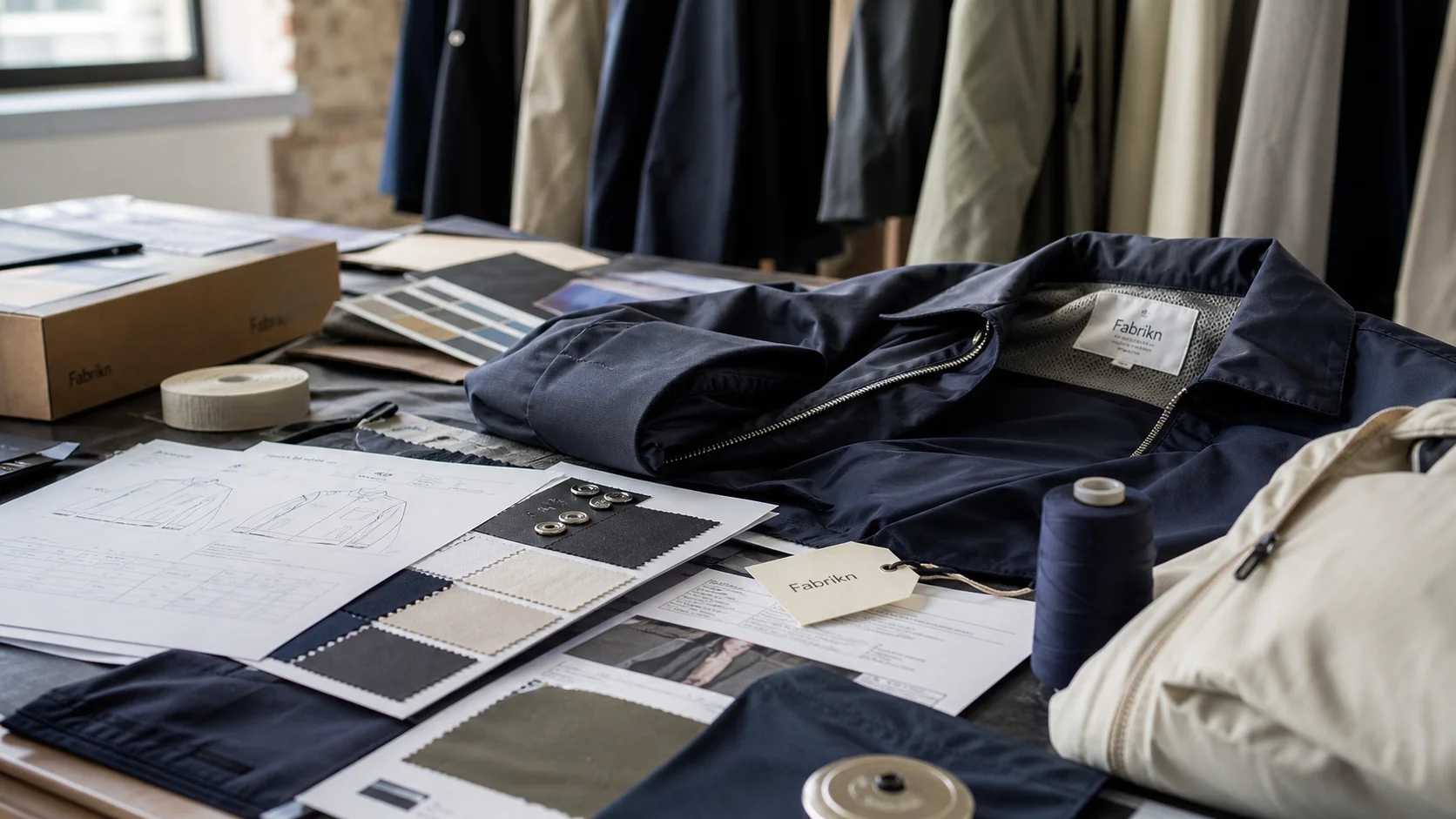
A pricing-focused outline for startup athleisure brands evaluating cut and sew tracksuits, with cost drivers, sample math, margin targets, and production...
Cut and Sew Tracksuit Pricing for Startups - Fabrikn production reference
Cut and sew tracksuit pricing for startup athleisure is not a fixed number. As a common sourcing range, a basic unbranded polyester or poly-cotton tracksuit set may quote around $16.50-24.00 per set at 300-500 sets per color, while a mid-range branded fleece or French terry set often lands around $24.00-38.00 per set at 500 MOQ. Premium styles using 320-420 GSM custom-dyed cotton fleece, YKK or SBS zippers, embroidery, silicone patches, or panel-heavy construction can move into the $38.00-62.00 per set range before freight, duty, and warehousing. The cost shifts with fabric quality, garment complexity, order quantity, trim package, sampling round count, and the level of finishing a brand wants to put in front of a retail buyer or direct customer.
For startups, the real question is not just what a tracksuit costs to produce. The more useful question is what level of product gives enough margin, quality, and repeatability to survive the first sell-through cycle. A low factory quote can look attractive until it is weighed against sample revisions, shipping, duties, defects, and rejected lots. Typical landed-cost planning should include 8-15% for international freight and brokerage on ocean shipments, more if air freight is used, plus testing or inspection fees where buyers request them. Pricing needs to be read as a total landed and operational cost, not a single FOB number.
For sourcing support and production capabilities, see Fabrikn services, or review the company background on about us before requesting a quote through contact us.
A cut and sew tracksuit is built from individual fabric panels rather than being made from a stock blank. That means the factory must mark, spread, cut, bundle, stitch, finish, press, and inspect more steps than a basic knit set. A typical production line may use a straight lockstitch machine for seams and topstitching, a 4-thread or 5-thread overlock for knit seam joining, a coverstitch machine for hems, a bartack machine for pocket stress points, and a buttonhole or eyelet machine for drawcord exits. The garment may include a jacket, hoodie-style top, zip top, jogger pant, or matching set with pockets, cuffs, waist rib, drawcord, lining, and surface decoration. Every added operation adds labor or material cost.
Startup athleisure brands usually face three pricing bands. A basic unbranded 180-220 GSM polyester tricot or 240-280 GSM poly-cotton fleece set can sit in a lower cost tier, commonly $16.50-24.00 per set at 300-500 MOQ. A mid-range set with 280-340 GSM cotton-poly fleece or French terry, branded details, better hand feel, and stronger finishing usually lands around $24.00-38.00 per set at 500 MOQ. A premium product using custom-dyed fabric, structured panels, technical trims, or 360-420 GSM heavyweight fleece often moves above $38.00 per set. The factory quote should be checked against the intended retail price before approving development.
The biggest mistake is designing for a target retail price without first checking the manufacturing reality. If the retail price must be $78-98 for the full set, the garment spec needs to be disciplined from the start because wholesale and DTC margin can disappear quickly. A startup that asks for luxury details on a discount budget will usually pay for that mismatch later through delayed sampling, revised materials, or higher defect rates.
Most startup pricing pressure comes from five areas: fabric, trims, labor, order quantity, and development time. Fabric usually leads the bill because a tracksuit set can consume roughly 2.8-3.8 linear meters of 60-inch knit fabric depending on size curve, shrinkage allowance, hood size, and pant inseam. Trim costs can surprise new brands: a basic nylon coil zipper may add $0.35-0.90, a branded metal puller can add $0.20-0.60, a flat braided drawcord with metal aglets may add $0.35-0.80, and a silicone patch can add $0.45-1.20 per piece at small MOQ. Labor cost rises when the design includes panel matching, contrast sections, topstitching, or multiple pocket operations.
Order quantity matters because a factory spreads setup cost across each unit. A 100-piece order rarely costs the same per unit as a 1,000-piece order. Small runs typically carry 20-45% higher per-piece pricing due to cutting waste, machine setup, trim minimums, and lower line efficiency. Startups should expect a higher unit cost at first and should avoid comparing that quote directly to mature brand pricing at much larger volumes.
Lead time also has financial impact. A standard sample round commonly takes 7-12 business days once fabric and trims are available, while a custom-dyed lab dip can add 5-8 business days and bulk fabric knitting or dyeing can add 18-28 business days before cutting starts. A rushed schedule may require overtime, priority sourcing, or air freight for missing trims. Each of those can compress margin. The cheapest quote is not necessarily the least expensive project once time pressure enters the picture.
Minimum order quantity is one of the first pricing gates. For custom cut and sew tracksuits, a realistic startup MOQ often falls between 100 and 300 sets per colorway or style for a small factory program, with many suppliers preferring 500 sets when fabric needs custom dyeing or knitting. Rib, drawcord, zipper tape, and logo patch suppliers may each have their own minimums; for example, custom rib dyeing may require 50-100 kg, zipper tape dyeing may require 300-500 yards, and woven labels often start around 1,000-3,000 pieces. Some facilities will quote lower, but lower MOQ can carry higher unit cost and less flexibility on color, fabric, and labeling.
Sampling is not a box-checking exercise. It is where the cost of the project gets revealed in practical form. A proper sample process usually starts with a tech pack or clear reference, then a proto sample, then fit comments, then a revised sample, then a pre-production sample. Proto samples commonly cost $80-180 per tracksuit set depending on fabric and decoration, and pre-production samples may cost $120-250 if they use bulk trims, embroidery, screen print, or heat transfer artwork. Some programs need size set approval, colorfastness checks, or wash testing before production release. Each round takes time and may add pattern or sample charges.
Startups should treat sample approval as part of the cost model. A garment that looks simple on paper can become expensive if fit corrections force pattern changes, pocket repositioning, waistband elastic changes, or zipper length adjustments. One extra sampling round may be manageable. Three or four rounds can add 3-6 weeks and $300-900 in sample, courier, and development charges before the bulk order even begins.
Fabric choice is the biggest lever in cut and sew tracksuit pricing for startup athleisure. Lightweight polyester tricot, 240-320 GSM CVC fleece, 280-360 GSM cotton French terry, brushed-back knit fleece, scuba knit, bonded interlock, and nylon-spandex technical blends all price differently. A heavier fabric usually costs more per meter and also increases sewing difficulty because operators need to manage bulk at cuffs, waistbands, pocket openings, and hood seams. Stretch content such as 5-8% spandex can improve comfort but can also increase handling complexity if the pattern, needle type, and stitch density are not tuned for recovery.
Trim choices are equally important. Standard drawcords and basic zippers are not the same as custom zipper pulls, branded aglets, molded tips, woven logo tapes, or specialty elastic. A common trim package for a jogger set may include 3-4 cm waistband elastic, 1.2-1.5 cm flat drawcord, size label, care label, brand label, hangtag, stickered polybag, zipper, pocket bags, and sometimes rib cuffs. Even a small label package can matter when a brand wants main labels, size labels, care labels, hem tags, and polybag inserts. The unit price seems minor on paper until every trim line is added together.
Color also affects price. Stock colors are usually easier than custom dye lots, and matching across jacket and pant components adds risk. If the startup wants consistent shade across shell fabric, rib, zipper tape, drawcord, and embroidery thread, the factory may need lab dips, strike-offs, and bulk lot approval. Buyers commonly request shade-band approval under D65 light, wash shrinkage results, and colorfastness to rubbing before production release. That is useful for brand consistency, but it can increase the chance of fabric rejection if shade variation is not managed carefully.
Cost Element Typical Startup Impact Risk to Watch Fabric weight and fiber blend High; 240 GSM fleece may support entry pricing, while 360-420 GSM fleece can add $4.00-10.00 per set Hand feel may be better, but cost, shrinkage control, and sewing difficulty rise Zippers and closures Medium to high; basic nylon coil zippers may add $0.35-0.90, while branded or metal options can exceed $1.50 Slider failure, tape shade mismatch, and poor top-stop finishing can cause returns or rework Labels and packaging Low to medium; commonly $0.45-1.50 per set depending on hangtag, barcode, polybag, and label count Small items still add up across hundreds of units and can delay packing if artwork is late Custom dye or print Medium to high; lab dips often take 5-8 business days and bulk dyeing commonly adds 18-28 business days Shade variation, crocking, hand-feel change, and approval delays are commonTracksuit construction choices can make a product feel commercial or cheap long before the buyer reads the spec sheet. Flatlock stitching, coverstitching, reinforced seams, lined hoods, articulated sleeves, clean-finished pocket bags, and bartacked pocket corners all improve perceived quality. They also increase machine time or operator skill requirements. A startup should decide where the customer will feel value and where standard construction is enough; for example, bartacks at pocket openings and drawcord exits usually cost little compared with the return risk they reduce.
Pattern complexity matters too. Panel-heavy designs with contrast inserts, piping, yokes, or curved seam lines take longer to cut and sew. A clean two-color set with straightforward paneling is much easier to produce than a performance-inspired tracksuit with 12-18 separate panels, piping at side seams, and matched contrast pocket bags. When speed to market is important, simpler construction usually reduces sampling risk and keeps production more stable.
Fit is another cost item that brands sometimes underestimate. A flattering tracksuit fit takes grading discipline. Oversized silhouettes can hide minor fit variance, but they also demand careful measurement control so the garment still hangs properly. Tighter athletic fits usually need more testing because stretch and recovery can change after wash or wear. Common checkpoints include half-chest, shoulder width, sleeve length, front rise, inseam, thigh, waist relaxed, waist stretched, and garment length, typically with +/- 1 cm tolerance on small points and +/- 2 cm on larger body measurements.
A factory quote for a cut and sew tracksuit usually reflects a combination of direct material cost, sewing labor, overhead, wastage allowance, packaging, and profit margin. Some suppliers quote on an FOB basis, while others may provide EXW or CIF terms depending on the arrangement. Startups should always ask what the quote includes and what it excludes. A quote that appears lower may omit packaging, testing, inspection, artwork setup, or accessory sourcing.
Factories also price differently based on how complete the information is. A clear tech pack with measurements, artwork placement, material callouts, stitch requirements, trim references, label files, packaging instructions, and size ratio lets the factory calculate consumption and labor more accurately. Without that information, the supplier may add a risk buffer of 5-15% or quote a placeholder price that changes after sampling. Common quote inputs include fabric GSM, fabric width, shrinkage allowance, marker efficiency, standard minute value, trim cost, wastage percentage, carton packing ratio, and payment terms.
Buyers should request a line-item breakdown when the price feels unclear. The factory may not disclose every internal cost, but it should be able to separate fabric, trims, decoration, packaging, sample charges, and bulk unit price. If a buyer needs documentation for a retailer, common requests include fabric composition reports, care label confirmation, restricted-substance testing, needle policy, inline inspection records, final inspection reports, and any buyer-required compliance documents. Those should be treated as buyer requirements or document requests, not assumed certifications.
A startup budget should separate development cost from bulk production cost. For a first tracksuit program, a practical planning model might include $300-900 for sampling and courier fees, $1,500-3,500 for fabric and trim deposits on a small run, 30-50% deposit on bulk production, and the balance before shipment or against agreed documents. If the order is 300 sets at $29.00 FOB, the bulk product cost alone is $8,700 before freight, duty, inspection, photography, warehousing, returns allowance, and marketing.
Lead time should be budgeted as carefully as cash. A typical custom program can take 7-12 business days for proto sampling, 7-10 business days for revisions, 18-28 business days for bulk fabric if custom dyed, 25-40 business days for cutting and sewing after pre-production approval, and 5-10 business days for final inspection, packing, booking, and handover. Stock fabric can shorten the calendar, while late artwork, zipper color matching, failed shrinkage tests, or buyer-requested lab reports can push the launch back.
Cash planning should also include a defect and overage position. Many apparel buyers plan for 2-4% commercial allowance for minor defects or size exchanges, while strict retailers may reject cartons if AQL results fail. If the brand is selling direct to consumer, holding 2-3% extra inventory in core sizes can prevent customer-service issues when exchanges begin.
Inspection risk starts before the final cartons are packed. Useful checkpoints include fabric inspection on a 4-point system, GSM and width confirmation, shrinkage testing after wash, shade lot segregation, trim approval, first-piece inspection at line start, inline measurement checks, needle detection where required by the buyer, and final AQL inspection. For apparel, buyers commonly use AQL 2.5 for major defects and AQL 4.0 for minor defects, although stricter programs may set different limits.
Hidden costs often appear when the garment fails at ordinary use points. Common tracksuit defects include twisting side seams after wash, wavy zipper insertion, uneven rib cuffs, waistband elastic rollover, pocket bag show-through, skipped stitches on stretch seams, drawcord fraying, embroidery puckering, and shade mismatch between top and bottom. Rework may cost $0.30-2.00 per garment for simple repairs, while rejected fabric or failed bulk dye lots can create much larger losses.
Startups should also account for inspection and testing fees. A third-party final inspection commonly costs $250-450 per man-day depending on scope and market, while basic fiber composition, colorfastness, dimensional stability, or pH testing can add separate lab charges if requested by the buyer. Certifications should only be discussed as buyer requirements or requested documents, such as OEKO-TEX material documentation, GOTS transaction certificates for organic cotton programs, or recycled polyester documentation, when those claims are part of the product brief.
Cost control works best when the startup protects visible value and removes hidden complexity. Keeping the shell fabric consistent across jacket and pant, limiting the first drop to 1-2 colorways, using stock rib and drawcord colors, and avoiding custom hardware on the first run can reduce MOQ pressure. A brand can still look finished by spending selectively on fit, fabric hand feel, clean stitching, reliable zippers, and packaging that supports retail presentation.
Good specifications reduce cost more reliably than hard negotiation. A factory can quote better when the tech pack states 320 GSM cotton-poly fleece, 2x2 rib at cuffs and hem, 5-thread overlock at joining seams, coverstitch at hems, bartack at pocket openings, zipper length by size, and tolerance by measurement point. Vague requests such as “premium quality” or “heavy fabric” leave room for mismatched assumptions and sample delays.
Another practical control is to build the first program around proven processes. Screen printing, embroidery, heat transfer labels, and standard knit construction are usually easier to manage than bonded seams, laser cutting, all-over sublimation on stretch fabric, or complex mixed-media panels. If the garment needs a special process, request a strike-off, wash test, and bulk-production sample before approving the full run.
A sourcing partner should help translate the brand idea into a factory-ready specification, not just collect quotes. For tracksuits, that means checking fabric consumption, stitch construction, trim availability, decoration placement, size grading, labeling, packing, and inspection requirements before bulk order placement. A useful partner will flag when a custom zipper, unusual rib color, or low MOQ fabric choice is likely to create cost or lead-time pressure.
Startups should ask for practical documents and checkpoints: a costed bill of materials, sample comments log, lab dip or strike-off approvals, pre-production sample approval, inline inspection notes, final measurement report, carton packing list, and shipment handover details. If a retailer or marketplace requires compliance documentation, those requirements should be stated early so the correct fabric, trim, and lab reports can be requested before production begins.
The right partner also keeps quote comparisons honest. A $22.00 set and a $31.00 set may not be comparable if one uses 240 GSM fleece with generic trims and the other uses 340 GSM French terry, branded zipper pulls, silicone patches, embroidery, and full packaging. The sourcing decision should compare specification, MOQ, lead time, inspection plan, and landed cost, not only the headline unit price.
Get a free quote from Fabrikn — your trusted B2B clothing manufacturer with 10+ years of experience. MOQ as low as 200 pieces.
Get a Free Quote →What is a realistic MOQ for a startup cut and sew tracksuit? A common range is 100-300 sets per colorway for simpler programs, but 500 sets is often more practical when custom fabric dyeing, custom rib, zipper tape matching, or branded hardware is required.
How long does production usually take? A typical custom tracksuit program takes 7-12 business days for the first sample, another 7-10 business days for revisions, 18-28 business days for custom bulk fabric, and 25-40 business days for sewing after pre-production approval. Stock fabric and approved trims can shorten that timeline.
What should be checked before approving bulk production? Common checkpoints include fabric GSM, width, shrinkage, shade, hand feel, zipper function, drawcord length, embroidery or print quality, garment measurements, seam strength, pocket placement, care label content, and packaging layout.
Which certifications should a buyer ask about? Buyers should request documents based on the product claim or sales channel, such as fiber composition testing, restricted-substance reports, OEKO-TEX material documentation, GOTS documentation for organic cotton claims, or recycled polyester transaction documents. Do not assume a supplier holds a certification unless it is documented.
Where can a startup reduce cost without making the tracksuit feel cheap? The safest areas are usually limiting colorways, using stock trims, simplifying panel lines, avoiding custom hardware on the first run, and keeping decoration focused. Fit, fabric hand feel, seam quality, zipper reliability, and measurement consistency should stay protected because customers notice those immediately.