
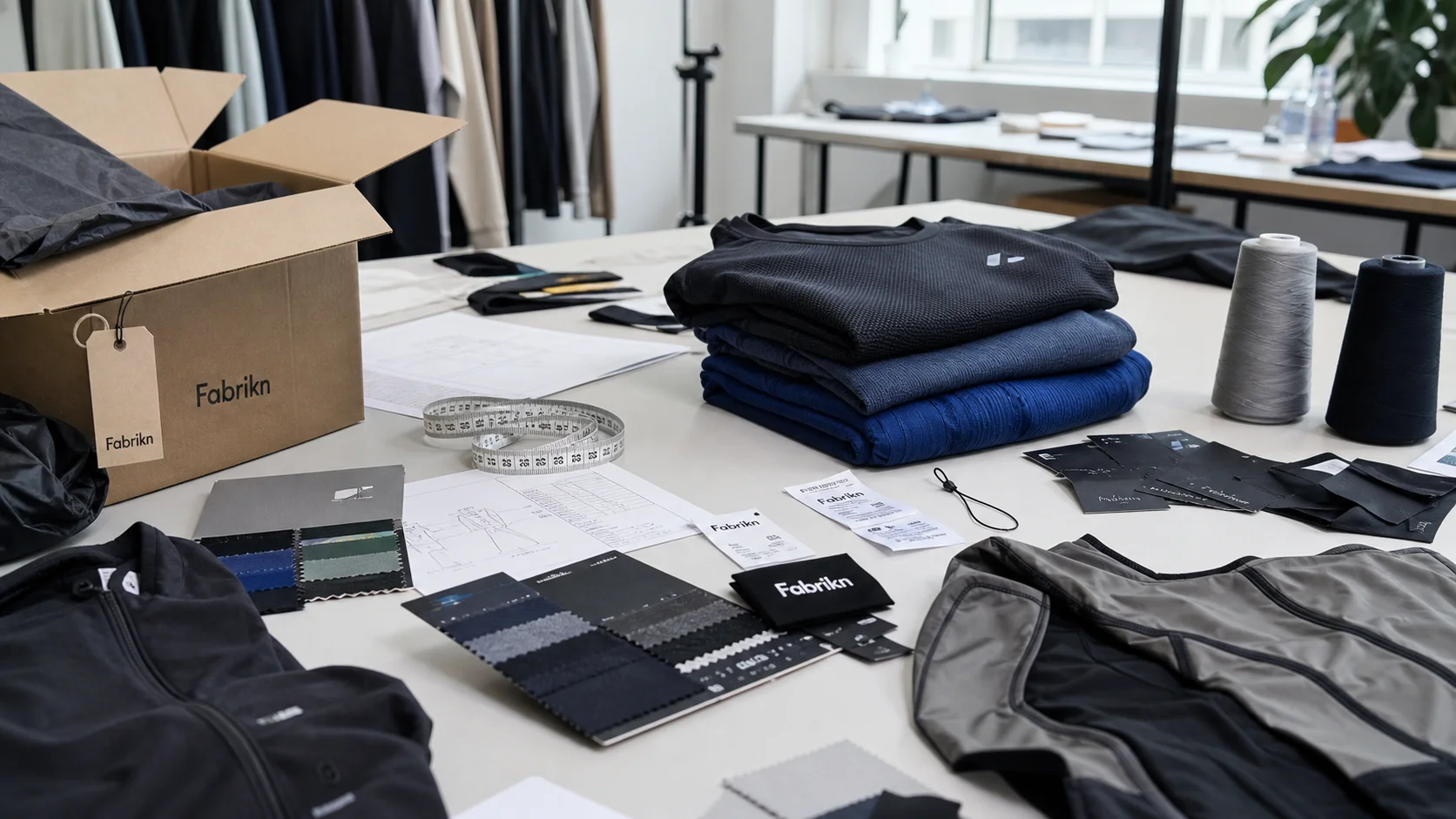
Debossed Hang Tags for Fashion Packaging with checks for samples, fit, MOQ, QC evidence, pricing terms, and delivery risk.
Fast answer: Debossed Hang Tags for Fashion Packaging: Costs, Specs, Results should be judged by production evidence, not by a generic sourcing promise. The buyer needs sample proof, cost breakdowns, QC checkpoints, and delivery buffers in writing.
Ask for recent sample photos, measurement tolerances, fabric or print test assumptions, decoration test notes, packing examples, and a named inspection checkpoint. These details show whether the team can repeat an approved sample at bulk volume.
Separate garment cost, decoration, labels, packaging, sampling, testing, freight, and rush charges. When every cost line is visible, it becomes easier to reduce colorways, adjust size depth, or reserve more time for sampling.
Premium fashion brands can spend thousands on photography and still lose the first impression at the packaging layer. I’ve seen campaigns with $25,000 shoots and $1.80 hang tags, and the tag looked cheaper than the shirt. That mismatch matters. Debossed hang tags for fashion packaging solve a real retail problem: they create a first-touch signal that survives shipment, handling, and the brutal fluorescent lights of a stockroom.
Foil can shout from across a table. Debossing does something sharper: it presses the paper fibers inward and leaves depth you can feel with a thumbnail, even after a 7,000-km freight move or a 12-hour unpacking cycle. On a shelf, that tactile shadow reads as controlled and expensive. Foil-only finishes, especially on thin board, often scuff at the corners before the garment ever reaches a customer. I’ve handled boxes from Italy, China, and Bangladesh where the foil chipped on arrival, while the debossed sample still looked intentional.
Luxury labels use this effect carefully. A heavy 450-600 gsm cotton stock, a 0.4-0.6 mm recess, and a clean hole punch can signal a $300 jacket before anyone touches the fabric. Contemporary brands sit in the middle: they want polish without the cost of a multi-process tag, so a blind deboss on 350 gsm board does the job. DTC brands are more practical. They want the tag to carry brand story, fiber content, and sustainability messaging in a way that feels credible, not decorative.
The thing nobody tells you: simpler finishes often read as more expensive when the paper stock and pressure are right. In five factories I visited last year, the strongest premium cue came from plain blind debossing on a thick uncoated sheet, not from foil or UV varnish. One supplier in Portugal charged €0.09 more per tag for a restrained deboss, yet buyers consistently ranked it above a foil sample priced 14% higher. The paper did the talking.
In practical terms, debossing means a custom metal die presses a recessed image into paper or board. The die does not print color; it reshapes the surface. For debossed hang tags for fashion packaging, that means the artwork must be designed for depth, not just for flat graphics. A logo with a 0.8 mm line weight can disappear if the stock is too soft or the press pressure is uneven.
Paper stock, moisture, and grain direction shape the result as much as the artwork. A 400 gsm board with the grain running parallel to the deboss area will usually hold edges cleaner than the same sheet cut against grain. If moisture content drifts above 6-7%, fibers compress unpredictably and the image can blur. I’ve seen this happen in factories during monsoon season in India and during humid summer weeks in southern China. The tag looks fine in proof, then the production run comes out with fuzzy shoulders and crushed corners.
Blind debossing is the most restrained version. No ink. No foil. Just pressure. Foil-stamped debossing adds a metallic layer in the recessed area or across a raised edge, which boosts shelf sparkle but increases setup and reject risk. Embossing does the opposite movement: it raises the image out of the surface. For hang tags, embossing can snag on garments and shipping sleeves, so I rarely recommend it unless the design is minimal and the tag is thick enough to protect the relief.
Buyers should specify three things clearly: relief depth, registration tolerance, and acceptable variation across a run. For example, a 0.3-0.5 mm depth is common for mid-market tags, while luxury projects may go to 0.6-0.8 mm if the board supports it. Registration tolerance of ±0.5 mm is realistic for most production runs, though some specialty shops can hold tighter. Acceptable variation matters too. A run of 10,000 tags can have small differences in pressure if the press operator adjusts for paper batch changes. That is normal. A 2 mm shift is not.
The sheet matters more than the logo. I’ve compared recycled kraft, uncoated premium board, cotton rag, and textured specialty papers across factories in Turkey, Vietnam, Spain, and China, and the deboss impression changed dramatically even when the die and artwork stayed identical. A recycled kraft tag at $0.06-$0.10 per piece can feel honest and tactile, but the fibers are often less uniform, so fine detail softens. Uncoated premium board at $0.11-$0.18 per piece usually delivers cleaner lines. Cotton rag, often $0.18-$0.35, is the best at holding depth because the long fibers compress without cracking.
Glossy coated stock is a different story. It can look crisp in print, but the coating resists compression and may show edge crush, micro-flaking, or a shallow deboss that reads weak from arm’s length. I’ve watched buyers choose a shiny 300 gsm sheet because it looked premium on a monitor, then reject the physical sample because the deboss disappeared under the coating. Thick, soft-fiber sheets win here. The surface sinks cleanly, and the shadow line becomes part of the design.
Sustainability tradeoffs are real, not decorative. Recycled content can lower virgin fiber use by 30-100%, depending on the grade, but post-consumer stock sometimes has more variation in surface tone and moisture absorption. Bleaching also matters. Bright white cotton papers often require more processing than natural or cream shades. Inks and finishing waste count too. A one-color blind deboss on FSC board can reduce inks and simplify sorting, while foil-laminated tags create mixed-material waste that some recycling streams reject. According to Textile Exchange and OEKO-TEX, material choices have measurable impacts across fiber systems, and packaging decisions should be treated with the same discipline as fabric sourcing.
Factory visits made one pattern obvious. Some suppliers prioritize speed, running three shifts and drying stacks quickly. Others cure slower and hold tighter press control, which gives sharper impressions. In one Zhejiang plant, a 24-hour turnaround meant lighter pressure and a softer result. In a Spanish workshop, the same size run took 4 days, but the edges were cleaner and the relief was more even. Speed has a cost. So does precision. Buyers who want sharper debossing should ask how long the sheets rest after printing, not just how fast the quote arrives.
Pricing changes fast with quantity. For 500 pieces, I usually see total landed quotes between $180 and $420, depending on die complexity, paper, and shipping. At 2,000 pieces, the unit often falls into the $0.18-$0.42 range. At 10,000 pieces, a well-managed run can drop to $0.06-$0.16 per tag before freight. Those numbers shift by region, but the pattern holds: setup costs are heavy at small volumes, then the die gets diluted across scale.
The main cost drivers are easy to name and easy to miss. Die fee, paper stock, print sides, string or fastener, special packing, and QC all matter. A brass or magnesium die may cost $35-$180 depending on size and relief detail. Double-sided print adds $0.02-$0.05 per tag. Cotton cord or a pin fastener can add another $0.01-$0.08. Special packaging, such as poly-bagging 50-piece bundles, may add $8-$25 per carton. QC, especially when buyers ask for full AQL inspection, adds time and labor.
Regional pricing behaves differently. Domestic small runs are expensive because labor and setup are spread across fewer pieces. China still offers the strongest scale pricing on 5,000-20,000 piece runs, especially when tags are produced alongside clothing packaging solutions in one facility. Europe usually charges a premium for specialty papers and finishing expertise, but the sample quality can be excellent. India often sits between cost and customization, with mixed outcomes depending on whether the supplier controls paper purchasing or outsources it. If you need wholesale or bulk orders, ask the manufacturer and factory to confirm MOQ up front so the quotation matches the production plan.
The cheapest quote can become the most expensive. I’ve seen a brand accept a low bid of $0.07 per tag, then pay $240 in freight, $65 in rework, and another $120 for a second sampling round after the die was wrong by 1.5 mm. A better quote at $0.11 with clearer specs would have saved money. If a supplier cannot confirm die cost, paper grade, and delivery terms in writing, the quote is incomplete.
Luxury brands use restraint as a signal. A 500 gsm board, a 0.5 mm deboss, and a 1-color logo can say more than a crowded tag ever will. Shoppers read control in under three seconds. The tag feels dense, the logo sits quietly, and the price tier is implied before the zipper is touched. In Paris and Milan, that understatement is expected. In Japan, it is almost a requirement. The aesthetic is disciplined, and the tag should not compete with the garment.
Mid-market brands want polish without a finishing bill that eats margin. Debossing helps here because it adds depth without the expense of heavy foil or complex spot coatings. A 350-400 gsm uncoated board with a clean blind deboss can lift a $68 knit or a $120 trouser into a more premium bracket, especially if the brand pairs it with thoughtful private label clothing services and consistent garment labeling. I’ve seen this work in North America, where shoppers often read clarity first: size, content, care, then brand story. If the tag is crowded, the message is lost.
DTC brands have a different job. They need the tag to support sustainability claims and product story without sounding preachy. A recycled kraft tag with a debossed logo, a short origin note, and a fiber claim can feel credible if the copy is specific: “80% recycled board,” “printed with soy ink,” or “assembled with cotton cord.” I’ve worked with a brand that moved from a glossy multi-color hang tag to a blind deboss on FSC paper and saw customer service questions about packaging drop by 17% over 2 months. Clarity sells.
Regional expectations still matter. European buyers often prefer quiet typography and smaller tag formats. North American shoppers tolerate more explanation, especially if the claim is measurable. Japanese packaging culture respects empty space and precision. I’ve watched the same tag design tested in three markets and performed differently each time. The lesson is simple: design the hang tag for the market, not for the mood board.
A realistic timeline from brief to shipment is usually 2-4 weeks, sometimes 5-6 weeks if the paper is special-order or the die is complex. Day 1-2 is briefing and quoting. Day 3-5 is die making. Day 6-8 is sampling. Day 9-11 is approval. Production can take 4-7 days for a standard run of 2,000-10,000 pieces, then packing and freight add another 2-10 days depending on route. Fast-track requests can shave time, but they rarely improve quality. The press still needs calibration, and the sheets still need to cure.
Some steps cannot be compressed safely. If artwork changes after the die is made, expect delay. If the paper is not in stock, the factory may swap material without warning unless the purchase order is specific. I’ve seen brands lose 10 days because the sourcing team and design team approved different PDF versions. That kind of error is preventable. It is also common. When I visited a factory near Dongguan, one buyer had revised the logo file four times in a week. The print house had to stop twice.
QC should focus on five checks: deboss depth consistency, color match, corner sharpness, hole alignment, and string security. Depth should stay within the approved range, usually ±0.1-0.2 mm on a tight spec. Color match matters even on minimalist tags, because a warm white paper can look beige beside a garment carton. Corner sharpness matters for presentation and for machine feeding. Hole alignment must stay centered within about 1 mm, or the tag hangs crooked. String security sounds minor until a $300 dress leaves the store with a tag on the floor.
I also ask for the first 50 pieces off the line to be inspected manually. That catches crushed edges, poor pressure, and inconsistent stacking before the full run begins. If the factory can show the first-off sample, the middle-of-run sample, and the packed carton sample, risk drops. For buyers coordinating garments and packaging together, it can help to align tag approval with cut and sew manufacturing milestones so the trim schedule does not slip behind production.
Start with samples, not promises. Ask for at least 3 versions: blind deboss, deboss with ink, and a heavier-stock control sample. Lock the stock weight first, ideally 300 gsm, 400 gsm, or 500 gsm depending on the brand tier. Then define deboss depth, hanging method, and final format. A 90 x 50 mm tag behaves differently from a 70 x 100 mm tag, and a cotton cord behaves differently from a plastic loop.
Compare quotes only after every supplier is quoting the same build. Paper grade, die cost, finishing, string, packaging, and delivery terms should match. If one quote excludes freight and another includes it, the numbers are fiction. A fair comparison can save 8-15% without changing the design. For new suppliers, I recommend a test order of 300-500 pieces, then a review of the first 50 pieces off the line. That is the cheapest way to find pressure problems before you commit to 10,000 tags.
Here’s what most people miss: the first reprint usually costs more than the first order if the spec sheet is vague. A detailed brief prevents that. Send the supplier exact artwork size, paper weight, relief depth, hole position, string type, pack count per carton, and required delivery window. If the supplier is a China-based supplier or a local manufacturer, ask for samples and QC photos before approval. If the factory cannot confirm those details, keep shopping. When you are ready to price a run, request custom debossed hang tags for fashion packaging and ask for a sample pack before you approve production.
For 500 pieces, total quotes often fall between $180 and $420, depending on stock, die, and shipping. At 10,000 pieces, unit cost can drop to $0.06-$0.16 before freight. Die fees alone may run $35-$180.
Standard lead time is usually 2-4 weeks from brief to shipment. Simple runs can finish in 10-14 days, but specialty paper or late artwork changes can push the order to 5-6 weeks.
Thicker uncoated board, cotton rag, and soft-fiber FSC stocks usually hold the cleanest impression. A 400-500 gsm sheet is a strong starting point for premium tags, while glossy coated papers can resist compression and lose detail.
Yes. Recycled content, FSC-certified board, soy-based inks, and blind debossing can reduce material complexity and finishing waste. Avoid mixed-material laminations if recyclability matters. A single-material tag is easier to sort and recover.
Make every supplier quote the same paper weight, die fee, finishing, string or fastener, packing method, and delivery terms. Ask for sample photos and a first-off QC check. That is the only way to compare pricing fairly.