
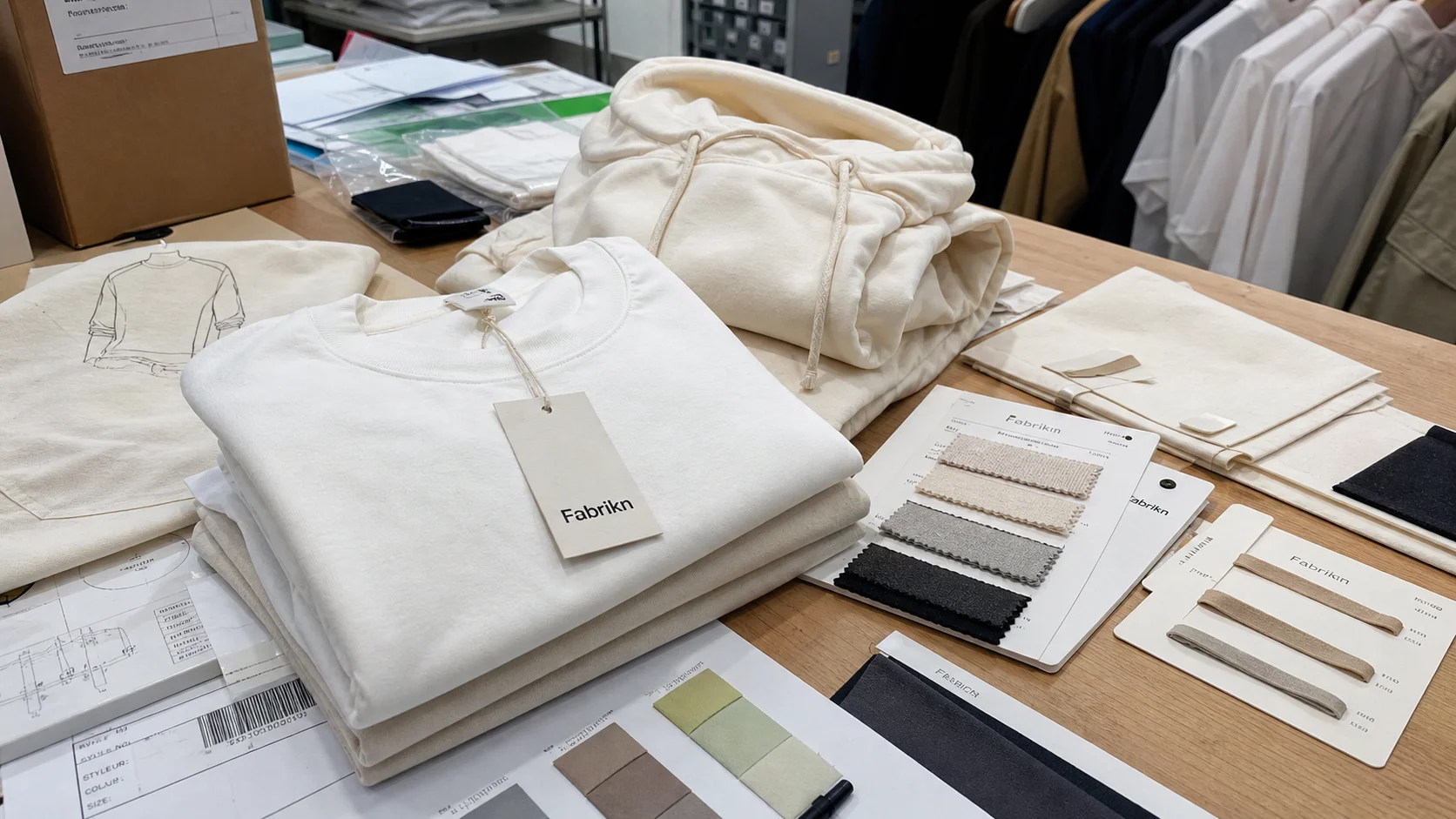
The Clothing Packaging for Ecommerce with checks for samples, fit, MOQ, QC evidence, pricing terms, and delivery risk.
Fast answer: The Clothing Packaging for Ecommerce: Material, Print, Packing Flow, and Cost should be judged by production evidence, not by a generic sourcing promise. The buyer needs sample proof, cost breakdowns, QC checkpoints, and delivery buffers in writing.
Ask for recent sample photos, measurement tolerances, fabric or print test assumptions, decoration test notes, packing examples, and a named inspection checkpoint. These details show whether the team can repeat an approved sample at bulk volume.
Separate garment cost, decoration, labels, packaging, sampling, testing, freight, and rush charges. When every cost line is visible, it becomes easier to reduce colorways, adjust size depth, or reserve more time for sampling.
Packaging fails in the places brochures never visit: damp warehouses, rushed pick lines, and the back of a carrier truck after a long day. That is why what is the best clothing packaging for ecommerce starts with shipping reality, not showroom theory. In factory samples, everything looks tidy. In a 5,000-unit run, cartons get compressed, wet, dropped, and handed off by three different teams before they reach a customer.
I have visited more than 200 factories across eight countries. Same pattern, every time. A packaging sample passes a 1-meter drop test in a clean room, then fails after three weeks in a humid export warehouse where cartons sit 12 high and forklifts scrape the outer layers. Clothing is soft, which sounds forgiving. It is not. A folded French terry 320 GSM hoodie can rebound after pressure, but a tissue-wrapped satin dress or ribbed knit set can pick up creases, moisture marks, and hanger dents that trigger returns.
Here’s the trade-off: protection, presentation, cost per shipment. Push one down too hard and the others climb. A $0.12 poly mailer can become a $2.40 problem if it drives one extra return on a $28 order. I saw this on a Vietnam export floor where a mid-market brand switched from a lightweight paper mailer to a reinforced poly mailer with a better seal. Material cost rose by $0.05. Repacks dropped 14%. Damage claims fell from 3.8% to 1.1% over 60 days.
Factory-reported specs rarely match warehouse reality because factories test at the source, while fulfillment centers test at speed. One carton line may pack 600 pieces per hour; another may only manage 220 when staff add tissue, stickers, and return cards. For clothing packaging solutions, that speed matters. A gorgeous box that needs 40 seconds of hand assembly is expensive if your labor is $18 an hour and you ship 20,000 units a month.
Soft goods react differently to moisture than rigid products. Corrugated boxes resist crush better, but they absorb humidity and can lose stiffness in monsoon-season lanes through South Asia and coastal Latin America. Poly mailers shrug off rain, yet they offer weak compression resistance. In my experience, what is the best clothing packaging for ecommerce usually balances damage rate below 2%, pack time under 20 seconds, and shipping weight low enough to dodge dimensional penalties from carriers charging by girth rather than grams.
The best package for a $14 tee is not the same as the right package for a $140 knit blazer, and that is where many brands waste money. For basics, a simple poly mailer or recycled paper mailer keeps costs near $0.10 to $0.28 per unit. For premium orders, presentation matters more, but not in the way most marketers assume. Customers want a clean opening experience, not a package that costs more than the item’s margin can support.
T-shirts, jersey basics, and value fashion usually ship best in lightweight mailers. They fold flat, resist wrinkling, and tolerate compression better than woven shirts or structured outerwear. Denim is heavier, so it needs stronger seals and often a box or a rigid mailer if returns are common. Knitwear sits in the middle. It can travel well in poly, but bulky gauge knits need more space to avoid seam impressions. Activewear — leggings, sports bras, that whole lane — often performs best with small paper mailers or slim boxes because customers expect neat branding and fast restocking. Outerwear is the exception. Puffers and wool coats need room, tissue protection, and more serious crush resistance.
Price point changes everything. Budget brands selling at $12 to $35 usually win on simple, consistent packing and low labor. Mid-tier labels in the $40 to $90 range can justify printed mailers, inserts, and a better return experience. Premium and giftable orders can use stronger boxes, but I have seen several premium launches ship in lightweight mailers with a rigid insert and a branded sleeve. That saved 38% on freight and still delivered the right unboxing feel.
Here’s what most people miss: premium does not always mean heavy. At a Turkish manufacturer and factory supplying a luxury DTC label, the winning format was a 38-micron mailer with a 1.8 mm card insert, not a 300 GSM rigid box. The brand cut outbound weight by 84 grams per parcel and lowered carton storage by 22 cubic meters across a 10,000-unit season. That matters if you also manage custom hat manufacturing, where shape retention and low volume often beat ornate packaging.
Returns and resale change the calculation too. A pack that opens neatly but tears on reseal creates friction, while a box that arrives pristine can be reused by resale teams or outlet channels. Premium fashion can support that extra structure. Basics usually cannot. If your AOV sits below $50, the smartest packaging is often the one that disappears into the shipping cost rather than trying to become a brand event.
Poly mailers remain the cheapest high-volume option, usually around $0.08 to $0.22 per unit for stock sizes, and custom printing adds another $0.03 to $0.10 depending on color count and order volume. They weigh little, often 8 to 14 grams, and they handle moisture better than most paper formats. Their weakness is obvious. They crush, they scratch, and they look cheap if the print quality is poor. Still, for 50,000 units a month, they are hard to beat on cost-per-shipment.
Recycled paper mailers usually land around $0.14 to $0.35 per unit, with more variance by region because pulp supply and converting capacity differ sharply between Europe, North America, and parts of Southeast Asia. They print beautifully and feel premium for the price. They also tear sooner than many brands expect when packed with zippers, metal trims, or hard labels. If the paper is thin, moisture can soften the seal. I have seen paper mailers work well in dry domestic shipping lanes, then fail badly on sea-freight replenishment where cartons sat near damp warehouse walls for 10 days.
Corrugated boxes run wider in price, from roughly $0.28 for plain stock cartons to $1.20 or more for custom printed rigid or double-wall formats. They offer the best crush protection and the strongest surface for branding. They also add weight fast. A box that adds 90 grams can push a parcel into a higher carrier bracket, especially on international routes where dimensional weight rules punish volume as much as mass. The box can be the right answer for outerwear, gift sets, and high-return categories, but it is expensive for low-margin basics.
Garment bags are a different category. They protect against dust and are useful for luxury hangers, bridalwear, and archived stock, but they are weak as a primary ecommerce shipper. I rarely recommend them alone unless a product needs visible presentation and the warehouse uses an outer shipper anyway.
According to ISO packaging and transport test standards, packaging should be evaluated in transit conditions, not just by material spec sheet. For brands sourcing in China, this also means checking the supplier's production methods, quality control, and MOQ before you commit to bulk or wholesale orders. The right supplier should be able to show how the packaging performs in real transport, not just in a sample photo. Paper is not automatically greener if it increases replacements by 3% or damages by 2%. A recycled mailer that arrives shredded is not sustainable; it is waste with better branding. In Germany and the Netherlands, paper recycling access is strong. In parts of the United States and India, contamination, sorting rules, and municipal capacity change the real outcome. Regional recycling systems decide whether a package becomes feedstock or landfill.
For brands selling across multiple regions, what is the best clothing packaging for ecommerce is often a mixed system: basic tees in mailers, premium edits in boxes, and outerwear in reinforced cartons. That combination cuts wasted material while keeping damage rates under control, which is the only metric I trust after seeing too many factory claims collapse in a real warehouse.
Packaging claims are easy to print and hard to prove. A mailer can say “recycled,” “recyclable,” or “compostable,” but the real question is what happens after a customer throws it away. Recycling rates differ sharply by city and country. In parts of the UK and Germany, paper recovery is relatively mature. In many U.S. metros, flexible plastics are still poorly sorted. In Indonesia, Kenya, and many smaller markets, the collection system may not support any claim beyond “technically recyclable” on paper.
Compostable mailers sound elegant, yet most require industrial composting at 50°C to 60°C, which many households never access. If a package goes into landfill, compostable film can behave much like conventional plastic. Recycled plastic mailers are often more practical because they protect garments better and can be made with 30% to 100% post-consumer content. Paper-based options look clean, but they can be contaminated by oils, stickers, and wet weather. Once contaminated, their recovery rate drops fast.
On factory floors, I ask for proof, not promises. Certificates such as GRS, FSC, and supplier declarations matter, but they do not tell the whole story. Minimum order quantities can be 5,000 to 20,000 units for custom recycled packaging, and print options may be limited to one or two colors. That restriction matters if your brand wants full-bleed color on a compostable film. Some factories can do it. Many cannot without increasing waste or rejecting a large share of the run.
Textile Exchange data has pushed the industry toward recycled inputs, but packaging decisions should be judged by material use per shipment, not slogans. For compliance and labeling guidance, brands should also review OEKO-TEX certification standards and U.S. trade and import resources when building cross-border packaging programs. If a heavier paper mailer adds 18 grams and drives 1 in 50 shipments into repack, your footprint may rise instead of fall. That is especially true for brands with high return rates, where the same package may travel twice.
The cleanest sustainability standard I use is practical. Measure grams of packaging per parcel, damage rate, return rate, and local waste system compatibility. Then choose the lightest format that keeps the garment safe and the brand credible. Sustainability without transit performance is just expensive waste dressed up as virtue.
Unit price is only the opening number. A stock poly mailer at $0.09 may look cheaper than a printed paper mailer at $0.24, but landed cost includes freight, labor, storage, and claims. I have seen brands save $0.07 on material and lose $0.19 on handling because the new pack required more tape, more folding, and more time at the bench. A 2-cent win can vanish before lunch.
Dimensional weight changes the math quickly. A flat mailer may keep a parcel under 500 grams billable weight, while a box can bump it into the next tier and add $1.20 to $3.80 on domestic routes, more on international lanes. Tape is another hidden cost. A box can need 2 strips plus closure tape, while a mailer usually needs one seal. Labor matters too. If packing a box takes 35 seconds and a mailer takes 12, the difference compounds over 10,000 units into many staff hours.
Lead times vary by format. Stock packaging can arrive in 7 to 14 days if a supplier has inventory. Custom-printed mailers usually take 3 to 5 weeks after artwork approval. Custom boxes often need 4 to 8 weeks, especially if you want a special size, coated finish, or insert. Sample rounds add time. I often budget 10 to 14 days for first samples, then another 7 days for revision and sign-off. Seasonal launches punish delay. A late packaging decision can eat half the selling window.
Rush production is costly. Air freight for packaging can raise landed cost by 15% to 40%, and that is before rush fees. If you are reordering into peak season, keep at least 8 to 10 weeks of buffer on custom items. For brands managing multiple categories, including custom baby clothing manufacturing and private label basics, packaging planning should start before the garment PO is finalized.
My rule is blunt. If packaging changes your delivery promise, your answer is wrong. The best format is the one that fits your factory schedule, warehouse speed, and carrier pricing without forcing an emergency air shipment in week 11.
Unboxing can lift repeat purchase behavior, but only when it is coherent and not bloated with extras. A clean outer mailer, crisp fold, and one useful insert often do more than a pile of tissue, ribbons, and oversized thank-you cards. I have watched brands spend $0.45 on decorative layers that customers discarded in five seconds. The better version was $0.16 in branded tissue, a small sticker, and a card that explained size exchange rules.
Returns-friendly design matters more than decorative detail. Reseal strips, clear size labels, and easy-open tear notches reduce service tickets and make repacking less messy. If you sell items with high fit volatility, such as denim or fitted knitwear, the return package should survive a second trip. That can mean a box with a reseal flap or a mailer with a second adhesive line. For premium DTC, an insert that explains care and fit can support brand memory. For basics, wasteful embellishment just adds cost.
Region matters. In Japan, presentation expectations are high, even for mid-priced garments. In the U.S., convenience and easy returns often outrank perfect presentation. In parts of France and South Korea, neatness and detail still matter, but consumers are less tolerant of packaging waste. I saw this clearly with a private label client using private label clothing services. The brand reduced tissue spend by 60% and improved customer satisfaction because the package was simpler to open and easier to reseal.
Branding touches should earn their keep. Stickers cost little, but too many become trash. Thank-you cards can be effective if they drive subscription sign-up or care instructions. Heavy inserts, metallic foils, and oversized boxes are often poor choices for essentials. Keep the detail where customers touch it, not where your accountant pays for it.
Start with four numbers: average order value, average parcel weight, return rate, and target margin. If your AOV is under $35 and your return rate is below 8%, a low-cost mailer usually wins. If your AOV is above $90 or you ship giftable products, stronger presentation can justify a box or hybrid format. Your packaging should fit the business model, not the mood board.
Then test three options. I recommend one stock mailer, one printed mailer, and one box or hybrid insert. Ship at least 100 orders per option over 2 to 4 weeks. Track damage, labor time, customer service complaints, and return rates. Ask fulfillment staff what slowed them down. They will tell you more truth in one shift than a brand deck delivers in ten meetings.
Check the operational constraints. MOQ might be 500 pieces for a stock item, 3,000 to 10,000 for custom print, and 5,000 or more for specialty boxes. Storage footprint matters too. A box that occupies 12 pallet positions can block cash and floor space. Print accuracy matters if your logo uses fine lines or PMS colors. I have rejected packaging that looked perfect on screen but printed muddy at scale.
Use a pilot timeline of 6 to 8 weeks before peak season. That gives you enough room for sampling, revisions, and one test replenishment. If you are launching a new category, the packaging should be validated alongside the garment. A heavier fleece, a delicate blouse, and a ribbed child’s set do not deserve the same shipper. The right answer changes with product, price, and geography.
My recommendation matrix is straightforward. Basics: mailers. Premium giftable orders: hybrid mailer-plus-insert or small box. Outerwear: reinforced box. High-return categories: resealable packaging with strong labels. If you need packaging tied to sourcing, clothing packaging solutions should be chosen after freight, labor, quality, and return data are on the table, not before. The answer to what is the best clothing packaging for ecommerce is the one that aligns with your product, your supplier, and your shipping network.
For low-cost T-shirts, a stock poly mailer or recycled paper mailer is usually best. Expect unit costs around $0.08 to $0.25, with packing time under 15 seconds and minimal dimensional weight impact. If damage rates stay below 2%, you are likely in the right range.
Premium apparel often works best with a lightweight branded mailer plus a rigid insert, or a small box if the product is giftable. Costs typically range from $0.25 to $1.20 per shipment depending on print and structure. The goal is presentation without adding more than 60 to 90 grams.
Basic stock mailers usually cost $0.08 to $0.22, recycled paper mailers $0.14 to $0.35, and corrugated boxes $0.28 to $1.20 or more. Printed versions add setup and plate charges, often $150 to $600 upfront. Landed cost should include freight, labor, and return handling.
Stock packaging can ship in 7 to 14 days. Custom-printed mailers usually take 3 to 5 weeks, while custom boxes often need 4 to 8 weeks. Sample rounds can add 1 to 2 weeks if artwork or sizing changes.
Choose packaging with reseal strips, clear size labels, and enough structure to survive a second trip. Mailers with dual adhesive lines or boxes with reclose tabs reduce return friction. For fit-heavy categories like denim or knitwear, that can cut repack damage by 10% to 20% in a busy warehouse.