
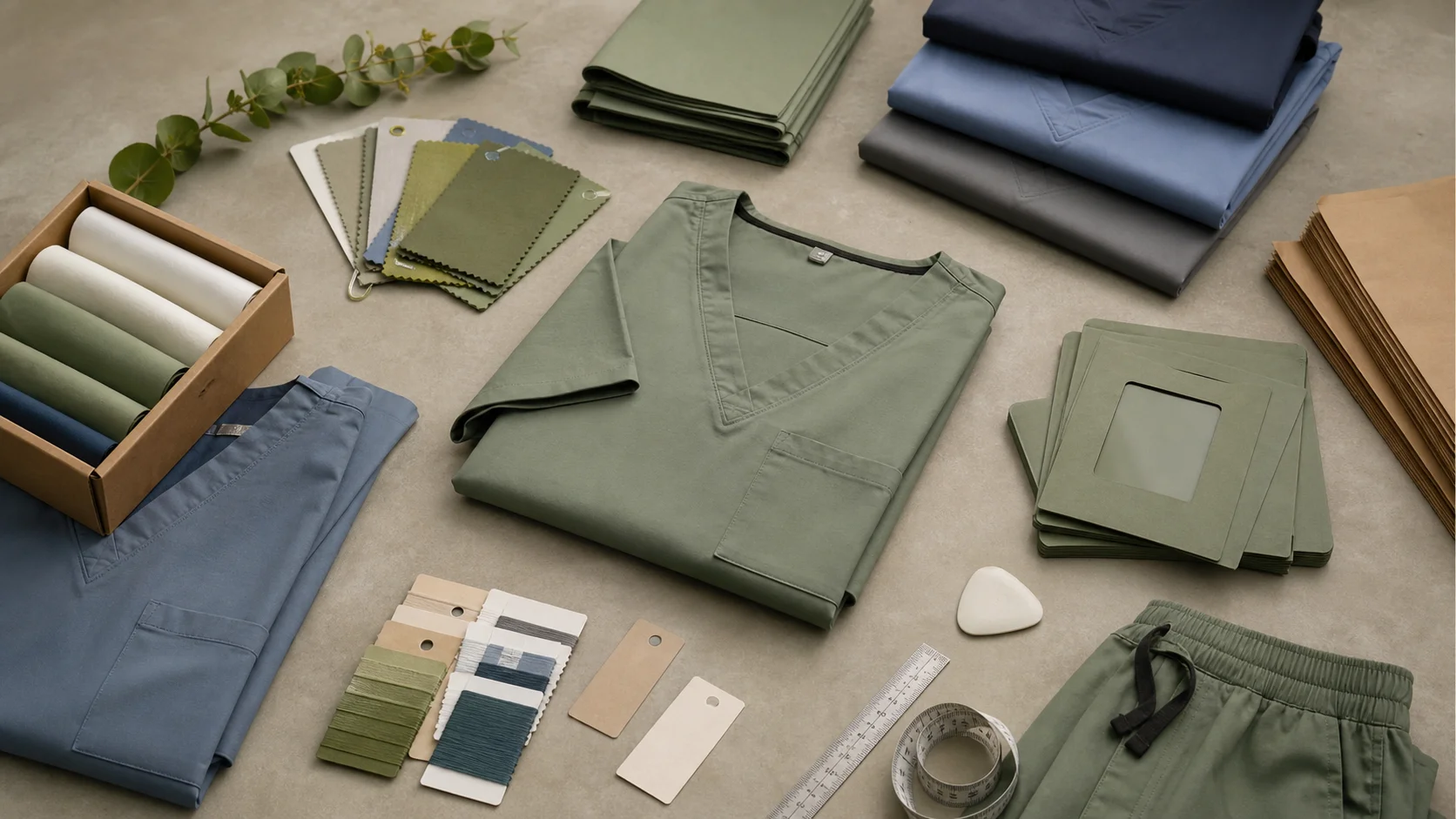
Eco-Friendly Apparel Mailer Bags with checks for samples, fit, MOQ, QC evidence, pricing terms, and delivery risk.
Fast answer: Eco-Friendly Apparel Mailer Bags: Material Claims, Seal, Print, and Shipping should be judged by production evidence, not by a generic sourcing promise. The buyer needs sample proof, cost breakdowns, QC checkpoints, and delivery buffers in writing.
Ask for recent sample photos, measurement tolerances, fabric or print test assumptions, decoration test notes, packing examples, and a named inspection checkpoint. These details show whether the team can repeat an approved sample at bulk volume.
Separate garment cost, decoration, labels, packaging, sampling, testing, freight, and rush charges. When every cost line is visible, it becomes easier to reduce colorways, adjust size depth, or reserve more time for sampling.
I’ve stood in fulfillment centers where a 140-gram cotton tee arrived wrapped in 18 grams of plastic, a paper insert, a sticker, and a second mailer because the first one tore in transit. That pileup is the real waste problem behind eco friendly mailer bags for apparel shipments. Lightweight apparel still creates outsized packaging volume because it ships in millions of units, not because each parcel is heavy.
Waste shows up fast in returns data. On one factory visit in Vietnam, I saw a mid-market basics brand lose 2.8% of outbound parcels to crushed corners, seal splits, or wet labels, and every repack added $0.12 to $0.18 per order before labor was counted. Cheap packaging looks efficient at $0.04 to $0.06 per bag. Then the math turns ugly.
Different garments drive different packaging behavior. Polyester basics in a 160 GSM jersey fold flat and ship cleanly in a slim poly mailer. Denim at 11 to 14 oz needs stronger puncture resistance, wider seals, and a bag that can handle hardware abrasion. Activewear, especially brushed leggings and bonded sports bras, often ships in higher volumes with more customer scrutiny, so a wrinkled or opaque bag can hurt perception even when the product itself is fine.
Retailers now press brands on two fronts: packaging reduction and proof. European buyers ask for recycled content statements, material disclosure, and labeling that matches Extended Producer Responsibility rules. According to WTO data, cross-border trade in consumer goods keeps expanding, which means packaging standards travel with the shipment, not just with the brand’s home market. Asia-based exporters often start with unit cost. European procurement teams often start with documentation. That split changes everything.
Last year I worked with a brand that switched from a standard 55-micron virgin poly mailer to a 70% PCR option at a unit premium of $0.018. Damage fell by 1.4 percentage points, and packing rework dropped by 11 minutes per 100 parcels. The cheapest mailer was never the cheapest choice. It was just the first invoice.
The phrase sounds simple. The product mix is not. In the market, buyers usually meet four families: PCR poly mailers, bio-based compostables, kraft-paper mailers, and hybrid constructions that combine paper with a polymer barrier or a peel-and-seal strip. Each has a different end-of-life route, and only some truly fit existing recycling streams.
PCR poly mailers are made from post-consumer recycled resin, often at 30% to 100% content. They behave much like standard poly in machine packing, seal well at 120 to 160 degrees Celsius, and resist moisture far better than paper. They can be recycled in plastic film streams where those streams exist. Their weakness is optics: consumers read “plastic” before they read “recycled.”
Kraft-paper mailers look cleaner on a sales sheet, but the hidden variables matter. A paper mailer with a PE barrier liner, a silicone-coated release strip, or too much adhesive can fail paper recycling. Compostable mailers, often PLA or starch blends, need industrial composting access and clear certification. Data from Textile Exchange shows material claims are under tighter scrutiny every year, and packaging is now judged with the same skepticism as fabric content claims. For certification context, buyers also commonly reference OEKO-TEX standards when validating broader material safety expectations.
Here’s what most people miss: a mailer can look “eco” and still be non-recyclable because of a tiny build detail. A metallic print, a multilayer gusset, or a silicone-coated adhesive flap can defeat the recycling route even when the base material is sound. I’ve seen sales teams sell “paper” mailers that were really composite bags with paper on only one face.
For quick comparison, I use this lens:
“Eco” is not a standard. I ask for recycled-content proof, compostability standard references where relevant, and exact material breakdowns by layer. If the supplier cannot name the barrier layer, they usually cannot prove the claim.
Unit price is the least interesting number on the quote, yet it gets the most attention. I’ve compared recycled poly, kraft, and compostable mailers across factories in China, India, and Turkey, and the cheapest item on paper often lost on landed cost. A 10% higher unit price can still win if the bag lowers volumetric weight, reduces re-ships, or cuts damage claims by 1% to 2%.
Typical price bands tell the story. A basic PCR poly mailer might land at $0.05 to $0.09 per piece at MOQ 10,000. Kraft-paper mailers often sit around $0.08 to $0.14, depending on thickness and print coverage. Compostables usually start higher, often $0.11 to $0.20, because resin costs, certification, and yield losses are harder to absorb. Those gaps narrow when the package is resized correctly and freight is optimized.
In a factory outside Guangzhou, I watched a line pack women’s tees into a 34 x 24 cm mailer, then switch to a 29 x 22 cm version. The smaller bag shaved 18 grams of dimensional weight per parcel. At 50,000 shipments a month, that was not a cosmetic change. It saved roughly 900 kilograms of chargeable weight monthly, which mattered more than the $0.012 unit premium on the better bag.
Premium DTC brands often accept a heavier mailer because the unboxing moment carries marketing value. Budget labels live elsewhere. They need high-speed packing, a 3 to 4 second seal cycle, and a low reject rate on auto-baggers. I’ve seen 55-micron recycled poly outperform a thicker paper mailer simply because the machine fed it at 2,000 units per hour without jams.
The carbon story is not linear. Paper can travel well in a dry domestic lane and lose badly in a wet export lane if rework doubles. Compostables can look attractive in theory and fail in practice if the supply chain has no collection route. The cleanest choice is the one that survives your actual route, not your mood board.
For brands with tight margin pressure, I point them to a custom packaging quote for eco friendly mailer bags for apparel shipments after they have fixed the spec. A properly briefed quote, with dimensions, print coverage, and recycled-content target, can show a 12% to 18% landed-cost swing that no unit price line item reveals.
Mailer choice should follow the garment, not the other way around. Tees and leggings do not need the same barrier level as jackets, shoes, or bundled sets. A 180 GSM French terry hoodie folded with tissue can sit happily in a recycled poly mailer with a 4 cm seal. A coated rain shell with hardware needs stronger puncture resistance and more opacity to protect the product image.
Route matters just as much. Domestic delivery in 2 to 4 days is forgiving. Ocean freight, especially 21 to 35 days with warehouse dwell time before final-mile dispatch, is not. In humid lanes through Southeast Asia or West Africa, kraft-paper options can warp, scuff, or absorb enough moisture to weaken seams. Compostables can soften under heat and humidity if storage runs above 30°C for too long.
For export programs, I ask for seal width, gusset depth, and tear-strip behavior in writing. A 25 mm seal may hold on a desktop test and fail under conveyor pressure. A 40 mm gusset can help on padded outerwear but add unnecessary material to slim basics. Print coverage matters too. Heavy ink blocks can interfere with recyclability and sometimes reduce seal quality near the flap.
Size discipline saves material. I’ve seen brands use a 38 x 30 cm mailer for a single rolled tee because the packaging team feared complaints. That habit adds filler, increases freight, and makes the parcel look bloated. A better fit keeps the garment flat, reduces movement, and often eliminates the need for void fill altogether.
For product development teams already working with private label clothing services or cut and sew manufacturing, the packaging brief should travel with the tech pack. If the garment is built for soft folding and low wrinkle risk, the mailer spec should reflect that. If the line includes outerwear, high-GSM knits, or return-heavy SKUs, the bag should be tested against abrasion, edge crush, and humidity, not just dimensions on a spreadsheet.
Opacity matters. A white opaque bag hides retail folds better than a translucent one, and that affects perceived quality. It also changes print coverage, because more ink on a lighter base can improve branding but raise cost by $0.003 to $0.007 per unit. Small numbers. Large effect.
Paper claims are easy. Production reality is harder. I ask factories for recycled content proof first: resin traceability, supplier declarations, and lot-level consistency if the order is large. For compostable or bio-based claims, request the actual standard reference, such as ASTM D6400 or EN 13432, plus the test report that matches the exact film build. If food-contact status matters for a cosmetics or gifting channel, get that too.
Then test the bag like a parcel, not a brochure. I run dart impact, seam failure, hot-humid storage, and ink rub checks. A bag that survives a 500-gram drop from 1 meter in a controlled room can still fail after 72 hours at 35°C and 85% relative humidity. That is where many hidden defects appear, especially on adhesive strips and print layers.
Factory capabilities vary sharply by machine type. A supplier running high-speed blown film lines can make tighter gauge control than a smaller shop with older cast film equipment. Two suppliers quoting the same 60-micron recycled poly spec may produce very different failure rates because one controls seal variance within 2 mm and the other lets it drift 6 mm. The quote will not tell you that.
Ask about MOQ, lead time, print registration, and change-control procedures before the first PO. A low MOQ of 5,000 can be fine for a pilot, but if artwork changes mid-run and the factory needs 12 days for new cylinders or plates, your launch slips. I also want written approval points for film thickness, adhesive width, and shade tolerance. Otherwise, the second production run can arrive looking like a cousin of the first.
Good suppliers will also tell you what they cannot do. Bad ones promise 100% recycled content, compostability, and premium gloss in one bag. That is usually the first warning sign. For compliance benchmarking, buyers often review U.S. Trade and export guidance alongside local import rules when moving packaging across borders.
Adoption is uneven, and that pattern tells its own story. Premium DTC brands usually move first because packaging is visible on social media and in returns, so a recycled mailer becomes part of the brand image. Budget labels move later, often after freight, damage, or retailer penalties force a change. Marketplace sellers tend to follow platform rules, which means the shift happens only when compliance becomes a listing condition.
In China and Vietnam, many factories have already switched enough production to recycled poly that lead times are now competitive with virgin film, often within 10 to 14 days for repeat orders. India often wins on print flexibility and smaller MOQs, sometimes 3,000 to 5,000 units, while Turkey can be strong on faster access to Europe, especially for buyers who need documentation in 5 to 7 working days. Europe typically asks for the most paperwork. North America often wants the consumer message to be clearer. Asia still tends to prioritize speed to conversion.
Here is the counterintuitive part: some high-end brands use heavier mailers than mass brands. I saw one premium label order a 90-micron matte recycled bag because the tactile feel supported a $120 jacket line, while a value brand shipped tees in a 55-micron recycled film and kept complaints lower because the packing line was faster and the closure failed less often. Presentation can beat grams saved. Not always. But often enough to matter.
The measurable gains are practical. One European activewear brand I tracked cut repacks by 17% after standardizing bag sizes across 12 SKUs. A Turkish basics supplier reduced packing time by 8 seconds per parcel after switching from inconsistent paper mailers to a single recycled poly format. Small efficiencies multiply at 20,000 or 50,000 shipments a month.
Start with three materials, not ten. Shortlist PCR poly, kraft-paper, and compostable only if your route can support it. Request matched samples in the same dimensions, same print coverage, and same closure type so you are comparing like with like. Then run shipping tests on actual garments, not empty bags.
Your supplier brief should include exact bag size, garment type, target recycled-content percentage, print location, seal width, MOQ, and acceptance criteria for drop and seal tests. If you need a sample set or a broader packaging comparison, browse the packaging product catalog for apparel mailers and match the bag spec to your SKU profile before you quote.
I recommend a pilot order by lane or by SKU, usually 1,000 to 3,000 pieces per test group. Measure damage, customer feedback, packing speed, and repack rate for at least 2 weeks. If your current process uses 4 bag sizes, the pilot should collapse them into 2 where possible. The less variation you allow, the easier the buying decision becomes.
Build in time for artwork proofing, material sourcing, and transit delays. A good first run usually needs 7 to 14 days for sampling, 10 to 20 days for production, and another 3 to 10 days for freight depending on origin. If you leave that to the last minute, the packaging spec will choose you.
They are usually made from PCR poly, kraft paper, compostable bio-based film, or a hybrid of paper and polymer. PCR poly is the most common for apparel because it balances moisture resistance, print quality, and recycling potential.
Most recycled poly mailers land around $0.05 to $0.09 per piece, kraft options around $0.08 to $0.14, and compostables around $0.11 to $0.20. Final cost depends on size, print coverage, MOQ, and freight lane.
Tees and leggings usually need slim, moisture-resistant bags with a 4 cm seal and minimal excess film. Hoodies and heavier knits often need a wider gusset, stronger puncture resistance, and a slightly larger format to avoid strain on the seal.
You can, but only if storage and transit conditions stay controlled and the destination has a real composting route. In lanes with 30°C-plus heat, long dwell times, or high humidity, compostables can soften or deform faster than recycled poly.
Sampling usually takes 7 to 14 days, production 10 to 20 days, and freight another 3 to 10 days depending on origin. If you need custom print plates or certification checks, add several extra days before approval.