
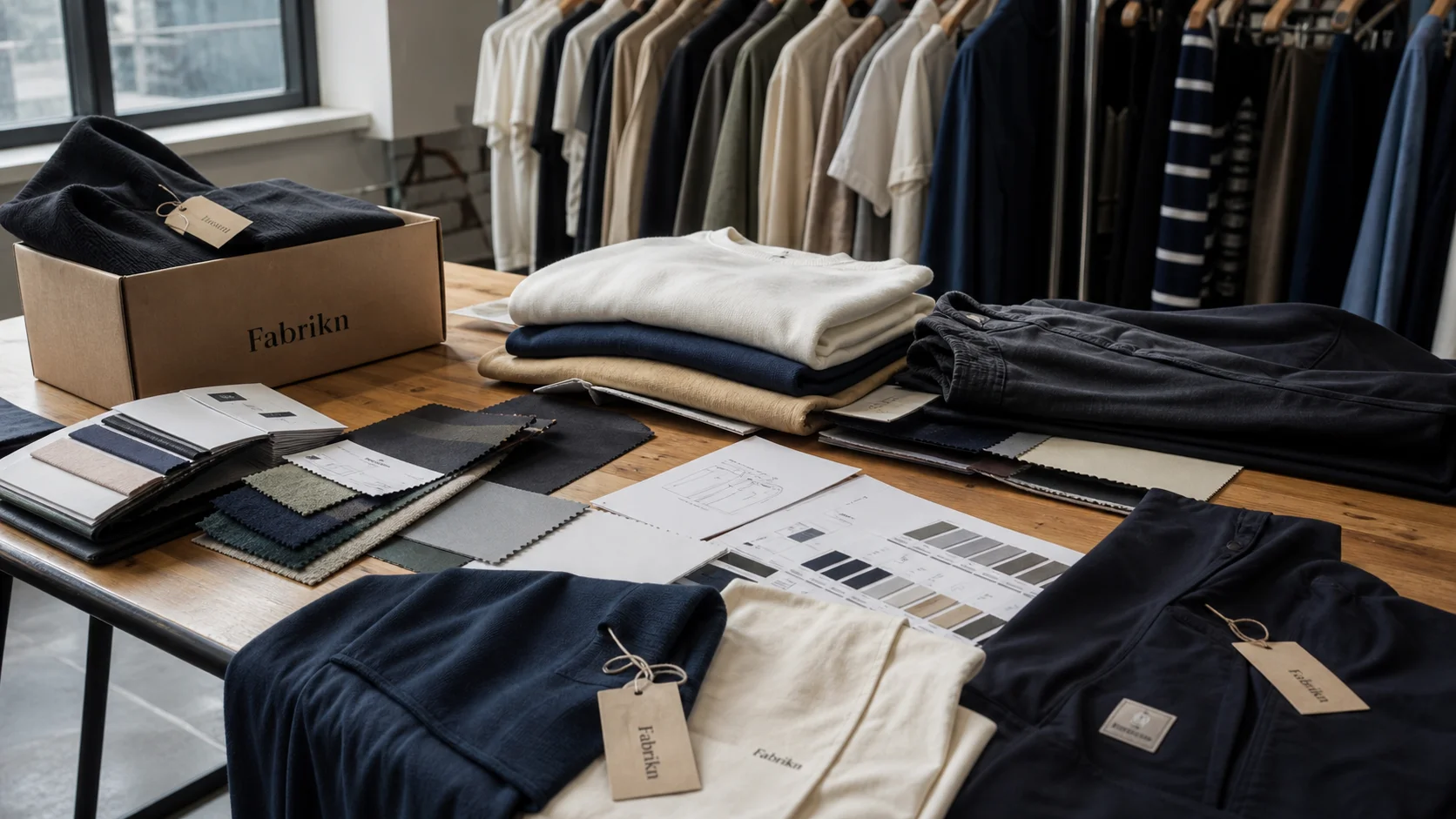
Sustainable Fashion Mailer Checklist with checks for samples, fit, MOQ, QC evidence, pricing terms, and delivery risk.
Fast answer: Sustainable Fashion Mailer Checklist: Claims, Seal Strength, Print, and Shipping should be judged by production evidence, not by a generic sourcing promise. The buyer needs sample proof, cost breakdowns, QC checkpoints, and delivery buffers in writing.
Ask for recent sample photos, measurement tolerances, fabric or print test assumptions, decoration test notes, packing examples, and a named inspection checkpoint. These details show whether the team can repeat an approved sample at bulk volume.
Separate garment cost, decoration, labels, packaging, sampling, testing, freight, and rush charges. When every cost line is visible, it becomes easier to reduce colorways, adjust size depth, or reserve more time for sampling.
Plastic backlash is no longer just a branding problem. It is a shipping problem, a compliance problem, and in some warehouses, a chargeback problem. I have watched brands lose retail shelf space after a buyer flagged poly mailers in a single audit, and I have seen DTC founders swallow 12% higher packaging costs just to avoid a wave of complaints. That is why eco friendly paper mailer bags for fashion brands have moved from niche experiment to standard brief across much of premium apparel.
The numbers explain the shift. A typical poly mailer weighs 8-12 grams, while a paper mailer for tees or lightweight knits often lands at 18-35 grams depending on GSM and gusset size. Paper is heavier, yes, but it scores better on curbside recyclability in many markets and carries a stronger unboxing signal before the parcel is even opened. In my factory visits, that perception matters more than many procurement teams expect. A 120 GSM kraft mailer with crisp one-color print can feel more premium than a glossy plastic bag that cost half as much to produce.
Here is the part brands tend to miss. A paper mailer can outperform thin plastic on perceived quality even when the customer has not seen the product yet. The tactile surface, matte ink, and stiffness all telegraph care. In London and Milan, buyers kept saying the same thing: “It looks expensive.” In Los Angeles, one merchant told me their packaging complaints dropped from 7.4% to 2.1% after the switch. Packaging does not create loyalty on its own, but it can remove friction.
Regional adoption is uneven. Europe moved faster because extended producer responsibility fees and retailer packaging rules arrived first, and many brands now review packaging by the quarter. North America is split: some department stores want recyclable paper now, while other chains still prioritize damage resistance and low cost. Asia remains the manufacturing engine, with deep capacity for kraft conversion, glue application, and print finishing. In Shenzhen and Ho Chi Minh City, I saw lines running 50,000 to 120,000 units per day, which is why premium labels usually test there first.
Packaging waste is not a side story. A fashion brand shipping 500,000 parcels a year can place 5 to 10 tons of mailers into circulation, depending on format and material mix. Repeat purchase behavior is tied to that visible waste in a way many teams underestimate. The packaging sits in the customer’s hand for 10 seconds. Then it sits in the bin, or the recycling stream, for much longer. Brands that understand that math are moving first.
Most paper mailers start with kraft paper, but the stack matters more than the label. Virgin kraft offers strength and a cleaner fiber profile. Recycled kraft lowers virgin fiber demand, yet it can lose tear resistance if the pulp blend is too short-fiber heavy. FSC-certified fiber gives buyers traceability, which matters for retail compliance and internal ESG reporting. For branding, water-based inks are the safer choice because they avoid the heavy solvent smell I have encountered in cheaper print shops.
The weak point is usually the barrier layer. Many suppliers advertise “eco” while using a thin plastic film or mixed laminate that blocks recycling in real municipal streams. I have reviewed samples that looked excellent in a showroom but failed basic repulping tests because of a glossy coating bonded too tightly to the paper. According to ISO packaging and quality standards, packaging claims need traceable material evidence, not just marketing language. If the supplier cannot state whether the adhesive is recyclable or compostable, treat the sustainability claim as incomplete. For broader material expectations, see Textile Exchange standards and OEKO-TEX guidance.
Paper grade changes everything. A 90 GSM bag may work for socks and tees, while 110-130 GSM is safer for heavier knitwear, and 150 GSM starts to make sense for denser returns packaging. Higher GSM improves puncture resistance and edge strength, but it also raises cost by roughly 8-18% depending on print coverage and size. Moisture resistance is another tradeoff. Paper handles short exposure well, yet a wet distribution center or monsoon route can reveal weak seams fast.
When I visited mills in Vietnam and Guangdong, the gap between sample and scale was obvious. A supplier can make 500 immaculate pilot bags with hand-fed glue, then struggle to hold defect rates under 3% at 100,000-unit volume. That is why I care less about a perfect mock-up and more about whether the line can run consistent die-cutting, seam folding, and seal pressure for 3-4 weeks without drift. Tees, knitwear, accessories, and lightweight apparel fit best. Heavy denim usually does not.
For brands that already use custom bra manufacturing, the packaging logic is similar: soft goods need structure, but not excess weight. The trick is to match the bag to the garment, not the other way around.
Paper mailers do not win on unit price. They win on total package economics when the design is right. For plain stock, I have seen poly mailers land at $0.07-0.12 per unit at 10,000 pieces, while paper mailers often sit at $0.14-0.28 depending on GSM and closure. Padded mailers can run $0.25-0.45, and folding cartons often start at $0.35-0.80 before inserts. At 1,000 units, the spread widens because setup is spread across fewer bags.
Print changes the math. One-color branding on a paper mailer might add $0.02-0.05 per unit and 5-7 days of lead time. Full-wrap print, by contrast, can push costs up by $0.08-0.18 and add 10-14 days, especially if the supplier needs a custom plate or color match. Plain stock usually ships in 7-10 days. Custom paper mailers for clothing brands with a die-cut handle or a reinforced tear strip often need 3-4 weeks, sometimes longer if the buyer wants FSC documentation and third-party test reports.
Transit durability matters because return rates are expensive. A damaged parcel can trigger replacement freight, repicking labor, and customer service time that adds $3.50-8.00 to a single order in some markets. Dimensional weight also hurts boxes, especially on cross-border shipments. I have seen brands reduce storage volume by 28% simply by moving from cartons to flat mailers for lightweight SKUs. Consumer disposal behavior matters too. Poly mailers often get trashed. Paper mailers are more likely to enter recycling streams where local systems accept them.
A slightly pricier mailer can lower total packaging cost if it reduces void fill and improves retention. I watched a premium T-shirt brand cut its average packaging spend from $0.61 to $0.54 per order after switching from a box plus tissue to a reinforced kraft mailer. Damage stayed under 1.8%, lower than the previous 2.6% box damage rate. That was not theory. That was a warehouse floor calculation.
Print quality is another hidden lever. Matte kraft accepts fine typography, but only if the file is built for low-ink coverage and the supplier controls registration within 1.5-2.0 mm. Brands that also manage private label clothing often already know this: packaging has to carry the same identity discipline as the garment label, or it feels cheap.
Supplier vetting begins with paperwork, but it should not end there. Ask for FSC chain-of-custody documents, ISO 9001 or ISO 14001 certificates, test reports for burst strength and seal integrity, and social compliance audits such as SMETA or BSCI. If the supplier cannot produce those within 24-48 hours, I slow the conversation. A good mill or converter knows where every claim lives. A weak one sells vibes.
In the factory, I inspect three things first: the paper conversion line, the glue application system, and the print registration. If the glue wanders by even 2-3 mm, the seam weakens. If print drifts, brand marks look sloppy at scale. I also ask for defect data over the last 3 months, not just one hero batch. A supplier shipping 200,000 units a month should be able to show a defect rate below 2% and explain what happens if a pallet gets wet in transit.
Region matters. Europe is strongest on compliance and documentation. China and Southeast Asia offer the widest range of speed and scale, with many converters able to handle 50,000-unit minimums and turnaround in 15-25 days. India is gaining on paper capacity and value, especially for recycled kraft and large web widths, though color control can vary by plant. The right choice depends on whether your brand needs speed, audit readiness, or cost discipline.
Greenwashing often hides in recycled-content claims. “30% recycled” tells me little unless the supplier can trace the fiber source and explain whether the balance is post-consumer or post-industrial. Ask for recyclability documentation in the destination market, not just a general statement. If you sell in the UK, ask how the bag aligns with WRAP guidance. If you sell in the EU, ask how local EPR fees will treat coatings, inks, and adhesives.
Before you place a PO, ask five blunt questions: What is the MOQ, 500 or 5,000? How fast can you sample, 7 days or 21? What is the acceptable defect rate, 1% or 3%? Can you prove recyclability in my market? Can you hold the same spec across 3 production lots? Those answers tell you more than a polished PDF. Brands that already work with cut and sew manufacturing know that consistency beats presentation every time.
Size is money. A bag that is 20 mm too wide can raise freight charges and packing labor, while a bag that is too tight invites seam splits and customer frustration. For tees, a flat mailer around 250 x 330 mm often works. For sweaters, I prefer a gusseted format closer to 320 x 420 x 80 mm, with reinforced edges and a closure that survives 2-3 handling cycles. Cross-border shipping punishes sloppy sizing more than most teams expect.
Print should support structure, not fight it. Keep ink coverage minimal, use water-based inks, and avoid heavy full-bleed artwork unless the brand margin justifies it. A strong logo, a secondary mark, and one line of recycling guidance are usually enough. Overprinting can make a mailer curl, and curl slows down packers. In a 6-person fulfillment line, that lost second per order becomes real money by the end of a 10,000-unit run.
Labels matter too. Tell customers how to recycle the bag in plain language. “Remove tape and place in paper recycling where accepted” is useful. A lecture is not. I have found that practical messaging outperforms moralizing copy because customers want direction, not guilt. Structural features such as double-side seams, tear strips, and pressure-sensitive closures reduce damage in warehouse handling, especially when parcels are stacked 8-10 high.
Luxury labels and value brands use the same materials differently. Luxury wants texture, stiffness, and a controlled reveal. Premium DTC brands want fast turnaround and packaging that photographs well in customer posts. Mass market brands want low defect rates and logistics efficiency. I have seen a $120 blouse arrive in a 130 GSM custom mailer with embossed type, and a $22 tee ship in a plain kraft bag that felt sturdier because the paper was better engineered. Price does not predict performance cleanly.
Europe remains the strictest region on packaging accountability. Higher labor costs raise conversion prices, sometimes by 15-25%, but retailer standards and EPR pressure push brands toward cleaner material declarations. China still offers the broadest scale, with some plants producing 100,000-150,000 units per day across multiple lines. South Asia is growing fast, especially in recycled kraft and paperboard capacity, and a few mills in India now quote competitive pricing for 50,000-piece orders with decent lead times.
What factory visits reveal is awkward and useful. A premium-looking paper is not always stronger. In one Guangdong plant, a soft-touch coated sample looked elegant but failed moisture testing after 12 minutes in 85% humidity. In another, a cheaper-looking recycled kraft bag passed seal and tear tests more easily and was fully recyclable in the target market. That is the tension buyers must manage: visual polish versus actual performance. I would choose the stronger stock nine times out of ten.
Packaging also shapes margin structure. A brand with 65% gross margin on apparel can absorb a $0.18 mailer. A brand working at 48% margin cannot, unless the switch reduces damage, storage, or return friction. That is why the right package is not a moral badge. It is a commercial decision. I have seen brands save more by reducing void fill than by chasing the cheapest unit price. The math is rarely sentimental.
Start with a 30-60-90 day plan. In the first 30 days, sample 3-5 supplier options, request material declarations, and test the mailers against your top 2 SKUs. In the next 30 days, run drop tests from 1.0 meter and 1.5 meters, check seal failure rates, and measure moisture resistance after 30 minutes in controlled humidity. By day 90, you should know whether the bag works in fulfillment, in transit, and in the customer’s hands.
Build a scorecard before you buy. Weight price at 25%, compliance at 20%, print quality at 15%, lead time at 15%, sustainability evidence at 15%, and defect performance at 10%. If a supplier cannot show a defect rate below 2% or sampling within 10 days, move on. If you need speed, ask whether they can hold stock of plain mailers while custom print is in production. That reduces risk during the pilot.
Roll out in phases. I recommend starting with one SKU cluster, such as tees or lightweight knitwear, or one geography, such as domestic orders only. If the pilot ships 2,000 to 5,000 units cleanly, expand to a second category. If not, keep a hybrid system: paper for low-risk apparel, poly or reinforced formats for humid routes, heavy items, or returns-heavy categories. Brands with mixed product lines often need that middle path. It is not a compromise. It is control.
The final decision should be simple. Convert fully if the paper mailer meets damage, cost, and compliance targets. Use a hybrid model if one region or one product class still fails testing. Stay category-specific if your assortment includes heavy denim, footwear, or highly moisture-sensitive goods. If you want a supplier conversation to start with real numbers, request a custom quote for paper mailer packaging and compare specs, not promises.
At 10,000 units, plain paper mailers often cost $0.14-0.28 each, while custom printed versions can reach $0.22-0.46 depending on GSM, size, and closure. Smaller runs of 1,000 units usually cost more per piece because setup is spread across fewer bags.
Most are made from kraft paper, recycled kraft, or FSC-certified fibers, paired with water-based inks and recyclable or compostable adhesives. Avoid mixed laminates or plastic coatings if you want curbside recyclability in many markets.
Sampling usually takes 7-14 days, and production commonly runs 15-25 days after approval. If you need custom print plates, special coatings, or third-party compliance documents, plan for 3-4 weeks total.
Yes, if they are reinforced and sized correctly. Look for double seams, tear strips, and closures tested for multiple openings, especially for categories with 2-3 handling cycles or cross-border shipping.
Ask for MOQ, sampling speed, defect rate, recyclability proof in your target market, and material traceability. Good suppliers can answer those in writing within 24-48 hours and back them with test reports.