
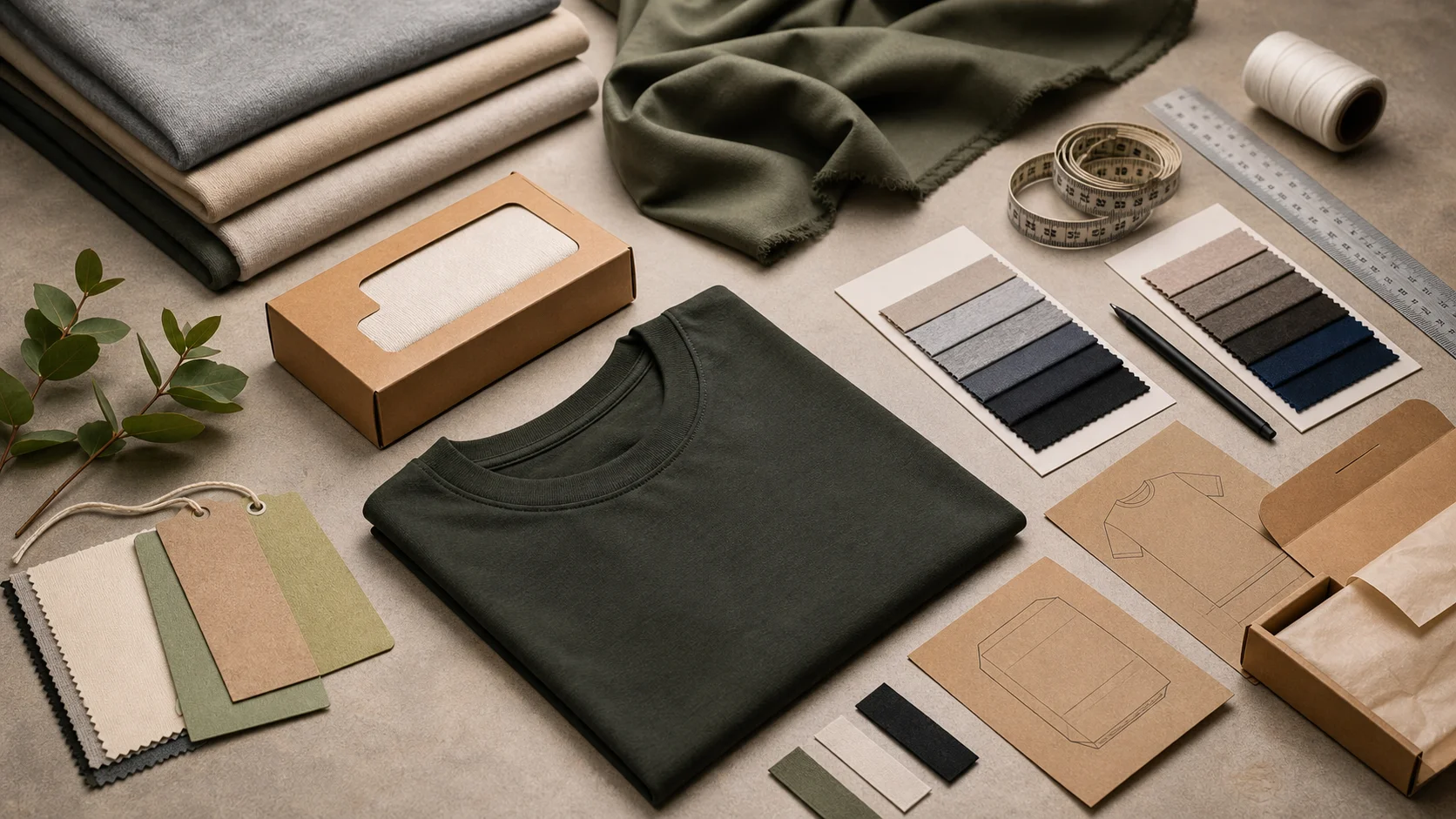
The Packaging for Online Clothing Store with checks for samples, fit, MOQ, QC evidence, pricing terms, and delivery risk.
Fast answer: The Packaging for Online Clothing Store: Material, Print, Packing Flow, and Cost should be judged by production evidence, not by a generic sourcing promise. The buyer needs sample proof, cost breakdowns, QC checkpoints, and delivery buffers in writing.
Ask for recent sample photos, measurement tolerances, fabric or print test assumptions, decoration test notes, packing examples, and a named inspection checkpoint. These details show whether the team can repeat an approved sample at bulk volume.
Separate garment cost, decoration, labels, packaging, sampling, testing, freight, and rush charges. When every cost line is visible, it becomes easier to reduce colorways, adjust size depth, or reserve more time for sampling.
I once watched a 14,000-unit knitwear launch wobble because 2% of the orders landed in crushed poly mailers, with wrinkled ribbed tops and torn corners that made the whole drop look careless. If you're asking what is the best packaging for online clothing store orders, start with damage math, not aesthetics. On paper, the return rate barely moved. In cash, it did. Each return cost the brand $6.40 in labor, $3.10 in outbound freight, and another $2.80 to inspect and rebag.
When I visited factories in Vietnam, Turkey, and Los Angeles, the same pattern showed up at three price points. A $24 tee shipped in a plain poly mailer with a folding insert. A $110 blouse went into a paper mailer plus tissue and a branded sticker. A $280 silk set got a rigid box, tissue wrap, and corner protection that added 220 grams before freight. Not just presentation. Survival. The package had to handle a 1.2-meter drop, a rainy last-mile transfer, and a warehouse stack 8 cartons high.
Premium brands spend more on the reveal. Mid-market brands spend more on consistency. Value brands spend more on speed. I have seen overpackaging cost more than the protection it delivers, especially for soft goods that already travel flat. One factory in Portugal showed me a luxury shirt program that added a rigid lid box costing $1.85 per unit on a garment with only $7.20 FOB value. The box looked expensive. The margins did not forgive it.
What changes in practice is simple. Packaging affects damage rates, return handling, customer reviews, and repeat purchase behavior. A bent collar or damp seam may sound minor, yet a 1-star review often mentions the packing before the fabric. That is why the best packaging depends on product type, shipping method, and price point, not on a brand mood board. For broader garment setup choices, brands often pair packaging decisions with clothing packaging solutions that match their fulfillment model.
The short answer is this: the best format is usually the lightest one that still protects the garment, keeps labor under control, and matches the customer’s price expectations. For a DTC basics brand shipping 500 to 5,000 orders a month, poly mailers still win on cost and speed. For a premium label selling 60 to 200 units per style, a folding carton or rigid mailer can carry enough perceived value to justify the extra $0.70 to $2.40 per shipment. Packaging follows the product, not the fantasy.
Poly mailers are cheapest for soft goods. Volume pricing usually lands around $0.06 to $0.28 each, and they weigh almost nothing. Dimensional weight stays down. They work for tees, leggings, and lightweight knits with tight folding. Paper mailers run about $0.14 to $0.40, and customers often like the feel, but they crush more easily and tear faster in wet transit. Folding cartons usually land around $0.35 to $1.10, depending on print, board grade, and MOQ. Rigid mailers or boxes can reach $1.25 to $4.00 and belong with premium pieces, sets, or anything with hardware that scratches.
Garment bags sit in a strange middle ground. They help with dust and presentation, especially for occasionwear and outerwear, but they often add labor without improving shipping survival. I have seen a $38 blouse packed in a garment bag inside a carton, then shipped 3,200 kilometers only to arrive with the collar crease because no one tested the fold line. Presentation did not save it.
Here is what most people miss: on low-ticket items, a heavier box can increase freight enough to erase the branding benefit. I saw a denim brand in Mexico switch from a 180 gsm paper mailer to a box that added 260 grams per order. Freight rose by $0.34 to $0.52 per parcel, which exceeded the perceived lift on their $42 average order value. For simple DTC basics, light mailers often outperform. For luxury apparel, a box makes sense because the customer expects theater as much as protection. Brands building premium assortments often coordinate with private label clothing services so the garment and package tell the same story.
Recycled paper mailers and compostable films sound cleaner, but they are not automatically better. A compostable bag that splits in a humid depot creates a replacement shipment and a second bag. That is waste with better branding. For sturdier items like denim, outerwear, and structured tops, I rank formats by use case like this:
Margin decides the argument faster than branding does. A packaging system that costs $0.18 per unit at 10,000 pieces can look cheap until freight, labor, storage, and damage are added. I have audited brands where the box itself was not the expensive part. The expensive part was the cubic air inside it. One 28 x 22 x 8 cm carton on a 320 gram shirt can add $0.70 to $1.60 in dimensional weight on domestic routes, and that penalty compounds quickly at 1,500 orders a week.
Here is the practical comparison I use on factory visits. A poly mailer may cost $0.08 to $0.22, a paper mailer $0.16 to $0.38, a branded folding carton $0.40 to $1.20, and a reusable mailer $0.75 to $2.10. But the per-unit price is only part of the story. MOQ 5,000 often gets you better print rates, while MOQ 20,000 can cut unit cost by 18% to 31% in Asia. In Europe, labor tends to cost more, so assembly time matters more. In the U.S., resin and board pricing move with freight and local supply, which makes lead time swings brutal during peak season. If you source through a manufacturer, factory, or supplier in China, ask how production timing changes at each MOQ and whether custom or wholesale runs affect lead time.
Storage footprint matters too. A carton that folds flat at 1,000 units still occupies 2 to 4 pallets, while a pallet of poly mailers can cover 25,000 to 40,000 units in the same warehouse footprint. That changes carrying cost, especially for brands paying $12 to $18 per pallet per month in third-party storage. Labor time is another hidden line. If a box takes 18 seconds to assemble and a mailer takes 7 seconds, that 11-second gap becomes a real expense at scale.
Packaging pays for itself when it reduces complaints, chargebacks, or returns more than it increases freight and handling. I have seen a premium basics label recover a $0.62 packaging upgrade because customer service tickets dropped by 14% and repeat purchase rose 6% over 90 days. That does not happen on every SKU. It happens on categories where presentation is part of the product promise. For lower-priced items, the better move is often smarter folding, tighter carton sizing, and fewer mixed materials. The math is less romantic. It is also more profitable.
For brands shipping across categories like hats, babywear, and apparel, the packaging conversation often sits beside production planning, and vendors that already handle custom hat manufacturing or custom baby clothing manufacturing tend to think more carefully about item shape, fragility, and safety labeling. That operational discipline shows up in lower damage rates.
Sustainability claims are where packaging marketing gets sloppy. Recycled content sounds good, compostable sounds better, and both can be meaningless if the local disposal system cannot handle them. According to Global Organic Textile Standard guidance and related packaging discussions, traceability matters more than slogans, because end-of-life claims collapse fast when materials are mixed or contaminated. I have seen brands print “eco” on a mailer that contained multilayer film, permanent adhesive, and a metalized strip that made recycling impractical in most municipal streams.
Recycled plastic mailers still have a role. They resist moisture, they survive puncture better than many paper alternatives, and they are often lighter than paper. For coastal routes, monsoon seasons, or long-haul shipping with rough handling, a 0.06 mm to 0.08 mm recycled film can protect a garment better than a paper mailer that absorbs water and fails on impact. That matters if a failure means a second shipment and another piece of packaging. Waste is not just material. It is failed logistics. For verified material standards, brands often reference Textile Exchange and OEKO-TEX when evaluating recycled content and chemical safety claims.
Kraft paper mailers and FSC boxes work well for dry domestic shipping, especially when the route is short and the garment is not delicate. But paper has limits. A 1,500 km route with rain exposure, humidity above 70%, and several handoffs can turn a paper mailer into mush. Compostable films face a different problem: many regions still lack industrial composting, so the bag ends up in landfill anyway. Data from trade.gov on sourcing and supply chain shifts also shows how packaging goods move across borders, which affects resin, paper, and board availability more than many founders expect.
The trade-off many brands miss is that a recyclable paper mailer that fails in transit may create more waste than a lighter plastic option that protects the garment the first time. In humid coastal markets, I would choose recycled plastic mailers or coated paper mailers with strong tear resistance. In dry domestic shipping, FSC boxes or kraft mailers can work well for tops, scarves, and accessories. For occasionwear and premium garments, reusable packaging can be justified if the return loop is real and the reverse logistics are documented. If the bag never comes back, it is not reusable. It is expensive theater.
Factory audits back this up. I have checked packaging bins in 8 countries, and the brands with the cleanest outcomes were not always the ones buying the most expensive materials. They were the ones matching material to route, climate, and actual disposal behavior.
A $25 tee and a $250 dress should not ship the same way. That sounds obvious until you inspect a warehouse and see both items packed in oversized cartons because procurement wanted one universal spec. The result is predictable. Cheap products look overpriced. Expensive products arrive underprotected. For apparel, packaging should follow garment behavior. T-shirts tolerate compression. Denim tolerates weight. Knitwear hates sharp folds. Activewear tolerates moisture better than silk. Occasionwear tolerates neither crush nor abrasion.
I have seen the cleanest packing discipline in lower-cost factories in Bangladesh and parts of Central America, where teams standardized folding templates and controlled insert placement to the millimeter. One plant near Dhaka achieved a 0.8% damage rate on basic tees with nothing fancier than tight fold boards, pre-sized mailers, and a 12-second packing sequence. A more expensive factory in Italy, by contrast, was losing 2.4% of orders because it relied on custom boxes that looked elegant but left too much void space. Higher cost did not mean higher control.
Regional differences matter. In Asia, carton sourcing can be fast and cheap, but MOQs are often 10,000 to 30,000 units. In Europe, board quality is often excellent and compliance expectations are high, yet labor can push assembly cost up by 20% to 35%. In Latin America, smaller-run flexibility is often better, but sourcing consistent inserts and printed sleeves can take 4 to 6 weeks longer than founders expect. Cold chain is not the issue. Humidity, crushing, and returns are.
Return costs also vary by category. Basic T-shirts may re-enter stock after a quick rebag and steam, costing under $1.50 to refurbish. Knitwear can need $2.50 to $4.00 in de-pilling, folding, and relabeling. Luxury dresses may require $8 to $15 in inspection and steaming. Those numbers shape packaging decisions more than design teams admit. I have watched brands overspend on glossy inserts for a $32 tee while underinvesting in structure for a $180 dress. That is backwards.
Packaging performance is not just about protecting fabric. It is about matching the cost of failure to the price of the item. A low-ticket product can survive a plain mailer if the fold is disciplined. A high-ticket piece needs more than a pretty box. It needs control.
Packaging should be chosen from data, not mood boards. I have seen founders approve a “luxury” sample in a meeting, then discover that the adhesive failed after 72 hours at 32°C and 85% humidity. Small-batch pilots catch that before the return spiral starts. Run 100 to 300 orders through each package version, then compare damage, complaints, and repurchase behavior over 30 to 45 days.
Test drop resistance first. A simple 1.2-meter drop test on corners, edges, and faces will show you more than a polished render ever could. Then test moisture protection, scuffing, and adhesive failure. If your product ships through hot hubs or rainy routes, add a 48-hour humidity chamber test at 30°C to 35°C and 70% to 85% relative humidity. I have watched paper seals peel, ink smear, and tissue wrinkle in that window. Those failures are expensive in the real world.
Track KPIs that connect packaging to commerce: damage rate, return reason codes, unboxing satisfaction, cost per shipment, and complaint volume. A brand can tolerate a $0.22 increase in packaging if it cuts complaint volume by 20% and reduces refunds by 8%. It cannot tolerate guesswork. Supplier claims should be checked against material specs, GSM, burst strength, recycled content certification, and lead times. Ask for the actual board grade, not just “premium paper.” Ask for the adhesive type, not just “strong seal.”
One more thing. Test the packaging alongside warehouse labor. A format that looks great but adds 9 seconds per order can destroy throughput at peak. That matters whether you ship 2,000 units a month or 20,000. For a factory-backed system that ties packaging to production, I prefer vendors who can explain fold logic, pack sequence, and QC checkpoints in numbers, not adjectives.
Start with a SKU audit. Rank products by damage risk, return cost, and margin sensitivity. Tees, denim, knitwear, activewear, and occasionwear should not sit in the same packaging bucket. Then match each group to one format, one insert standard, and one QC process. I have seen brands save 11% on packaging cost simply by cutting three unnecessary box sizes and standardizing two mailer widths.
Here is a practical rollout. In the first 30 days, review current packaging costs, freight charges, and damage data for your top 20 SKUs. Identify which items ship in oversized cartons, which ones arrive wrinkled, and which ones trigger complaints about presentation. In days 31 to 60, pilot one new format on your highest-volume item, ideally a style with at least 300 monthly orders and a stable return rate. Measure damage, returns, and packing time against the old setup. In days 61 to 90, expand to the next five SKUs if the data holds.
Training matters. Warehouse staff need a packing standard with photo references, not vague instructions. QC sampling should catch at least 1 in 20 orders during the pilot, then 1 in 50 once the system stabilizes. Vendor scorecards should include unit cost, lead time, defect rate, and consistency across 3 lots. I have seen brands lose months because procurement bought the cheapest box, only to discover that 18% arrived crushed before packing even started. If you're comparing custom, bulk, or wholesale packaging runs, ask the supplier for lot-level defect data before you scale production.
Avoid the classic mistakes. Oversized boxes drive freight up. Mixed-material constructions make recycling harder. Heavy branding on low-margin products can eat 4% to 7% of gross profit if you are not careful. Also avoid packaging decisions that confuse the customer about product value. A $28 tee in a luxury rigid box feels odd. A $240 dress in a flimsy mailer feels worse.
My editorial view is simple: the best packaging protects garments, fits the margin, and survives real shipping conditions. Choose the option that does that cleanly, then test it ruthlessly before you buy in volume.
For tees, leggings, and other soft goods, a poly mailer or recycled paper mailer is usually the best balance of cost and protection. In volume, poly mailers often cost $0.06 to $0.28 each and keep freight low because they add very little weight. For dry domestic routes, paper mailers work well if the route is not exposed to heavy rain.
Typical unit costs range from $0.06 to $0.28 for poly mailers, $0.14 to $0.40 for paper mailers, $0.35 to $1.10 for folding cartons, and $1.25 to $4.00 for rigid boxes. Total cost changes with MOQ, labor, freight, and storage. A box that adds 200 to 300 grams can also raise dimensional shipping charges by $0.34 to $1.60 per order.
Premium garments usually need folding cartons or rigid boxes with tissue and a controlled fold. That helps protect the garment from creasing, abrasion, and presentation damage during transit. For items above $100, the extra $0.70 to $2.40 per order is often easier to justify if it reduces complaints and lifts repeat purchase.
Yes, but only if the material matches your route and local disposal reality. Compostable films can work in controlled programs, yet many markets lack industrial composting, so the bag may still end up in landfill. For humid or rainy routes, recycled plastic mailers sometimes protect better and create fewer replacement shipments.
A simple swap can take 3 to 4 weeks if the material is standard and the artwork is ready. Custom printed cartons, new inserts, or special coatings often need 6 to 10 weeks, especially when MOQs are 5,000 to 20,000 units. Pilot testing should happen before full rollout so you do not learn about failures after launch.