
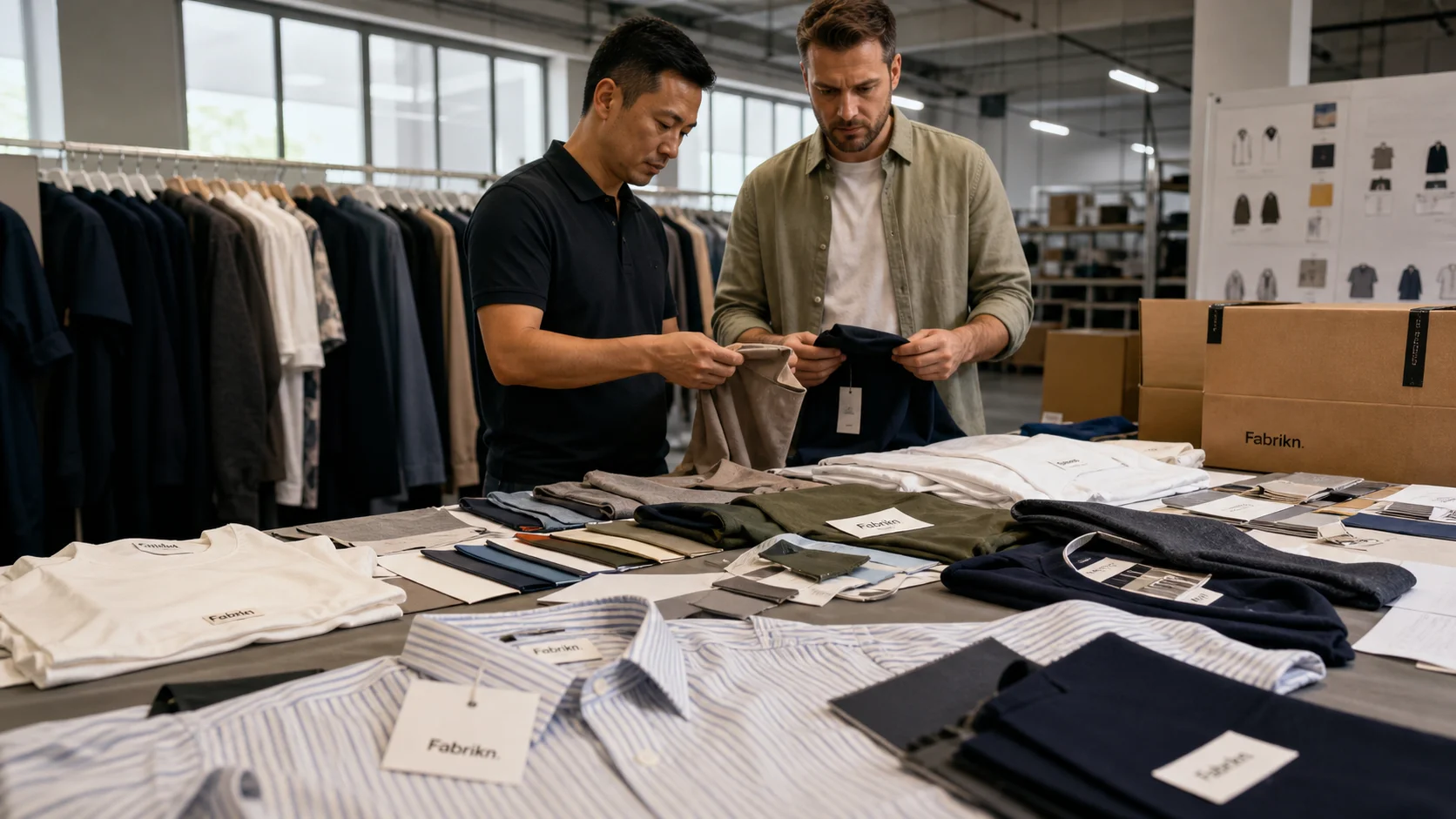
Embossed Apparel Box Packaging for Brands with checks for samples, fit, MOQ, QC evidence, pricing terms, and delivery risk.
Fast answer: Embossed Apparel Box Packaging for Brands: What Works should be judged by production evidence, not by a generic sourcing promise. The buyer needs sample proof, cost breakdowns, QC checkpoints, and delivery buffers in writing.
Ask for recent sample photos, measurement tolerances, fabric or print test assumptions, decoration test notes, packing examples, and a named inspection checkpoint. These details show whether the team can repeat an approved sample at bulk volume.
Separate garment cost, decoration, labels, packaging, sampling, testing, freight, and rush charges. When every cost line is visible, it becomes easier to reduce colorways, adjust size depth, or reserve more time for sampling.
In a Guangdong sample room, a buyer ran her thumb across an embossed lid for three seconds, nodded, and approved it without opening the carton. That is why embossed apparel box packaging for brands still sells at price points from $28 basics to $280 luxury shirts: the package tells the story before the garment does. In my factory notes, raised logos and textured panels kept outperforming loud graphics, especially on rigid structures with tight corners and clean wraps.
I have seen conversion lift estimates of 8% to 18% in gift-led apparel retail tests, with repeat purchase intent climbing another 5% to 9% when customers kept the box. Asian buyers often ask for layered textures and foil combinations that signal craft; North American buyers more often want minimal branding, uncoated board, and easier recycling. Retained packaging tends to sit around 22% to 35% in premium fashion, and that matters because a box that lives on a shelf becomes a second advertisement.
Embossing changes perceived value fast. A 1.5 mm raised mark on rigid board reads as engineered, while a flat printed logo can disappear under fluorescent retail lighting. On a $35 knit top, that difference can justify a $2 to $4 packaging spend; on a $150 shirt, buyers will often absorb $5 to $9 if the unboxing looks refined. I have watched shoppers pick up two similar products, one in a plain folding carton and one in a debossed drawer box, and the second one wins before the fabric is even seen.
Simpler embossing can look more expensive than heavy ink coverage on uncoated board. The quiet finish feels intentional. Heavy ink often looks like a compromise unless the print is flawless, which is rare at 6-color coverage and tight registration tolerances. For brands already investing in custom clothing packaging solutions, the texture decision can carry as much weight as the garment tag.
Luxury cues are not about decoration alone. They are about restraint, density, and touch. When I visited a manufacturer producing for premium shirting and tailored separates, the winning packs used 1200 gsm greyboard, 157 gsm wrap paper, and a single blind emboss rather than three print effects competing for attention. That kind of packaging pairs especially well with private label clothing, where the product story needs calm, not noise.
Embossed apparel box packaging for brands works because it compresses several signals into one object: weight, texture, and precision. Even mass-premium labels can borrow that language. I have seen $18 hosiery boxes upgraded with a 0.8 mm debossed pattern and soft-touch wrap, then sell at a 12% higher average ticket in department store programs. The box is never just a box. It is a pricing cue.
Embossed apparel box packaging for brands covers more than a raised logo. It includes construction, board selection, finishing stack, and the way the garment sits inside. I usually separate it into rigid set-up boxes, folding cartons, drawer boxes, and mailer-style apparel boxes. Rigid boxes use greyboard from 1000 gsm to 2000 gsm, wrapped in specialty paper, kraft, or printed art paper. Folding cartons rely on paperboard around 300 gsm to 450 gsm and are cheaper, faster, and lighter.
Finish combinations matter. Blind embossing raises an area without ink or foil. Registered embossing aligns the relief with printed artwork, which demands tighter tolerances. Foil stamping adds metallic or pigment shine. Spot UV adds contrast, while lamination changes sheen and durability. For luxury shirts, knitwear, gifting, and seasonal drops, a drawer box or rigid lid-and-base format works best. For hosiery, scarves, and accessories, a folding carton often gives enough impact without blowing the freight budget.
Blind embossing looks understated. Debossing presses into the surface and can hide fingerprints better on uncoated papers. Foil stamping works well for logos under 30 square centimeters, but larger fields raise reject risk because foil cracks at sharp folds. Soft-touch lamination feels rich, though it can make recycling harder if a brand adds plastic film over a fiber board. I have seen brands combine a 1.2 mm emboss with matte paper wrap and no foil, then get a cleaner premium response than boxes loaded with three finishes.
Design complexity affects defect rates. A logo with thin serifs, a pattern aligned to a corner wrap, and a deep emboss all raise the chance of misregistration. Die costs typically start around $80 to $250 for simple shapes and can rise to $500 or more for intricate tooling. In apparel packaging, the best-performing specs are often the least fussy. The more moving parts you add, the more production risk you buy.
Rigid boxes feel expensive because they are expensive to make. They use thicker board, more glue, more wrap labor, and usually a longer hand-finish process. Folding cartons are lighter and more efficient for mailer programs and high-volume retail replenishment. I have seen brands choose rigid boxes for launch kits and then switch to folding cartons for replenishment once the market proved the concept. That is usually the right move.
Some categories almost always justify rigidity. Tailored shirts, cashmere knits, gift sets, and premium lounge sets gain from a structured pack. Accessories and entry-price apparel usually do better in a well-designed carton. A brand producing custom bra manufacturing lines, for example, may want delicate inserts, low-profile folds, and a carton that protects shape without excessive material use.
Costs move quickly once embossing enters the spec. At 500 pieces, a rigid embossed box often lands around $2.40 to $5.80 per unit, depending on size, board thickness, and finish stack. At 2,000 pieces, that range can fall to $1.35 to $3.40. At 10,000 pieces, I have seen strong factory pricing between $0.78 and $2.10 for simpler structures, with premium drawer boxes sitting higher. The first 1,000 units carry the heaviest setup burden, and that is where most buyers underestimate their landed cost.
Fixed costs include dielines, samples, plates, dies, and sometimes engraving for foil tools. Sampling may run $60 to $180 per round. A custom embossing die can cost $120 to $400. Freight adds another layer: 500 boxes shipped by air may add $0.60 to $1.50 per unit, while ocean shipping on larger runs may add $0.08 to $0.25 per unit, depending on box size and consolidation. QC inspection can add $250 to $600 per visit, especially if a third-party team checks 1,200 to 2,000 units against AQL standards.
Domestic production usually gives faster feedback and lower communication friction, but labor can be 20% to 45% higher than offshore options. Offshore production can reduce unit cost, yet lead times stretch by 3 to 6 weeks once shipping and customs are added. I have worked with brands that saved $0.70 per unit by moving production overseas, then spent $0.18 more on inspections and $0.32 more on buffer freight. The saving was real, but not dramatic.
Board thickness changes everything. Moving from 1000 gsm to 1400 gsm greyboard can increase unit cost by $0.10 to $0.35, depending on scale. Specialty wrap paper can add $0.08 to $0.45. Inserts are cheap if they are paper-based, but foam or flocked trays can add $0.25 to $1.20. Multi-process finishing, such as emboss plus foil plus spot UV, can raise cost by 15% to 30% at low volume.
Embossing itself is not always the most expensive line item. The real cost comes from precision. Deep relief, multi-level art, and tight registration drive setup time and increase scrap. Simple blind embossing on a single logo panel may add only a small premium over standard print. A wrap with large flood ink, by contrast, can consume more labor, more ink, and more rejection risk than a restrained embossed surface.
That is why brands should quote specs, not assumptions. One supplier may price a 300-piece seasonal box at $4.90 because the file uses a full-coverage print and insert. Another may offer $2.70 for a cleaner 2-color board with a 1 mm emboss. To compare properly, ask for identical dimensions, wrap paper, insert type, and freight terms. Brands planning long-term private label clothing programs should also plan re-order cost, not just launch cost.
Premium embossing and sustainability are not enemies, but they do need discipline. Recycled fiber board, FSC-certified paper, and fiber-based inserts support strong premium presentation without forcing brands into plastic-heavy structures. Coated papers can hold sharper emboss detail, though uncoated papers feel more natural and usually recycle more easily. I have seen 1200 gsm recycled greyboard with a 157 gsm FSC wrap produce a cleaner result than virgin board dressed up with plastic lamination.
Data from FSC and OEKO-TEX shows how certification has become part of apparel trust, not just packaging talk. Still, factory claims can be vague. In Europe, buyers often ask for chain-of-custody documents, recycled content percentages, and proof that adhesives and inks do not block recyclability. Some Asian suppliers still hand over certificates that say very little about the actual board. I have had to chase mill invoices to verify a 30% recycled content claim more than once.
Plastic-free finishes are possible, but not automatic. Water-based coatings, unlaminated wraps, and paper inserts keep end-of-life simpler. The trade-off is surface sensitivity. An emboss deeper than 1.8 mm can weaken fibers if the board is too soft, especially on recycled stock with shorter fibers. That is why a recycled board needs testing before a brand approves a run of 5,000 or 20,000 units.
Freight weight matters too. A rigid box can add 180 grams to 420 grams per unit depending on size, and that weight multiplies quickly over a container. At 10,000 units, the difference between a 180-gram carton and a 320-gram rigid box can mean 1.4 to 2.0 metric tons of extra shipped material. That affects cost, carbon, and storage. Brands that care about scale should also ask whether the package is shipping or staying in store. Those are not the same decision.
Here is what most people miss: the greenest-looking box can be the least practical if the glue, film, or foil blocks recovery. In my visits, I found that a simple FSC wrap with soy-based inks and paper insert often performed better in recycling tests than a box with soft-touch film and metallic foil. The difference showed up in tear behavior, not marketing copy. Recyclability is a material system, not a slogan.
For suppliers who already handle custom private label clothing programs, the best packaging partners are usually the ones willing to document board origin, adhesive type, and ink coverage in writing. That documentation matters more than a badge on a sample card.
Embossing defects show up fast under overhead light. The common failures are crushed embossing, misregistration, uneven foil, color drift, warped boards, loose wraps, and corner split. On the factory floor, humidity above 65% can soften board edges, while adhesive choice changes how well the wrap holds at the spine and hinge. Die wear also matters. After 8,000 to 12,000 impressions, a tired die can flatten detail enough to ruin a luxury look.
Luxury buyers often reject flaws invisible at one meter, especially on black wraps and metallic foil. Mass-premium buyers tolerate more, but they still expect corners to sit square within 1.5 mm to 2 mm. I inspect samples by checking the emboss depth, foil alignment, and glue bleed at the edges. If the lid rocks, if the logo is off by more than 0.8 mm, or if the wrap pulls at the corner, I do not approve it.
Pre-production, mid-run, and packing-stage inspections catch different problems. Pre-production shows dieline errors and paper mismatch. Mid-run catches process drift and operator variation. Packing-stage checks spot crushing, scuffing, and mixed lots. A good factory will hold a 50-piece pilot, then run a 200-piece control batch before committing to full volume. I have seen this save brands from a 4,000-unit rework when the foil pressure was set too high.
For apparel packaging tied to cut and sew manufacturing, sample timing also matters. A box approved too early may fit the first size set but fail once fold volume changes. Keep the garment fold method in the brief.
A standard run usually takes 3 to 5 weeks from dieline approval to sample delivery, then another 4 to 7 weeks for production, plus shipping. Domestic programs can move in 2 to 4 weeks for samples and 2 to 3 weeks for making. Overseas programs often need 10 to 16 weeks total once ocean freight is included. Rush orders are possible, but they narrow paper choice, increase air freight, and leave less room for corrections.
More premium finishing does not always mean longer total lead time if the supplier controls printing, die-cutting, embossing, and gluing in-house. I have seen one factory shave 6 days off a schedule because the whole process stayed on one site. By contrast, a fragmented supply chain can add 7 to 12 days simply through handoffs. For a seasonal launch, that difference is everything.
Custom dies, foil approval, and paper sourcing are the slow steps. A special wrap paper may need 10 to 14 days to source, while foil color matching can take 2 sample rounds. Small runs of 300 to 1,000 pieces may fit into 2 to 3 weeks if the box is simple and the factory stocks board. Ongoing replenishment is easier. Once the spec is locked, re-orders can move 25% to 40% faster because tooling already exists.
Brands that run apparel alongside custom cut and sew manufacturing services should align packaging approval with garment PPS approval, not after it. That saves rework and prevents box dimensions from chasing the product.
Start with a clear brief. I tell brands to define retail channel, target unit cost, order volume, garment type, and sustainability requirements before asking for samples. A luxury e-commerce label might target $3.50 to $6.50 per box at 1,000 units. A high-volume basics brand may need to stay under $1.25 at 10,000 units. Those are different jobs. If you do not set the ceiling early, suppliers will quote to the highest possible finish stack.
Your brief should include dimensions, fold method, artwork files, finish specs, budget ceiling, insert needs, and test pack requirements. Ask for carton strength if the box ships by mail. Ask for compression data if it stacks in a retail back room. Ask for a sample with the garment inside, not just an empty shell. That is how you catch the real problems. I have seen boxes approved empty, then fail once a hoodie added 140 grams and changed the lid fit.
When comparing quotes, normalize the details. One supplier may include freight, one may not. One may quote 1200 gsm board and another 1000 gsm. One may include a foam insert while another uses paperboard. Always compare the same carton size, same emboss depth, same wrap, same insert, same shipping terms. If you cannot get apples-to-apples, the price is meaningless.
Startups should favor 300 to 1,000 piece pilots unless they have confirmed replenishment demand. Established labels can tolerate 5,000 to 20,000 unit runs, but they must plan storage, cash flow, and re-order windows. I have seen small brands lock too much capital in packaging, then miss garment production because the box was over-designed. Packaging should support sell-through, not tie up the balance sheet.
Last year I worked with a brand that moved from a glossy folding carton to a restrained embossed rigid box, then tested both in two regions. The premium box won in Asia by 14%, but the simpler recyclable version outperformed in North America by 9%. Different buyers. Different cues. Same product. That is the real lesson behind embossed apparel box packaging for brands: match the pack to the market, not to your mood board.
At 500 pieces, expect roughly $2.40 to $5.80 per unit for a rigid embossed box, depending on size, board, wrap, and finishing. At 10,000 pieces, simpler versions can drop to $0.78 to $2.10. The largest cost driver is usually setup and tooling on the first 1,000 units.
Simple domestic programs can finish in 4 to 6 weeks total. Overseas production usually takes 10 to 16 weeks once samples, production, and shipping are included. Custom dies, foil approval, and specialty paper sourcing are the main sources of delay.
Yes, if you use recycled fiber board, FSC-certified paper, and paper-based inserts. Avoid plastic lamination and heavy foil if recyclability is a priority. A rigid box can still be sustainable, but it will add 180 to 420 grams of material per unit, so freight and carbon should be planned carefully.
Many suppliers will quote 300 to 500 pieces for a pilot run, but 1,000 pieces is a more efficient starting point. At that volume, tooling costs are spread better and the price per box becomes easier to control. Premium rigid structures often become much more efficient at 2,000 to 5,000 pieces.
For a clean premium look, blind embossing on matte or uncoated paper is often strongest. Foil works well for logos, but it raises complexity and can increase defect risk. If the brand wants a more tactile feel with easier recycling, a simple emboss plus paper wrap is usually the safest choice.
For brands evaluating suppliers, ask the manufacturer, factory, or supplier to provide samples, production timelines, MOQ details, and quality notes in writing. If you are sourcing wholesale or bulk packaging from China, compare board, finish, and freight on the same spec sheet. For broader sustainability verification, review Textile Exchange standards for responsible materials, U.S. trade and customs guidance, and OEKO-TEX certification resources.