
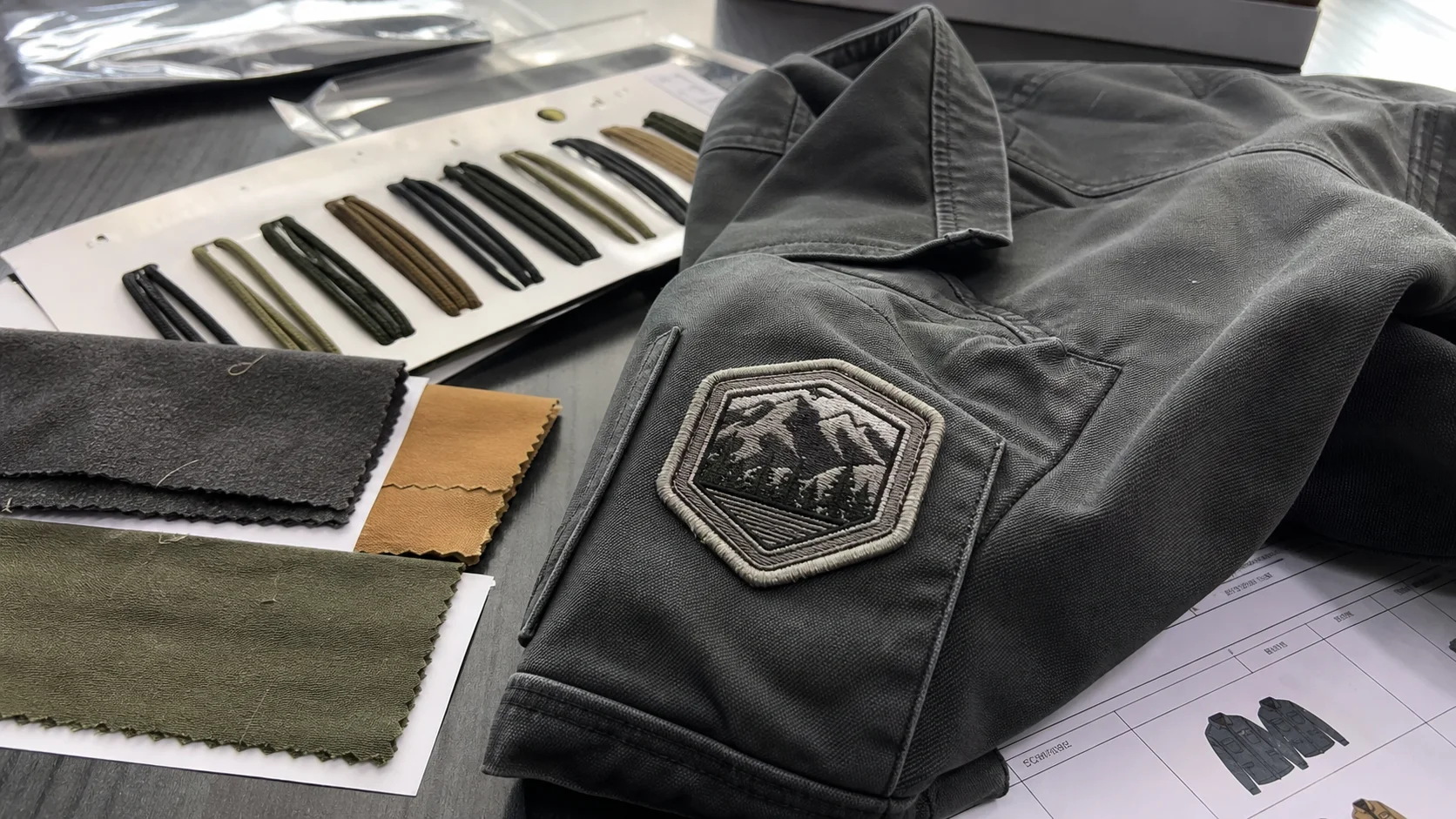
A distributor-focused outline for inspecting embroidered jacket patches under AQL, covering artwork, stitching, backing, attachment readiness, labeling,...
Embroidered Jacket Patch AQL Checklist for Buyers - Decoration & Printing manufacturing guide
For distributor buyers, embroidered jacket patches are small components with outsized commercial risk. A patch that looks acceptable on a factory table can become a return issue once it is sewn onto jackets, packed by size, and shipped to retail or corporate buyers. Thread shade, border density, backing stiffness, placement accuracy, adhesive behavior, and loose yarns all affect whether the finished jacket looks premium or cheaply decorated.
This embroidered jacket patch AQL inspection checklist is written for sourcing teams, wholesalers, promotional apparel distributors, uniform buyers, and private-label brands that need a practical quality control framework before bulk shipment. It focuses on patch decoration and attachment quality, not just general jacket workmanship. The goal is simple: define what to check, when to check it, how to classify defects, and where buyers should be strict.
Buyers sourcing custom embroidered jackets can use this guide alongside factory specifications, approved samples, purchase orders, and third-party inspection reports. For broader apparel production support, buyers can review Fabrikn’s services, learn more about sourcing background on Fabrikn’s about us page, or discuss project requirements through Fabrikn’s contact page.
AQL stands for Acceptable Quality Limit. It is a sampling method used to decide whether a production lot should be accepted, rejected, sorted, or reworked. For embroidered jacket patches, AQL is useful because inspecting every single jacket is often too slow and expensive, especially for distributor orders with multiple sizes, colors, and customer logos.
AQL does not mean defects are acceptable from a brand perspective. It means the buyer and supplier agree on a statistical threshold for shipment release. If the inspection finds defects above that threshold, the lot fails and needs corrective action. For high-visibility embroidery on jackets, buyers should treat AQL as a control tool, not a replacement for strong pre-production approval.
Patch decoration has a different risk profile from plain jacket sewing. A slightly uneven inside seam may never be noticed by the end customer. A crooked chest patch, wrong thread color, or puckered backing is visible immediately. Distributor buyers often sell to corporate programs, schools, clubs, hospitality teams, outdoor groups, and event organizers. Those customers compare decorated garments side by side. Inconsistent patches can damage repeat business.
Practical buying rule: the patch must be judged as part of the jacket, not as a separate decoration. A good patch attached badly is still a failed finished product.
An embroidered jacket patch AQL inspection should cover three areas: the patch itself, the jacket area where it is applied, and the finished garment after decoration. Many quality problems come from the interaction between these three elements. A dense patch may be technically well embroidered but too stiff for a lightweight nylon shell. A heat-applied backing may hold on cotton canvas but fail on water-resistant polyester. A merrowed edge may look clean on a flat patch but distort when sewn over a curved chest panel.
Distributor buyers should define the inspection scope before production starts. If the purchase order only says “embroidered patch on left chest,” there is too much room for interpretation. A reliable inspection checklist needs clear artwork, patch dimensions, thread references, placement tolerance, attachment method, backing type, and packaging requirements.
This checklist does not replace laboratory testing for restricted substances, flammability, nickel content, wash durability, or adhesive bond strength where those tests are required by the buyer’s market. It also does not replace legal review of licensed logos or trademark usage. AQL inspection is a shipment decision tool; compliance requirements should be handled earlier in the development process.
AQL inspection works best when the buyer has already approved a clear standard. Without a signed sample or detailed tech pack, inspectors are forced to make judgment calls. That usually leads to disputes after the inspection report is issued.
For embroidered jacket patches, pre-production approval should be more disciplined than for simple printed artwork. Embroidery depends on stitch density, pull compensation, thread direction, backing, fabric tension, and digitizing. A flat digital mockup is not enough.
Small text is one of the most common pre-production risks. Embroidered lettering under roughly 4 to 5 mm height can become unclear depending on font, stitch type, and fabric. Fine serif fonts, tight curves, and multiple color outlines often need simplification. Buyers should not assume that artwork designed for print will work well as embroidery.
MOQ depends on patch complexity, thread colors, backing material, edge finish, jacket style, and whether the supplier is producing jackets from scratch or decorating blank stock. For distributor buyers, typical MOQ ranges may look like this:
Order Type Typical MOQ Range Buyer Notes Loose embroidered patches only 100 to 300 pieces per design Lower MOQ is possible for simple designs, but unit cost rises quickly. Patch attached to stock jackets 50 to 200 pieces per logo Best for distributor programs with short timelines and limited size runs. Custom jackets with embroidered patches 300 to 1,000 pieces per style/color Fabric sourcing, dyeing, trims, and pattern work usually drive MOQ. Multi-logo distributor program Varies by logo and base jacket Consolidating jacket fabric and trims can help, but patch MOQ may still apply per design.These ranges are not fixed rules. A supplier may accept lower quantities if fabric is in stock, thread colors are standard, and patch setup is simple. The tradeoff is usually higher unit price, fewer customization options, and less room for production trials.
Lead time for embroidered jacket patch orders depends on more than embroidery machine capacity. Buyers should confirm the full production path. For stock jackets with simple chest patches, sampling and bulk decoration may move quickly. For custom jackets with special fabric, lining, zippers, snaps, and multiple patch placements, production can take much longer.
Holiday periods, fabric dyeing, special thread sourcing, waterproof coatings, embroidery density, and repeated sample revisions can extend lead time. Buyers working toward event dates should build in a buffer for inspection failure and rework. A tight delivery schedule is not a reason to lower quality standards; it is a reason to approve samples earlier.
Most apparel inspections use ISO 2859-1 or ANSI/ASQ Z1.4 sampling tables. The buyer selects an inspection level and AQL limits for critical, major, and minor defects. For embroidered jacket patches, many buyers use General Inspection Level II for standard final random inspection. General Level I may be considered for repeat programs with stable suppliers and low-risk designs. Level III gives more sample coverage for high-value orders, first-time suppliers, or complex multi-logo programs.
A cautious distributor buyer should not rely only on final random inspection. Inline inspection is valuable when patch placement, thread shade, or attachment quality has shown variation. Catching a crooked patch after 50 pieces is manageable. Catching it after 5,000 pieces is a costly argument.
For premium retail, corporate uniform, or licensed brand orders, AQL 1.5 for major defects is usually more appropriate than 2.5. For low-cost promotional jackets, buyers may accept AQL 2.5 major if expectations are clearly set. Critical defects should stay at zero acceptance.
Distributor buyers often order multiple size ratios and several logo versions. Sampling must cover that mix. If the inspector checks only medium navy jackets with one logo, the report may miss placement problems on small sizes, contrast issues on black jackets, or spelling mistakes on regional logo versions.
The checklist below is designed for final random inspection and can also be adapted for inline checks. It should be used with an approved sample, measurement sheet, artwork file, purchase order, packing list, and carton marks.
Quantity issues are common in distributor programs because different logos may be produced in small batches. One missing size or wrong logo allocation can disrupt an entire customer rollout.
Logo accuracy should be treated as a major issue at minimum. For licensed, corporate, or government uniform programs, wrong logo use can become a critical commercial issue because the buyer may not be allowed to sell or distribute the goods.
A slightly oversized patch can interfere with pocket seams, zippers, snaps, or panel curves. A slightly undersized patch may look cheap or fail to cover a required placement area. Buyers should set realistic tolerances based on patch size and production method.
Overly dense embroidery can cause puckering, stiffness, and needle damage. Low density can expose backing or base fabric. The best standard is the approved physical sample, supported by practical defect limits in the inspection checklist.
Thread shade can change under warehouse lighting, daylight, and retail lighting. For corporate colors, buyers should provide a physical thread reference where possible. Pantone references help with communication but do not guarantee exact embroidery thread matching.
Edge defects become more visible after jackets are packed and compressed. Rough edges can also catch during wear. For premium jackets, edge finish deserves strict inspection because it frames the entire decoration.
Backing choice should match the jacket fabric and end use. A stiff patch can work on varsity wool or canvas workwear but look awkward on lightweight nylon. Heat-seal backing may not be suitable for coated, textured, or water-resistant fabrics unless tested.
Common placement tolerance is plus or minus 5 mm for many commercial jacket programs, though premium or technical garments may require tighter control. Buyers should be careful with chest patches on small sizes because pocket placement, darts, or panel seams can make the same measurement look visually different.
Sewn attachment is usually more durable and more forgiving across fabric types. Heat application can be cleaner and faster, but it depends on temperature, pressure, dwell time, adhesive chemistry, and fabric compatibility. Velcro systems add flexibility but also add cost, bulk, and alignment risk.
Decoration should not downgrade the jacket. A well-made jacket can fail inspection if patch attachment causes puckering, burns, or visible damage. Inspectors should look at the garment from normal wearing distance and close range.
Clear defect classification prevents arguments during inspection. Buyers should define what is critical, major, and minor before the inspector opens cartons. The same defect can be classified differently depending on customer expectations, brand positioning, and sales channel.
Critical defects should have zero acceptance. A distributor buyer should not ship goods with safety or legal risk, even if only one sample is affected.
Major defects affect saleability. For distributor buyers, major defects often create direct customer complaints because decorated jackets are usually ordered for a specific group or event. Replacing a few pieces after delivery can be expensive if the jacket or patch batch is no longer available.
Minor defects should still be tracked. If minor issues appear repeatedly, they may indicate machine tension problems, poor trimming, or weak final QC at the factory.
A good patch specification sheet reduces inspection ambiguity. It should be simple enough for factories to follow and detailed enough for inspectors to enforce. Distributor buyers should attach this sheet to the purchase order and approved sample record.
Specification Item What to Define Inspection Risk if Missing Patch size Width, height, shape, tolerance Inconsistent scale and poor garment balance Artwork Vector file, version number, logo orientation Wrong logo, outdated artwork, distorted proportions Thread colors Thread codes or approved physical thread standard Shade mismatch and customer rejection Base fabric Twill, felt, canvas, polyester, or other base Wrong texture, stiffness, or durability Backing Sew-on, heat-seal, Velcro, adhesive, no backing Attachment failure or unsuitable hand feel Edge finish Merrowed, satin stitch, laser cut, folded Fraying, uneven border, poor appearance Placement Measurement points and tolerance Crooked or inconsistent decoration Attachment Stitch type, thread color, heat press settings, Velcro position Loose patch, garment damage, poor durability Packaging Folding method, polybag, carton assortment Crushed patches, mixed sizes, wrong logo allocationFabric and trim specs should also be connected to patch decisions. A coated polyester shell may need lower heat exposure. A thick sherpa lining may make patch sewing harder. A metal zipper or snap near the patch can affect placement. A quilted jacket may need reinforcement or special handling to avoid catching insulation during stitching.
Final AQL inspection tells buyers whether the shipment is acceptable. Process checks help prevent the shipment from failing. For embroidered jacket patches, the factory should control digitizing, patch production, trimming, attachment, pressing, and packing as linked steps.
Digitizing is the translation of artwork into stitch instructions. Poor digitizing can ruin a good logo. Buyers should ask suppliers to confirm stitch type, density, underlay, pull compensation, thread sequence, and expected limitations. This is especially important for small lettering, outlines, gradients, and detailed icons.
Patch production should include trimming and edge checks before attachment to jackets. Loose threads, uneven edges, and shade variation are easier to fix before the patch is sewn or heat-applied. Once attached, repair becomes slower and may damage the garment.
Attachment line workers need clear placement guides. Chalk marks, templates, jigs, laser guides, or printed placement boards can reduce variation. Measuring every piece by hand is slow and inconsistent unless operators are well trained.
Packing can create patch damage after production is complete. Raised embroidery can be crushed, distorted, or indented if jackets are folded tightly under heavy cartons. Heat-applied patches may lift if packed before cooling. Velcro patches can snag nearby fabric or labels if not covered.
Mixed carton errors are especially costly for distributors. A jacket with the right size but wrong branch logo may not be noticed until the customer distributes the order. Inspection should include carton assortment verification, not only product appearance.
Embroidered jacket patch inspections often fail for predictable reasons. Buyers can reduce these risks by writing better specifications and pushing suppliers to check earlier.
A fixed measurement may not look visually balanced across all sizes. Small jackets have less chest area, while larger jackets may have wider panels and pocket spacing. For left chest patches, buyers should define both measurement points and visual expectations. A size run sample is useful when the order includes a wide size range.
Many jackets use polyester, nylon, coatings, water-resistant finishes, or quilted insulation. Heat pressing can create shine marks, color change, flattening, or adhesive migration. Buyers should require a heat application test on actual bulk fabric before approving heat-seal patches.
Dense embroidery can look premium on a patch by itself but stiff or puckered on a jacket. Heavy stitch coverage also increases machine time and cost. Buyers should balance appearance with flexibility, especially for lightweight jackets or curved body areas.
Screen colors are not production standards. Embroidery thread has texture and luster, and different thread suppliers may not match exactly. For brand colors, buyers should approve a physical sample and keep it as the inspection reference.
Small text is one of the most frequent embroidery complaints. Buyers should avoid forcing print-level detail into thread. If the wording must be readable, simplify the font, increase patch size, reduce outlines, or consider woven patches instead of embroidery.
One loose thread may be minor. Many loose threads indicate weak trimming or stitch security. If loose threads appear near border seams or lettering, they can become major defects because unraveling may continue during wear.
Buyers should be realistic about the relationship between design complexity, price, MOQ, and inspection risk. A detailed multi-color logo with tiny lettering, metallic thread, merrowed border, and heat-seal backing will cost more and carry more risk than a simple two-color chest patch. If the target price is low, simplify the design before squeezing the supplier.
Sewn patches are usually the safer choice for durability, especially on work jackets, varsity jackets, and outerwear that will be washed or worn heavily. The tradeoff is visible stitching on the inside or outside, longer labor time, and possible lining handling. Heat-applied patches can produce a clean finish and faster output, but buyers need confidence in adhesion and fabric compatibility. Velcro patches are useful for uniforms and removable identification, though they feel bulkier and can snag.
Premium buyers should be strict on placement, edge quality, shade consistency, and garment damage. Promotional buyers may accept slight stitch variation if the logo is readable and the patch is secure. Uniform buyers should prioritize durability, repeatability, and reorder consistency. Retail buyers need both appearance and shelf presentation.
MOQ negotiation also has tradeoffs. Very low MOQ may push suppliers to use available thread, standard backing, or manual placement methods. That may be acceptable for a small local event order but risky for a distributor program with repeat customers. Buyers should decide where flexibility is acceptable and where the standard must not move.
Direct sourcing judgment: if the logo is complex and the jacket fabric is technical, spend time and money on sampling. A failed bulk inspection costs more than a proper pre-production approval.
A distributor buyer can structure the inspection process in four stages. This keeps quality control practical without overloading every order with unnecessary checks.
This workflow is especially useful for distributor buyers managing multiple customers or repeat programs. It creates a record that can be reused for reorders and helps prevent the same defect from returning.
Shipment release should be based on evidence, not pressure. If the inspection fails because of fixable loose threads, a controlled trimming and reinspection plan may be enough. If the lot fails because of wrong logos, damaged fabric, poor adhesion, or widespread placement error, accepting shipment usually transfers the problem from factory floor to distributor warehouse.
An embroidered jacket patch AQL inspection checklist gives distributor buyers a practical way to control decoration quality before goods leave the factory. The most important checks are logo accuracy, patch construction, stitch quality, edge finish, backing suitability, placement, attachment strength, garment condition, and packing accuracy.
The strongest results come from combining AQL inspection with disciplined sample approval. Buyers should approve physical patch samples, test attachment on actual jacket fabric, define realistic tolerances, and classify defects before production starts. Final inspection is then a verification step, not the first time quality expectations are explained.
For distributor buyers, the commercial lesson is clear: embroidered patches are not minor trims. They are visible brand markers. Treat them with the same control as fabric, fit, and garment construction, and the finished jackets are far more likely to pass inspection, satisfy customers, and support repeat orders.
Get a free quote from Fabrikn — your trusted B2B clothing manufacturer with 10+ years of experience. MOQ as low as 200 pieces.
Get a Free Quote →Many distributor buyers use General Inspection Level II with AQL 0.0 for critical defects, 1.5 or 2.5 for major defects, and 4.0 for minor defects. Premium, licensed, or uniform programs should usually use stricter major defect limits.
Both stages are useful. Inspect patches before attachment to catch embroidery, edge, backing, and shade issues. Inspect finished jackets after attachment to check placement, garment damage, adhesion, sewing security, and final appearance.
A common commercial tolerance is plus or minus 5 mm from agreed reference points, but this depends on jacket style, patch size, and buyer expectations. Premium orders may require tighter control. The tolerance should be written into the specification before production.
They can be reliable when adhesive, fabric, temperature, pressure, and dwell time are properly tested. They are riskier on coated polyester, nylon, textured fabrics, and water-resistant shells. Buyers should test heat application on actual bulk fabric before approving production.
Common major defects include wrong logo, wrong thread color, unreadable lettering, patch placement outside tolerance, open attachment stitching, edge lifting, severe puckering, fabric damage, and visible stains or adhesive marks.
Buyers can reduce failures by approving a physical sample, simplifying small details, defining patch specs clearly, checking first bulk output, using placement templates, and running inline inspections before final random AQL inspection.
Loose embroidered patches often start around 100 to 300 pieces per design. Stock jackets with attached patches may start around 50 to 200 pieces per logo. Custom jacket production usually requires higher MOQ, often 300 to 1,000 pieces per style or color depending on fabric, trims, and supplier setup.
Buyers should provide the purchase order, packing list, approved artwork, patch specification sheet, approved physical sample, placement measurements, size breakdown, carton marks, and any special testing or packaging requirements.