
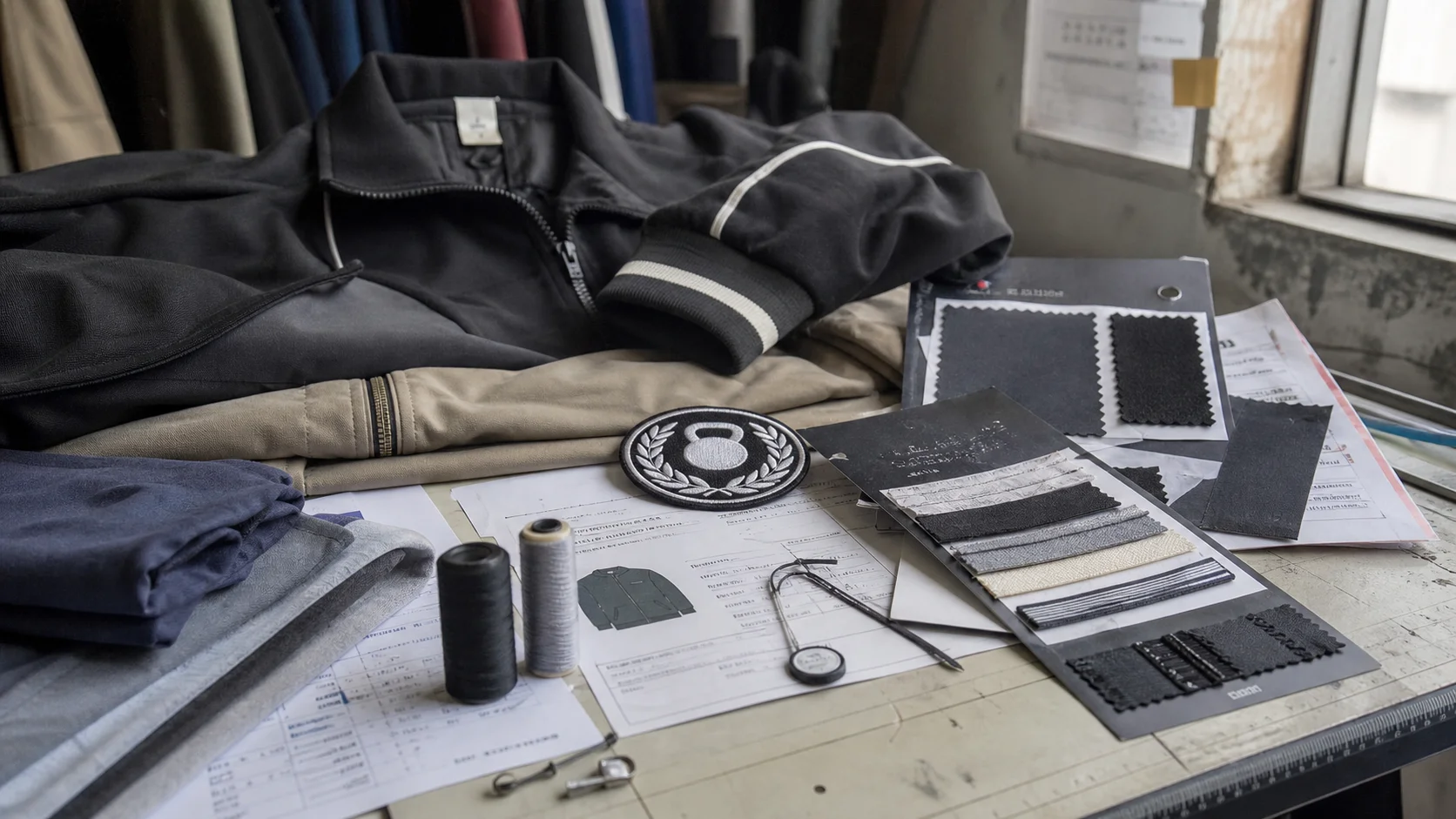
A practical landed cost outline for fitness club buyers sourcing embroidered jacket patches, covering patch specs, decoration variables, freight, duties,...
Embroidered Jacket Patch Cost Guide for Fitness Clubs - Fabrikn production reference
For fitness club buyers, embroidered jacket patches look simple until the first quote arrives with setup charges, minimums, sample fees, backing options, freight, and import duties listed separately. The real question is not only “What does the patch cost?” It is “What is the landed cost per jacket once the patch is designed, approved, produced, shipped, applied, inspected, and delivered?”
This embroidered jacket patch landed cost guide is written for gym chains, boutique fitness studios, sports clubs, wellness groups, and franchise buyers planning branded outerwear. It focuses on practical sourcing decisions: patch type, stitch coverage, size, MOQ, jacket fabric compatibility, application method, lead time, quality risks, and cost control.
For buyers who are sourcing complete decorated apparel rather than patches alone, it is usually worth discussing decoration options early with a manufacturer. Fabrikn’s services page is a useful starting point for reviewing broader apparel production and decoration support.
Landed cost is the full cost of getting the finished decorated product to your receiving point. For embroidered jacket patches, it may include more than the patch itself. A buyer comparing patch quotations should confirm whether the supplier is quoting loose patches, patch application on jackets, or finished jackets with patches already sewn or heat-applied.
A practical landed cost calculation usually includes:
Purchasing judgment: do not compare a loose patch quote against a finished jacket quote. The cheaper number may exclude the costliest part of the process: attaching the patch neatly and consistently to production garments.
Patch pricing varies by country of production, size, stitch density, backing, order volume, and artwork complexity. The ranges below are broad planning references, not guaranteed quotations. Buyers should use them to estimate budgets before requesting formal pricing.
Patch Type / Size Typical MOQ Indicative Patch Unit Cost Common Use Small embroidered patch, 2–2.5 inches 100–300 pcs US$0.60–US$1.80 Chest logo, sleeve badge, trainer name mark Medium embroidered patch, 3–4 inches 100–300 pcs US$1.20–US$3.50 Club crest, event patch, membership tier badge Large embroidered patch, 5–7 inches 100–500 pcs US$2.80–US$7.50 Back jacket patch, team identity, staff outerwear High-density or 3D embroidered patch 200–500 pcs US$2.50–US$8.50+ Premium club merchandise, limited collections Velcro-backed embroidered patch 200–500 pcs US$1.80–US$6.50 Staff roles, rotating challenge badges, instructor jacketsDigitizing fees often range from US$20 to US$80 for simple logos and can be higher for complex crests or multi-layer artwork. Some suppliers waive setup at higher order quantities, but the cost is usually recovered somewhere in the unit price. Sample patches can range from US$20 to US$100 depending on urgency and complexity.
Patch attachment cost is often overlooked. Sewing a patch onto a jacket may add roughly US$0.50 to US$2.50 per garment, depending on patch size, placement, jacket construction, and production country. Heat application can be faster, but it depends heavily on backing quality and jacket fabric tolerance.
Size is one of the clearest cost drivers. A 2.5-inch left chest patch uses far less thread, base fabric, and machine time than a 7-inch back patch. Fitness clubs often prefer visible branding on outerwear, but oversized patches can make the jacket heavier, stiffer, and more expensive.
A good starting point for most club jackets is a 2.5–3.5 inch chest patch or sleeve patch. Back patches are better reserved for staff uniforms, team travel jackets, or merchandise where bold visibility is part of the product value.
Embroidery cost depends heavily on stitch count. A patch with 30% stitch coverage on a twill base is usually cheaper than a fully embroidered patch with dense background stitching. A simple logo with clean block lettering is easier to price and produce than a detailed illustration with gradients, fine outlines, and small text.
For fitness club buyers, the practical tradeoff is brand precision versus production stability. A highly detailed emblem may look good on a screen but lose definition when reduced to jacket patch size.
Most embroidered patches can handle multiple thread colors, but each color change increases production handling. The cost impact is usually less dramatic than size or stitch count, yet it matters for small orders and complex logos.
Club brands using six or more colors should ask for a digitized artwork preview and a physical strike-off before approving bulk production. Thread colors should be matched to standard embroidery thread charts, not only Pantone references, because thread sheen changes the perceived color.
Patch borders affect both appearance and durability. Merrowed edges are common for round, oval, square, and shield shapes. Satin stitch borders offer cleaner control on irregular shapes. Laser-cut borders work for detailed silhouettes but may need heat-sealed backing to prevent fraying.
Border Type Best For Cost / Risk Notes Merrowed edge Standard shapes, sports crests, circular club logos Durable and economical; not ideal for sharp internal curves Satin stitch edge Custom shapes, letters, shield designs Cleaner for irregular outlines; needs good digitizing Laser-cut edge Detailed silhouettes and modern badges Can look premium; edge sealing and base fabric choice matterThe backing determines how the patch is attached to the jacket. Sew-on backing is generally durable and dependable. Heat-seal backing can reduce sewing time, but the jacket fabric must tolerate press temperature and pressure. Velcro backing is useful for staff roles or interchangeable badges, though it adds cost and bulk.
For gym and fitness club jackets, sew-on application is usually the safest choice for long-term wear, especially on woven shells, fleece, and varsity-style jackets. Heat application may be suitable for some polyester jackets, but testing is essential because some performance fabrics can scorch, shine, shrink, or delaminate.
Traditional embroidered patches are the default option for club logos, instructor jackets, member merchandise, and event apparel. They provide texture and perceived value without requiring direct embroidery into the jacket panel.
The buyer advantage is flexibility. Patches can be produced separately, checked before garment application, and attached to different jacket styles. The tradeoff is that patch edges and attachment stitching must be controlled carefully to avoid a cheap or uneven appearance.
Chenille patches are common on varsity and athletic-inspired outerwear. They provide a raised, fuzzy texture and work well for large letters, initials, and collegiate-style club branding.
Chenille is less suitable for fine details and small text. It can also appear too bulky on lightweight running jackets or technical shells. For fitness clubs selling lifestyle merchandise, chenille can work well on heavyweight fleece, wool-blend varsity jackets, or premium staff jackets.
Woven patches use threads to create finer detail than standard embroidery. They are flatter and can reproduce small lettering more clearly. If the club logo has tight lines, small taglines, or detailed icons, woven may be a better option.
The tradeoff is texture. Woven patches do not have the raised premium feel that many buyers associate with embroidery. They are often a good choice for compact sleeve labels or discreet branding.
PVC patches are not embroidered, but they are often considered during the same decoration planning stage. They are durable, modern, and moisture-resistant, which can suit activewear and gym environments.
PVC usually requires mold setup and can have higher MOQs. It also gives a more technical look, which may not suit heritage-style fitness clubs or premium wellness brands seeking a softer apparel finish.
MOQ depends on whether the buyer is ordering patches only, jackets only, or finished jackets with applied patches. A patch supplier may accept 100 pieces for a simple embroidered badge, while a garment factory may require higher quantities for custom jackets.
Order Scenario Typical MOQ Range Buyer Notes Loose embroidered patches only 100–300 pcs Good for testing designs or applying locally Stock jackets plus patch application 50–300 pcs Lower risk if jacket style is available and decoration is simple Custom jackets with applied patches 300–1,000 pcs Depends on fabric, trims, color, and factory capacity Multiple branch or franchise rollout 500–2,000+ pcs Better unit economics, but size breakdown and distribution need planningSmall clubs often prefer low MOQ, but very small runs carry higher unit costs and limited customization. Larger chains gain better pricing but face inventory risk if sizing, branch allocation, or staff turnover is not planned properly.
Purchasing judgment: if the club needs fewer than 100 jackets, it may be more economical to use stock jackets and a standard patch rather than developing a fully custom outerwear program. If the program will repeat seasonally, investing in a better patch standard and production file can pay off across multiple orders.
A controlled sample process reduces the risk of receiving patches that look different from the approved logo. Fitness club buyers should not approve bulk production from a flat digital mockup alone, especially when the patch includes small text, gradients, metallic thread, or unusual shapes.
Approval should be documented with measurements, photos, and written comments. A phrase like “logo looks good” is not enough. The supplier should know the approved patch width, height, border color, backing, placement from seams, and tolerance range.
Lead time for embroidered jacket patches depends on artwork readiness, sampling rounds, order quantity, backing type, jacket availability, factory workload, and shipping method. A simple patch-only order may be completed quickly. A custom jacket program with patch application requires more coordination.
Stage Typical Time Range Key Dependencies Artwork review and digitizing 2–5 business days Logo quality, number of revisions, stitch complexity Patch strike-off sample 5–10 business days Thread availability, border type, supplier schedule Application sample on jacket 3–10 business days Jacket fabric availability, sewing or heat press testing Bulk patch production 7–20 business days Quantity, machine capacity, stitch count Patch application to jackets 5–20 business days Garment quantity, placement complexity, QC requirements International freight 3–35 days Air vs sea shipment, customs clearance, destinationA realistic schedule for finished jackets with approved embroidered patches is often 4–8 weeks after artwork approval for straightforward programs. Custom jackets, special fabrics, imported trims, packaging requirements, or repeated sample changes can push this longer.
Seasonal timing matters. Clubs ordering jackets for winter member kits, tournament travel, New Year promotions, or franchise launches should build in approval time. Rush orders increase the chance of skipped testing, higher freight cost, and weak inspection control.
Patch quality is not only about embroidery. The jacket fabric and trim package determine whether the patch can be applied cleanly and worn comfortably.
Patch placement can interfere with zippers, pockets, seams, drawcords, reflective tape, quilting lines, or ventilation panels. A left chest patch may seem standard, but on a zip jacket with a vertical pocket, the available decoration area may be smaller than expected.
Buyers should request a garment measurement diagram showing exact patch position. Typical placement references include distance from center front zipper, shoulder seam, armhole seam, pocket opening, or hem. Tolerances should be realistic. For bulk production, a placement tolerance of approximately 0.3–0.5 inch may be common, depending on garment type and production method.
A clean landed cost formula helps fitness club buyers compare vendors on the same basis. The simplest version is:
Landed cost per jacket = jacket unit cost + patch unit cost + setup allocation + sample allocation + patch application cost + packaging + freight + duty/tax/brokerage + inspection/rework allowance
The setup and sample charges should be allocated across the order quantity. This matters most for smaller orders. A US$80 setup fee is only US$0.08 per unit across 1,000 jackets, but US$0.80 per unit across 100 jackets.
This example shows why a US$2.10 patch does not mean the decoration only adds US$2.10 to the landed jacket cost. Once setup, application, packing, freight, and inspection allowance are included, the decoration program may add several dollars per jacket.
For higher-end club merchandise, that added cost may be justified. For free member giveaways, a simpler decoration method or smaller patch may be more commercially sensible.
The left chest is the most common placement for fitness club jackets. It is visible, easy to recognize, and usually cost-efficient. A 2.5–3.5 inch patch is often enough for a club logo or staff emblem.
The main risk is pocket interference. If the jacket has a zip chest pocket or seam detail, placement must be checked on every size.
Sleeve patches work well for trainer roles, location names, event badges, or franchise identifiers. They add a subtle retail feel and allow the main chest logo to remain clean.
Sleeve application can cost more if the sleeve opening is narrow or if the jacket is already assembled. Sewing tubular areas requires more handling than flat panel application.
Back patches create strong visibility for coaching staff, competition teams, and event crews. They also increase patch cost, application time, and stiffness.
A large back patch may not suit lightweight training jackets. It can affect drape and comfort, especially if the wearer is stretching, lifting, or coaching movement classes.
Decoration defects are easy to spot once jackets are distributed to staff or members. The problem is that many issues could have been caught earlier with a clear inspection checklist.
Buyers should ask for inspection photos or arrange third-party inspection for larger orders. At minimum, the supplier should check patch dimensions, logo appearance, thread color, border finish, backing adhesion, placement, sewing neatness, and packing accuracy.
Inspection Area What to Check Why It Matters Patch size Width, height, border consistency Visible variation makes uniforms look inconsistent Color Thread shade under consistent lighting Brand colors can shift due to thread sheen Placement Distance from zipper, shoulder, pocket, or sleeve seam Misplaced patches are difficult to repair in bulk Attachment Sewing tension, missed stitches, adhesive bond Patches must survive wear, washing, and movement Garment condition Needle holes, scorch marks, puckering, stains Decoration can damage otherwise acceptable jacketsFitness apparel is worn actively and washed often. A patch that passes a visual check but fails after several washes can damage the club’s merchandise reputation. Wash testing is especially important for staff uniforms that will be worn weekly.
Freight changes the landed cost picture quickly. Loose patches are small and light, so air shipment can be practical. Finished jackets are bulkier, especially fleece, softshell, or insulated styles. Air freight may be fast but can add heavily to the landed cost per unit.
Import duty depends on destination country, product classification, fiber content, and trade arrangements. A patch imported separately may be classified differently from a completed decorated jacket. Buyers should ask their customs broker or logistics provider to confirm the applicable tariff code and duty rate before finalizing landed cost.
Packaging also affects freight. Individual polybags, hangtags, branch labels, and carton sorting add handling value but increase packing volume and labor. For multi-location club rollouts, carton labels by branch and size can reduce receiving errors, even if the packing cost is slightly higher.
Small gradients, thin lines, and tiny text usually do not translate well into embroidery. A simplified embroidery version of the club logo can reduce stitch count and improve clarity. This is not a downgrade. It is often the difference between a patch that looks professional and one that looks crowded.
A patch that is too large increases cost and can make the jacket less comfortable. A patch that is too small may lose branding impact. For most fitness club jackets, a medium chest patch or sleeve patch provides the best balance.
Custom dyeing thread is usually not practical for small and mid-size orders. Standard embroidery thread charts offer enough options for most brands. If exact color matching is critical, approve a physical sample under consistent lighting.
Franchise and multi-branch buyers can reduce unit costs by consolidating patch production, even if jackets are later allocated by location. Location-specific text can be handled through smaller secondary patches, woven labels, or branch-specific packing when necessary.
Repeated changes to size, border, backing, or thread color create delays and may trigger new sample charges. Approve one patch standard for the season or program, then use it across staff jackets, coach outerwear, and member merchandise where suitable.
Stock jackets are faster and lower risk for small programs. Custom jackets give better brand control but require higher MOQs and longer development. A fitness club launching its first merchandise run may want to test demand with stock jackets and embroidered patches before committing to custom fabric colors, branded zipper pulls, and private-label trims.
Clubs considering a broader apparel program can review company background and manufacturing approach on Fabrikn’s about us page, then discuss project requirements through contact us when ready for costing.
Embroidered jacket patches are usually worth the extra cost when the jacket is intended for staff uniforms, retail merchandise, team travel, premium member gifts, or long-term brand visibility. The tactile finish gives a stronger identity than basic print decoration on many outerwear styles.
They may not be the best choice for low-cost promotional giveaways, very lightweight performance jackets, or designs with photographic detail. In those cases, screen printing, heat transfer, woven labels, or silicone branding may be more appropriate.
Purchasing judgment: choose embroidered patches when durability, texture, and perceived value matter. Choose simpler decoration when the main target is low unit cost or high-volume giveaway distribution.
A complete request for quote should remove guesswork. The more precise the specification, the easier it is for suppliers to provide comparable pricing.
Suppliers should quote setup, sampling, unit cost, application, packing, freight, and production time separately. Bundled quotes can be convenient, but separated cost lines make it easier to adjust the specification without restarting the entire quotation process.
The lowest patch price is not always the lowest landed jacket cost. A cheap patch with poor backing, weak edge control, or unclear digitizing can create rework, late delivery, or rejected merchandise. A more expensive patch may be the better buy if it reduces defects and improves the finished jacket’s perceived value.
For fitness club buyers, the strongest purchasing approach is to define the jacket purpose first. Staff uniform, retail merchandise, event gear, and member gift programs have different cost tolerances. Then match the patch type, size, backing, and application method to that purpose.
A reliable embroidered jacket patch program should have a clear spec, approved physical sample, tested application method, realistic MOQ, documented placement, and landed cost calculation before bulk approval. That is the difference between buying a patch and sourcing a finished branded product that members and staff will actually wear.
Get a free quote from Fabrikn — your trusted B2B clothing manufacturer with 10+ years of experience. MOQ as low as 200 pieces.
Get a Free Quote →Small embroidered patches commonly range from about US$0.60 to US$1.80 each, while medium patches may range from US$1.20 to US$3.50. Large or high-density patches can cost more. The landed cost is higher once setup, sampling, application, packing, freight, duties, and inspection allowance are included.
Many patch suppliers work with MOQs around 100–300 pieces for standard embroidered patches. Custom jackets with applied patches often require higher MOQs, commonly around 300–1,000 pieces depending on the garment, fabric, trims, and production setup.
Local application can be practical for small orders or urgent programs, especially if jackets are already in stock. Factory application is often more consistent for larger orders, but it must be included in the landed cost comparison. Freight, QC, and rework risk should also be considered.
They can be suitable, but only after testing. Some polyester, nylon, laminated, or stretch fabrics may react poorly to heat and pressure. Sew-on patches are usually safer for long-term durability, especially for staff jackets that will be washed frequently.
A simple patch-only order may take 1–3 weeks after approval. Finished jackets with patch application often require 4–8 weeks or more, depending on sampling, jacket availability, production capacity, inspection, and shipping method.
A 2.5–3.5 inch patch is a practical range for left chest or sleeve branding. Larger back patches can work for staff, teams, and event crews, but they add cost and may affect comfort on lightweight jackets.
Clean logos with bold shapes, limited small text, and strong contrast work best. Fine lines, gradients, shadows, and tiny lettering often need simplification. A physical strike-off should be approved before bulk production.
Common risks include wrong thread colors, unreadable small text, uneven borders, loose threads, patch puckering, poor placement, heat marks, weak adhesive backing, and inconsistent sizing. Inspection should cover both the patch and the applied jacket.