
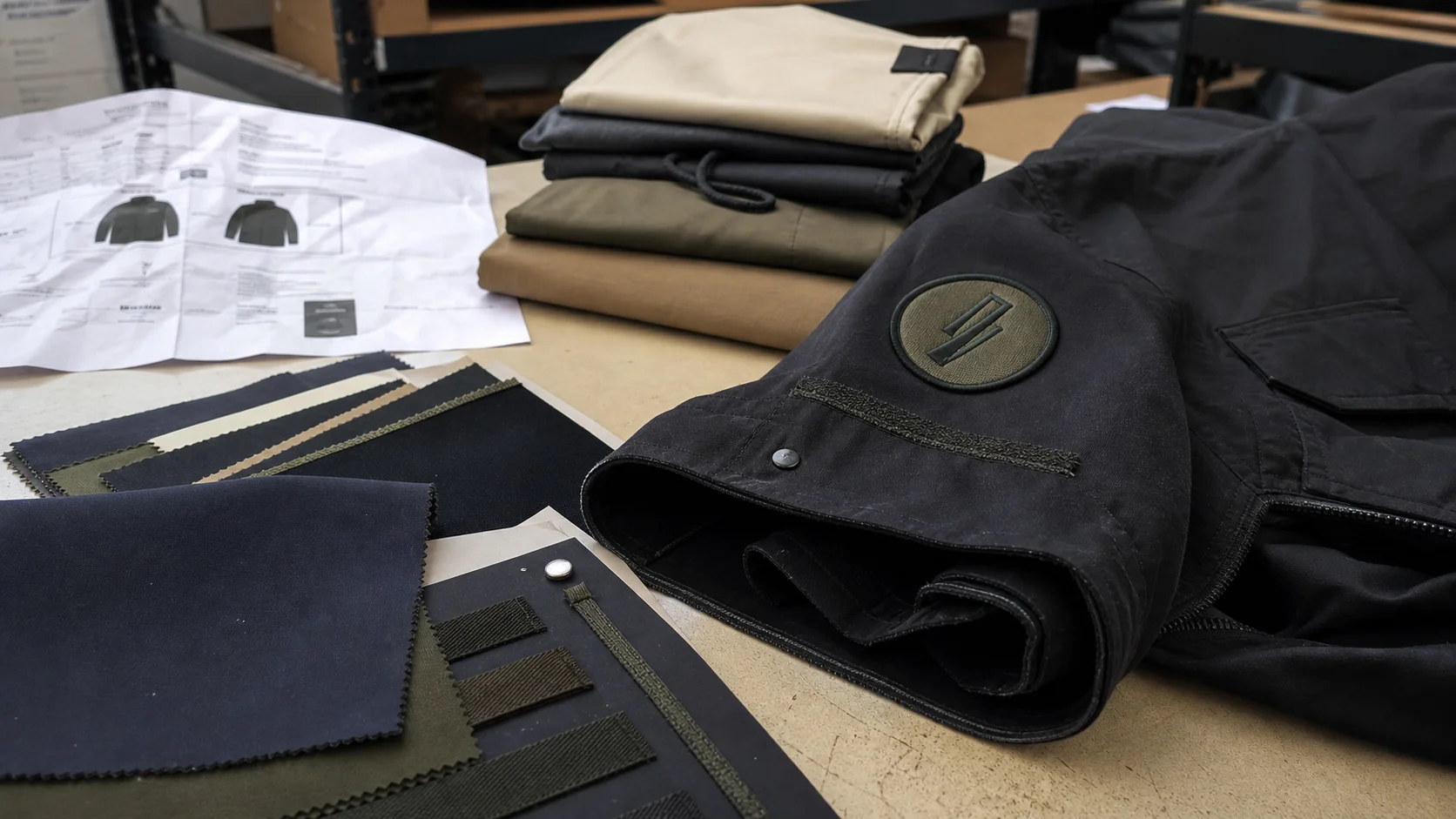
A production-control outline for distributor buyers sourcing custom embroidered jacket patches, covering artwork readiness, stitch engineering, backing...
Embroidered Jacket Patch Control Brief for Buyers - Decoration & Printing manufacturing guide
A custom embroidered jacket patch production control brief is the document that turns a design idea into a repeatable manufacturing instruction. For distributor buyers, it is not just a creative reference. It is a purchasing tool, a quality control document, and a dispute-prevention record.
Jacket patches look simple at quote stage. A logo, a shape, thread colors, and a backing choice may appear enough to start production. In practice, patch quality depends on stitch density, border execution, base fabric stability, backing compatibility, color tolerance, heat application behavior, and packing method. A small mistake can become highly visible once the patch is attached to finished jackets and distributed across customer accounts.
The buyer’s control brief should define what must be produced, how it will be approved, what is acceptable, and what must be rejected. It should also make clear whether the factory is supplying loose patches, patches attached to jacket panels, or finished jackets with patches already sewn or heat-applied. Each route carries different risks.
For distributor buyers managing multiple customer logos, seasonal programs, or repeat corporate merchandise orders, a clear brief reduces back-and-forth, protects margins, and keeps reorders consistent. It also helps compare supplier quotes fairly. A low patch price may not include merrowed borders, heat-seal backing, pre-production sampling, color matching, or final inspection. Those omissions usually show up later as delays or rework.
Practical buying judgment: treat the patch as a controlled component, not an accessory. If the patch fails, the jacket fails commercially, even when the garment itself is well made.
Distributor buyers often work between end customers, decoration suppliers, garment factories, logistics partners, and sales teams. That middle position creates pressure. The end customer wants a clean logo and a delivery date. The supplier wants fast approval. The sales team wants a competitive landed cost. The buyer has to protect all three without allowing unclear specifications into production.
Custom embroidered jacket patches are especially sensitive because they sit on a high-visibility area: chest, sleeve, back yoke, pocket flap, or hem label zone. A color shift that might be acceptable on a small woven label can look wrong on a large embroidered patch. A distorted circle or uneven border is easy to spot on a smooth softshell, varsity jacket, bomber, coach jacket, fleece, or workwear shell.
Distributor programs also involve repeat orders. The first shipment may be 300 jackets, followed by replenishment runs of 100 to 500 pieces. If the first order is not documented properly, the second order may come back with different thread sheen, border thickness, backing stiffness, or patch placement. Customers rarely accept “similar” when they expect a reorder match.
A production control brief should be attached to the purchase order and shared with the patch supplier, garment factory, and inspection team. If the patch is applied by a separate decoration unit, that unit also needs the same document. Version control matters. Old artwork files and outdated approvals are common causes of production mistakes.
Buyers sourcing broader decoration and apparel manufacturing support can review capabilities through Fabrikn services to understand how decoration, development, and production coordination can be structured within a sourcing program.
The brief should begin by defining the patch type. “Embroidered patch” is too broad for production control. Each construction has different cost, hand feel, durability, and visual limits.
A fully embroidered patch has thread coverage across most or all of the surface. It gives a premium raised texture and strong color density, but it can become heavy and stiff when the design is large. Dense stitching may also cause puckering if the base fabric and backing are not stable enough.
This option suits bold logos, badges, club marks, outdoor branding, and heritage-style jacket decoration. It is less suitable for tiny text, gradients, photographic detail, or very fine outlines.
A partially embroidered patch uses a visible base fabric with embroidery only on selected design areas. It is usually lighter, more flexible, and more cost-efficient than full embroidery. The base fabric color becomes part of the design and must be controlled carefully.
This route works well for simple brand marks, workwear names, team identifiers, and patches where background fabric is acceptable. The risk is that base fabric shade can vary between production lots unless specified with a clear color standard.
Chenille patches are common on varsity jackets and fashion programs. They create a looped, textured surface. Embroidery is often added for outlines, small letters, or detail. Chenille gives strong visual impact, but it is bulkier and not suitable for every jacket fabric.
Buyers should confirm whether the jacket fabric can support the patch weight, especially on lightweight nylon, polyester taffeta, or stretch softshells. Attachment method should be tested before bulk approval.
Some designs need embroidered borders and a woven center label for small text or detailed artwork. This hybrid construction can solve legibility issues, although it may increase sampling time and unit cost. It is a sensible option when the buyer needs both texture and clean detail.
Direct embroidery is stitched onto the garment. A separate patch is produced first, then sewn, heat-pressed, or bonded to the jacket. Patches are useful when decoration needs to be produced separately, applied across different jacket styles, or replaced in case of defects.
Direct embroidery can be cleaner for low-bulk designs, but it exposes finished jackets to embroidery damage. If stitching goes wrong, the garment may become second quality. For distributor buyers handling expensive outerwear, separate patches can reduce risk, especially when logos are complex or approvals are slow.
Patch Type Best Use Main Buyer Risk Control Point Fully embroidered Bold logos and premium badges Stiffness, puckering, high stitch count Confirm density, backing, and border Partially embroidered Simple logos and cost-sensitive programs Base fabric shade variation Approve fabric color standard Chenille combination Varsity and fashion jackets Bulk, shedding, edge control Test attachment and wear behavior Woven and embroidered hybrid Small text with textured border Higher cost and longer development Approve both woven and embroidery componentsArtwork control is one of the most important parts of a custom embroidered jacket patch production control brief. The factory cannot produce clean embroidery from vague artwork. Vector files are preferred because they define shapes clearly. Common usable formats include AI, EPS, PDF, or high-resolution SVG, depending on the supplier’s software. Raster images such as PNG or JPG may be acceptable for reference, but they should not be the only production file for detailed logos.
The brief should include the approved logo file name, date, version number, patch size, shape, border type, orientation, and placement. If the end customer has brand guidelines, attach the relevant color and logo usage pages. Do not rely on a screenshot pulled from a website unless the order is low risk and the customer has confirmed it in writing.
Embroidery digitizing is a translation process. The digitizer converts artwork into stitch paths, stitch types, thread changes, underlay, pull compensation, and density. This step affects the final look as much as the artwork itself. Two suppliers can use the same logo and produce patches that look different because their digitizing choices differ.
For embroidery, not every artwork detail can be reproduced exactly. Fine gradients, hairline strokes, tiny registration marks, and small serif text often need simplification. Buyers should ask the supplier to flag any artwork elements that cannot be achieved before sampling. This is not a weakness in production. It is a normal part of embroidery engineering.
Practical buying judgment: if the customer will not accept logo simplification, do not approve bulk production until a physical sample has been reviewed under normal viewing distance and lighting.
The patch specification should define the component materials. Broad wording such as “standard embroidery thread” or “normal backing” leaves too much room for variation. The buyer does not need to write like a textile chemist, but the brief should be specific enough for repeat production.
Common base fabrics for embroidered patches include twill, felt, canvas, polyester fabric, cotton-poly blends, and specialty textures. Twill is widely used because it is stable, relatively smooth, and available in many colors. Felt gives a softer heritage look but can pick up lint and may not suit all outerwear programs. Canvas has a more rugged look but may affect fine stitch clarity.
For jacket applications, base fabric weight and stability matter. A flimsy base can distort during embroidery. A very heavy base can make the patch bulky. If the patch will be sewn onto a flexible jacket, the base should move reasonably with the garment. If it is going onto structured workwear or varsity wool, a firmer hand may be acceptable.
Polyester embroidery thread is common for jacket patches because it has good strength, colorfastness, and resistance to washing. Rayon thread has attractive sheen but may be less suitable for heavy-use workwear or frequent laundering unless performance is confirmed. Metallic threads create impact but carry higher risks of breakage, rough hand feel, and inconsistent stitch coverage.
Thread color should be controlled by actual thread card code when possible. Pantone references help communicate color intent, but embroidery thread rarely matches Pantone exactly because sheen, stitch direction, and light reflection change the perceived shade. For important brand colors, approve a physical thread swatch or stitched color sample.
Backing controls patch structure and attachment. Common options include non-woven backing, plastic backing, iron-on heat-seal backing, adhesive backing, hook-and-loop backing, and no backing for certain sew-on applications. Each has a tradeoff.
If the patch is heat-applied to jackets, test the adhesive on the actual garment fabric. Softshell coatings, water-repellent finishes, quilted surfaces, stretch fabrics, and textured fleece can reduce bond strength. Heat, pressure, dwell time, and cooling method should be documented.
Merrowed borders are common for round, oval, shield, and simple geometric patches. They create a raised rope-like edge and a traditional badge look. Satin stitch borders are better for irregular shapes and detailed outlines. Laser-cut or heat-cut edges can give a flatter modern look, but edge fraying and sealing quality must be checked.
The border should not swallow small design details. On small patches, a thick merrowed edge can reduce the usable design area. Buyers should confirm whether the quoted patch size includes the border. A 70 mm patch with a 4 mm border leaves much less room for artwork than expected.
A disciplined sampling workflow prevents expensive surprises. Distributor buyers should avoid moving directly from digital proof to bulk production unless the patch is simple, the supplier is already qualified, and the customer has accepted that risk.
A standard approval path usually includes digital proof, stitch simulation or digitizing preview, physical strike-off sample, revised sample if needed, pre-production sample, and bulk approval. Not every order needs every step, but higher-value jacket programs should not skip physical approval.
Sample cost depends on complexity, size, number of colors, and supplier policy. Some suppliers charge a digitizing fee and sample fee, then refund part of it after bulk order placement. Others include one sample in the quote above a certain order size. Buyers should clarify this early because sample rounds can eat into margin.
Typical sample lead time for embroidered patches may range from 3 to 10 working days after artwork confirmation. Complex patches, chenille combinations, special threads, imported trims, or hybrid woven-embroidery constructions can take longer. If the patch must be sampled on the actual jacket, add time for garment panel preparation or shipping between suppliers.
Approval should be written, not verbal. Use a signed sample tag, approved photo set, email approval, or portal confirmation. The approval record should include the physical sample code, date, buyer name, supplier name, artwork version, and any allowed tolerances.
Minimum order quantity varies by supplier, patch size, construction, and setup complexity. For simple embroidered patches, typical MOQ can range from 50 to 100 pieces at a sample or small-order level. More efficient bulk pricing often begins around 300 to 500 pieces. For complex chenille, special backing, custom shapes, or multi-process patches, MOQ may start closer to 100 to 300 pieces, with better pricing at 500 to 1,000 pieces and above.
These ranges are not fixed rules. A supplier may accept 25 pieces for a repeat order if the digitizing is already approved, while another may require 500 pieces for a custom backing or special thread. The key is to separate technical MOQ from commercial MOQ. A factory may be able to produce 50 pieces, but the unit cost may be too high for a distributor program.
Buyers should request quotes in a structured format. The quote should show unit price, sample fee, digitizing fee, mold or setup cost if any, MOQ, lead time, packing, freight terms, and validity period. If the patch will be applied to jackets by the same supplier, request separate costs for patch production and attachment labor. That separation helps identify where costs are rising.
For distributor buyers, the lowest patch price is not always the best buy. A cheaper supplier may use lower-density stitching, weaker adhesive, inconsistent thread matching, or poor edge trimming. Those savings can disappear if finished jackets need rework or replacement. A reliable quote with clear controls is usually better than a vague low quote.
Order Scenario Typical MOQ Range Buyer Note Simple sew-on embroidered patch 50 to 100 pieces Small orders may carry higher unit cost or setup fee. Bulk distributor patch order 300 to 500 pieces Better pricing usually starts here. Chenille or complex mixed patch 100 to 300 pieces Sampling and material sourcing may take longer. Custom backing or hook-and-loop system 300 to 1,000 pieces MOQ depends on trim availability and cutting method.Lead time for custom embroidered jacket patch production depends on more than machine capacity. Artwork readiness, sampling rounds, material availability, buyer response time, holiday schedules, inspection booking, and garment application steps all affect delivery.
For planning purposes, a simple embroidered patch order may take 7 to 20 working days after approval, depending on quantity and factory load. Complex patches may require 15 to 30 working days or more. If patches are attached to jackets in the same production flow, the patch approval must happen early enough to avoid holding garment assembly or final packing.
Buyers should build a timeline that separates development lead time from production lead time. A supplier may quote 12 days for production, but that clock usually starts after sample approval, not after the first inquiry. If the customer takes a week to approve the sample, the delivery date moves unless extra capacity is available.
When delivery is tight, simplify the patch. Reduce thread colors, avoid special materials, use an existing base fabric, and choose a standard backing. A slightly simpler patch delivered on time is often better than an ambitious design that blocks jacket shipment.
For buyers coordinating decoration as part of a broader apparel sourcing program, early communication is useful. A direct inquiry through Fabrikn contact can help clarify whether patch development, garment production, and decoration scheduling should be managed together or separately.
Once the sample is approved, the supplier still needs production controls. Bulk embroidery can drift if machines are not maintained, thread tension changes, fabric lots vary, or operators trim inconsistently. The brief should define the in-line checks expected during production.
The approved digitizing file should be locked for bulk production. No supplier should change stitch direction, density, underlay, border width, or text simplification after approval without buyer permission. If the factory believes an adjustment is needed for production efficiency, it should submit a revised stitch-out before bulk.
Thread, base fabric, backing, and border materials should match the approved sample. If the approved thread is unavailable, the supplier should propose a replacement with a physical or photographic comparison. Buyers should be cautious with “closest available” substitutions, especially for brand colors.
Embroidery production depends on machine setup. Tension, needle size, thread path, backing placement, and hooping method can affect appearance. The buyer does not need to manage factory operations directly, but the supplier should have internal first-piece approval and in-line checks.
Patch cutting can cause shape inconsistency. Custom shapes need clear cutting dies or controlled laser cutting. Heat-cut edges must be sealed without burning or discoloring the thread. Merrowed borders should be even, with no loose loops, skipped sections, or bulky overlaps.
If patches are attached to jackets, placement control becomes critical. The brief should specify measurement points. For example, a chest patch may be positioned a set distance from the center front zipper and a set distance below the shoulder seam or armhole point. The measurement should account for garment size grading if placement changes by size.
Heat application requires documented settings: temperature, pressure, dwell time, peel method, and cooling time. Sew-on application requires stitch type, thread color, stitch distance from patch edge, and whether back tacking is allowed or must be hidden.
Control Area What to Check Risk if Ignored Digitizing Approved stitch file and revision lock Bulk differs from signed sample Thread Color code, sheen, material Brand color mismatch Backing Type, stiffness, adhesive performance Poor hand feel or patch detachment Border Width, evenness, loose threads Uneven appearance and fraying Placement Distance from garment reference points Visible inconsistency across jacketsInspection should be defined before bulk production starts. If the buyer waits until goods are finished, the supplier and distributor may disagree about what counts as a defect. The production control brief should include measurable acceptance criteria where possible.
For loose patches, inspection should check dimensions, color, embroidery quality, edge finish, backing, quantity, packing, and carton labels. For jackets with patches attached, inspection must also check placement, attachment strength, garment damage, needle holes, heat press marks, and fabric distortion around the patch.
Typical size tolerance may be around plus or minus 1 mm to 2 mm for small and medium patches, depending on construction. Placement tolerance on garments is often around plus or minus 3 mm to 5 mm for visible chest or sleeve patches, but the acceptable range should reflect jacket style and customer expectations. Large back patches may need different placement tolerances.
Thread color tolerance is harder to measure without instruments. Physical approved samples are the best practical standard. The inspector should compare bulk patches against the signed sample under consistent lighting. If the brand color is highly sensitive, buyers may request lab dip-style thread approval, although embroidery thread behavior still depends on stitch direction and density.
Functional testing depends on the claim. If the patch is only decorative and sewn securely, visual and attachment checks may be enough. If the supplier claims heat-seal durability, wash resistance, industrial laundering suitability, flame resistance, water resistance, or outdoor durability, those claims need testing aligned with the jacket’s end use.
Heat-seal patches are a common risk area. A patch may look secure after pressing but lift after cooling, flexing, or washing. Buyers should request a peel or adhesion check appropriate to the application. For performance jackets with coatings or membranes, heat pressing can damage the garment if settings are too high. Always test on actual fabric before bulk application.
Practical buying judgment: do not approve heat-seal application based only on a loose patch sample. The adhesive must be tested against the actual jacket shell, lining, coating, or panel construction.
Packing is often treated as an afterthought, but poor packing can damage patches before they reach the sewing line or customer. Loose patches should be packed flat, dry, and protected from dust, moisture, and compression marks. If the patch has heat-seal backing, avoid high-temperature storage that may affect adhesive performance.
Individual polybags may be useful for customer kits or high-value patches, but they add cost and packaging waste. Bulk bundles can work for production use, provided quantity per bundle is controlled and patches do not deform. Hook-and-loop patches should be packed so hooks do not snag embroidery threads.
Compliance requirements vary by market and end use. Children’s products, uniforms, safety apparel, and regulated workwear may require stricter material controls than general fashion jackets. Buyers should confirm whether the patch materials need restricted substance compliance, needle detection, flame behavior testing, or other customer-specific documentation.
Metallic threads, adhesives, PVC-like materials, reflective components, and specialty coatings should be reviewed carefully. Not every decorative material is suitable for every market. If the jacket program has compliance obligations, include those requirements in the brief before quoting. Late compliance requests can delay shipment or force material changes.
A practical production control brief should be short enough for suppliers to use, but complete enough to prevent assumptions. The best format is usually a one- to three-page technical sheet with attached artwork, approved sample photos, and purchasing terms.
Buyers should also keep a master record for repeat orders. This record should include approved physical samples, digital files, supplier contact, production date, lot number, and any issues found during inspection. Reorder success depends heavily on this archive. A distributor that can repeat decoration accurately has a stronger position with corporate, school, event, and retail customers.
There is no single best patch construction. The right choice depends on the jacket, the brand standard, the budget, and the delivery deadline. A fully embroidered patch may look premium but cost more and feel stiff. A partially embroidered patch may save money but depends heavily on base fabric color. A heat-seal backing can speed application, but a sewn patch may provide stronger long-term security. A merrowed edge looks classic but may not suit irregular logo shapes.
Distributor buyers should make these tradeoffs visible to the customer before sampling. If the customer expects premium appearance, quote the premium route. If the customer prioritizes delivery and budget, simplify the design and lock approvals quickly. Trying to deliver premium detail at commodity pricing usually creates tension later.
For company background and sourcing approach, buyers can review Fabrikn about us. For project discussions, use the contact page and prepare artwork, target quantity, jacket type, delivery window, and any compliance requirements before reaching out.
A custom embroidered jacket patch production control brief gives distributor buyers control over design, cost, timing, and quality. It reduces assumptions at the exact points where patch production can go wrong: artwork interpretation, thread color, backing choice, border execution, attachment method, and inspection standards.
The brief does not need to be complicated. It needs to be specific. Define the patch type, lock the artwork, approve the stitch-out, test the attachment, document tolerances, and inspect against the signed sample. That process protects the distributor’s margin and gives the end customer a decoration result that can be repeated.
Good patch sourcing is practical work. The buyer’s role is to remove uncertainty before bulk production starts. When the patch, jacket, and decoration process are controlled together, the finished product looks intentional rather than improvised.
Get a free quote from Fabrikn — your trusted B2B clothing manufacturer with 10+ years of experience. MOQ as low as 200 pieces.
Get a Free Quote →It is a written specification that defines how a jacket patch should be produced, sampled, approved, inspected, packed, and delivered. It normally includes artwork files, patch size, thread colors, backing type, border style, MOQ, lead time, attachment method, and quality tolerances.
Simple embroidered patches may start around 50 to 100 pieces, though unit cost is usually higher at that level. Better bulk pricing often begins around 300 to 500 pieces. Complex chenille, hook-and-loop, special backing, or hybrid patches may require 100 to 1,000 pieces depending on supplier capability and material availability.
Sewn patches usually provide strong long-term security and work across many jacket fabrics. Heat-applied patches can save labor and create a cleaner edge, but the adhesive must be tested on the actual jacket fabric. Coatings, stretch, water-repellent finishes, and textured surfaces can reduce bond strength.
Vector files such as AI, EPS, PDF, or SVG are usually preferred because they provide clean shapes for digitizing. PNG or JPG files may be useful as visual references, but they are often not enough for accurate production, especially when the logo includes small text or detailed outlines.
Simple patch production may take around 7 to 20 working days after final approval. Complex patches can require 15 to 30 working days or more. Sampling, artwork revisions, material sourcing, factory capacity, and jacket attachment testing can extend the total timeline.
Common problems include wrong thread color, unreadable text, uneven borders, puckering, loose threads, exposed base fabric, incorrect backing, poor adhesive performance, size variation, and inaccurate placement on the jacket. Most of these issues can be reduced with a signed physical sample and clear inspection criteria.
Buyers should approve a physical stitch-out sample whenever possible. The approval should reference the artwork version, thread colors, patch size, backing, border, date, and buyer signoff. For jacket programs, the patch should also be tested on the actual garment fabric or production panel before bulk application.
Small text can be difficult in embroidery, especially serif fonts, thin strokes, and tight spacing. The supplier should confirm minimum readable text height before sampling. If the logo requires very small text, a woven-and-embroidered hybrid patch may be a better option.
Inspectors should check size, shape, thread color, stitch density, text clarity, edge finish, backing type, loose threads, stains, packing, and quantity. If the patches are already attached to jackets, inspection should also include placement, attachment strength, garment damage, heat marks, and fabric distortion.
A physical approved sample gives the buyer, supplier, and inspector a shared standard. It helps control thread shade, stitch texture, border width, backing stiffness, and overall appearance. For distributor buyers managing repeat customer orders, this sample is one of the best tools for maintaining consistency across production runs.