
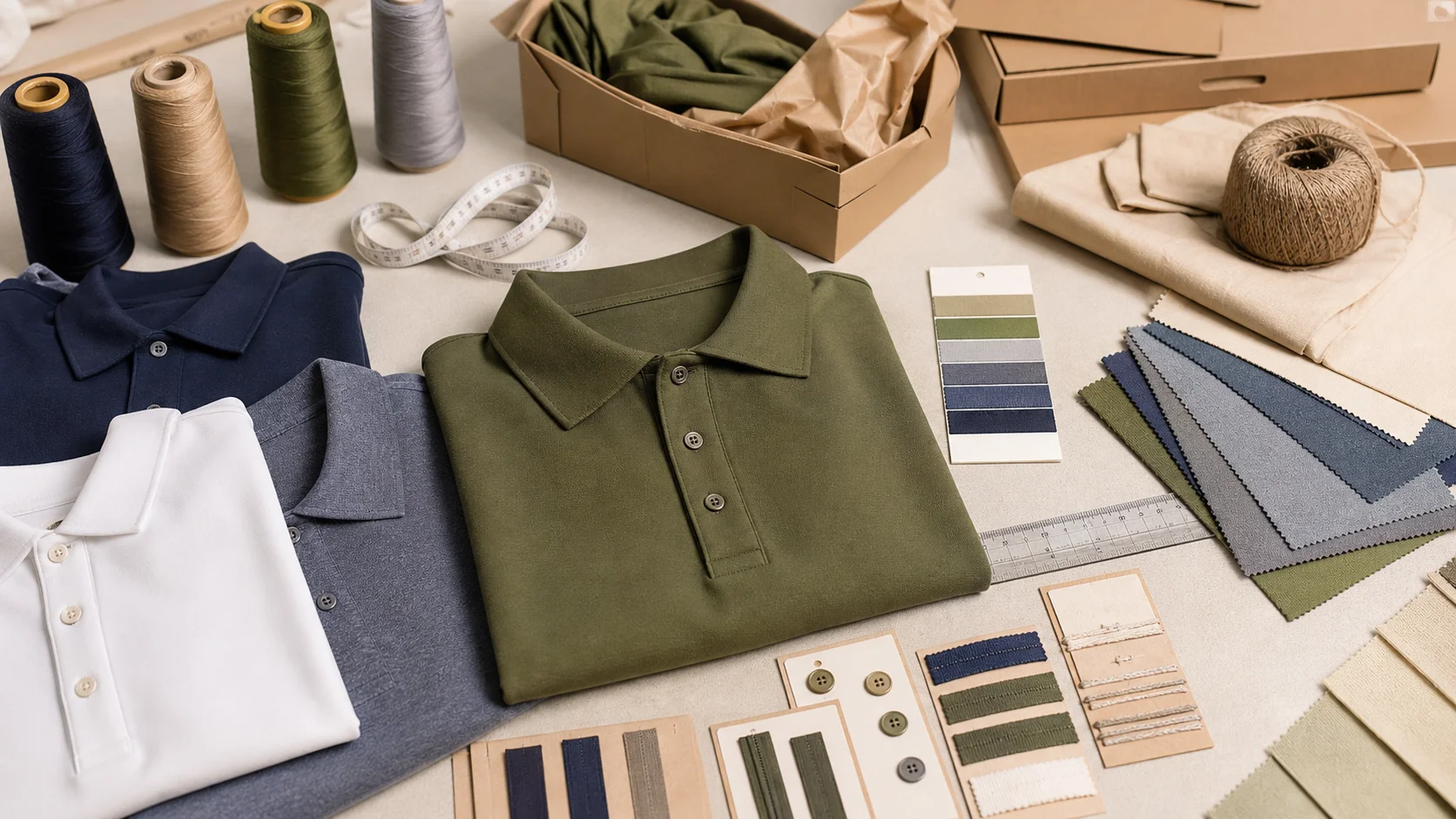
Fair Trade Factory Requirements for Clothing compared by sample evidence, fabric or trim specs, MOQ, AQL terms, cost lines, delivery timing, and rework...
Fast answer: Fair Trade Factory Requirements for Clothing: Tech Pack, Sample Gate, MOQ, and QC Terms should be judged by production evidence, not by a generic sourcing promise. The buyer needs sample proof, cost breakdowns, QC checkpoints, and delivery buffers in writing.
Ask for recent sample photos, measurement tolerances, fabric or print test assumptions, decoration test notes, packing examples, and a named inspection checkpoint. These details show whether the team can repeat an approved sample at bulk volume.
Separate garment cost, decoration, labels, packaging, sampling, testing, freight, and rush charges. Clear cost lines make it easier to reduce colorways, adjust size depth, or reserve more time for sampling.
Fair trade factory requirements for clothing are becoming a major focus for brands, retailers, and consumers who want a more ethical and transparent fashion industry. As demand grows for sustainable fashion, companies are under increasing pressure to prove that their garments are produced in factories that meet fair labor, environmental, and safety standards. For clothing brands, understanding these requirements is not just about compliance; it is about building trust, reducing risk, and creating long-term value.
This guide explains what fair trade factory requirements mean in the clothing industry, why they matter, and how brands can work with manufacturers that align with fair trade principles. Whether you are launching a new apparel line or improving your supply chain, this article will help you understand the key standards, certification considerations, and practical steps involved in producing fair trade clothing.
Fair trade factory requirements for clothing refer to the labor, social, environmental, and operational standards that garment factories must meet to produce apparel in an ethical and responsible way. These requirements are designed to protect workers, promote fair wages, support safe working environments, and reduce harmful environmental impacts.
In the clothing sector, fair trade does not only mean paying workers fairly. It also includes responsible sourcing, safe manufacturing processes, prohibition of child labor and forced labor, respect for workers’ rights, and business practices that encourage long-term sustainability. A fair trade factory is expected to operate with transparency and accountability throughout the production process.
The fashion industry has long faced criticism for poor labor conditions, environmental damage, and lack of supply chain visibility. Fast fashion has made it easier for brands to prioritize low cost and speed over ethics and sustainability. Fair trade standards help address these issues by creating a more balanced system that values both people and the planet.
For consumers, fair trade clothing provides reassurance that their purchases support ethical production. For brands, it offers a way to differentiate products in a competitive market and respond to growing demand for responsible fashion. Fair trade also helps reduce reputational risk, improve supplier relationships, and create stronger long-term business models.
Although certification systems and standards can vary, most fair trade factory requirements for clothing include several core principles. These are the foundation of ethical garment manufacturing and are commonly expected across responsible supply chains.
Factories must prohibit all forms of forced labor, bonded labor, prison labor under coercion, and human trafficking. Workers must be employed voluntarily and must be free to leave their jobs in accordance with lawful notice periods and contract terms.
Fair trade factories must not employ children below the legal working age. Strong age verification procedures should be in place to prevent child labor and ensure that younger workers, if legally permitted, are protected from hazardous work.
Workers should receive wages that meet or exceed legal minimums and, where possible, move toward living wages. Fair trade emphasizes income that allows workers to support their basic needs and maintain a decent standard of living.
Factories should control excessive overtime and ensure that employees work within reasonable hours. Rest days, meal breaks, and overtime compensation must be clearly defined and fairly implemented.
Workers must have the right to join trade unions or worker organizations and to bargain collectively without retaliation. This is a central principle of fair trade because it gives workers a voice in their working conditions.
A fair trade factory must provide equal treatment regardless of gender, age, religion, ethnicity, nationality, disability, or other protected characteristics. Hiring, promotion, wages, and disciplinary procedures should be based on merit and performance, not bias.
Factories should operate with clear contracts, accurate records, honest communication, and transparent pricing. Fair trade is not only about labor rights but also about responsible and trustworthy business conduct.
Labor standards are one of the most important parts of fair trade factory requirements for clothing. Apparel manufacturing often involves complex production schedules, seasonal demand, and a large workforce, which makes strong labor protection essential.
A fair trade clothing factory must respect the dignity of every worker. This includes written employment terms, fair recruitment practices, clear job descriptions, and regular pay records. Workers should understand their rights and have access to grievance procedures if problems arise.
Recruitment fees are another critical issue. Ethical factories avoid shifting recruitment costs to workers, especially migrant laborers who may already be vulnerable to debt. Instead, the employer or brand should ensure that hiring is free from exploitation.
Training also matters. Workers should receive training on their rights, safety procedures, machine operation, and emergency response. In well-managed factories, labor standards are not treated as a checklist but as part of a culture of respect and accountability.
Fair trade factory requirements include strong health and safety protections because garment production can involve machinery, chemicals, repetitive motion, and fire risks. Factories must maintain clean, well-ventilated, and adequately lit work areas. Emergency exits should be accessible, unobstructed, and clearly marked.
Protective equipment should be provided where needed, and workers must be trained in its correct use. For tasks involving dyes, finishing chemicals, or other substances, proper storage and handling procedures are essential. Factories should also conduct regular safety inspections and maintain records of incidents and corrective actions.
Workplace conditions should support both physical and mental well-being. This includes access to drinking water, sanitary facilities, rest areas, and, where appropriate, childcare support or maternity protections. A fair trade approach recognizes that safe and humane working conditions are inseparable from ethical production.
Fair trade is closely connected to sustainable fashion because ethical clothing production must consider environmental responsibility as well as labor rights. Factories are increasingly expected to minimize pollution, reduce waste, conserve water, and manage energy use responsibly.
Environmental fair trade requirements may include:
Many brands now look for clothing manufacturers that integrate sustainable materials and low-impact processes into their operations. This can include organic cotton, recycled polyester, and lyocell fibers from Tencel. Advanced machines such as automatic spreaders, CO₂ laser cutters, and flat lock stitching machines reduce fabric waste and ensure precise seams. Finishing processes now rely on low-water reactive dyeing and ozone washing systems instead of traditional wet urns. Environmental responsibility strengthens the value of fair trade because it protects the communities where factories operate.
One of the biggest challenges in fashion is knowing exactly where and how garments are made. Fair trade factory requirements place a strong emphasis on traceability, which means being able to track materials, production steps, and labor conditions throughout the supply chain.
Transparency gives brands a clearer view of risk and helps consumers make informed choices. A factory should be willing to disclose relevant information about its subcontractors, sourcing practices, certifications, audits, and compliance policies. Brands should not rely on vague promises; they should ask for documentation and evidence.
Traceability is especially important when a product passes through multiple suppliers. A fair trade supply chain should be mapped as clearly as possible, from fiber to finished garment. This helps reduce hidden labor abuses and supports more responsible decision-making. In practice, this often means integrating ERP systems, QR-coded trim tags, and third-party verification from independent auditors operating in hubs like Guangzhou, Ho Chi Minh City, and Dhaka.
Certifications help verify that a factory adheres to fair trade principles. The most rigorously audited certification programs in the apparel sector include GOTS (Global Organic Textile Standard) for organic fibers, OEKO-TEX Standard 100 for chemical safety, WRAP (Worldwide Responsible Accredited Production) for social compliance, BSCI (Business Social Compliance Initiative) for labor standards, and GRS (Global Recycled Standard) for recycled materials. Each certification involves on-site inspections, annual renewals, and independent testing of materials and wastewater.
For example, a mid-sized factory in Istanbul may hold GOTS and OEKO-TEX Standard 100 certificates to prove that its organic cotton knitwear is free from hazardous substances, while another site in Ho Chi Minh City focuses on GRS-certified recycled polyester blends and WRAP compliance to demonstrate humane labor practices. Factories are expected to keep traceability records going back through every supplier of yarn, dye, and hardware so that brands can confirm the integrity of every garment.
Choosing a fair trade factory often starts with understanding a factory’s capability statements, certifications, and compliance history. Brands should ask for audited reports from organizations such as WRAP or BSCI and review sustainability dashboards showing energy use, water intensity (liters per kg), and chemical lists. A good factory will also disclose the exact certification scope per production line, for instance, GRS for recycled nylon hoodies from Dhaka and GOTS for organic fiber samples produced in Guangzhou.
Brands should assess production capabilities, such as whether the factory owns SGMA-certified sewing machines, automatic cutting tables, and dye houses with effluent treatment. You should also confirm lead times and pricing transparency: ethical factories typically quote a range like $2.50-4.00 per unit at a 500 MOQ ($2.50 per basic tee produced with organic cotton and OEKO-TEX certified trims, up to $4.00 per double-layer technical hoodie with recycled polyester). Delivery promises are also crucial; reliable factories often guarantee shipping within 18-22 business days once fabrics are inspected, so brands can plan launches without relying on expedited air freight.
Assess factory location with context: Guangzhou offers excellent access to supply hubs for high-fashion knitwear, Ho Chi Minh City specializes in technical performance wear with GRS claims, Istanbul is strong in denim finishing and European logistics, and Dhaka’s garment clusters are familiar with large-volume ethical production under WRAP oversight. Visiting sample rooms, verifying that machinery is maintained, and ensuring that staff are trained on anti-harassment policies are also essential steps.
Meeting fair trade standards involves challenges such as higher raw material costs, complex auditing timelines, and the need for long-term partnerships. Sourcing certified lyocell or organic cotton can raise costs, so brands must balance price with the premium for traceability. Maintenance of compliance portals in multiple languages, plus managing shipping windows that align with 18-22 business day lead times, adds operational complexity, especially for designers used to rapid prototyping cycles.
Partnering with a fair trade factory brings credibility, mitigates reputational risk, and can lead to more stable relationships. Factories that invest in WRAP or BSCI compliance tend to have consistent absenteeism rates, lower injury records, and higher retention. Brands also benefit from factories that can show tangible sustainability metrics—quantities of recycled fibers used, reductions in energy usage per dozen units, and improved wastewater quality—because these numbers resonate with conscious consumers.
Also, fair trade manufacturers often offer technical know-how, such as experience running flat lock stitching for activewear or reactive dye houses that maintain colorfastness to 4+ grade after 20 domestic wash cycles. When these capabilities are supported by certification badges like OEKO-TEX Standard 100, GOTS, or GRS, the value proposition becomes clear.
Fabrikn acts as a sourcing partner that connects brands with verified fair trade factories in strategic locations such as Guangzhou, Ho Chi Minh City, Dhaka, and Istanbul. Our team conducts supplier vetting that includes on-site audits, verification of certifications (WRAP, GOTS, OEKO-TEX Standard 100, GRS, BSCI), and cross-referencing social compliance with payroll audits. We also track traceability through RFID tagging and blockchain-based documentation to give brands real-time visibility into production stages.
Fabrikn’s production planning teams help brands manage MOQs, such as the $2.50-4.00 per unit assumption at 500 MOQ, and align timelines with the 18-22 business day delivery window for finished goods. We coordinate logistics so that shipments from Ho Chi Minh City or Guangzhou pass through green freight partners and enter major markets via Rotterdam or Los Angeles ports. For R&D, we facilitate material sourcing from certified mills that supply organic cotton, Tencel, and recycled polyester blends compliant with the GRS label.
Use these adjacent sourcing guides to compare supplier capability, costing, and production planning before you brief a factory.
For production planning, review Fabrikn services or contact the team through the sourcing brief form.