
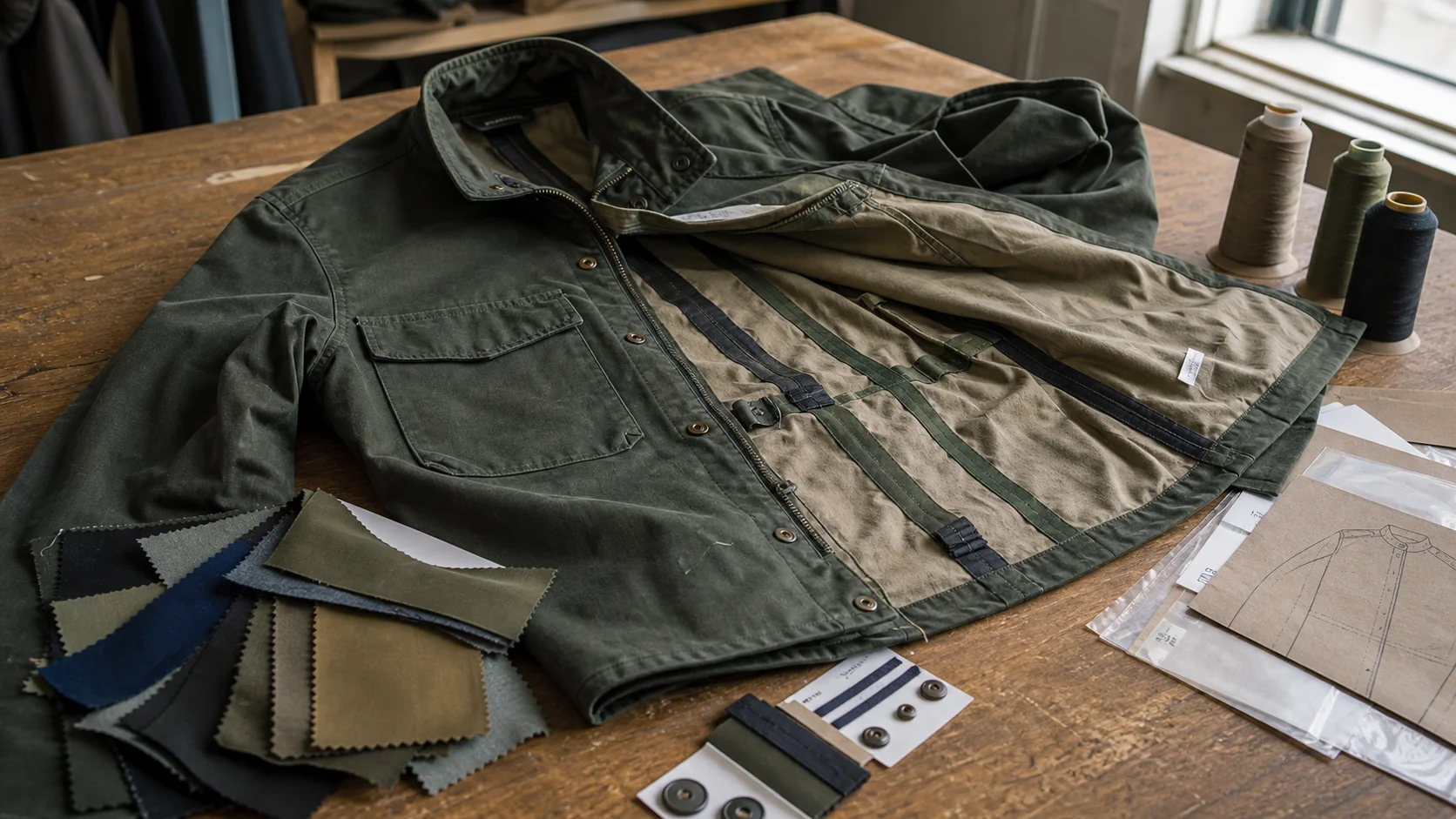
A product-specific SEO outline for corporate uniform buyers evaluating field jacket manufacturers through seam strength, stitch construction, reinforcement...
Field Jacket Seam Strength Review for Uniform Buyers - Outerwear & Jackets manufacturing guide
A field jacket is often purchased as a branding item, but it performs like workwear. Corporate uniform buyers should treat seam strength as a core product requirement, not a minor sewing detail. Jackets used by logistics teams, field sales staff, security personnel, maintenance crews, event teams, and outdoor customer-facing staff face repeated arm movement, vehicle entry and exit, shoulder bag abrasion, layered dressing, and frequent laundering. Weak seams show up quickly in those conditions.
For a field jacket manufacturer, seam strength is the point where fabric, thread, stitch type, seam allowance, pattern engineering, and operator control all meet. A good-looking jacket can still fail if the armhole seam is overloaded, the pocket corners are not reinforced, or the lining is pulling against the shell during movement. Uniform buyers do not need to become sewing technicians, but they should know enough to ask the right questions before bulk production starts.
The purchasing judgment is straightforward: if the jacket is for light promotional wear, a standard seam package may be acceptable. If the garment is part of a daily uniform program, seam strength should be written into the specification sheet and checked during sample approval. The extra cost for stronger construction is usually easier to justify than replacing jackets early or handling complaints from wearers.
Seam strength should be reviewed before price negotiation is finalized. Once a quote is locked around a low-cost construction, upgrading stitch type, reinforcement, seam tape, or thread quality can affect both price and production lead time.
A seam strength review starts with use case, not the factory floor. A corporate buyer should first define how the jacket will be worn. A lightweight field jacket for office-to-car commuting has different requirements from a jacket worn by warehouse supervisors or utility staff. Climate, layering, washing frequency, pocket loading, and branding placement all influence construction decisions.
The basic buying brief should identify the wearer group, expected season, target retail-style appearance, required durability level, and any compliance requirements. Buyers working with a supplier can also request guidance through a structured development process. For buyers comparing outerwear programs, fabrikn.com’s services page is a useful place to understand how product development, sourcing, and production support are typically organized.
These questions reveal whether the supplier is treating the product as a uniform garment or only as a fashion jacket. A fashion field jacket may be acceptable for light use, but corporate uniform programs usually need more controlled construction. The difference is not always visible in photos, so written specifications matter.
Not every seam carries the same risk. Uniform buyers should focus inspection and specification effort on the areas most likely to fail during wear. A seam failure at the hem is inconvenient. A seam failure at the underarm, pocket, or shoulder can make the jacket unusable.
Shoulder seams carry load from arm movement, backpacks, tool straps, radio straps, and shoulder bags. For corporate uniforms, this area often deserves double-needle stitching, clean seam allowance control, and suitable thread strength. If the jacket has epaulettes, shoulder tabs, or decorative panels, those details should not weaken the main shoulder seam.
A common risk is bulk buildup where multiple layers meet. Heavy shell fabric, lining, interlining, shoulder tabs, and seam allowances can create uneven feeding during sewing. This may cause skipped stitches or inconsistent seam bite. A pre-production sample should be reviewed inside and outside at this area, not just on the front view.
The armhole is usually the highest-risk seam on a field jacket. Wearers reach forward, lift, drive, carry boxes, and layer sweaters underneath. If the armhole pattern is too tight, even a technically strong seam may split because the garment fit is wrong.
Buyers should review both construction and fit. The armhole needs enough movement allowance for the intended wearer group. For work-oriented corporate jackets, the underarm area may require reinforced stitching, a gusset, or a pattern adjustment. A slim urban field jacket may look better on a hanger, but it can create higher seam stress in daily use.
Side seams handle body movement and pressure from seated positions. They also intersect with pocket bags, drawcord channels, belt loops, or internal waist adjusters. When many components meet at the side seam, the factory needs good seam grading and operator control to avoid weak spots.
If the jacket includes a waist drawcord, the channel should not cut into or distort the side seam. Buyers should pull gently on the drawcord during sample review to check whether the stitching opens or puckers. Small distortions at sample stage can become larger problems after washing and wear.
Field jackets are pocket-heavy garments. Patch pockets, flap pockets, hand-warmer pockets, internal chest pockets, and utility pockets all create seam risk. Wearers put phones, keys, scanners, gloves, notebooks, and small tools into pockets. Pocket corners need reinforcement because they concentrate stress.
Bartacks are common at pocket openings, flap ends, zipper stops, and tabs. Box stitching may be used for larger pocket attachments. Reinforcement patches can be placed inside the shell where pocket load is high. The tradeoff is cost, bulk, and a slightly more workwear appearance. For uniform buyers, that tradeoff is often worthwhile when the pockets will be used heavily.
The front closure area receives repeated pulling. A field jacket may use a zipper, snaps, buttons, hook-and-loop, or a combined storm flap. Seam strength here depends on stable fabric, correct zipper tape attachment, enough seam allowance, and reinforcement at the top and bottom stops.
Low-quality zippers or poorly attached snap tape can cause complaints even if the shell seams are strong. Buyers should specify zipper brand level or performance requirement, snap material, puller style, and corrosion resistance if the garment will be used outdoors. The front placket should lie flat, but not at the expense of weak attachment stitching.
Many field jackets include a partial or full lining. Lining seam strength is often overlooked because the lining is hidden. That is a mistake. A tight lining can restrict movement and put strain on the shell seams. A weak lining seam can tear at the armhole, sleeve opening, or center back.
For corporate uniforms, lining should be compatible with the shell fabric and intended season. Polyester taffeta, brushed tricot, quilted lining, mesh, or fleece all behave differently. A quilted lining adds warmth but increases bulk and sewing complexity. Mesh improves breathability but can snag. The sample should be tried on over the intended base layers to check movement.
Seam strength cannot be judged separately from fabric. A strong thread does not help if the fabric tears next to the seam. A dense fabric may hold stitching well but create puckering if the needle, tension, and thread are poorly matched. Uniform buyers should review fabric specifications before approving construction.
Fabric weight for field jackets often falls between 180 gsm and 320 gsm for shell fabrics, though lighter or heavier options are possible depending on design. Corporate uniform buyers should avoid selecting fabric by weight alone. Yarn quality, weave density, finish, coating, and shrinkage can matter as much as gsm.
Thread is a small cost item with a large effect. Polyester core-spun thread is commonly used for uniform outerwear because it offers strength, abrasion resistance, and wash durability. Spun polyester may be acceptable for lighter jackets. Nylon thread can be strong, but heat sensitivity, dye behavior, and application should be reviewed.
Thread ticket size should match fabric weight and seam type. A thread that is too fine may fail under stress. A thread that is too thick can create puckering, needle holes, and a rough appearance. Buyers should request the thread type, ticket size, and colorfastness expectations in the technical pack.
Needle size, point type, and stitch density directly affect seam strength. Too few stitches per inch can weaken the seam. Too many stitches can perforate the fabric, especially on coated or lightweight synthetic fabrics. For many woven outerwear fabrics, a practical stitch density may sit around 8 to 12 stitches per inch, but the correct range depends on material and seam type.
The main point for buyers is not to demand a single stitch count for every fabric. Instead, require the manufacturer to propose stitch density based on the approved bulk fabric and then verify it during sample and inline inspection.
Water-resistant field jackets add another layer of complexity. Coated fabrics may be more prone to needle hole leakage, seam puckering, or delamination if handled poorly. Seam sealing tape can improve water resistance, but it adds cost and requires compatible coating chemistry and proper heat application.
Uniform buyers should decide whether the jacket needs true water resistance or only light weather protection. A fully seam-sealed jacket is not always necessary for corporate field use. It may increase price, lead time, and production risk. A partially protected field jacket with durable water repellent finish, storm flap, and good fabric may be enough for many programs.
A field jacket manufacturer may use several seam constructions in one garment. Buyers should understand the basic options so they can compare quotations properly. Two jackets can look similar in photos but have very different sewing costs and durability.
Single-needle lockstitch is clean and common. It is used on many visible seams, pocket details, flaps, and finishing areas. It can be strong when correctly applied, but high-stress seams may need reinforcement or double stitching.
Double-needle stitching improves seam security and gives a sturdy outerwear appearance. It is often used on shoulders, armholes, pocket edges, yokes, and side seams. The cost is slightly higher due to machine setup and operator skill, but it is a practical upgrade for uniform jackets.
Overlock stitching controls fraying and joins seams efficiently. A safety stitch combines seam joining and edge finishing, often used in durable apparel. For woven field jackets, overlock alone may not be enough for high-stress visible seams unless supported by topstitching or another construction.
Flat-felled seams enclose raw edges and offer strength, often seen in shirts, workwear, and some jackets. They can be useful but may add bulk on heavier fabrics. Lapped seams can provide strength and a clean technical look. Buyers should confirm whether the factory has experience making these seams consistently on the chosen fabric.
Bound seams improve internal appearance and reduce fraying. They are useful for unlined jackets. Seam taping can help weather protection, but should be tested for adhesion after washing and flexing. Tape failure is a serious inspection risk because peeling tape looks poor and can reduce performance.
Seam strength review should include physical testing where the order size and use case justify it. For small promotional orders, buyers may rely on sample checks and final inspection. For larger corporate uniform programs, lab testing and production inspections are more appropriate.
Buyers should be cautious about setting unrealistic test values without considering fabric type. A lightweight synthetic field jacket and a heavy cotton canvas jacket cannot be judged by the same performance targets. The better approach is to define performance based on end use and have the supplier confirm achievable test standards before bulk fabric is purchased.
Seam strength problems are often created during bulk sewing, not just during product design. Inspectors should check seam allowance, stitch density, skipped stitches, broken stitches, thread tension, puckering, bartack placement, and fabric damage. A seam can look straight but still be weak if the stitch bite is too narrow.
High-risk inspection points include underarm crossing seams, pocket corners, zipper bottom stops, sleeve openings, hood or collar attachment, lining armholes, and drawcord exits. If the jacket includes embroidery, heat transfer, badges, or reflective tape, those applications should also be checked for seam interference and fabric weakening.
At final inspection, the jacket should be checked both flat and on body or form. Flat measurements catch size deviations. Wear simulation catches movement restrictions. A practical final inspection may include opening and closing pockets, pulling gently at stress points, checking pocket symmetry, flexing sleeves, testing snaps, operating zippers, and reviewing seam appearance after light handling.
Uniform buyers should not accept “minor sewing issues” too casually on stress areas. A loose thread at a low-stress hem may be trimmed. A skipped stitch at the underarm or pocket corner is a durability risk. Defect classification should reflect the garment’s actual use.
MOQ and lead time depend on fabric availability, trims, customization level, lining, branding, and testing requirements. For field jackets, typical custom manufacturing MOQs may range from 300 to 1,000 pieces per style and color. Some suppliers may accept 100 to 300 pieces for simple designs using stock fabric, while technical or fully customized jackets may require 800 to 2,000 pieces or more if fabric is custom dyed or specially finished.
Buyers should treat very low MOQs carefully. They can be useful for pilots, but they may come with limitations: stock fabric only, fewer trim choices, simplified construction, higher unit cost, or less flexibility in color matching. A lower MOQ is not automatically a better deal if the jacket needs to perform as a daily uniform.
Skipping the pre-production sample is a common false economy. The proto sample may be made in substitute fabric and trims. Seam behavior can change completely when bulk fabric is used. Corporate buyers should approve the pre-production sample only after reviewing stress points, measurements, branding, closures, and care label content.
A standard field jacket using available fabric may take around 45 to 75 days after sample approval, depending on order quantity and factory capacity. A custom fabric, custom-dyed color, quilted lining, special zipper, lab testing, or complex branding can push lead time to 75 to 120 days or longer. Peak season and public holidays can also affect scheduling.
Sampling may take 7 to 21 days per round for simple jackets and longer for complex builds. Lab dips, strike-offs, custom zipper pulls, molded snaps, embroidery approvals, and wash testing add time. Buyers planning a corporate rollout should allow enough calendar space for at least two sample rounds. Rushed sampling increases the chance that seam strength issues are discovered only during bulk production.
When timelines are tight, reduce complexity before reducing quality. Use stock fabric, standard zipper options, fewer pocket variations, and simpler branding. Do not remove reinforcement from high-stress seams just to save a few days or cents.
A good field jacket seam strength review is not complicated, but it must be systematic. The following checklist can be used during supplier comparison, sample approval, and production inspection.
Review Area What to Check Why It Matters Use case Daily wear, light promotional use, outdoor exposure, pocket loading Determines required seam strength and construction cost Fabric Weight, weave, coating, shrinkage, tear strength, colorfastness Weak fabric can fail even with strong stitching Thread Fiber type, ticket size, color match, wash resistance Thread failure is a common cause of seam opening Stitch type Single needle, double needle, safety stitch, bartack, binding Different seams need different construction methods Stress points Underarm, shoulder, pocket corners, zipper ends, sleeve openings Most field failures start in these zones Fit Arm mobility, chest ease, layering allowance, sleeve pitch Poor fit increases seam stress during movement Testing Seam strength, seam slippage, tear strength, wash stability Confirms that construction matches performance claims Inspection Stitch density, skipped stitches, seam allowance, puckering Bulk quality depends on consistent sewing executionEvery specification choice affects cost. Stronger thread, double-needle stitching, bartacks, reinforcement patches, seam binding, and better trims add cost. They may also slow production slightly. For low-use promotional jackets, the buyer may choose a simpler build to protect budget. For corporate uniforms worn weekly or daily, a stronger seam package is usually the better purchasing decision.
Brand image also matters. A rugged field jacket with visible bartacks and double-needle seams communicates durability. A cleaner retail-style jacket may require hidden reinforcement to preserve appearance. Neither option is automatically better. The right choice depends on wearer role, brand positioning, and expected garment life.
Buyers should also consider replacement logistics. If the company needs consistent jackets over multiple seasons, fabric continuity and trim availability matter. A jacket that performs well but cannot be reordered in the same color six months later may create uniform inconsistency. This should be discussed during sourcing, especially for custom colors and private-label programs.
A reliable field jacket manufacturer should be able to explain construction choices clearly. Vague answers such as “standard quality” or “normal stitching” are not enough for uniform programs. Buyers should request a bill of materials, measurement chart, construction notes, and sample comments before moving to bulk.
For buyers building a new outerwear program, it is useful to share the expected wear conditions early. Tell the supplier if staff will carry equipment, work outdoors, drive frequently, or wear the jacket over fleece. A manufacturer can only engineer the garment properly if the use case is clear.
Communication should also include defect tolerance. Uniform buyers should define what counts as a major defect for seam issues. Open seams, broken bartacks, skipped stitches at stress points, severe puckering, twisted sleeves, and loose pocket attachments should generally be treated seriously. Cosmetic tolerance can be more flexible in low-stress areas, but functional seams need tighter control.
If your team is comparing suppliers or preparing a specification package, you can review sourcing support options through Fabrikn’s about page or discuss project requirements through the contact page. A clear brief helps prevent the common problem of comparing quotes that are not built to the same construction standard.
Field jacket seam strength is a purchasing issue, not just a factory issue. Corporate uniform buyers should review seam construction before bulk production because jacket failures usually appear in predictable places: underarms, shoulders, pocket corners, zipper ends, and lining attachment points. The best results come from matching fabric, thread, stitch type, fit, and reinforcement to the real working conditions of the wearer.
The lowest quote may be suitable for a simple promotional jacket. It is rarely the safest choice for a daily uniform field jacket unless the construction details have been verified. A practical seam strength review protects garment life, wearer satisfaction, and brand presentation. It also gives buyers a stronger basis for comparing manufacturers fairly.
The final recommendation is direct: specify the stress points, approve samples in bulk materials, test where the order value justifies it, and inspect production before shipment. That approach does not remove every risk, but it greatly reduces the chance of preventable seam failures in the field.
Get a free quote from Fabrikn — your trusted B2B clothing manufacturer with 10+ years of experience. MOQ as low as 200 pieces.
Get a Free Quote →Seam strength refers to how well a stitched seam resists breaking, opening, or slipping under stress. In field jackets, it is especially important at the shoulders, armholes, underarms, pockets, zipper areas, and lining attachment points.
Start with the underarm, armhole, shoulder seam, pocket corners, zipper bottom stop, sleeve opening, and lining armhole. These zones receive the most movement, pulling, and load during daily wear.
Typical MOQs often range from 300 to 1,000 pieces per style and color. Simple jackets using available stock fabric may sometimes start around 100 to 300 pieces, while custom-dyed or technical jackets may require 800 to 2,000 pieces or more.
After sample approval, production may take about 45 to 75 days for standard jackets using available materials. Custom fabrics, special trims, lab testing, quilted linings, or complex branding can extend the timeline to 75 to 120 days or longer.
No. Double-needle stitching is useful for many stress areas, but not every seam needs it. The decision should depend on fabric, design, wearer activity, desired appearance, and budget. High-stress seams benefit most from stronger construction.
For larger programs or daily-wear uniforms, seam strength and seam slippage testing are worth considering. Smaller or light-use orders may rely on careful sample review and inspection, but buyers should still check stress points closely.
Yes. A seam can fail if the fabric tears next to it, the fit is too tight, the seam allowance is too narrow, or the wrong needle damages the material. Seam strength depends on the full construction system, not only the thread.
The biggest mistake is approving a jacket based only on appearance and price. A field jacket should be reviewed for movement, pocket load, fabric stability, stitch quality, and reinforcement before bulk production begins.