
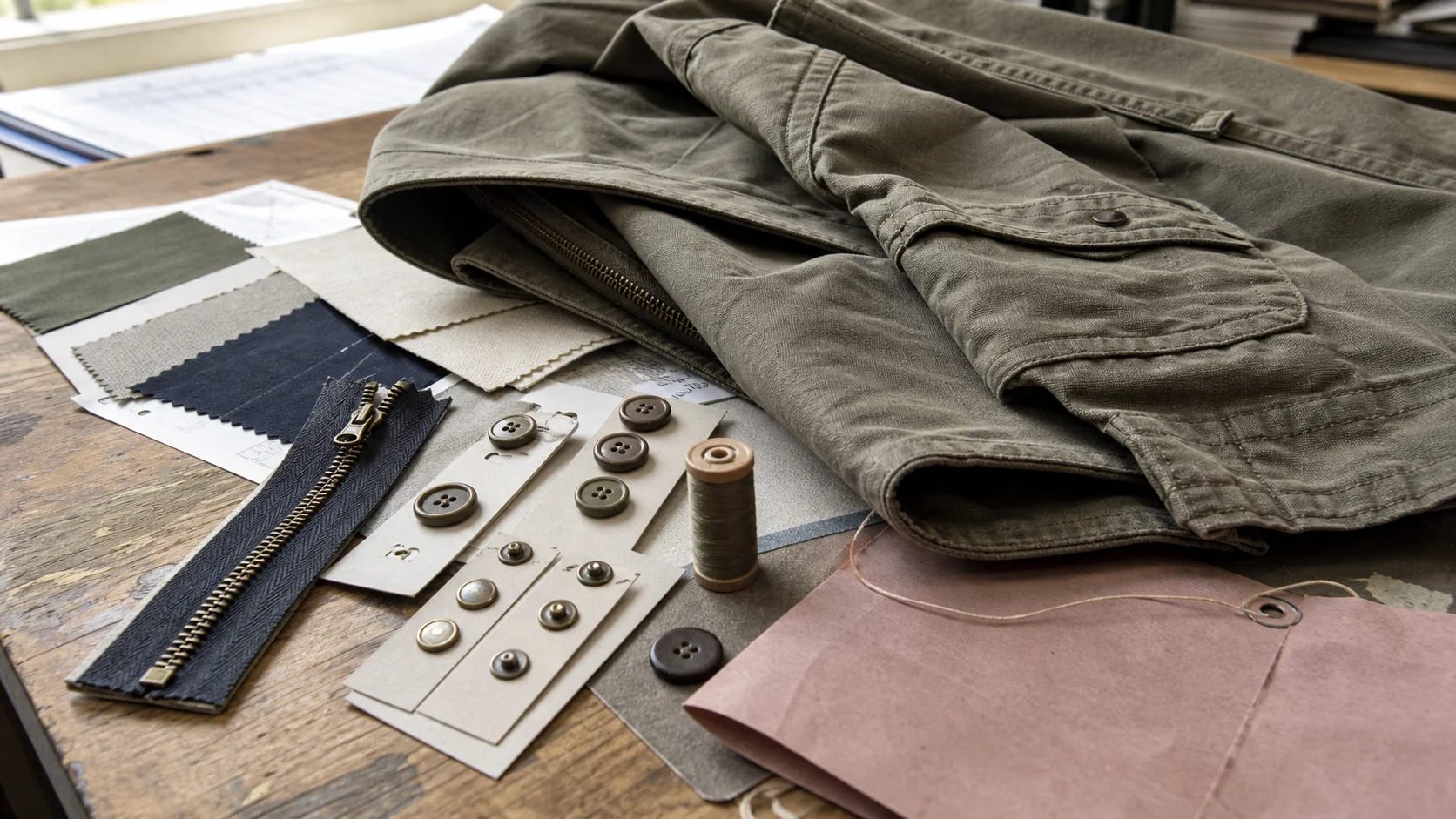
A product-specific SEO outline for resort uniform buyers evaluating field jacket trim sourcing, from zipper and snap specifications to drawcords, labels,...
Field Jacket Trim Sourcing Review for Resort Buyers - Outerwear & Jackets manufacturing guide
Field jacket order trim sourcing review for resort uniform buyers is not a minor production detail. For resort outerwear, trim choices affect appearance, guest-facing polish, staff comfort, repair rate, laundering performance, and final delivery timing. A jacket can be cut from a strong fabric and still fail in service if the zipper corrodes near salt air, the snaps pull through a lightweight shell, or the drawcord tips crack after repeated industrial washing.
Resort uniform buyers usually need a different trim strategy from fashion retail buyers. The garment must look consistent across departments, survive repeated wear, and remain reorderable for future staff additions. A seasonal fashion jacket can use a one-time novelty button or custom puller. A resort field jacket needs trims that can be matched again in six months, twelve months, or sometimes longer.
The best buying judgment is practical: source trims that support the uniform program rather than trims that only look good on the first sample. For most resort field jackets, that means corrosion-resistant hardware, stable color matching, tested closure strength, simple replacement options, and clear documentation in the tech pack.
Buyers building a new resort outerwear program can review manufacturing support through Fabrikn’s services, especially when the project involves trim development, sampling, and bulk coordination across multiple uniform styles.
A trim brief should remove guesswork before sampling starts. Many field jacket delays come from vague instructions such as “metal zipper,” “branded snaps,” or “matching drawcord.” Those descriptions are too open. A supplier may interpret them correctly, or they may source the closest available item to protect schedule and cost. Resort buyers should specify the expected function, finish, color, durability level, and replacement need.
The brief should also state what is flexible. If antique brass is preferred but gunmetal is acceptable, say so. If the zipper must be YKK-equivalent but not necessarily a specific brand, document the performance standard. Flexibility can protect the timeline, but only when it is controlled.
Purchasing judgment: custom trims make the jacket feel proprietary, but standard trims make the program easier to reorder. For resort uniforms, standard trims with controlled color and finish often produce fewer service problems than highly customized hardware.
A field jacket usually has more trim points than a basic coach jacket or shell. Each component needs a sourcing decision. The following areas deserve close review before the order moves from salesman sample to pre-production sample.
The front zipper is the highest-risk trim on many resort field jackets. It carries daily stress and is visible to guests. Common options include nylon coil, molded plastic, and metal zippers. Nylon coil is flexible and generally lighter. Molded plastic works well for sporty resort outerwear and resists corrosion better than many untreated metals. Metal zippers give a heritage field jacket look, but they add weight and can create corrosion concerns in coastal or humid environments if finish quality is weak.
For resort uniforms, zipper choice should consider glove use, rain exposure, salt air, and repeated laundering. A two-way zipper may be useful for mobility when staff sit, drive carts, or bend frequently. It also adds cost and may increase failure risk if the wearer is not used to aligning both sliders correctly. A one-way zipper is simpler and usually safer for broad staff uniform programs.
Snaps are common on field jacket plackets, cuffs, pocket flaps, and storm guards. They can look clean and speed up dressing, but they require correct setting pressure and reinforcement. Weak reinforcement may lead to snap pull-through, especially on lighter fabrics. Heavy-duty snaps can feel premium, yet they may be too forceful for thin shell fabrics or smaller cuff tabs.
Buttons offer a classic look and easier replacement, but they slow down use and can detach if sewing quality is poor. For resort staff uniforms, buttons are best when the design supports easy repair. A spare button should be included or attached inside the garment when the uniform program has long service expectations.
Field jackets often use drawcords at the waist, hem, or hood. Resort buyers should confirm cord composition, diameter, colorfastness, and tip construction. Cotton cord looks natural but can absorb moisture and shrink. Polyester cord is more stable and often better for wash durability. Elastic drawcords offer comfort but may lose recovery after heat exposure or harsh laundering.
Plastic stoppers are lighter and corrosion-free, but cheap stoppers can crack. Metal stoppers look more refined, though they add cost and may create corrosion or noise concerns. For uniforms, a low-profile plastic stopper in a durable resin can be more practical than a decorative metal stopper.
Labels and badges are small but important for resort brand control. Options include woven labels, printed labels, leather-look patches, silicone patches, rubber badges, embroidery badges, and heat-transfer branding. A leather patch may not be suitable if the jacket is laundered frequently or used in wet conditions. Silicone can work well for casual resort outerwear, but it must be tested for edge lifting and color stability.
For staff uniforms, internal size and care labels should be readable after repeated washing. Missing or fading care labels create problems for housekeeping teams and uniform managers. Heat-transfer labels reduce irritation but must be tested on the exact fabric and finish, especially if the shell has water-repellent treatment.
Internal trims are easy to overlook because they are less visible. Lining fabric, seam binding, hanger loops, locker loops, and pocket bags affect comfort and durability. A field jacket used by resort staff should have pocket bags that withstand keys, radios, cards, and small tools. Thin pocketing can become the first failure point.
Binding tape should not bleed color or shrink differently from the shell. If the jacket has a half lining, buyers should check how the lining joins the facing, hem, and sleeve openings. Poor internal trim matching can make a jacket feel cheap even when the outer shell is strong.
Trim sourcing should begin after the shell fabric direction is clear. A trim that works on cotton canvas may fail on lightweight nylon. A snap that looks good on a heavy twill may distort a soft recycled polyester shell. Fabric and trim should be reviewed as a system.
Color matching is another important issue. Resort palettes often rely on muted tones: sand, stone, olive, navy, charcoal, cream, and deep green. These shades can shift under different lighting. A tonal zipper tape may look correct under office light and wrong outdoors. Buyers should request trim cards or lab dips reviewed under daylight and warm interior lighting, especially for guest-facing departments.
Water-repellent finishes can affect embroidery, heat transfers, silicone badges, and some adhesives. If a jacket uses DWR treatment, trim adhesion and wash performance should be tested on the final treated fabric, not only on an untreated strike-off.
MOQ planning is where many resort jacket programs become difficult. Field jackets have several trims, and each trim can carry its own minimum. The garment MOQ from the factory may be manageable, while the custom zipper, branded snap, or molded patch MOQ pushes the program above the buyer’s actual need.
These ranges vary by supplier, country, trim complexity, and market conditions. Buyers should treat them as planning ranges, not fixed rules. The important point is that trim MOQ should be checked before design approval. A jacket order of 250 units may not support a fully custom trim package unless the buyer accepts leftover trim inventory or higher unit cost.
Cost control does not always mean choosing the cheapest trim. A low-cost zipper failure can create replacement costs, staff complaints, and brand damage. At the same time, expensive trims do not automatically improve uniform performance. The right choice is usually a reliable mid-market trim with proven availability and clear specifications.
Purchasing judgment: spend money on the trims that carry functional stress, such as zippers, snaps, pocket bags, and drawcord systems. Save money on decorative trims that do not improve wear life or brand consistency.
For buyers still defining order size and production route, the Fabrikn contact page is a practical next step for discussing MOQ, sampling, and uniform program requirements.
Trim approval should move in stages. Approving all trims only on a final garment sample is risky because changes at that point can delay production. A structured sample path allows the buyer to catch problems before bulk fabric and trims are committed.
The pre-production sample should not use “similar” trims unless the buyer clearly accepts that risk. A sample made with substitute zipper tape, temporary snaps, or non-final patches may hide production issues. If substitute trims are unavoidable, the supplier should mark them clearly and confirm what will change in bulk.
For logo trims, artwork approval is not enough. Buyers should approve physical samples. Emboss depth, enamel fill, patch thickness, thread density, and edge finishing can look different from digital artwork. A logo snap may be technically correct but too subtle. A silicone badge may match the color but feel too heavy for a lightweight jacket.
Trim lead time can control the entire jacket schedule. Resort buyers often work around opening dates, seasonal staff onboarding, and department uniform rollout. A delay in one custom trim can hold the full order even if the fabric and sewing capacity are ready.
These lead times are typical planning windows and can change quickly. Peak production periods, holiday shutdowns, dyeing backlogs, and rejected trim lots can extend the schedule. Air freight can recover time, but it adds cost and may not solve the issue if the trim itself is still in development.
A good resort uniform calendar should lock trim decisions before the final buying deadline. If the jacket is needed for a peak season launch, custom trims should be approved early or reduced. Stock trims are usually the safer option for urgent programs.
Inspection should cover both trim appearance and trim function. A jacket can pass visual review and still fail in wear if snaps are loose, zipper sliders are rough, or pocket rivets damage the fabric. Resort buyers should ask the supplier or inspection team to include trim-specific checkpoints in the quality control plan.
Inspection should include simple functional tests. Zip the garment fully several times. Pull the pocket opening. Open and close snaps repeatedly. Tug drawcords and stoppers. Check whether metal hardware has sharp edges. Review the garment after light steaming or pressing because puckering around trims may become more visible.
For coastal resorts, corrosion resistance deserves special attention. Hardware should be reviewed for plating quality and finish durability. Buyers can request salt spray test information from the trim supplier when appropriate, especially for larger programs. Not every small order will justify formal testing, but visible plating defects should never be accepted as normal.
Wash testing should use the likely care method. If the resort’s laundry team uses commercial washing, a domestic machine test may not be enough. Buyers should check shrinkage, color bleed, zipper function, snap security, patch adhesion, drawcord twisting, and label legibility after wash. A garment that looks good before wash but deteriorates after three cycles is not ready for uniform use.
Drying temperature also matters. Elastic, heat-transfer labels, adhesives, and some coated trims can react poorly to high heat. The care label should match the actual trim package, not only the shell fabric. If a jacket has a decorative patch that cannot tolerate tumble drying, the buyer must decide whether that trim is realistic for staff use.
Before issuing a purchase order, resort buyers should ask direct trim questions. The answers will show whether the supplier has control over the sourcing process or is simply assembling available parts without a clear risk review.
These questions are not only for risk control. They also help compare supplier professionalism. A capable manufacturing partner should be able to discuss trim details clearly, flag limitations early, and suggest alternatives when the buyer’s preferred choice creates MOQ, cost, or lead-time problems.
Buyers comparing production partners can also review company background and approach through Fabrikn’s about page before starting a sourcing conversation.
For resort uniform buyers, the strongest field jacket trim package is usually not the most decorative one. It is the package that looks right, performs reliably, and can be reordered without rebuilding the garment from zero. The trim should support the resort’s brand identity while staying practical for staff movement, laundering, and replacement.
For small and mid-size resort orders, stock zippers, standard snaps, woven labels, and limited custom branding often create the best balance. A custom patch or branded puller can add identity without forcing every component into a high-MOQ development path. For larger resort groups or multi-property programs, custom trims can make sense if they are used across several styles and seasons.
Buyers should avoid late trim changes unless there is a clear reason. Changing the snap finish or zipper tape after the pre-production sample can affect cost, lead time, and garment appearance. If the change involves new molds, dyeing, plating, or logo approval, it may also reset part of the development calendar.
The right review process is straightforward: define the uniform use case, specify trim performance, approve physical samples, test with the final fabric, check MOQ before design lock, and inspect trims during production. This approach reduces surprises and gives the resort a field jacket that can function as a dependable outerwear uniform rather than a fragile seasonal item.
Get a free quote from Fabrikn — your trusted B2B clothing manufacturer with 10+ years of experience. MOQ as low as 200 pieces.
Get a Free Quote →The most important trims are the front zipper, snaps or buttons, drawcords, pocket bags, labels, patches, and internal reinforcements. These parts affect daily function, appearance, laundering, and repair rate.
Stock trims may start around 100 to 500 pieces, while custom logo snaps, zipper pullers, or molded patches can range from 500 to 5,000 pieces depending on supplier and complexity. Buyers should confirm MOQ for each trim before approving the design.
Custom trims are worth considering for larger or repeat programs where the same components can be used across several styles. For smaller orders, standard trims with one or two controlled branding elements are usually more practical.
Nylon coil and molded plastic zippers are often practical for resort use because they are lighter and less prone to corrosion than many metal options. Metal zippers can work for a heritage look, but they need careful finish and corrosion review, especially near coastal environments.
Buyers should review physical trim cards or samples under daylight and indoor lighting. Tonal colors such as olive, sand, navy, and stone can shift noticeably between lighting conditions and fabric bases.
Common risks include zipper malfunction, snap pull-through, weak button sewing, patch edge lifting, drawcord fraying, label errors, pocket bag tearing, and hardware corrosion. Inspection should include both visual and functional checks.
Yes, the pre-production sample should use final trims whenever possible. If substitute trims are used, they should be clearly identified, and the buyer should understand what will change in bulk production.
Buyers can reduce delays by approving trim direction early, limiting unnecessary custom components, confirming MOQ before design lock, and requiring a clear trim development timeline from the supplier.
Small resort orders usually work best with stock zippers, standard snaps or buttons, available cord systems, and simple branded labels or patches. This keeps MOQ, cost, and lead time under better control.
Laundering affects zipper performance, snap security, patch adhesion, label readability, drawcord stability, and elastic recovery. The trim package should be tested according to the actual care method used by staff or resort laundry teams.