
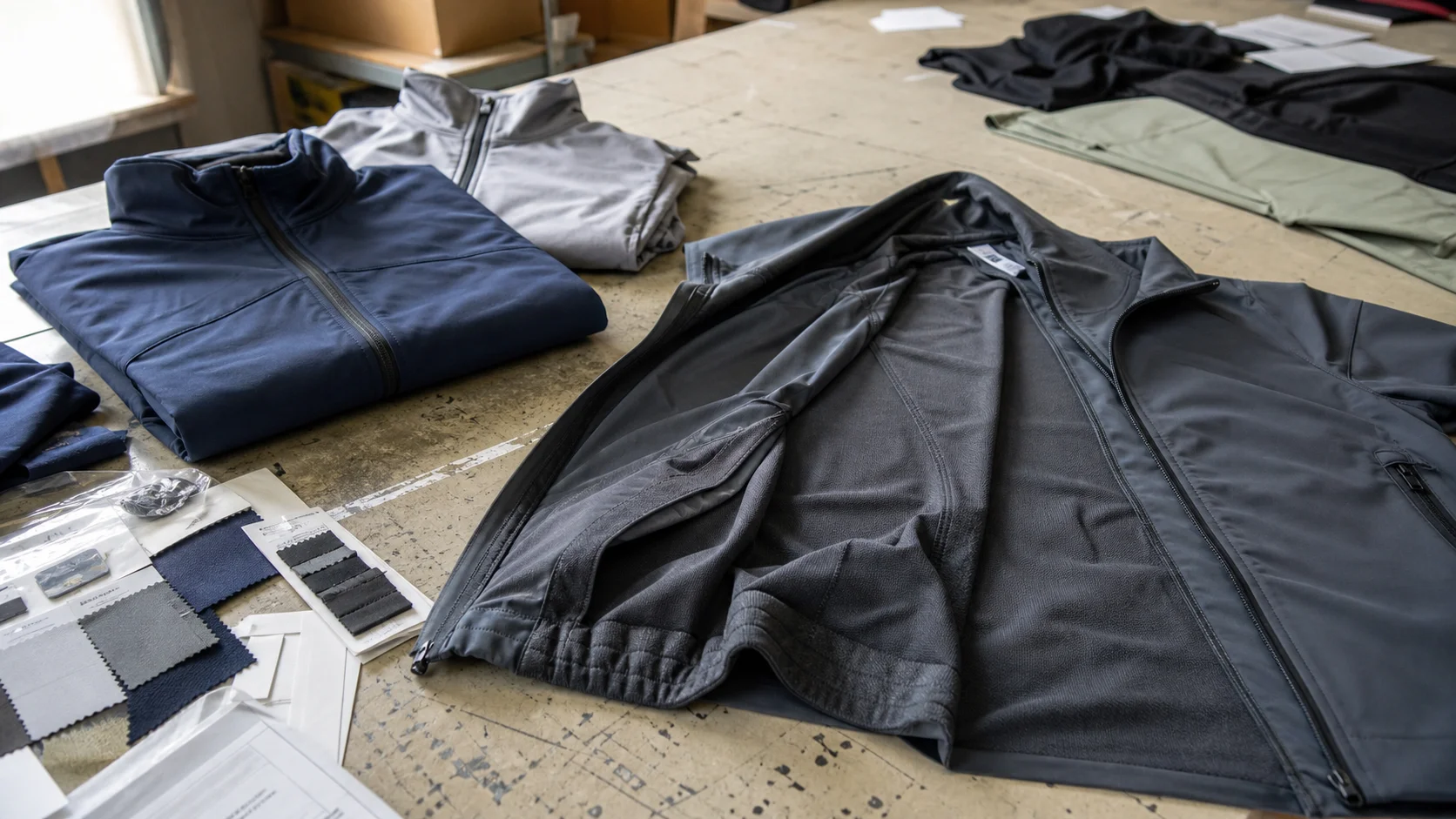
A distributor-focused outline for auditing fitness jacket colorfastness before purchase orders, covering lab dips, fabric tests, trim risks, wash...
Fitness Jacket Colorfastness Audit for Buyers - Fabrikn production reference
For distributor buyers, colorfastness is not a lab detail buried in a technical file. It is a commercial risk that shows up as customer returns, mismatched team orders, stained base layers, and complaints after the first wash. A fitness jacket may look correct at shipment, but poor dye fixation, weak print durability, or unstable contrast panels can damage the buyer’s margin once the goods enter the market.
This guide explains how to run a practical fitness jacket manufacturer colorfastness audit for distributor buyers. It focuses on activewear and teamwear jackets where polyester, nylon, spandex blends, mesh linings, zippers, reflective trims, heat-transfer logos, and contrast color blocking create multiple points of color risk.
Buying judgment: if a supplier cannot explain its colorfastness controls before sampling, do not wait until bulk production to find out. Color problems are rarely solved by final inspection alone.
Fitness jackets are exposed to sweat, friction, outdoor light, repeated washing, and contact with other garments. Teamwear and distributor programs add another challenge: repeatability. A club, school, gym chain, or retail distributor may reorder the same jacket months later and expect the navy, black, red, or royal blue shade to remain consistent.
Colorfastness problems usually appear in four ways. The first is fading, where the jacket loses depth after laundering or sunlight exposure. The second is staining, where a dark panel transfers color onto a lighter lining, white logo, base layer, or packaging tissue. The third is shade variation between panels, sleeves, hood, body, rib, binding, and zipper tape. The fourth is decoration failure, where heat-transfer prints crack, bleed, peel, or discolor around the edges.
Distributor buyers face heavier exposure than one-off private label buyers because they often handle mixed SKUs, repeat orders, and team customization. If a black jacket stains a white team logo or a red contrast panel bleeds into a light grey sleeve, the problem may affect an entire sales channel rather than one purchase order.
A good colorfastness audit does not guarantee perfection, but it reduces preventable risk. It forces the manufacturer to show how fabric lots are approved, how trims are tested, how shades are controlled, and how finished garments are checked before shipping.
A fitness jacket colorfastness audit should include both documentation and physical checks. Many buyers make the mistake of asking only for a test report. Test reports are useful, but they do not show whether the fabric used for testing is the same fabric used in bulk production. The audit should connect the test report to the actual purchase order, fabric lot, trim lot, decoration method, and finished jacket.
At minimum, the audit should cover the following areas:
For buyers building a broader sourcing program, colorfastness should sit inside a wider technical and quality framework. A manufacturer that offers structured product development, sampling, and quality management is easier to control than a workshop that simply accepts a tech pack and starts cutting. Buyers can review sourcing support options through Fabrikn services when setting up supplier evaluation criteria.
Fitness jackets use performance materials that behave differently from basic cotton apparel. Polyester may show good wash stability but still suffer from sublimation migration or poor color matching between fabric lots. Nylon can be sensitive to dyeing conditions and may show shade variation between shell and lining. Spandex blends can create heat-setting and dye uptake issues. Bonded fabrics and laminated shells introduce adhesive and delamination risks that can affect appearance after washing.
Common fitness jacket materials include woven polyester, nylon taslan, polyester-spandex interlock, fleece-backed softshell, lightweight ripstop, tricot lining, mesh lining, rib cuffs, elastic binding, waterproof zipper tape, drawcords, toggles, and reflective trims. Every one of these components can create a colorfastness or shade-matching issue.
Contrast color blocking deserves special attention. A black body with white sleeves, red shoulder panels on grey fabric, or navy shell with yellow piping can look strong in a catalog but carry higher risk. Dark shades often require stronger dye loads, and light panels reveal staining quickly. For teamwear, the risk is amplified because club colors are often non-negotiable.
Trim colorfastness is frequently overlooked. Zipper tape, drawcords, elastic, bindings, hook-and-loop patches, and printed labels may not come from the same dye house as the main fabric. If the manufacturer does not test trims, buyers should treat them as separate risk items.
Buyers do not need to become laboratory technicians, but they should know which tests matter. The right tests depend on market, fabric, color, and end use. Requirements for a low-cost gym promotion jacket may differ from a premium team travel jacket or branded distributor program.
Common tests include colorfastness to washing, rubbing or crocking, perspiration, water, light, sublimation, seawater or chlorinated water where relevant, and color migration for heat-transfer decoration. Test methods may reference ISO, AATCC, GB, or other regional standards depending on the destination market.
Grades should be agreed before the purchase order is confirmed. A buyer asking for premium performance after the fabric has already been sourced has limited leverage. Some dark shades, fluorescent colors, and special finishes may struggle to meet high scores in all conditions. The right purchasing decision is not always to reject them, but to understand the tradeoff and label, price, or design the product accordingly.
Direct buying call: if the jacket uses dark shell fabric, white decoration, and heat transfer, request migration testing on the actual bulk fabric. A generic logo test on a different fabric is not enough.
A reliable approval process starts before the first salesman sample is made. The buyer should provide a clear tech pack with fabric composition, target weight, color references, trim standards, logo artwork, wash care instructions, and intended market. Vague color instructions such as “nice navy” or “standard black” invite shade disputes later.
The first stage is lab dip or fabric color approval. For solid dyed fabric, the manufacturer should submit lab dips against Pantone, physical swatch, or approved color standard. Buyers should approve shade under controlled lighting and keep a signed or sealed reference. Digital photos are not enough for final approval because camera settings, screens, and light conditions distort color.
The second stage is trim and decoration approval. Zipper tape, drawcords, elastic binding, rib, snaps, reflective tape, and logo applications should be reviewed against the main shell and lining. If the jacket includes heat-transfer logos, the buyer should request strike-offs on actual fabric. This is especially important for polyester and softshell materials where dye migration can turn white logos grey, pink, blue, or yellowish over time.
The third stage is fit sample or proto sample. Colorfastness is not usually finalized at this stage, but the buyer can identify risky seams, color blocking, panel contact, and decoration placement. For example, a white inner placket against a black zipper tape may look clean but can stain after washing if zipper tape quality is weak.
The fourth stage is pre-production sample approval. This should use bulk or near-bulk fabric, approved trims, production decoration, correct care label, and final construction method. Distributor buyers should treat the pre-production sample as the commercial reference for bulk shipment.
The fifth stage is bulk shade approval. Before cutting, the factory should submit bulk fabric swatches from each dye lot. If multiple lots are used, buyers should approve an acceptable shade band. Cutting mixed lots into the same garment or same order without control can create visible panel mismatch.
Buyers developing new activewear programs can also use supplier communication channels early rather than waiting until production pressure builds. For technical sourcing inquiries or program review, contacting Fabrikn can help clarify what information should be ready before approaching a manufacturer.
A manufacturer colorfastness audit should look at how the factory controls inputs, not just how it inspects finished goods. The best time to prevent color issues is before fabric cutting. Once unstable fabric is cut and sewn, the buyer usually faces three poor options: accept risk, discount the goods, or remake the order.
Start with fabric sourcing. Ask whether the manufacturer buys greige fabric and controls dyeing through nominated mills, or purchases finished fabric from the market. Both models can work, but the risk profile is different. Market fabric may offer speed and lower MOQ, yet shade repeatability and test documentation can be weaker. Nominated dyeing gives better control but usually requires higher MOQ and longer lead time.
Incoming material inspection should include fabric shade checking, width, weight, hand feel, coating or lamination condition, visible defects, and test report matching. Shade should be checked roll by roll, not only by one swatch per lot. Rolls outside the approved shade band should be segregated before cutting.
Cutting controls matter because poor roll planning can mix shade variations within one jacket. If a factory cuts sleeves from one roll and body panels from another roll without shade grouping, the finished jacket may show subtle but visible panel mismatch. This is common in dark navy, charcoal, black, and heather-effect fabrics.
Printing and heat-transfer departments should control temperature, pressure, dwell time, peeling method, and curing conditions. Overheating can damage fabric color or cause shine marks. Under-curing can reduce wash durability. Sublimation and transfer processes need particular care because polyester dye migration may continue after production if the wrong adhesive or barrier layer is used.
Packing controls also matter. Damp garments, high-temperature storage, and tight packing of dark and light panels can increase staining risk. Finished jackets should be fully dry before polybagging. If the jacket includes white panels or light lining, buyers should be cautious about long storage periods in hot containers or warehouses.
A practical audit does not need to be hostile. It should be specific. Good suppliers can answer these questions clearly. Weak suppliers often respond with general phrases such as “no problem,” “standard quality,” or “we always do this.” Those answers should not satisfy a distributor buyer placing repeat orders.
Final inspection is important, but it has limits. Inspectors can compare shade, check stains, review labels, perform simple rubbing checks, and verify packaging. They cannot fully replace lab testing or undo poor dye fixation. Distributor buyers should use final inspection as a last gate, not the main quality system.
Inspection should include AQL visual checks and targeted color risk checks. Inspectors should compare finished garments against the approved pre-production sample and bulk shade standard. They should check different sizes, cartons, and production lots. Shade variation may appear between size runs if the factory cut different fabric lots at different times.
Inspectors should examine high-contact areas: underarms, collar, cuffs, zipper guard, pocket openings, hem, hood edge, printed logos, reflective panels, and contrast seams. A white tissue rubbing check can reveal obvious dry crocking, but it is not a replacement for laboratory wet rubbing or perspiration testing.
For jackets with lining, the inspection should look inside the garment. Dark shell bleeding onto mesh lining may not be visible on the outside but will still create customer complaints. Light-colored pocket bags are another risk area because keys, phones, and hand moisture create friction and damp contact.
Packaging should be inspected for dye transfer as well. White tissue, size stickers, hangtags, collar inserts, and polybags can show early staining. If a dark jacket has already marked its packaging before shipment, it may stain other garments after warehousing.
The key judgment is whether the issue is isolated, systemic, or design-related. One stained garment in a carton may be a handling defect. Consistent staining across multiple cartons suggests a material or process failure. Shade mismatch across all units may mean the buyer approved loose tolerances or the factory mixed lots without control.
MOQ has a direct effect on color control. Low MOQ programs often use available fabric, stock colors, and standard trims. This can reduce lead time and cost, but limits control over exact shade and test performance. Custom dyed programs offer better color matching and repeatability, but they require more planning and usually higher minimums.
Typical MOQ ranges vary by supplier, fabric, and customization level. Stock fabric fitness jackets may start around 100 to 300 pieces per color if the manufacturer has fabric and trims available. Semi-custom orders with selected stock fabric, custom trims, and logo decoration may sit around 300 to 600 pieces per color. Fully custom dyed fabric, special color blocking, and nominated performance testing may require 800 to 1,500 pieces per color or more. Softshell, bonded fabric, special membrane, and custom yarn-dyed or laminated materials can push MOQ higher.
These figures are not universal. A factory may accept a lower MOQ at a higher unit price, or combine fabric dyeing across styles if the same material is used. Buyers should ask whether the MOQ is driven by fabric dyeing, trim dyeing, printing setup, cutting efficiency, or factory policy. The answer reveals where negotiation is realistic.
Lead time depends on material availability, lab dip approvals, trim sourcing, testing, production capacity, decoration complexity, and inspection requirements. A stock fabric jacket with a simple logo may ship in 3 to 6 weeks after sample approval. A custom dyed fitness jacket may need 8 to 12 weeks or longer, especially if lab testing fails and re-dyeing is required. Peak season, holiday closures, and shipping method can extend the schedule.
Buyers should build testing time into the calendar. Colorfastness testing, wash testing, and decoration durability checks are not instant. If a distributor commits to a retail delivery date before fabric approval, the schedule may force poor decisions later.
A colorfastness audit becomes easier when the purchase specification is clear. The spec does not need to be overcomplicated, but it should define the product well enough that the supplier cannot substitute risky materials without approval.
For the main shell, specify fiber content, construction, target weight, finish, stretch requirement, water-repellent treatment if applicable, coating or membrane details, color standard, and required tests. For lining, specify fiber content, weight, mesh type or tricot type, color, and staining requirements. For trims, specify zipper brand level or performance grade, tape color, puller material, drawcord type, elastic quality, reflective trim wash durability, and label material.
For decoration, specify method, size, placement, color, film or ink type, stretch requirement, wash durability, and migration resistance. White logos on dark polyester need careful testing. Metallic, reflective, neon, and silicone effects also require approval because they may behave differently after washing or heat exposure.
Wash care instructions should match the tested product. If the jacket is labeled machine washable, the testing should support that claim. If the garment requires cold wash, low spin, no tumble dry, or wash inside out, the care label should be commercially realistic. Customers may ignore delicate instructions on activewear, so buyers should avoid fragile decoration methods on products intended for frequent training use.
Not every colorfastness risk requires rejecting a supplier. Some risks can be managed through design, pricing, labeling, or order strategy. The buyer’s job is to decide which risks are acceptable for the market position.
For entry-level promotional jackets, stock colors and standard trims may be acceptable if the buyer avoids high-risk contrast combinations and keeps claims modest. For club and teamwear programs, repeatability matters more, so approved color standards and reorder controls should be stronger. For premium activewear distribution, buyers should invest in testing, sealed samples, documented inspection, and manufacturer process review.
Design can reduce risk. Avoid placing dark unstable fabric directly against white lining. Use barrier layers or darker linings where possible. Choose embroidery instead of heat transfer if migration risk is high, while remembering that embroidery can affect waterproofing and stretch. Use tone-on-tone trims if zipper tape matching is difficult. Limit fluorescent shades if lightfastness and shade repeatability are critical.
Supplier selection should reflect the order type. A low-cost sewing factory may be fine for a simple stock jacket, but a color-blocked performance jacket with reflective trims and heat-transfer logos requires stronger material control. Buyers should review the manufacturer’s background, service model, and quality approach before building a distributor program. General company information can be reviewed through Fabrikn about us when assessing sourcing fit.
The following checklist can be used before placing a fitness jacket order with a manufacturer. It is designed for distributor buyers who need a practical tool rather than a laboratory manual.
Some supplier responses should immediately raise concern. A manufacturer that cannot identify fabric lot numbers may not be able to control shade. A supplier that offers very low MOQ for custom dyed colors without explaining fabric minimums may be using available fabric rather than truly custom dyeing. A factory that says testing is unnecessary because “customers never complain” is asking the buyer to carry the risk.
Another red flag is decoration approval without fabric confirmation. Heat-transfer and printed logos should be tested on the intended bulk material. A logo that performs well on one polyester fabric may fail on another because dye chemistry, finish, stretch, and heat history differ.
Be cautious when the manufacturer refuses to provide test reports or only provides old reports with unrelated dates, colors, or fabric references. Test reports should be reviewed for product relevance. A report for black polyester fleece does not automatically cover a navy woven shell or red softshell laminate.
Rush production is also risky. When sampling, testing, bulk dyeing, and inspection are compressed into an unrealistic schedule, colorfastness controls are usually the first things skipped. A late shipment is expensive, but a shipment of unstable jackets can be worse.
Every buyer wants strong colorfastness, low MOQ, fast delivery, and competitive price. In real sourcing, these priorities compete. The practical route is to decide which points cannot move and where compromise is acceptable.
If speed is the top priority, choose stock colors with existing test history and avoid risky contrast panels. If color accuracy is the top priority, allow time for lab dips, bulk dyeing, and shade approval. If low MOQ is the top priority, accept limited color ownership and choose safer shades. If brand reputation is the top priority, pay for testing, stronger trims, and more disciplined inspection.
Distributor buyers should also think about reorder strategy. If the jacket will become a recurring program style, invest more in color standards and supplier documentation from the beginning. If the jacket is a one-season promotional item, the buyer may accept stock color limitations but should still protect against staining and obvious fading.
Best purchasing rule: never let a low unit price hide an unstable color. A cheap jacket that stains team uniforms or customer laundry is not cheap after claims, replacements, and lost accounts.
A fitness jacket manufacturer colorfastness audit for distributor buyers should connect design, fabric sourcing, testing, production control, and final inspection. The goal is not paperwork for its own sake. The goal is to prevent avoidable claims and protect repeat business.
The strongest buyers set expectations early. They define fabric and trim specifications, approve lab dips carefully, test high-risk materials, control bulk shade lots, and inspect finished garments against sealed references. They also understand tradeoffs. Stock fabric can support lower MOQ and faster delivery, but it may limit shade control. Custom dyeing improves repeatability, but it needs higher minimums, longer lead time, and tighter approval discipline.
Colorfastness problems are easier to prevent than to repair. For activewear and teamwear distributors, that makes the audit a buying tool, not an administrative step.
Get a free quote from Fabrikn — your trusted B2B clothing manufacturer with 10+ years of experience. MOQ as low as 200 pieces.
Get a Free Quote →A colorfastness audit checks whether the jacket’s fabric, trims, lining, and decoration can resist fading, staining, rubbing transfer, perspiration, washing, and light exposure. For distributor buyers, it should also verify that test reports, shade approvals, and production lots match the actual order.
Washing, dry rubbing, wet rubbing, perspiration, water staining, lightfastness, and sublimation or migration testing are commonly important. The exact test package depends on fabric type, color, decoration method, and destination market.
Dark fabrics may contain higher dye loads or surface dye residue. Under moisture, heat, pressure, or friction, color can transfer to lighter materials. Polyester jackets with heat-transfer logos also need migration control because dye can move into the logo film.
Stock fabric jackets may start around 100 to 300 pieces per color. Semi-custom programs often fall around 300 to 600 pieces per color. Fully custom dyed fabric may require 800 to 1,500 pieces per color or more, depending on fabric mill minimums, trim dyeing, and production setup.
No. Final inspection can catch visible shade mismatch, stains, packaging transfer, and obvious rubbing issues, but it cannot replace lab testing or fabric lot control. Colorfastness must be managed before cutting and sewing.
Use approved physical color standards, avoid risky dark-to-light panel contact, test decorations on actual fabric, approve bulk shade lots before cutting, and inspect garments across sizes and cartons. Repeat teamwear programs should maintain sealed samples and shade bands for future orders.
Not always. Stock colors can be faster and lower MOQ, but buyers may have less control over shade repeatability and test history. Custom dyed colors can offer better control if the manufacturer manages lab dips, bulk lots, and testing properly.
First confirm the test method, grade, and fabric lot. Then ask whether washing, additional soaping, dye process adjustment, or fabric replacement can improve performance. If improvement is not realistic, the buyer should reconsider the color, lining, decoration, care label, or commercial positioning.
Yes. Zipper tape, drawcords, elastic binding, rib, labels, and reflective trims may come from different suppliers and dye processes. They should be checked for shade match, staining, and wash durability where they contact the garment or skin.
Requirements should be agreed before purchase order confirmation and preferably before sampling. Once bulk fabric is purchased or cut, the buyer has fewer options if testing fails or shade variation appears.