
A product-specific SEO outline for outdoor school buyers evaluating trims for fitness jackets, including zipper systems, reflective details, elastic...
Fitness Jacket Trim Sourcing Review for School Buyers - Fabrikn production reference
Outdoor school buyers often focus first on jacket fabric, color, size range, and price. That is understandable. Fabric is visible, budget is tight, and schoolwear programs usually involve multiple stakeholders. Yet trim sourcing can decide whether a fitness jacket feels durable, looks consistent across repeat orders, and survives daily use by students.
For activewear and teamwear, trims are not minor decoration. Zippers, pullers, cords, elastic, reflective tape, labels, snaps, toggles, binding, and heat-transfer logos all affect function. A poor zipper can make an otherwise good jacket feel cheap. Weak elastic can distort cuffs after several washes. Reflective tape that peels after laundering can create complaints from parents and sports coordinators. A drawcord that fails safety expectations can delay shipment or require rework.
School fitness jackets sit between uniform apparel and performance outerwear. They must be practical for outdoor activity, presentable for school identity, and affordable enough for bulk purchase. That creates a sourcing challenge: buyers need reliable trims without over-specifying luxury components that push the garment beyond budget.
For sourcing support across activewear and school teamwear categories, buyers can review the manufacturing service scope at fabrikn.com/services/. The main issue is not choosing the most expensive trim package. It is choosing trims that match the jacket’s intended use, order quantity, wash expectations, and replacement cycle.
The strongest purchasing decision is usually not the premium trim option. It is the trim package that performs consistently at the agreed price, ships on time, and can be repeated in future school seasons.
School buyers rarely source fitness jackets for a single use case. The same jacket may be worn during PE classes, outdoor sports practice, field trips, after-school clubs, and general campus wear. That means trims must support movement, quick dressing, repeated washing, and a wide student size range.
Typical school requirements include modest styling, school-approved colors, clear branding, and safe components. Buyers also need predictable reorders. A jacket approved in one academic year may need to be repeated the next year with the same zipper color, logo placement, label wording, and reflective detail. Trim continuity matters because visible variation can cause complaints when new students receive jackets that look different from older stock.
For outdoor school fitness jackets, trim decisions should be reviewed against these common priorities:
Outdoor school buyers should be cautious with highly customized trims unless the order volume supports them. Custom rubber pullers, branded zipper tape, jacquard elastic, custom reflective prints, and molded badges can improve brand identity, but they add sampling time, MOQ pressure, and replacement risk. If the school program is small or has uncertain repeat demand, standard trims with carefully controlled colors are often the safer route.
The zipper is usually the highest-risk trim on a school fitness jacket. Students pull zippers quickly, often while wearing backpacks or gloves. A weak slider, uneven teeth, or poor sewing alignment can lead to returns. For outdoor school jackets, buyers normally review coil zippers, molded plastic zippers, or waterproof-look zippers depending on the fabric and price level.
Coil zippers are common for lightweight activewear jackets because they are flexible and cost-effective. Molded plastic zippers look more substantial and can suit heavier jackets, but they may feel bulky on lightweight fabrics. Waterproof zippers or coated zipper tapes add a technical look but are not always necessary unless the jacket is positioned as weather-resistant. They can increase cost and may require more careful sewing to avoid puckering.
Buyers should specify zipper length, tape color, teeth color, slider finish, puller type, and whether the zipper is reverse coil or standard. Do not rely only on a supplier saying “matching zipper.” Matching can mean close enough to the factory, but not close enough for a school uniform committee.
Pullers are small, but they affect daily usability. Standard metal or plastic pullers are usually enough for school fitness jackets. Rubberized custom pullers create a stronger teamwear look, but they often come with higher MOQs and tooling considerations. If the jacket is for younger students, avoid oversized detachable pullers or parts that can break off easily.
Toggles and cord stoppers should be reviewed carefully. They may be useful at hems or hoods, but schoolwear safety rules and age groups matter. For younger students, exposed drawcords in hood and neck areas can be problematic. Buyers should ask suppliers to confirm drawcord layout against the destination market’s children’s apparel safety expectations.
Elastic quality affects fit and garment life. Low-grade elastic may stretch out quickly, creating loose cuffs or a wavy hem. For fitness jackets, elasticated cuffs, stretch binding, or rib cuffs are all possible. Each has tradeoffs.
For school orders, stretch recovery is more important than decorative complexity. Ask for elastic width, composition, stretch ratio, and recovery after laundering. A basic lab test is useful for large programs, but even a practical sample wash can reveal weak elastic before bulk production.
Reflective trims are attractive for outdoor school jackets, especially for morning travel, field activities, and sports teams. They must be sourced with care. Not all reflective tape performs the same after washing, abrasion, or heat pressing. Some reflective details are decorative rather than safety-certified.
Buyers should clarify whether reflective trim is required for visibility styling or for a specific performance claim. If a jacket is marketed as reflective or safety-enhancing, the supplier should provide appropriate specifications and test references. For general school activewear, small reflective piping, printed reflective logos, or reflective zipper pulls can add value, but they should be inspected for adhesion and cracking.
School jackets usually need several label types: main neck label, size label, care label, country-of-origin label where required, and sometimes a name label. Branding may also include embroidery, heat transfer, silicone patch, woven badge, or screen print.
Heat transfers are popular for activewear because they avoid bulky stitching and suit stretch fabrics. They need wash testing, especially when applied to polyester, nylon, or coated fabrics. Embroidery is durable but can create needle holes and stiffness on lightweight shells. Woven badges look traditional, but edges and stitching must be clean.
Buyers sourcing broader school and teamwear programs can learn more about the supplier background and positioning at fabrikn.com/about-us/. The practical point is simple: branding method should match the jacket fabric, not only the school logo style.
Trim sourcing cannot be separated from shell fabric and lining choices. A lightweight polyester knit jacket needs different trims from a woven windbreaker. A softshell jacket needs stronger zippers and potentially different label placement. A fleece-lined fitness jacket needs bulk control at seams and cuffs.
Common fabric options for school fitness jackets include polyester interlock, polyester tricot, nylon or polyester woven fabric, bonded softshell, and lightweight fleece-backed fabrics. Each fabric changes trim decisions.
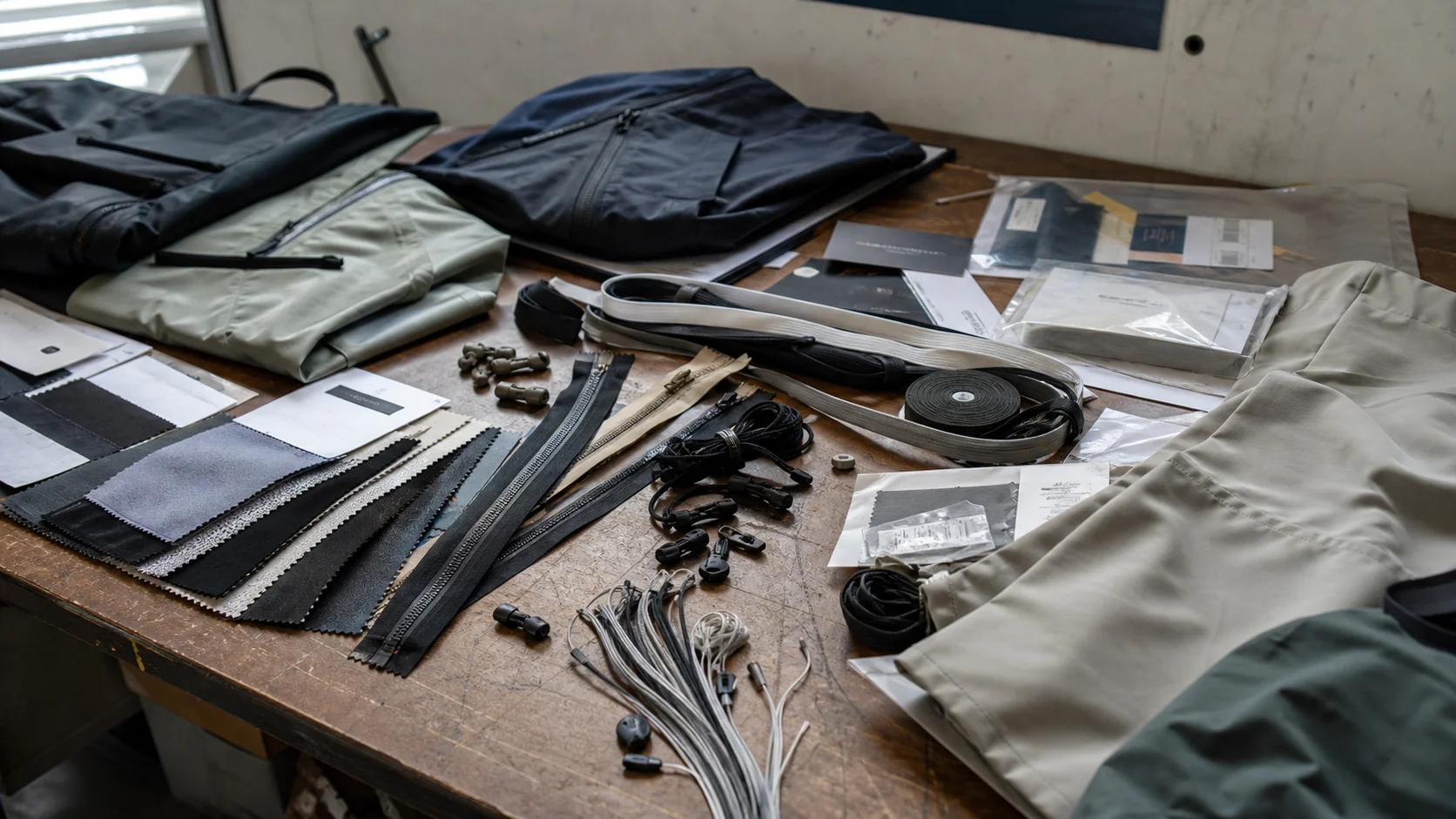
Fabric Type Typical Use Trim Considerations Main Risk Polyester interlock or knit PE jackets, warm-up jackets, teamwear Flexible coil zipper, stretch binding, heat-transfer logo Puckering, logo cracking, weak recovery Polyester woven Light outdoor fitness jacket, windbreaker Coil zipper, elastic cuff, reflective piping, woven label Seam slippage, zipper mismatch, noisy fabric Nylon woven Lightweight outdoor shell Fine zipper, low-bulk labels, careful heat application Heat damage, shade variation, coating marks Softshell Cool-weather school jacket Stronger zipper, molded puller, clean badge or embroidery Bulk at seams, zipper stiffness, embroidery tension Fleece-backed polyester Warm fitness jacket Stable zipper tape, rib or elastic cuff, durable care label Pilling, lint contamination, uneven sewingBuyers should request a trim card with physical samples attached. A digital specification sheet is not enough for shade and hand-feel review. The trim card should include zipper tape, puller, elastic, binding, drawcord, stopper, reflective tape, label samples, badge materials, and logo application samples where relevant.
Color matching deserves special attention. School colors are often strict, and trims can vary by material. A navy zipper tape may not match navy polyester fabric. A green heat transfer may look different on a white jacket than on a dark jacket. Reflective trims may change appearance under indoor lighting. Approval should be done against physical fabric swatches, not only Pantone references.
MOQ is one of the biggest constraints in outdoor school buyers fitness jacket trim sourcing review. Factories may accept a garment MOQ, but trim suppliers often have their own minimums. A school may need 300 jackets, while a custom zipper supplier requires 1,000 pieces per color. That gap can create hidden cost, leftover trim inventory, or pressure to simplify the design.
Typical MOQ ranges vary by supplier and market, but school buyers can use these cautious benchmarks during early discussions:
Trim Item Typical MOQ Range Best Use Case Buyer Caution Standard coil zipper 300-1,000 pieces per color/length Small to mid-size school jacket orders Confirm exact length and tape shade before bulk Custom zipper puller 1,000-3,000 pieces or more Large programs or repeat school contracts Tooling, approval time, and leftover stock risk Reflective tape 500-2,000 meters Outdoor jackets with visibility details Check wash durability and claim level Woven labels 500-1,000 pieces Most schoolwear orders Artwork, spelling, and size grading must be approved Heat-transfer logo 300-1,000 pieces per artwork Activewear jackets and lightweight shells Requires fabric compatibility and wash testing Jacquard elastic or branded tape 1,000-3,000 meters or more Premium teamwear programs Can overcomplicate small school ordersFor small school orders, the smartest cost decision is often standard trim with controlled color and placement. Custom trims make sense when the program has enough volume, when the school wants a distinct identity, or when a distributor expects repeat orders across multiple campuses.
Unit price should not be reviewed alone. A cheaper zipper that causes field complaints is expensive. A custom puller that delays delivery beyond the school term is also expensive. Buyers should compare total risk: component cost, sampling time, production reliability, inspection failure risk, and reorder availability.
A disciplined sample approval process protects school buyers from avoidable problems. Fitness jacket trims should be checked in stages, not left until the final pre-production sample. Trim issues discovered late can delay the entire garment order.
A practical approval flow usually includes the following steps:
School buyers should not approve trims from photos only unless the order is very basic and risk is low. Photos do not show zipper smoothness, elastic recovery, label irritation, or reflective tape adhesion. A physical sample is worth the extra few days when the order has strict delivery and visibility requirements.
Care-label approval is especially important. Outdoor fitness jackets may include coated fabric, heat-transfer logos, reflective tape, or elastic trims with different heat tolerance. The washing instruction must reflect the weakest relevant component, not only the shell fabric. If the heat-transfer logo cannot tolerate tumble drying, the care label should not suggest it.
Lead time for school fitness jackets depends on fabric availability, trim procurement, sample approvals, production capacity, decoration method, inspection schedule, and shipping mode. Trim sourcing is often the hidden delay, particularly when buyers request custom colors, branded components, or reflective materials.
For standard activewear trims, sourcing may take one to three weeks if materials are available and colors are common. Custom trims can add two to six weeks or more, especially when tooling, strike-off approval, or special dyeing is needed. Heat-transfer logos and woven labels may be faster than custom zipper pullers, but artwork approval can still slow the process.
A cautious schoolwear timeline often looks like this:
Stage Typical Time Range Dependency Risk if Rushed Specification and quotation 3-10 days Clear tech pack, logo files, target quantity Wrong assumptions on trim quality or cost Trim sourcing and card approval 1-3 weeks Standard trims, available colors Shade mismatch or unsuitable substitute Custom trim development 2-6 weeks or more Tooling, MOQ, artwork, supplier capacity Missed school delivery window Fit and pre-production sample 1-3 weeks Pattern, fabric, trims, decoration Bulk starts before design is stable Bulk production 4-8 weeks Order size, factory capacity, decoration load Uneven workmanship or late shipment Inspection and shipment 1-4 weeks or more Inspection booking, packing, shipping method Unresolved defects reach the schoolPeak season matters. Schoolwear orders tend to cluster before academic terms and sports seasons. A trim supplier that is quick in March may be slower in June or July. Buyers should avoid approving custom trims too close to the required delivery date unless the supplier has confirmed stock, production slots, and a realistic dispatch plan.
For urgent orders, simplify trims. Use standard zipper tapes, existing pullers, stock elastic, and tested logo methods. It is better to deliver a clean, reliable jacket on time than to chase a custom trim package that arrives after the school event.
Trim defects can be harder to catch than fabric defects because they appear in operation, wash, or repeated wear. A jacket can look acceptable on a hanger but fail when zipped, stretched, or washed. Inspection should include functional checks, not only visual review.
Key inspection risks include zipper jamming, uneven zipper length, twisted binding, loose pullers, sharp snap edges, elastic distortion, reflective tape peeling, label mistakes, logo misplacement, color inconsistency, and poor bartack reinforcement at pocket or zipper stress points.
For school buyers, the following trim checks are practical and valuable:
Inspection sampling should be agreed before production. Many buyers use AQL-based inspection, but school programs may also require 100% checks on visible branding or size labels if the order is sensitive. Mislabeling a size run can create distribution problems for schools, especially when jackets are packed by student name, class, or team.
One common mistake is approving a logo on one sample size and assuming it scales properly. For children’s and youth sizing, the same logo may look too large on small sizes or too high on larger sizes if placement rules are not graded. Buyers should define placement by measurement from fixed points, such as center front, shoulder seam, or chest line, rather than relying only on visual judgment.
The best trim package depends on the school’s order profile. A primary school PE jacket, a secondary school outdoor fitness jacket, and a competitive team warm-up jacket should not use the same trim strategy. Buyers should decide where trims need to perform and where they simply need to look clean.
For budget school PE jackets, prioritize standard coil zippers, durable elastic, simple labels, and a tested school logo application. Reflective details can be minimal. Avoid custom molded parts unless volume justifies the cost.
For mid-range outdoor school fitness jackets, consider better zipper quality, stronger pocket construction, controlled reflective accents, and a trim card that can be repeated for future terms. This is the most common sweet spot for school buyers because it balances function, identity, and price.
For premium teamwear or representative school sports jackets, custom pullers, branded badges, contrast binding, and higher-grade reflective trims can make sense. The order should have enough volume or repeat demand to absorb MOQ and development time. If the buyer cannot forecast reorders, keep custom trim limited to removable or easily repeatable elements such as labels and heat transfers.
School buyers should also ask whether trim substitutions are allowed. Factories sometimes replace unavailable trims with similar alternatives during production. That can be acceptable for hidden components, but visible trims should require written approval. A substitute zipper tape or reflective strip can change the entire look of a uniform jacket.
Before confirming a purchase order, ask these direct questions:
Buyers preparing a school jacket program can contact a manufacturing partner early through fabrikn.com/contact-us/. Early trim review is useful because the quotation stage is where many future problems can be prevented. Once bulk fabric is cut and trims are ordered, changes become slower and more expensive.
A trim specification should be clear enough that a different production manager could understand the order without guessing. Vague wording such as “good zipper,” “matching elastic,” or “standard school label” is not enough for repeatable manufacturing.
Trim Area Specification to Confirm Approval Evidence Main zipper Type, length, tape color, teeth color, slider, puller, opening direction Physical zipper sample and approved garment sample Pocket zipper Size, tape shade, puller, pocket position, reinforcement Fit sample and pre-production sample Elastic or binding Width, color, composition, stretch recovery, sewing method Trim card and wash check Reflective detail Material type, width, placement, wash resistance, claim level Supplier specification and applied sample Logo Artwork, size, color, method, placement, grade rules Strike-off and final sample Labels Main label, size label, care label, name label, legal wording Label proof and physical sample Drawcords and toggles Location, length, end finish, stopper type, age suitability Safety review and garment sampleGood specifications reduce arguments. If a zipper jams during inspection, the approved reference helps decide whether the issue is component quality, sewing quality, or an unrealistic specification. If a school complains about shade variation, the trim card gives the buyer and supplier a common standard.
Outdoor school jacket sourcing is full of tradeoffs. Buyers do not need every performance feature. They need the right features for the use case and budget.
It is usually worth paying slightly more for a reliable main zipper. Students use it every time they wear the jacket, and zipper failure is highly visible. It is also worth spending time on logo testing because school identity is the reason many jackets are purchased in the first place.
It may not be worth developing custom zipper pullers for a small one-time order. The added MOQ and tooling can consume budget better spent on fabric quality or inspection. It may also be unnecessary to use high-spec reflective tape if the detail is decorative and the school has not requested a certified visibility standard.
Buyers should be careful with too many contrast trims. Contrast zipper tape, contrast binding, contrast pullers, and contrast logos can create a strong look, but each color adds approval work and shade risk. A cleaner design with fewer trim colors is often easier to reproduce across years.
The safest approach for many school buyers is a controlled trim hierarchy: invest in the zipper, elastic, label accuracy, and logo durability; keep decorative trims simple; reserve custom components for confirmed repeat programs.
A fitness jacket for school buyers is not judged only on first appearance. It is judged after students zip it daily, stuff it into bags, wear it in damp weather, wash it repeatedly, and compare it with classmates’ jackets. Trim sourcing affects all of those moments.
The right trim review process gives buyers better control over quality, timing, and cost. It also reduces the chance of late-stage surprises. Start with the jacket’s real use, define essential trims, request physical trim cards, approve samples in stages, and inspect functional details before shipment.
For outdoor school buyers, the most reliable sourcing decision is rarely the most complicated design. A well-built jacket with standard but dependable trims will usually outperform a highly customized jacket that strains MOQ, lead time, and inspection control. In activewear and teamwear, consistency is a purchasing advantage.
Get a free quote from Fabrikn — your trusted B2B clothing manufacturer with 10+ years of experience. MOQ as low as 200 pieces.
Get a Free Quote →The main zipper, pocket zippers, elastic or binding, logo application, care labels, and reflective details are usually the most important. The main zipper deserves special attention because it receives the most daily use and creates immediate complaints if it fails.
Standard trims may start around 300-1,000 pieces depending on the item and supplier. Custom pullers, jacquard elastic, branded tape, or special reflective materials often require 1,000-3,000 pieces or more. Exact MOQ should be confirmed trim by trim, not only at garment level.
Custom zipper pullers can be worthwhile for large or repeat programs, especially premium teamwear. For small school orders, they often add cost, MOQ pressure, and development time. A standard puller with a strong logo application elsewhere is usually more practical.
Reflective trims can add useful visibility and a technical outdoor look. Buyers should clarify whether the trim is decorative or intended to meet a performance standard. Wash resistance, adhesion, and placement should be checked before bulk production.
Buyers should approve a physical trim card, a fit sample, logo strike-off, and a pre-production sample with final trims. Photos are not enough for zipper feel, elastic recovery, reflective adhesion, or exact color matching.
Custom colors, tooling, branded components, reflective materials, artwork changes, and late approvals commonly delay trim sourcing. Peak schoolwear seasons can also slow supplier response. Standard trims are usually safer when delivery dates are tight.
Common problems include zipper jamming, uneven zipper sewing, loose pullers, stretched elastic, peeling reflective tape, incorrect labels, logo misplacement, and shade differences between approved samples and bulk trims. Functional checks should be included in inspection, not just visual review.