
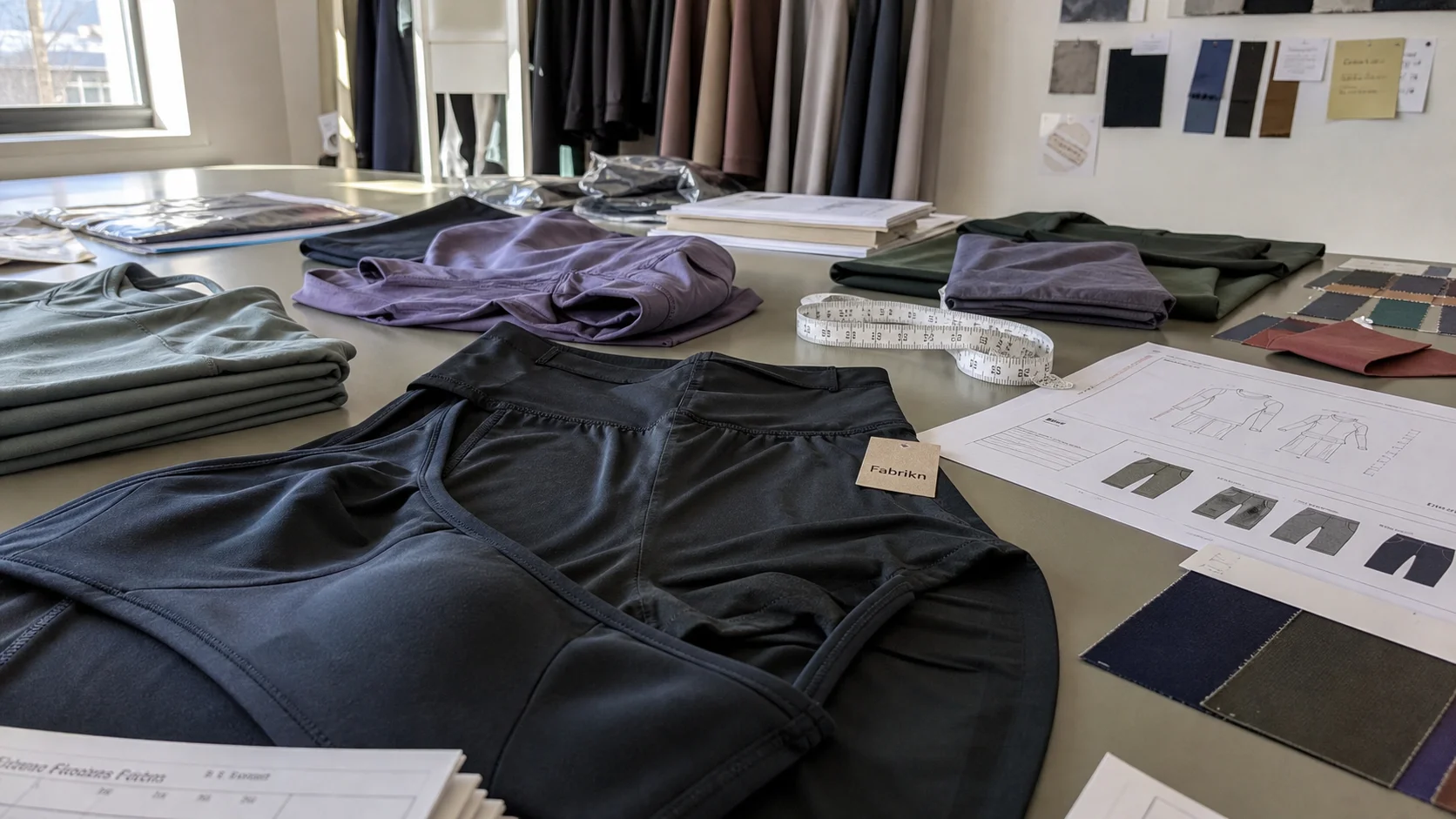
Foil Stamped Hang Tags for Clothing with checks for samples, fit, MOQ, QC evidence, pricing terms, and delivery risk.
Fast answer: Foil Stamped Hang Tags for Clothing: Costs, Specs, ROI should be judged by production evidence, not by a generic sourcing promise. The buyer needs sample proof, cost breakdowns, QC checkpoints, and delivery buffers in writing.
Ask for recent sample photos, measurement tolerances, fabric or print test assumptions, decoration test notes, packing examples, and a named inspection checkpoint. These details show whether the team can repeat an approved sample at bulk volume.
Separate garment cost, decoration, labels, packaging, sampling, testing, freight, and rush charges. When every cost line is visible, it becomes easier to reduce colorways, adjust size depth, or reserve more time for sampling.
Shoppers make a premium-or-not judgment in seconds, and the hang tag often does the talking before the garment gets a chance. For brands comparing packaging options, foil stamped hang tags for clothing can create that first polished signal at the fixture edge. Across more than 200 factories in eight countries, I’ve watched the same shirt move from forgettable to worth trying on simply because the tag caught the light cleanly.
Three seconds. That’s the window.
A neutral paper stock can look flat under store LEDs, but foil throws contrast back at the eye in a way plain offset print can’t. Ivory, kraft, stone, warm grey—those boards all benefit from a crisp metallic hit. In racks where 40 to 80 SKUs are competing for attention, that little flash does real work.
Smaller labels often get the bigger lift. A $28 tee with a tight silver accent and clean typography can feel more considered than a $90 sweater carrying a muddy tag with no hierarchy at all. Big brands can coast on name recognition. Newer labels cannot.
Factory sample tables tell the same story. Last year, in Vietnam, a tag converter laid out two versions of one design: flat and stamped. Buyers kept pointing to the foil version and saying “more expensive,” even though the paper cost only $0.04 more per piece. Bridal basics, cashmere, premium kidswear, giftable products—the reaction was even stronger there.
Decoration for decoration’s sake? Wasteful. Hang tags affect conversion, gifting appeal, and post-purchase memory. For brands selling through boutiques, department stores, and clothing packaging solutions, foil stamped hang tags for clothing can act like a silent salesperson at the fixture edge.
The process is more technical than many buyers expect. A manufacturer starts with the design file, creates the die, selects foil, sets up the press, stamps the artwork, cuts the shape, and finishes with stringing or attachment. On a standard run, that can mean 3 to 5 production steps after approval. One mistake in the first file echoes through every tag in the order.
Paper choice drives the result. Coated stocks usually give crisper foil edges because the surface is smoother and less absorbent. Uncoated papers can still work well, but they demand more pressure control and often show softer edges—especially on fine serif fonts or logos with hairline rules below 0.25 pt. I’ve seen 350 GSM coated board beat a thicker 400 GSM textured sheet simply because the surface held detail better.
Foil comes in more than gold and silver. Brands use black foil for understated luxury, rose gold for beauty-adjacent apparel, holographic foil for youth drops, and matte metallics for technical outerwear. Hot foil stamping gives strong tactile definition. Cold foil can suit certain high-volume setups. Blind emboss adds depth without metallic shine, which some heritage labels prefer for a quieter finish. Put emboss and foil together, and the tag carries both touch and light.
That combination raises cost and risk. Dense logos, reversed type, tiny copy—any of them can fail if the die or paper is wrong. A detailed monogram that looks perfect on screen may collapse during stamping if the supplier cannot hold registration to within 0.3 mm. The practical move is to simplify the artwork before production, not after rejection.
There’s a sustainability caveat too. Mixed substrates, laminated layers, adhesive systems—those make some foil constructions harder to recycle. Ask what board, foil, and glue are being used. If the brand’s materials policy includes certified inputs, request FSC paper and confirm whether the supplier can support cut and sew manufacturing programs with consistent packaging specs across styles. Data from OEKO-TEX shows how material scrutiny now reaches far beyond the garment itself.
Pricing shifts fast with quantity. A 500-piece run can cost many times more per tag than a 10,000-piece run, even if the artwork never changes. Setup costs stay stubbornly fixed: die creation, press make-ready, proofing, trimming. They do not shrink just because the order is small. In my sample books, the gap between 500 and 5,000 pieces often looks absurd on paper and completely logical on a press sheet.
Here’s the rough cost structure I see most often. Paper: $0.03 to $0.12 per tag, depending on stock and thickness. Printing: $0.02 to $0.08. Foil stamping: commonly $0.05 to $0.20. Die cutting, string attachment, packing: another $0.04 to $0.15. Tooling sits apart. A die may cost $40 to $180, sometimes more for complex shapes or multiple foil areas.
Hidden costs trip up first-time buyers. Revisions to artwork can add one or two extra proofs. Rush fees can push an order up by 10% to 30%. Specialty cords, rounded corners, spot lamination, an extra emboss pass—each one nudges the bill higher. A brand ordering 1,000 tags at $0.32 each may find the final invoice landing closer to $0.41 once corrections and packaging are added.
Market tier matters. Entry-level fashion labels often tolerate $0.10 to $0.18 per tag and skip complex structures. Mid-market DTC brands can justify $0.18 to $0.35 when the tag supports a clean unboxing story. Luxury houses may spend $0.50 to $1.20 or more if the finish supports a broader retail narrative. I’ve seen a private label line save money through smarter paper choice and better batch planning, which is why private label clothing services often focus on standardizing tag specs across colors and sizes.
Spend on foil clarity and paper feel. Save on unnecessary folds, double windows, oversized hang systems that don’t improve shelf impact. A 65 x 90 mm tag with precise foil and good board can outperform a more elaborate piece at twice the cost. For importers scaling foil stamped hang tags for clothing in bulk, buying wholesale from a China supplier or China manufacturer can improve unit economics when quality controls are in place.
Brands ordering foil stamped hang tags for clothing in bulk should also review MOQ, packaging, and approved proof standards before production starts. A lower MOQ is helpful for testing, but wholesale pricing usually improves when quantities are planned around the factory’s press setup and paper sheet utilization. Clear specs reduce waste and keep the supplier from adding padding into the quote.
Restraint reads as premium. One foil accent usually beats a full metallic flood because the eye needs contrast, not saturation. A single logo lockup in gold on a warm white board can feel richer than a tag covered in shine from edge to edge. Buyers have looked at a 20% foil coverage design and called it more expensive than a 70% coverage version, just because the first one had breathing room.
Typography carries more weight than many creative teams think. Large caps, simple hierarchies, generous whitespace—those make the foil the focal point. Put the brand name on the front, then move size, care text, season code, and material story to the back. Clutter disappears. The visual hit stays clean. Small point sizes below 6 pt, reversed type, thin serifs—they can break during stamping, especially on textured board.
Color contrast needs a steady hand. Gold foil on cream can vanish. Silver foil on cool grey can look tired. Black foil on white or bone stock often creates the sharpest modern effect, while rose gold works well on blush, taupe, and off-white. Streetwear drops can take bolder contrast and holographic details. Heritage tailoring wants a quieter hand. Minimalist labels usually do best with one logo hit and nothing extra.
No one tells you this: a smaller foil area often looks richer because emboss depth and edge sharpness improve when the press has less surface to manage. A 22 x 18 mm mark can feel more luxurious than a large stamped panel, provided the die is clean and the paper holds pressure. I saw that again and again in Italy and Turkey, where heritage mills favored precision over scale.
Which is why the best designs feel edited. They do not shout. They signal control, and control sells.
Quality inspection starts with registration. If foil drifts by even 0.5 mm on a narrow logo, the whole tag can look cheap. I check alignment, foil coverage, paper cracking, cut precision, cord hole strength, and color consistency on every first-off sample I can get. On textured stocks, I look especially close at letter corners and any place where the foil meets a die-cut edge.
Foil fails in predictable places. Fine details can fill in. Edges can halo. Pressure can leave pinholes where the stock is too rough or the die is worn. I ask suppliers to show both the press proof and the final packed lot, because a beautiful sample does not guarantee the same result at scale. Batch variation between shifts is common on metallic foils, especially when a night crew runs slightly different pressure settings from the day crew.
Simple stress tests catch a lot. A rub test tells me whether the foil flakes under handling. A bend test shows whether the board cracks at the fold or hole. A hang test mimics real retail use, where tags swing against zippers, hooks, and garment racks. If a tag fails after 20 bends or shows scuffing after 15 seconds of abrasion, I don’t approve it.
Ask for supplier-side metrics. Defect rate. Proof approval stage. Remake policy. A 2% defect rate on 20,000 tags means 400 failures, and 400 bad tags can erode luxury positioning very fast. For babywear or delicate knits, I want even tighter tolerances because parents notice details immediately, and the tag often sits next to the product for weeks before disposal. That’s one reason brands in this space often pair careful labeling with custom baby clothing manufacturing requirements that keep every touchpoint consistent.
When you compare foil stamped hang tags for clothing between samples, inspect each lot under the same lighting and on the same paper stock. A factory can look strong on one proof and weak on another if pressure, die sharpness, or foil supply changes. Quality is not just appearance; it is repeatability across production.
Foil, emboss, spot UV, letterpress, and digital print each solve a different problem. Foil wins on instant visual recognition. Embossing wins on touch. Spot UV gives a glossy highlight at moderate cost. Letterpress feels artisanal. Digital print wins on speed and flexibility, especially for short runs and multiple SKU changes. I’ve seen all five in the same sample room, and the choice always came back to brand goal, not taste.
Lead time changes with finish. A digital tag can often move in 5 to 8 working days once artwork is approved. Foil stamping with custom dies and specialty substrates usually needs 10 to 20 working days, and more if the factory is balancing multiple presses. In some Asian factories, integrated finishing can compress the schedule because printing, stamping, and die cutting sit under one roof. Smaller European shops often deliver tighter craftsmanship, but the price can run 15% to 40% higher.
Use the finish to match the job. Launch collections benefit from foil because buyers notice them quickly. Premium capsules and gifting programs often justify emboss plus foil. Limited editions can support holographic or black foil if the brand wants sharper scarcity cues. Digital print makes sense for test drops, regional variations, or fast replenishment. A spot UV tag may look polished in an e-commerce box, but it rarely has the same shelf punch from 1 meter away.
Decision rule: if the tag must signal premium quality from 1 meter away, foil usually justifies the added cost. If the tag will live mostly in a box or be read close-up, another finish may deliver better economics. For brands building broad assortments through clothing packaging solutions, consistency across hang tags, tissue, and inserts matters as much as the single finish itself.
For brands sourcing internationally, it is worth checking trade guidance on tariffs, customs, and supplier due diligence before placing larger orders. Resources from trade.gov can help teams evaluate production risk and import requirements when comparing suppliers across regions.
Start with a budget, not a mood board. Define how many tags you need, the target spend per piece, and the date they must land at the factory. Then confirm logo complexity, choose substrate, and request foil swatches before anyone approves a prototype. I’ve seen brands save 2 to 3 rounds of revisions simply by narrowing choices early.
Order multiple samples. Ask for at least two paper weights, such as 350 GSM and 400 GSM, and compare different foil densities on the same artwork. A matte board can make silver sharper. A smoother board can make black foil cleaner. If the supplier only sends a PDF, keep pushing for a physical prototype. Screen color lies. Paper texture does not.
Your brief needs specifics. Dimensions, hole position, string type, foil color, finish, quantity, packaging method, delivery date. Add the carton count and the target carton weight if shipping cost matters. Ask for production photos and a pre-press proof, not just a mockup. The brands that get accurate pricing are the ones that remove ambiguity early.
Ask for sustainable options at the same time. FSC-certified paper, soy or water-based inks where relevant, and the least wasteful pack-out method should be part of the quote. If your supply chain already includes private label clothing services or broader cut and sew manufacturing, align the hang tag spec with those programs so the whole order behaves the same at packing stage. Many buyers also ask their supplier for documented quality checks and factory capacity details before approving bulk production.
My decision framework is blunt: if foil stamped hang tags for clothing support conversion, gifting, and price perception, pay for foil clarity and clean paper. If they are only decoration, cut the spend. Speed matters too. Missing a launch by two weeks can cost more than an upgraded finish ever returns.
When you shortlist a manufacturer, look beyond price alone. The right foil stamped hang tags for clothing supplier should show stable production capability, clear quality records, and realistic MOQ options for your target volume. Ask the factory how they handle sampling, die storage, repeat orders, and color matching across seasonal reprints.
It also helps to compare a local factory against a China supplier if you need bulk wholesale production. China often offers stronger tooling efficiency and competitive unit costs, while smaller regional factories may offer faster communication or lower freight complexity. The best choice depends on your timeline, artwork complexity, and whether your brand values flexibility over scale.
Request references, production photos, and evidence of defect control before you commit. A good supplier should explain how they manage paper sourcing, foil consistency, and pack-out checks without overpromising. If they cannot describe their process clearly, that is usually a sign to keep looking.
If you are buying foil stamped hang tags for clothing in bulk, start by asking for a detailed quote from the same supplier that handles your garment packaging or apparel accessories. Bundling hang tags, swing tickets, and inserts can reduce setup waste and improve consistency across the line. It can also simplify reorders when seasons change.
Wholesale buyers should compare minimum order quantities, production lead times, and remake policies before sending artwork. The cheapest quote is not always the lowest total cost if the factory misses deadlines or requires multiple revisions. A reliable factory will be transparent about setup fees, packaging options, and freight assumptions.
For sustainability-minded teams, it is smart to review standards from organizations such as Textile Exchange before locking in materials. That extra step can help you align foil choices, paper sourcing, and compliance documentation with broader brand goals.
For most brands, I see foil stamped hang tags for clothing land between $0.10 and $0.35 each on runs of 1,000 to 5,000 pieces. Small orders of 500 pieces can rise well above that because die creation, proofing, and press setup stay fixed. Luxury finishes, specialty cords, or embossing can push costs to $0.50 or more.
Typical lead time is 10 to 20 working days after artwork approval. Very simple digital tags can move in 5 to 8 working days, while custom foil with embossing, unusual paper stocks, or rush revisions can add another week. I always advise brands to buffer at least 3 extra days for shipping and final QC.
Premium tags use restraint: one logo area, strong spacing, and a paper stock that lets the foil edges stay crisp. A foil area of 20% to 30% of the tag often looks more refined than a full metallic surface. Fine typography below 6 pt and crowded layouts usually weaken the effect.
Yes. Many suppliers can use FSC-certified paper and water- or soy-based inks for the printed portions. The foil layer is the variable to examine closely, because some constructions are harder to recycle than plain printed tags. Ask the factory exactly which board, adhesive, and foil system they use before approving the order.
Include dimensions, quantity, paper weight, foil color, logo file type, hole placement, string type, packaging method, target delivery date, and whether you need emboss or deboss. I also recommend requesting a physical sample, a pre-press proof, and a remake policy in writing. That is the fastest way to avoid pricing surprises and missed deadlines.