
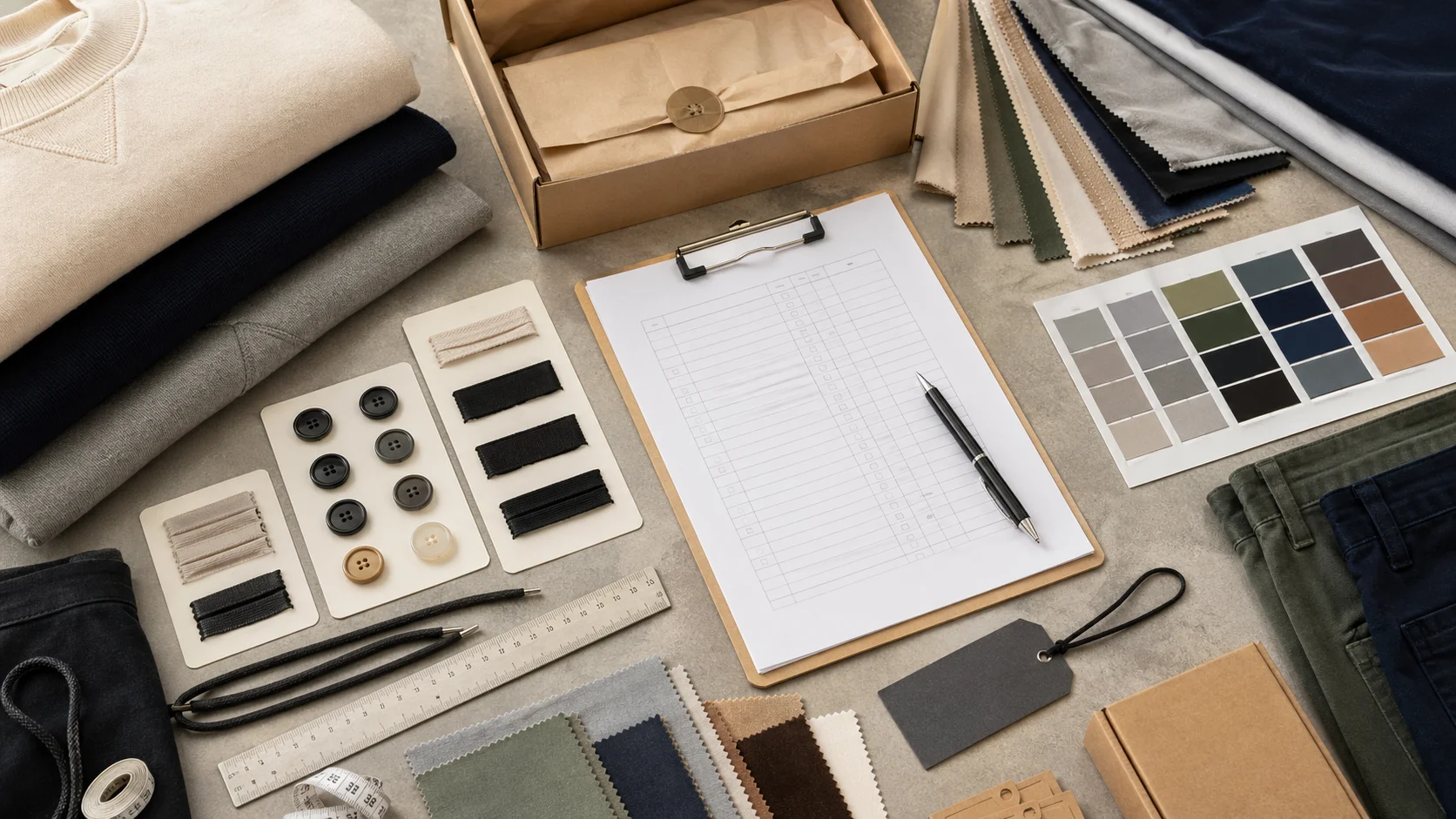
French Terry Sweatshirt Manufacturer with checks for samples, fit, MOQ, QC evidence, pricing terms, and delivery risk.
Fast answer: French Terry Sweatshirt Manufacturer: Fabric GSM, Fit, Dye, and QC should be judged by production evidence, not by a generic sourcing promise. The buyer needs sample proof, cost breakdowns, QC checkpoints, and delivery buffers in writing.
Ask for recent sample photos, measurement tolerances, fabric or print test assumptions, decoration test notes, packing examples, and a named inspection checkpoint. These details show whether the team can repeat an approved sample at bulk volume.
Separate garment cost, decoration, labels, packaging, sampling, testing, freight, and rush charges. When every cost line is visible, it becomes easier to reduce colorways, adjust size depth, or reserve more time for sampling.
French terry wins because it knows how to behave. It feels substantial without turning stiff, carries warmth without trapping heat, and gives premium casualwear the kind of drape buyers can actually sell. A French terry sweatshirt manufacturer lives or dies on those details. On the factory floor, I’ve watched one 320 GSM knit read airy and spring-ready, while another from the same cotton count looked heavy and boxy because the loop density was tighter and the finish was cleaner. Same fabric family. Very different retail story.
Yield loss tells the rest. In mills across Portugal, Turkey, and Vietnam, shade variation and shrinkage can wipe out 3% to 8% of an order before a brand signs off on bulk. Premium buyers hate the math, but they love what happens when the fabric behaves. French terry gives them year-round utility, fewer complaints about overheating, and a surface that takes dye, embroidery, and garment wash with better control than brushed fleece.
The first sample often flatters the product. A proto cut from 280 GSM French terry can look polished even when the loops are irregular, because sample room teams pull the best section from the roll. Then bulk starts. At 500 pieces or 5,000 pieces, that uneven loopback can create vertical torque, side seam twist, or a collar that waves after wash. I’ve measured shrinkage at 4% on a salesman sample and 9% in bulk when yarn quality shifted between dye lots.
Premium brands use French terry for midweight basics, travel sets, and athleisure pieces that need to sit under outerwear without bulk. Entry-level blanks usually sit at $8 to $14 wholesale and rely on simple construction. DTC private label pieces move into $16 to $28 wholesale with better trims and tighter tolerances. Luxury streetwear can sit above $40 wholesale when the knit, the wash, and the finishing are all controlled.
A cleaner loopback finish changes how the garment lands on the body. Even, short, compact loops hold shape better after 10 washes, while loose loops pill faster and snag in transit. The best mills use ring-spun yarn, tight gauge knitting, and pre-shrinking that keeps measurement drift under 3% in many programs. Want a refined handfeel? Ask for French terry 320 GSM with a brushed face only if the brand story truly needs softness.
When I visited factories supplying premium hoodies and crewnecks, one pattern kept showing up: brands that also buy from custom hoodie manufacturing teams tend to demand sharper spec control, because the same knit has to work across silhouettes. That pressure pushes a French terry sweatshirt manufacturer to keep the loopback tidy, the ribs stable, and the neck tape consistent. Fewer returns. Better repeat orders. Less discounting at season end.
The strongest French terry sweatshirt manufacturer does three things well: controls knitting, controls dyeing, and respects measurement after wash. I ask to see GSM records across at least 3 rolls, not one. I ask how much the fabric can vary before the line stops. I want a shrinkage report based on 30°C and 40°C wash tests, because a sweatshirt that loses 2 cm in body length may be acceptable, while one that loses 5 cm will trigger customer returns and fit complaints.
Small-batch ateliers and large factories fail in different ways. Smaller teams often deliver better trim accuracy, especially on neck labels, drawcord tips, and embroidery placement, because one technician may handle the whole sample run with obsessive attention. Larger factories usually win on repeat consistency, better calendar planning, and defect control over 1,000 to 3,000 pieces. The wrong supplier can look perfect in the showroom and unravel at the inspection table.
On the knitting side, ask about loop formation, yarn count, and knit machine gauge. A 32s ring-spun cotton yarn behaves differently from an open-end yarn, even before washing. On the dyehouse side, I want to know how many lab dips are approved before bulk starts, whether the factory caps shade variation to a Delta E target, and whether reactive dyeing is tested for crocking. A factory that cannot explain those points in plain language is usually leaning on luck.
For shrinkage management, the practical questions are simple. Do they test body length, sleeve opening, chest width, and rib recovery after wash? Do they check pilling resistance after 5,000 cycles or just say it “looks fine”? Do the side seams torque more than 3 degrees after wash? Data from AATCC test methods gives buyers a language for this, and a credible mill should be comfortable discussing it.
Spec-sheet discipline matters more than buyers admit. I’ve seen a 2 cm mistake in rib height turn into a neckline that feels cheap on body. I’ve also seen a 7 mm change in shoulder slope affect drape enough to force a full re-block. Good sample rooms work from graded specs, not memory. They confirm measurements after wash, mark deviations clearly, and keep revision notes tied to each sample round.
Here’s the part many people miss: a factory can be better at trim accuracy when it is smaller, but worse at repeat consistency once the order moves beyond 800 pieces. That split showed up again and again in my visits. So ask early. What are your testing standards? What is your wash protocol? What is the maximum shade variation you accept before you reject a lot? If the answers are vague, move on.
Pricing is a stack of small decisions. Fabric weight, yarn quality, enzyme wash, garment dye, embroidery, woven labels, packaging, freight, and duty all shape the final quote. A plain 300 GSM crewneck in basic cotton-poly French terry might land at $7.50 to $11 wholesale in volume, while a custom-dyed piece with embroidery and premium rib can jump to $14 to $22 before shipping. Add a washed finish and the number can climb again because wash houses charge for chemistry, water, drying time, and rework risk.
Order size changes everything. At 100 to 300 units, you often pay a penalty of 20% to 40% because setup costs are spread over too few pieces. At 1,000 to 3,000 units, the unit price usually drops sharply, especially if fabric is reserved in advance. Many buyers compare quotes as if they are simple retail math. They are not. A factory quoting $12 may be cheaper than one quoting $10 if the first includes lab dips, testing, and final carton packing while the second adds those as extras.
I break the quote into three buckets. First: the base garment—knit, cut, sew, standard construction. Second: finishing—enzyme wash versus stone wash, garment dye versus piece dye, preshrinking, steaming. Third: the brand layer—woven labels, screen print, embroidery, polybags, hangtags, carton markings. A premium French terry sweatshirt manufacturer that handles all three can save time, but only if the costing sheet is transparent.
Hidden costs trip up first-time buyers. Lab dips can add $40 to $120 per color. Strike-offs for embroidery or prints may run $25 to $80 each. Rework after fit approval can wipe out the savings of a low quote if the sleeves need recutting or the rib needs replacement. I’ve seen a brand spend an extra $1.60 per piece on correction after approving the wrong sample stage. That hurts margins far more than a higher base quote.
Portugal usually sits higher on labor but offsets that with EU compliance, ideally suited for European brands looking to tag “Made in Portugal.” Guangzhou factories that run 18-cylinder circular knitting machines and 3D loopers commonly set a lower starting point—sometimes as low as "$2.50-4.00 per unit at 500 MOQ" for basic cotton-poly French terry before trims when colors are matched from stock yarns. Dhaka factories lean into efficient cutting and sewing lines, keeping labor costs low but requiring close oversight on shrinkage reports and back-neck taping to avoid off-spec issues. Ho Chi Minh City mills invest in dyehouses that handle reactive and pigment dyeing on 12-ton winch dyeing machines, which helps them hit Delta E ≤ 1.2 even for dark navy shades, while Istanbul ateliers focus on small-batch luxury orders with premium Italian trims and finishes.
Freight and duty shift the quote, too. Air freight from Guangzhou to Los Angeles runs about $4.20 per kilogram, while consolidated ocean freight from Ho Chi Minh City to Hamburg can be $0.95 per kilogram if booked 30 days ahead with a 20-foot container. Istanbul exports benefit from short trucking distances to European ports, cutting inland logistics by roughly $0.18 per piece. Every region has a learning curve: buyers in Dhaka need to schedule inspections at the knitting, dyeing, and sewing stages separately, while those working with Portugal-based manufacturers factor in a longer public holiday calendar when planning rollouts.
Manufacturing timelines depend on clarity in the tech pack and the chosen processes. A standard path might look like this: 3 to 5 business days for pattern making and marker planning, 5 to 7 days for knitting plus 3 days for GOTS-certified yarn inspections, 2 to 4 days for dyeing and lab dips, 6 to 8 days for cut and sew, and another 2 to 3 days for finishing, quality control, and packing. That brings most programs to a 18-22 business days window after tech pack approval, not counting shipping.
Delays often stem from late trim confirmations, especially when brands switch from woven labels to silicone tabs that require separate tooling. When a brand requests garment wash (enzyme, ozone, stone, or pigment), the line adds 2 to 3 days per cycle, because the washing machines run 4,500-rpm spin cycles and multiple rinse tanks. Calibrating the wash house to mimic retail wash results is why buyers often reserve time for a pre-production wash test; I’ve seen it shave 1.5% off shrinkage variance in subsequent bulk runs.
Guangzhou-based manufacturers typically combine vertical knitting, dyeing, and finishing, which lets them quote faster but sometimes sacrifices flexibility. Dhaka’s clusters often specialize in high-volume cut-and-sew, relying on imported Turkish or Egyptian cotton yarn that is rotated through 3-shuttle knitting machines. Ho Chi Minh City suppliers tend to offer more bespoke finishes and a tighter pick-and-pack operation tailored to digital-native brands. Istanbul suppliers, meanwhile, use a combination of manual pressing and automated pressing machines (like the Karl Mayer steam presses) that deliver strong handfeel for luxury streetwear.
Each region also handles compliance differently. Guangzhou factories may present OEKO-TEX Standard 100 and WRAP certifications tied to their entire campus, but I expect details on chemical inventories if I’m requesting a GRS-mix recycled blend. Dhaka factories often pursue BSCI audits to prove ethical labor practices and provide full visibility into their dyehouse effluent treatment plants. Ho Chi Minh City remains attractive for brands needing quick turnaround and low MOQ for color development, while Istanbul provides a European base for final inspections and a shorter shipping lane to Spain, France, and the UK.
Every credible factory should show third-party certificates: GOTS for organic cotton programs, OEKO-TEX Standard 100 for skin-safe dyestuffs, WRAP or BSCI for working conditions, and GRS when recycled fibers are blended into the French terry. Those certificates aren’t décor—they tie to real processes. For example, a GOTS-certified mill in Istanbul will track fiber tracing back to a specific Egyptian cotton farm, while an OEKO-TEX-label mill in Guangzhou provides per-batch chemical release forms.
I also expect a QC protocol covering incoming yarn inspection, inline seam checks, and final random audits. Machines such as the Lockstitch 858 series seize rejects before they travel past the quality gate. Physical testing—Dimensional stability per AATCC 135, colorfastness per AATCC 16, and pilling resistance per AATCC 179—should be recorded in a shared spreadsheet. The operator should be able to pull up the last 15 defects per palette on demand. If they dodge those questions, your turnaround is likely to stall when a shipment is held at customs for failing a colorfastness test.
Ask for a detailed MOQ and cost table that breaks out yarn costs, trims, wash, and packaging. “What is your MOQ on a 32s cotton-poly blend versus a 100% organic cotton blend treated for GOTS certification?” should be a canned question. Probe capability: “Do you own your dyehouse or do you work with a partner?” “What is the lead time for an enzyme wash if we change the recipe from 1.5% to 2.2% enzyme loading?”
Demand transparency on defects. “Can you show me the last 90 days of inline FPY (First Pass Yield) for French terry crewnecks?” “How often do you retest shade after a wash cycle?” “Do you have an internal Delta E target, and what happens if you miss it?” The right factory will tailor their answers to your brand’s tolerance; the wrong one will talk in generalities.
First, compare not only quotes but also process transparency. Look for factories that can provide a sample room video, show you their knitting machines (Saurer 3.2, Stoll ADF, Shima Seiki), and explain how they handle loops per inch. Second, request a pre-production meeting—virtual or in-person—to review the tech pack and confirm that trims, wash codes, and packaging artwork are locked.
Finally, solidify your timeline from tech pack to delivery with realistic buffers for testing and freight. A 500-unit order might reach the port in 18-22 business days, but add another 10 business days for ocean freight and customs clearance if shipping out of Ho Chi Minh City to Rotterdam. Book inspections early, and secure contingency plans for material substitutions, especially if you’re using recycled fibers under the GRS umbrella.
Q: What is a typical MOQ for a premium French terry sweatshirt? A: Expect MOQs of 500 to 1,000 per color in Guangzhou or Ho Chi Minh City if you’re using standard 32s cotton-poly and machine-dyed loops; Dhaka suppliers sometimes start at 300 units but add costs for finishing, while Istanbul ateliers can go as low as 200 units for made-to-order luxury runs.
Q: How long does prototyping take? A: From tech pack submission to sample approval usually takes 12-14 business days if you account for pattern cutting, knitting, dyeing, and wash tests; add another 4 to 5 days if you require third-party certification uploads (OEKO-TEX Standard 100 or GOTS documentation).
Q: What certifications should I prioritize? A: Prioritize GOTS for organic cotton, OEKO-TEX Standard 100 for chemical safety, WRAP/BSCI for labor compliance, and GRS if you blend recycled yarns. Also confirm that the dyehouse and washing partners match those certifications or operate under a recognized chemical management system.
Q: What should go on the spec sheet? A: List yarn counts, loop density targets, rib height, and seam allowance tolerances. Include wash instructions with AATCC references, target GSM, shrinkage allowances (body length ≤3%, chest width ≤2%), and trim details such as drawcord length or eyelet size. Also note finishing steps: enzyme wash recipe, silicone softener percentage, pressing sequence, and folding template.
Q: How do I manage freight timelines? A: Secure space on ocean vessels at least 30 days out for Guangdong or Ho Chi Minh City shipments. For Istanbul, regular truck routes to Izmir or Trieste allow 2-3 day lead times before the container hits the ferry. Always build a 5-day buffer for customs inspection when documents are not fully digital.