
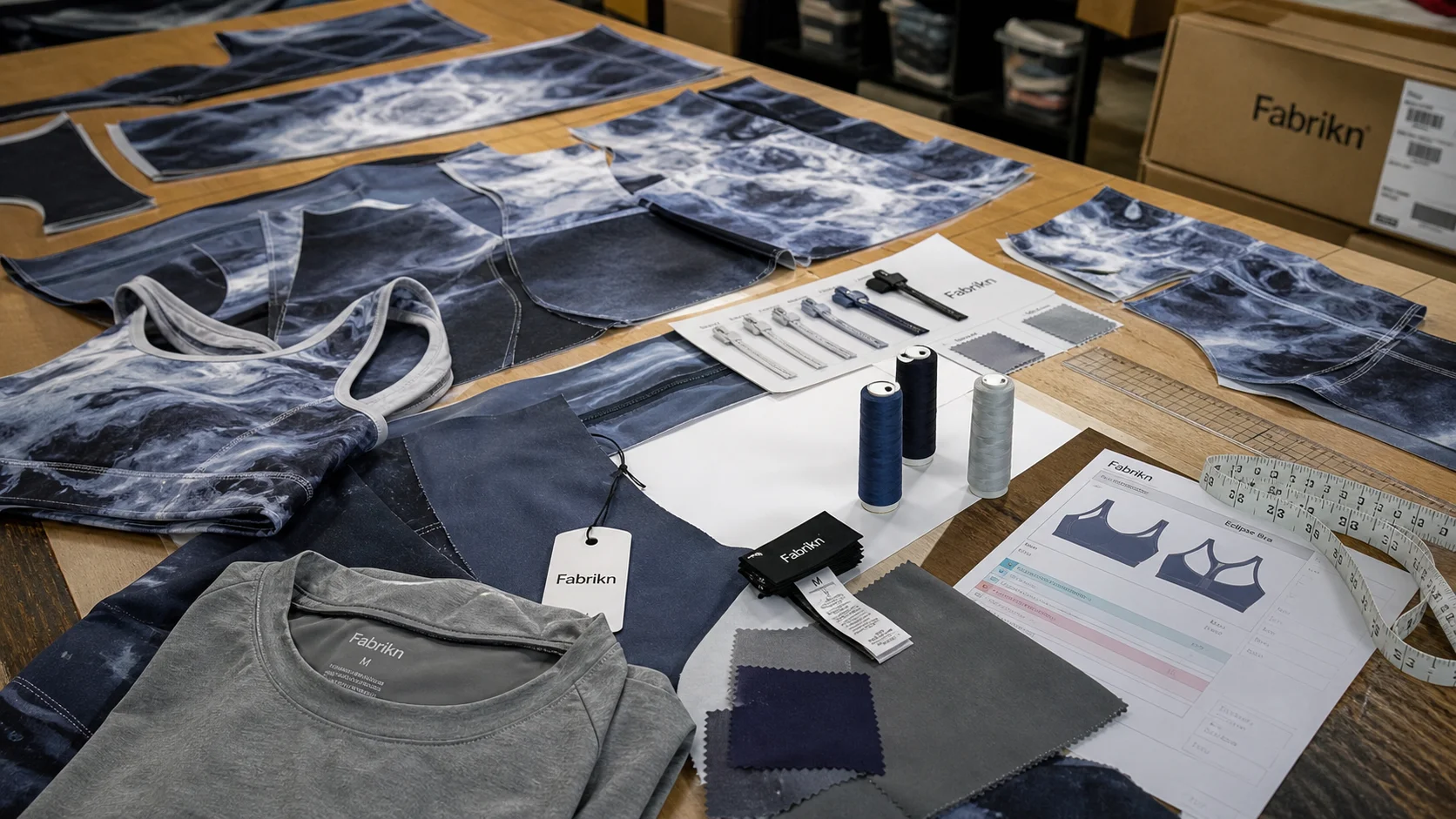
The Minimum Information on Care Labels compared by sample evidence, fabric or trim specs, MOQ, AQL terms, cost lines, delivery timing, and rework...
Fast answer: The Minimum Information on Care Labels: Material, Print, MOQ, and QC Terms should be judged by production evidence, not by a generic sourcing promise. The buyer needs sample proof, cost breakdowns, QC checkpoints, and delivery buffers in writing.
Ask for recent sample photos, measurement tolerances, fabric or print test assumptions, decoration test notes, packing examples, and a named inspection checkpoint. These details show whether the team can repeat an approved sample at bulk volume.
Separate garment cost, decoration, labels, packaging, sampling, testing, freight, and rush charges. Clear cost lines make it easier to reduce colorways, adjust size depth, or reserve more time for sampling.
Tiny label mistakes turn into the loudest problems in the room. When brands ask what is the minimum information on care labels, they usually want the shortest compliant version that still passes inspection. A missing fiber line stalled a 42,000-piece shipment I reviewed out of Guangzhou; the satin label had been printed on a 12-color digital Webjet printer with OEKO-TEX Standard 100 certified ink. The label itself cost less than $0.04 per unit, but the hold cost the brand nearly $18,000 in storage, reprinting on a WRAP-accredited production line, and express rework via a Guangzhou finishing house running 6-shaft looms. And the ugly answer to what is the minimum information on care labels: tiny on paper, expensive in real life.
During one factory visit in Ho Chi Minh City, a production manager froze carton release because the washing symbol was correct but the country of origin line had been left off a satin label. The batch held 25,000 pieces of 320 GSM organic cotton French terry knit prepared under GOTS and BSCI oversight. The retailer chargeback covered the whole 9,600-unit PO; the labels had been woven using a Sulzer P7100 loom and cut on a ZaraCut ultrasonic blade. On a mass-market tee priced at $14.99, the mistake shredded margin. And on a $220 knit dress manufactured in Istanbul with recycled polyester GRS-certified tricot, it hurt trust first and cash second.
Why do buyers catch label problems after fit issues? Because fit can be debated and label compliance cannot. A blouse that runs one size small may still sell if the fabric feels premium. But a blouse with missing origin data may not clear receiving, and then the calendar turns hostile. Retailers often allow 2-4 weeks for corrective action; factories usually need 5-7 days just to reprint, relabel, and verify cartons. In Dhaka, relabeling with a heat transfer press tied up the entire workshop for 18-22 business days because the 500-piece PO used multiple colorways and each label had to be cured on a manual Teflon platen.
I’ve seen care labels treated like decoration. But they are packaging-plus-compliance. Legal line, wash instruction, first audit trail — all of it rides on that strip before the garment leaves the dock. According to the ASTM and related labeling standards used by many buyers, consistency is part of product acceptance, not a nice-to-have. A label may cost $0.02-$0.12 in simple runs, but a noncompliant shipment can trigger $500-$5,000 in retail deductions, plus freight changes that add $1.20-$3.80 per piece. That is why some factories dedicate a screen printing line with an automatic registration system from Fuba and a PVS laminator to assemble labels approved under OEKO-TEX Standard 100, GRS, and BSCI.
Premium brands learn this late. Their labels look beautiful, often on 20 mm satin or recycled woven tape, but the legal copy gets pushed to final QC. Backwards.
The last legal check belongs before the carton seals. After the truck leaves, it is too late, and I say that to anyone who will listen.
Start with four pillars: fiber content, care instructions, country of origin, and manufacturer or importer details where local rules require it. Those four pieces answer most of the questions I hear on factory floors, from T-shirts to duvet covers. In practice, the minimum can also include size, RN or registered business identification, and symbol-based washing guidance if the market expects it. For a private label launch, I usually see brands build around 4-6 mandatory data fields before adding marketing language.
Apparel and home textiles do not share one clean rulebook. A 320 GSM French terry hoodie, a 600 GSM bath towel, and a pair of rib socks may roll off the same line, yet the label content can differ because of product category, end use, and retailer policy. Bedding often needs more emphasis on material composition and care symbols. Towels may need clearer drying guidance because shrinkage complaints spike after the first wash. Accessories can be trickier still; a cap or belt may need origin and composition, but not the same wash matrix as a shirt. These items often ship from Istanbul or Ho Chi Minh City plants where laser engraving adds small-font traceability data without adding bulk.
In factories I visited in Turkey and Bangladesh, a counterintuitive pattern kept repeating. Large mills often print more detail than required because it lowers rework; one template with 6-8 data points beats three versions. Smaller workshops, even skilled ones, can miss basics when the purchase order is vague or the tech pack skips label specs. Strong garment, wrong label. Common as rain. Many Turkish mills, especially those servicing EU retailers, embed OEKO-TEX Standard 100 and WRAP claims on separate neck labels to ensure full traceability from the stenter machine to final packing.
The smart minimum is not always the legal minimum. If a brand sells into the US, UK, EU, and one Asian market, the strictest common denominator often wins. A label that is legal in one country but vague in another can get held at customs or rejected by a retail buyer. I’ve seen brands use one base label with region-specific overstickers, which adds $0.03-$0.09 per unit but avoids a 3,000-unit relabeling job later.
For brands using private label clothing, that planning is not cosmetic. It changes proofing, carton timing, and the final green light from the buyer.
The U.S. tends to be the easiest starting point for label structure because buyers focus heavily on fiber content, care, and origin. For many categories, those three elements solve most of the compliance burden, though retailer-specific rules can add identification lines or symbol requirements. The EU and UK usually ask for more consumer-readable guidance, and multilingual presentation becomes more common. Parts of Asia vary sharply by product, distribution channel, and whether the item is sold through wholesale, marketplace, or direct-to-consumer channels.
In the U.S., one clear content line and one clear care method often pass internal review. In the EU, readability matters more, and a label that works in Germany may need translation support elsewhere. In the UK, brands often mirror EU expectations but still need to check buyer policies and packaging rules after Brexit. In Japan, Korea, and some Southeast Asian markets, local language requirements can decide whether a label is accepted at all. Same artwork, different outcome. Guangzhou-based suppliers often negotiate these layers while balancing GOTS, OEKO-TEX Standard 100, and WRAP documentation for each SKU.
Here is what most people miss: multilingual labels do not just add translation cost. They raise failure rates on small MOQ orders because every extra language increases proofing time, line-clearance checks, and the chance of a typo. A 500-piece run with 3 languages can take 2-3 extra days to approve, while a 5,000-piece run absorbs that delay more easily. I have seen suppliers quote $0.07 for a one-language label and $0.19 for a four-language version, before any relabeling. When printed on a Heidelberg LexJet UV press used in Dhaka, those multilingual labels often require an additional pass through a hot-knife trimming table.
According to guidance from trade.gov and other regulators, keeping a tight log of label changes and approvals is non-negotiable. Every new language, symbol, or fiber percentage needs to land on a tech pack before bulk printing starts. Ignore that and you are just guessing at compliance paperwork.
A strong brief makes the supplier's job narrower and the quote more reliable. For what is minimum information on care labels?, include the target customer, sales channel, expected order quantity, size range, decoration needs, packaging requirements, and delivery market. Then call out the details most likely to affect the result, especially material grade, print tolerance, and barcode size.
The brief should also explain what cannot change. Some brands care most about hand feel, some about price, some about launch timing, and some about retail compliance. When those priorities are not written down, suppliers tend to optimize for whatever is easiest to quote. Clear priorities help the factory make better tradeoffs before the first sample is cut or printed.
Ask the supplier to respond with assumptions, not just a price. A useful reply states MOQ, sample route, production capacity, inspection plan, packing method, and freight handoff. If the answer is vague, the project may still work, but it needs a tighter pre-production stage before money and calendar pressure build up.
The best time to catch problems is before the pre-production sample is approved. Check measurements, color, placement, material behavior, shrinkage, construction, labels, and packaging in the same review instead of approving each item in isolation. Many bulk issues are not caused by one dramatic mistake; they come from several small unchecked assumptions.
For what is minimum information on care labels?, pay special attention to folding method, pack-out sequence, and retail compliance. These details often look minor in an email but become expensive once cutting, printing, sewing, packing, or shipping begins. A simple checklist with owner, due date, and approval status keeps the brand team and factory aligned.
Bulk production should not start until the supplier can explain how the approved sample becomes a repeatable production standard. That means reference sample storage, line instructions, inline checks, final inspection, and defect handling. A factory that can describe this process clearly is usually safer than one that only promises speed.
Price differences are useful only when the quotes cover the same work. Compare sample cost, material source, trims, decoration, packaging, testing, inspection, and freight assumptions. A low unit price can become expensive if it excludes items the brand needs before launch.
Timeline promises deserve the same scrutiny. Ask what happens if the first sample needs revision, whether materials are in stock, when the production slot is reserved, and how export packing is handled. The most reliable supplier is often the one that gives a realistic calendar instead of the fastest optimistic answer.
Before making the final decision, write down the specification, approval owner, delivery expectation, and the one or two risks that would cause the most trouble if missed. For what is minimum information on care labels?, this usually means checking material grade, print tolerance, barcode size, and the support process after the order is placed.
This last review does not need to be complicated. It simply makes the decision easier to repeat, easier to explain, and easier to verify when the finished product or jewelry arrives.
One useful way to pressure-test the decision is to ask what would happen if the order had to be repeated in six months. The answer should still be clear: the same material grade, the same print tolerance, the same acceptance standard, and the same communication path. If a second order would depend on memory or guesswork, the first order is not documented well enough yet.
Another useful check is to separate preference from requirement. Preference is the look, wording, or finish the brand likes. Requirement is the measurement, tolerance, certificate, material, or delivery condition that cannot fail. Good buying decisions keep both visible, so the final choice is not pushed around by the last email, the cheapest quote, or the prettiest sample photo.
Finally, ask who owns each approval. A project with one accountable owner for sample review, one owner for final content or artwork, and one owner for delivery sign-off usually moves faster than a project where every decision is shared loosely across a team. Clear ownership reduces delays and makes the finished result easier to judge.