
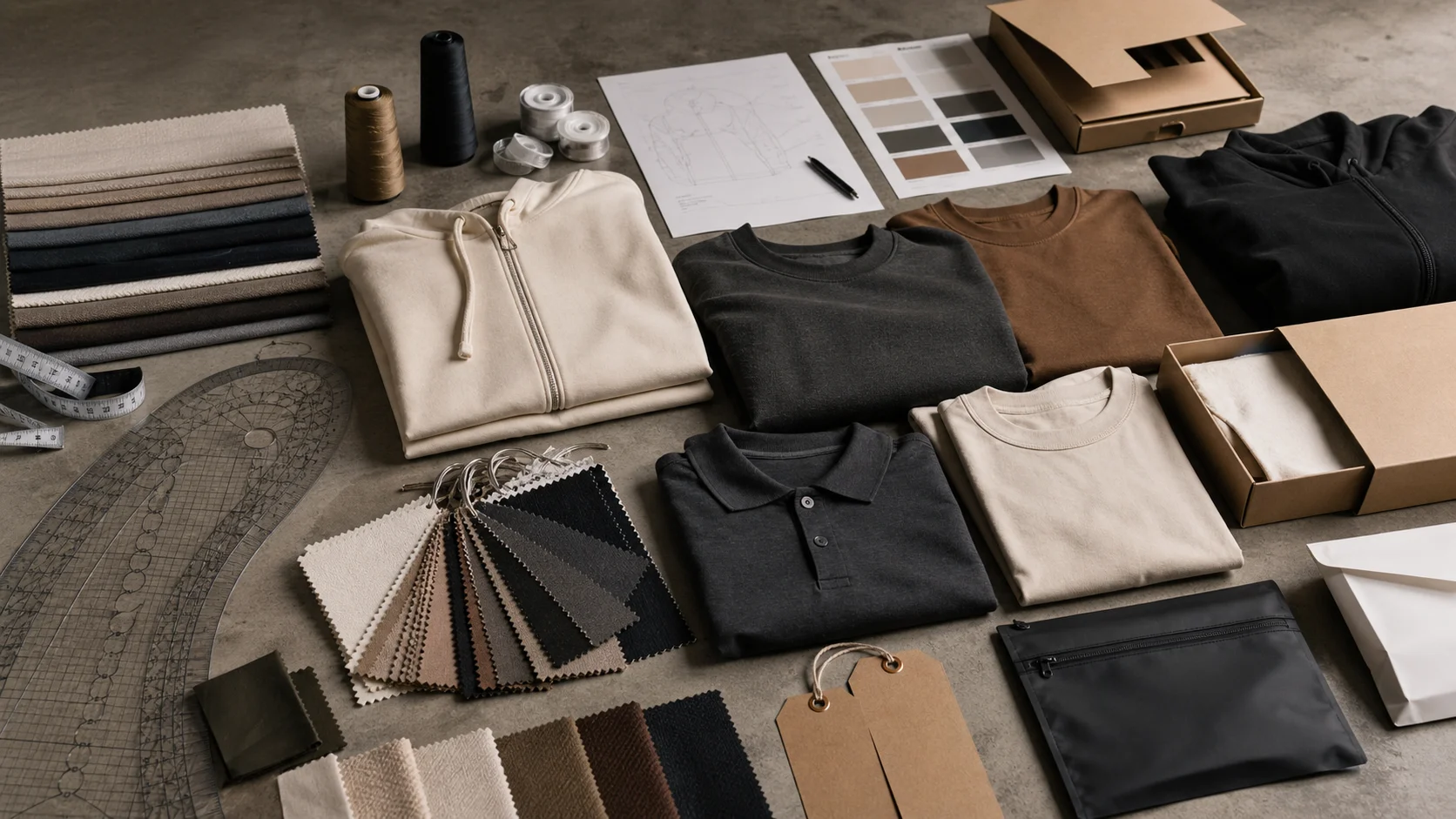
FSC Paper Boxes for Clothing Delivery with checks for samples, fit, MOQ, QC evidence, pricing terms, and delivery risk.
Fast answer: FSC Paper Boxes for Clothing Delivery: Certification, Board, and Cost should be judged by production evidence, not by a generic sourcing promise. The buyer needs sample proof, cost breakdowns, QC checkpoints, and delivery buffers in writing.
Ask for recent sample photos, measurement tolerances, fabric or print test assumptions, decoration test notes, packing examples, and a named inspection checkpoint. These details show whether the team can repeat an approved sample at bulk volume.
Separate garment cost, decoration, labels, packaging, sampling, testing, freight, and rush charges. When every cost line is visible, it becomes easier to reduce colorways, adjust size depth, or reserve more time for sampling.
The first thing I learned on a packing line is that a box can look elegant and still behave badly. One line I visited pushed out 1,200 cartons an hour; another barely managed 280. FSC certified paper boxes for clothing delivery looked nearly identical in the catalog, but carton geometry, pallet stacking, and handling touchpoints told the real story.
In Ningbo, 18,000 corrugated boxes sat in tight stacks at 120 per pallet. Near Ho Chi Minh City, the same weekly volume needed 156 pallets because the cartons were overbuilt and awkwardly sized. That extra footprint eats storage, adds forklift moves, and slows dispatch by 12 to 20 minutes per batch.
FSC certified paper boxes for clothing delivery are judged twice: first by the warehouse team, then by the customer with the parcel open in her lap. Damage rates tell the truth. In the factories I visited, boxes made with 32 ECT board and a clean die-cut profile held up better in transit than decorative boxes with heavy inserts.
They also packed faster and rejected less often. A decent plant keeps warp under 2 percent and moisture-related rejection below 3 percent in humid months. Poor plants lose 7 to 9 percent of production to curl, crushed corners, and print misregistration.
Print pass rates say plenty. A good two-color box should clear 95 to 98 percent on first inspection. Complex six-color varnish jobs can fall to 88 percent if humidity swings 10 points in a day.
I have seen premium-looking boxes fail for something mundane: the glue line opened after 48 hours in a warehouse sitting at 75 percent humidity. Hardly glamorous. And still common. The boxes that look most luxurious are often structurally simpler, with fewer components, fewer glue points, and less waste than embossed, ribboned alternatives.
That is why unboxing data matters more than claims. A pretty box that arrives swollen is not premium. A plain carton that opens cleanly, protects a knit set, and fits 24 units per master case is the better commercial choice. Last year I worked with a brand that shifted from a rigid sleeve to a lighter mailer box and cut packing time from 42 seconds to 27 seconds per order.
For custom baby clothing manufacturing, the same logic applies even faster because tiny garments leave no room for wasted space.
FSC is not decorative paperwork. It is a forest-management and chain-of-custody system that tracks fiber from certified forests or controlled sources through mills, converters, printers, and the final box supplier. If a brand wants to claim the material is FSC certified, every handler in the chain must carry valid documentation.
Miss one link and the claim collapses. I have seen importers lose two weeks because a carton supplier had a current forest certificate but an expired chain-of-custody number on the invoice.
For fashion buyers, chain-of-custody paperwork changes procurement behavior. Mixed-material packaging creates more audit friction because paper, plastic windows, and foil laminates each need separate proof paths. More vendor declarations. More sampling. More internal sign-off.
Certified paper sourcing is simpler to trace, and that simplicity matters during peak seasons. When a warehouse is shipping 30,000 units a week, nobody wants to argue over whether a laminated mailer counts as recyclable in one market and not another.
According to FSC, certification helps brands document responsible fiber sourcing, while data from Textile Exchange shows how supply-chain disclosure is becoming a hard commercial requirement, not a marketing option. For broader trade compliance guidance, trade.gov is also a useful reference. Recycled content helps, but it has limits.
Many packaging grades rely on 30 to 100 percent recycled fiber depending on strength needs, and some premium print jobs still need virgin pulp for stiffness. Recovery rates for paper remain high, often above 60 percent in mature collection systems, yet emissions still depend on transport distance, mill energy, and how much virgin fiber is mixed in.
That is where clothing delivery packaging meets logistics. Boxes get opened, reclosed, returned, and stacked again. In Europe, reverse-logistics teams often treat the box as a return sleeve, which can lift resale-grade return rates by 8 to 12 percent.
In North America, where parcel sorting is harsher and seasonal peaks are brutal, a box that survives a 90-minute warehouse cycle can save labor on repacking. For private label clothing services, the packaging standard has to match both the product and the return policy.
When the box is specified correctly, the sustainability case is not abstract. Less mixed material means cleaner recovery. Better fiber sourcing cuts compliance risk. A verified chain of custody reduces the chance of marketing claims being challenged.
In a market where a single packaging mistake can cost $0.40 to $1.10 per unit in rework, that paperwork is part of the margin, not a side note.
Paper boxes sit in the middle of the apparel packaging triangle. Poly mailers are cheap and light. Rigid gift-style boxes feel expensive and eat space. FSC certified paper boxes for clothing delivery offer the compromise most operations actually need: enough protection for folded garments, enough surface area for branding, and a freight profile that does not punish the warehouse.
At 5,000 to 10,000 units, a plain paper mailer box might cost $0.28 to $0.55 each, depending on board grade, board caliper, and one- or two-color print. A poly mailer can come in at $0.08 to $0.18. A rigid box with wrapped board, inserts, and soft-touch lamination can jump to $1.20 to $2.80, especially if the MOQ is only 500 pieces.
Printed cartons become cheaper at 20,000 units and beyond, often falling 15 to 25 percent as tooling is amortized. Freight tells a second story: 1,000 flat-packed paper boxes may occupy 0.9 to 1.4 cubic meters, while the same number of rigid boxes can take 2.5 to 3.8 cubic meters before assembly.
North America usually rewards simplicity. Labor can run $18 to $28 an hour in distribution hubs, so every extra fold, insert, or tissue layer becomes expensive. Europe has tighter packaging and waste expectations, which pushes brands toward paper formats that are easy to sort and accept in municipal recovery systems.
Asia often offers faster carton availability and lower unit conversion costs, but the range is wide. In Shenzhen, I have seen a supplier quote 7-day sampling and 18-day production; in Poland, the same brief took 14 days to sample but delivered stronger consistency across 50,000 units.
AATCC textile testing standards remind buyers that packaging and garment performance are both only as good as the test method behind them. The same logic applies when comparing factory output from a manufacturer in China versus a regional supplier closer to market.
The thing nobody tells you: the lighter plastic mailer often costs less upfront, but it can create higher return-processing cost and weaker resale presentation. I have seen a $0.12 mailer become a $0.68 handling problem once a returned blouse needed rebagging, relabeling, and a new presentation sleeve.
A better-looking paper box made the reverse flow cheaper because the garment came back cleaner, flatter, and easier to resell. That is one reason cut and sew manufacturing teams increasingly ask for packaging specs before the first production run, not after shipment.
For premium fashion, the decision is not just about survival in transit. It is about how the box behaves on shelf, in social photos, and during returns. Rigid boxes signal luxury at $300 price points, but they are a poor fit for $45 basics.
Paper boxes land better across the middle of the market, where brand perception matters but freight still has to stay under 8 percent of landed cost.
Start with structure, not print. Single-wall board is enough for most folded tees, leggings, and midweight knitwear at 250 to 350 GSM garment weight. Double-wall makes sense when the box also serves as a return container or when the route involves long regional transit, high stacking, or humid storage.
I have seen brands spend an extra $0.22 per unit on double-wall board when a thicker single-wall plus a better closure would have solved the problem for half that. FSC certified paper boxes for clothing delivery should be chosen by use case, not by the assumption that heavier is always better.
Tuck-end, mailer-style, and lid-and-base formats all behave differently. Tuck-end boxes are cheapest to die-cut and fastest to fold, with a good fit for small accessory bundles. Mailer-style cartons close more securely and reduce tape use, which matters at 500 units a day.
Lid-and-base boxes look polished, but they add board area and labor. The specification variables that move cost most are size, board caliper, print coverage, coatings, inserts, and MOQ. A 10 mm change in depth can alter board usage enough to shift cost by 8 to 14 percent.
Choose finishes like a buyer, not a designer. Spot UV, foil, and heavy lamination raise price without helping the garment survive shipping. A matte aqueous coating, a clean one-color logo, and a restrained interior print often deliver the right feel at 20 to 35 percent less than a wrapped premium box.
If you need a premium touch, keep it where the customer notices it first: the lid edge, the opening panel, or a recycled tissue insert. Avoid filling the whole surface with ink unless your forecast exceeds 10,000 units per style.
Freight efficiency is a quiet cost driver. Flat-packed cartons should nest tightly, with carton dimensions matched to pallet size and warehouse shelving. I like to see 90 percent pallet utilization on a standard 1,100 x 1,100 mm base, and I do not approve luxury formats that waste 25 percent of cubic space just to create visual drama.
If you need a supplier starting point, you can request a custom quote for FSC certified packaging and ask for three options: economy, balanced, and premium. That makes the trade-off visible before anyone signs off.
I never trust a supplier on certification alone. First, check that the FSC certificate is valid today, not last quarter. Then ask for the chain-of-custody number on a real packing list, a real invoice, and a real shipping mark.
If the documents look generic, stop. A factory with export experience should be able to show QC records for at least 3 months, complaint logs, and destination markets it has served in the last 12 months. That is basic quality control for any serious manufacturer.
Practical tests catch failure early. I ask for crush resistance, drop testing from 60 to 100 cm, humidity exposure for 48 hours at 70 to 80 percent relative humidity, print rub resistance, and adhesive strength after cold storage and warm storage.
In one Guangdong plant, the box looked perfect until the adhesive failed after 20 minutes in a 38°C staging area. That defect would have cost 2,400 returns if it had made it into market. A capable factory and supplier should be able to explain how they prevent that during production.
Small factories can customize faster. They often react in 5 to 7 days and can tweak dielines without six layers of approval. Large plants usually deliver steadier consistency, better color control, and lower rejection rates over 50,000-unit runs.
I have seen both models work. The right choice depends on whether your brand needs speed or scale. For brands building seasonal capsules or custom baby clothing manufacturing ranges, fast sampling may matter more than perfect throughput.
Red flags are easy to spot if you know where to look. Vague sourcing claims. Mixed inventory sitting beside certified stock. Moisture readings never recorded. Boxes stored on the floor next to open docks.
If a supplier cannot explain why warp appears in rainy weeks or cannot show how they separate certified paper from non-certified paper, I move on. The best plants have simple habits: dry storage, dated lot codes, and a QC team that rejects the ugly carton before it leaves the building.
Begin with sample approval. Order 3 to 5 prototypes in the exact board grade, print count, and finish you expect to ship. Test them with real garments, not paper inserts. I want folded denim, knit tops, and any accessory pouch you plan to include.
Then run a pilot of 500 to 2,000 units through the warehouse and track pack time, damage rate, and customer feedback for at least 2 shipping cycles. FSC certified paper boxes for clothing delivery should prove themselves in live operations, not just in a mockup review.
After the pilot, measure what matters. Damage rate should stay below 1.5 percent for standard apparel and below 2.5 percent if the box doubles as a return package. Pack time should not rise more than 10 seconds per order.
Shipping cubic efficiency should improve or hold steady. Return-condition quality needs a simple score: resell-ready, rebag-needed, or unsellable. Complaint volume should be counted per 1,000 orders, not by anecdote.
Internal approvals matter as much as the carton itself. Marketing must sign off on claim language, procurement must verify certificate numbers, and operations should confirm pallet pattern, case pack, and dock handling.
If your brand also uses private label clothing services, align the packaging timeline with product approval so you are not waiting on cartons after the first cut is sewn. It is faster to fix a claim on paper than in a customs hold.
Scale in phases. Move from pilot to 20 percent of volume, then 50 percent, then full rollout if the data stays clean. Keep supplier onboarding tight: certificate check, dieline approval, test report, pilot sign-off.
Do not let a pretty mockup skip the warehouse test. I have watched brands rush this step and end up with 14,000 boxes that fit the model in a presentation but not the garment on the line.
For seasonal launches, lock the carton earlier than you lock the campaign photography. Packaging lead times can run 3 to 4 weeks for standard print and 5 to 8 weeks for special finishes.
If the garment range is built through cut and sew manufacturing, the box spec should travel with the tech pack. That is how you keep claims, margins, and warehouse reality in the same file.
They are usually made from corrugated or paperboard stock sourced through FSC chain of custody. Common constructions use single-wall or double-wall board with 30 to 100 percent recycled content depending on strength needs.
At 5,000 to 10,000 units, many apparel boxes land around $0.28 to $0.55 each for simple print and standard sizing. Premium finishes, inserts, and low MOQs can push pricing above $1.00 per unit.
Standard production often takes 18 to 35 days after artwork approval. Sampling can take 5 to 10 days, while special finishes or tight season windows may stretch total lead time to 6 to 8 weeks.
Yes, if the board grade, closure style, and print finish are chosen well. I have seen premium shirts, knit sets, and outerwear ship safely in mailer-style cartons with good crush resistance and a clean presentation.
Ask for the FSC certificate number, chain-of-custody documents, and recent invoice examples showing the claim. Then match the certificate holder name against the supplier’s legal entity and confirm it is current before placing the order.