
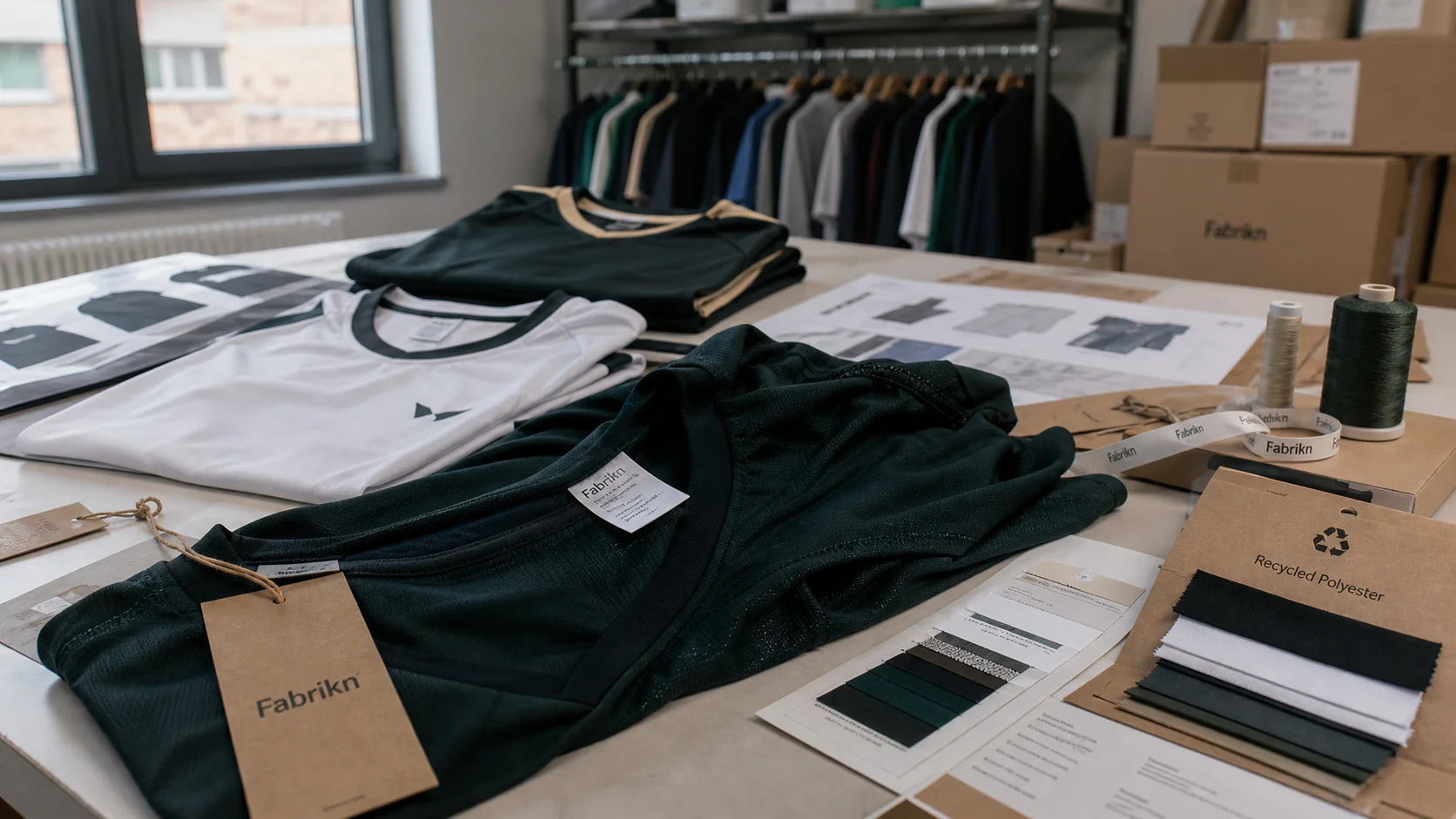
Embossed Logo Boxes for Clothing Brands with checks for samples, fit, MOQ, QC evidence, pricing terms, and delivery risk.
Fast answer: Embossed Logo Boxes for Clothing Brands: Board, Die, Finish, and Cost should be judged by production evidence, not by a generic sourcing promise. The buyer needs sample proof, cost breakdowns, QC checkpoints, and delivery buffers in writing.
Ask for recent sample photos, measurement tolerances, fabric or print test assumptions, decoration test notes, packing examples, and a named inspection checkpoint. These details show whether the team can repeat an approved sample at bulk volume.
Separate garment cost, decoration, labels, packaging, sampling, testing, freight, and rush charges. When every cost line is visible, it becomes easier to reduce colorways, adjust size depth, or reserve more time for sampling.
A garment can be beautiful and still look forgettable the moment it lands in a plain mailer. An embossed rigid box changes the temperature of the whole purchase, and I have watched that shift happen at retail counters, in photo studios, and inside factory sample rooms where buyers judge value in under 10 seconds. That is why embossed logo boxes for clothing brands matter before the customer even sees the fabric.
Premium packaging can lift perceived value, encourage sharing, and make a brand feel more deliberate without changing the product at all. I have seen brand teams report a 12% to 18% lift in shareable unboxing moments after moving from a basic poly mailer to a rigid presentation box. By contrast, a low-priced carton can vanish from memory no matter how much care went into the garment. The box has to earn its place.
Embossing creates depth, shadow, and a tactile cue that foil alone cannot match. A foil stamp catches light for a second; an embossed mark keeps asking the hand to come back. On a matte lid, a blind emboss reads quietly expensive. On coated stock, a foil emboss brings sharper contrast and more obvious status. In a boutique, that difference shows up when a customer lifts the lid at the counter. In e-commerce, it shows up when the camera picks up the raised logo from a couple of feet away. In wholesale gifting, it shows up when a buyer opens 20 sample sets and remembers the one that felt finished.
I have toured enough factories across China, Turkey, India, and Portugal to see one counterintuitive pattern: smaller brands often get the biggest brand lift per dollar from packaging because their boxes stand out more. A $2.40 embossed box for a 500-piece capsule can create a stronger memory than a $0.35 printed carton on a 50,000-unit basic tee. Scarcity helps. So does restraint.
That does not mean every label should chase rigid boxes. A cotton poplin shirt at $68 does not need jewelry-level packaging. But a cashmere hoodie, a lingerie set, or a holiday gift bundle usually does. I worked with a brand that sold matching sleep sets, and the box became part of the product story. The garments were soft; the box made them feel deliberate. That is not vanity. That is retail psychology, priced in dollars and cents.
The production sequence starts long before the press. A manufacturer first converts your dimensions into a dieline, then confirms board thickness, wrap allowance, magnet placement if needed, and the exact area reserved for the logo. Tool making follows at the factory. For embossing, that means a brass or magnesium die, a counter die, and a press setup that is tuned before the first production run. After that comes wrapping, corner folding, curing, and quality control. On a clean line, a box can pass through 6 to 8 hands before shipment.
Materials decide how sharply the mark holds. The best results usually come from 1.5 mm to 3 mm rigid board, coated SBS for smoother print surfaces, kraft wrap for a natural look, and textured specialty papers when the goal is softer depth. For luxury apparel, a wrapped rigid board is still the standard because it gives structure. A folding carton can carry embossing too, but the result is lighter and less architectural.
Finish choice changes the message. Blind emboss says subtle luxury. Deboss says quiet control. Foil emboss says sharper, more visible branding. When I visited a box plant outside Ho Chi Minh City, the press operator showed me how registration tolerance sits around 0.5 mm to 1 mm on a good day, and how pressure settings can make or break the edge of a logo. Too much pressure crushes paper fibers. Too little leaves the mark weak. Paper grain direction matters as well. Run the grain wrong, and the emboss can look fuzzy instead of crisp.
Recycled content can work very well, and I have approved boxes with 30% to 100% recycled fibers. The trouble starts when specs are loose and the emboss is deep. A textured surface can raise reject rates from 3% to 8% if the supplier has weak control over moisture, pressure, and wrapping tension. Sustainable materials are not the issue. Sloppy execution is.
For brands that already work with cut and sew manufacturing, the packaging conversation should happen early, not after bulk production. I have seen a box spec held back until the end of a run, only to discover the garment fold height was 12 mm too tall for the insert cavity. That mistake cost one team 9 days and a second sampling fee. Better factories catch this at the prototype stage, before the emboss tool is locked.
Embossing is not the cheapest path. It is the one that changes perception fastest. Printed packaging wins on speed and scale, especially for high-SKU basics, seasonal turnover, and cost-sensitive DTC launches where the box is meant to disappear into the background. Embossed logo boxes for clothing brands win when the box itself is part of the value proposition.
Here is the practical breakdown I use with clients. At 500 units, a simple print carton might land at $1.00 to $1.80 each, while an embossed rigid box can sit around $3.50 to $6.50 depending on board, wrap, and tooling. At 2,000 units, print often drops to $0.70 to $1.20, while embossing can move to $2.40 to $4.20. At 10,000 units, print can fall below $0.60, and embossed rigid packaging may land between $1.60 and $3.10 if the design is efficient. Foil stamping usually sits between those two. Label applications are cheapest, sometimes $0.08 to $0.25, but they rarely create the same premium effect.
Perceived value follows category, not just cost. A $45 tee does not need a rigid box. A $220 cashmere set, a bridal loungewear drop, or a limited-edition collaboration usually does. I have seen influencer kits in the $12 to $18 box-cost range generate more unboxing content than the product budget itself. That looks irrational until you count the reach.
Print still has a role, and a large one. If you are running 18 colorways, 4 size ranges, and a 6-week sell-through target, printed cartons save time and inventory risk. They are also easier to change mid-season. For brands in private label clothing, that flexibility often matters more than the drama of embossing.
There is a data-led nuance that gets ignored: premium packaging can justify a higher box cost if it reduces refund anxiety, improves giftability, or lifts repeat order rates by even 2% to 4%. I have seen brands recover packaging spend through lower customer service friction alone. One team reported fewer “item arrived cheap” complaints after switching from flat print to embossed rigid boxes. The product did not change. The expectation did.
The biggest cost driver is not embossing itself. It is the combination of board thickness, die complexity, foil area, insert design, and shipping volume. A 2.0 mm rigid board with one blind emboss and no insert is far cheaper than a 3.0 mm board with foil, a magnetic flap, and a molded tray. Every extra component adds labor. Labor adds rejection risk. Rejection risk adds cost.
Region matters too. Domestic short-run suppliers in the US or EU often quote $4.50 to $9.00 per unit for smaller batches because labor and freight are built in. Asia-based production can come in much lower on volume, with many factories offering $1.60 to $4.00 for structured boxes once you reach 2,000 to 5,000 units, though shipping and duties can change the math fast. I have compared identical specs across 3 regions, and the cheapest ex-factory price was not always the cheapest landed cost. China remains a major sourcing option for bulk packaging because production capacity and tooling availability are strong.
MOQ usually starts at 500 to 1,000 units for efficient pricing. Some specialty vendors will go to 200 units, but tooling and setup charges can make that a false bargain. When I visited factories in Guangdong and Izmir, managers told me the same thing in different ways: the press does not care about your branding story. It cares about setup efficiency.
The timeline is predictable if you respect the sequence. Design approval takes 2 to 5 days if your dieline is final. Sampling usually needs 5 to 10 days. Tooling for emboss dies can take 3 to 7 days. Production often runs 10 to 20 days depending on quantity. Transit adds 4 to 8 days domestically or 18 to 35 days by sea from Asia. If you need rush air, budget more and accept higher freight emissions.
Rushed emboss jobs usually fail at the sampling stage, not the press stage. The sample is where the supplier discovers the logo is too close to the fold, the foil is too wide for the board, or the paper grain runs against the mark. I have seen brands lose 2 weeks because they approved a sample that looked fine under office light but failed under retail lighting.
Restraint usually reads as money. Busy layouts read as panic. A single embossed logo on the lid, placed with generous negative space, often looks more premium than full-panel decoration because the eye has room to register the depth. I have opened boxes with 14 graphics, 3 finishes, and 2 fonts, and none of them felt expensive. They felt crowded.
Logo size matters more than brands admit. As a rule, I keep embossed marks around 18 mm to 45 mm wide for smaller boxes and 40 mm to 70 mm for larger lids. Oversized embossing can flatten the effect because the paper fibers spread too much, especially on softer wraps. Margins should stay clean. Give the logo 12 mm to 20 mm of breathing room from edges, and more if the box has a magnetic flap or a wrap seam.
Texture and color should work together, not fight. Matte wraps, soft-touch coatings, and uncoated papers each tell a different story. Soft-touch feels modern but can scratch. Uncoated stocks feel natural and pair well with organic cotton, French terry 320 GSM, or heritage basics. Matte coated wraps usually photograph better for e-commerce because light falls more evenly across the embossed mark. Dark colors like charcoal, forest, and navy make depth obvious. Bright white can look elegant, but only if the emboss is deep enough to catch shadow.
I have seen one well-placed logo on the lid outperform full-panel decoration for luxury and contemporary brands because the hand reads the mark before the eye processes the rest. That is why premium lingerie kits and tailored outerwear samples often use the simplest layouts. For custom baby clothing manufacturing, the box needs a softer, calmer voice. Clean spacing works there too. Parents trust calm. They do not trust noise.
If the wrap seam lands on the logo zone, the emboss can lose definition by 20% to 30%. I have rejected samples for that reason alone. Small decision. Big visual cost.
Sustainability begins with specification, not slogans. A box with recycled content is not automatically better if it is oversized, heavily laminated, and shipped halfway around the globe with excess air inside. The specs that matter most are recycled fiber percentage, FSC certification, water-based coatings, and right-sized dimensions. According to FSC, chain of custody matters because material claims are only useful if the source can be traced. According to Textile Exchange, verified material standards are what keep marketing claims from floating free of evidence. For broader sourcing and trade guidance, trade.gov is a useful reference point.
Rigid premium boxes use more material than folding cartons. That is the tradeoff. But the right rigid box can still be defensible if it protects a high-value item, gets reused, and avoids secondary packaging. I have seen factories weigh two versions of the same box and find a 35 g difference per unit. On 10,000 units, that is 350 kg of extra freight before anyone opens a lid.
That weight matters. A heavier box can create avoidable freight costs if it adds dead weight without protecting the garment better. I saw one brand move from a laminated 3.0 mm box to a lighter 2.0 mm structure with better internal fold control, and their shipping weight fell by 14%. The presentation still looked premium. The freight invoice looked better too.
Water-based coatings and soy- or vegetable-based inks can reduce certain chemical concerns, though claims should be checked against actual vendor certificates. If you want a cleaner route, ask for FSC paper, no PVC lamination, and a design that can be recycled in standard paper streams. Reuse helps as well. A box that survives 3 or 4 closet cycles is often better than a prettier box that gets tossed on day one.
I care less about green language than about total material input. Reuse, recyclability, and lower shipment weight beat vague “eco premium” storytelling every time.
Start with the product, not the artwork. Define the garment category, measure folded dimensions, and decide whether the box must hold tissue, inserts, or a return card. Then request 3 mockups from different vendors, approve one physical sample, confirm the dieline, and lock production only after checking the embossed area against your actual folded product. That sequence saves money.
Ask suppliers who owns the tooling, what their color tolerance is, how they handle press alignment drift, and what happens if 5% to 10% of the run shows glue or corner defects. Compare at least 3 to 5 vendors in a simple matrix with price, minimums, timeline, sample quality, and freight terms. I have seen brands choose the lowest quote and pay more in rework than they saved on unit cost. A good supplier will explain production risk before you place a bulk order.
For quality control, inspect emboss sharpness, corner crush, odor, glue lines, and print alignment. Open 20 cartons from the top, middle, and bottom of the shipment. Check 5 units for fit with actual garments. If one seam line rubs the logo, fix it before the next order. Packaging mistakes multiply fast.
If you already manage custom bra manufacturing, you know how one millimeter can wreck a fit. Box production works the same way. Precision is the whole business.
At 500 units, expect roughly $3.50 to $6.50 per rigid box, depending on board thickness, foil, and inserts. At 2,000 units, many quotes fall to $2.40 to $4.20, and at 10,000 units the range can drop closer to $1.60 to $3.10.
Plan for 2 to 5 days of design approval, 5 to 10 days for sampling, 3 to 7 days for tooling, and 10 to 20 days for production. Sea freight from Asia can add 18 to 35 days.
Most factories start efficient pricing at 500 to 1,000 units. Specialty suppliers may accept 200 units, but setup fees usually make that route expensive on a per-box basis.
Yes. Recycled board can work well if the supplier controls moisture, grain direction, and emboss pressure. Ask for FSC-certified paper and confirm whether the wrap, coating, and glue are also recyclable or recoverable.
Choose embossing for premium apparel, gift sets, limited drops, and influencer kits. Choose printed cartons for high-SKU basics, rapid seasonal turnover, and tighter budgets. If the garment sells under $50, print is usually the smarter spend.