
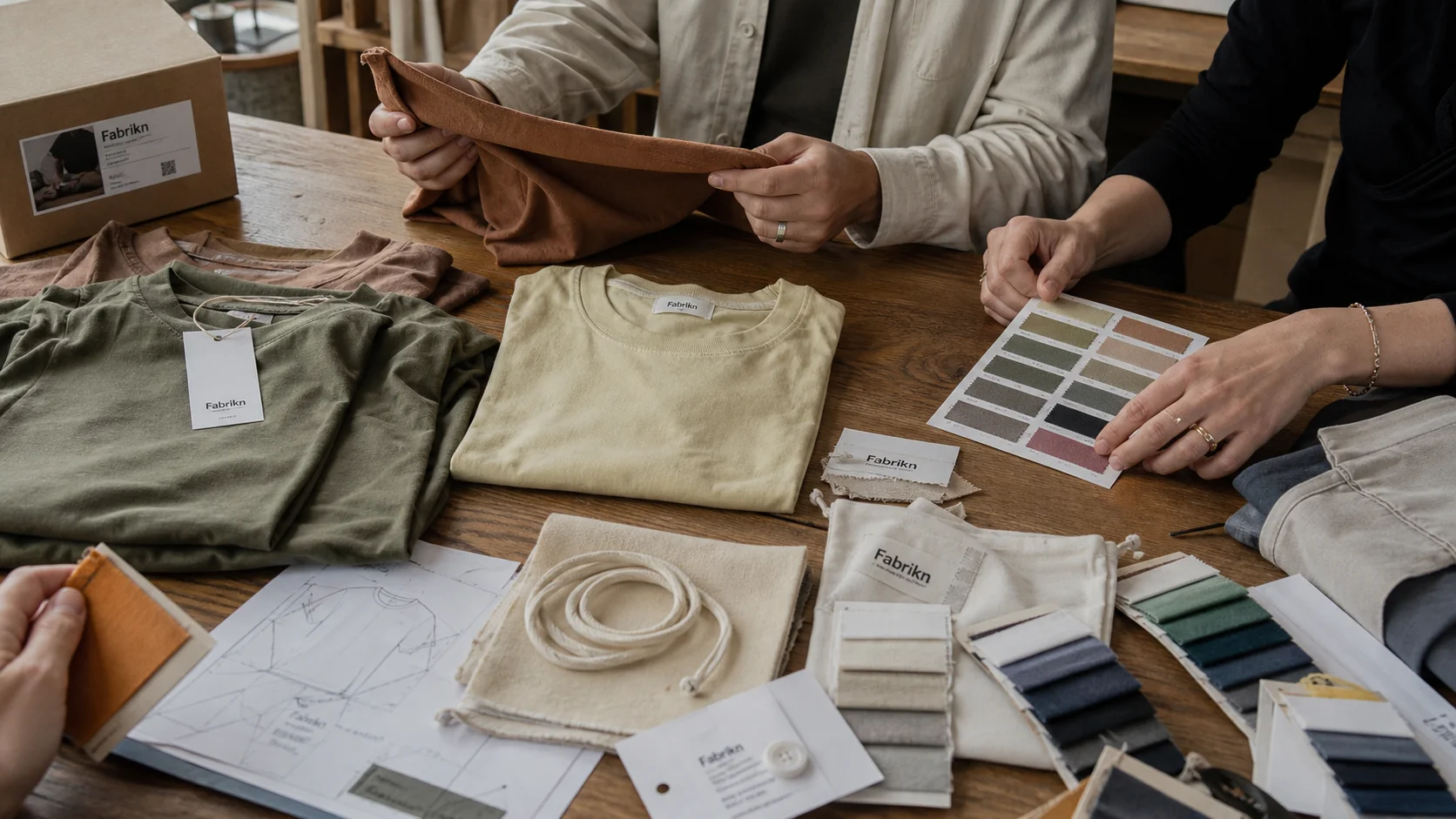
FSC Paper Clothing Packaging with checks for samples, fit, MOQ, QC evidence, pricing terms, and delivery risk.
Fast answer: FSC Paper Clothing Packaging: Claims, Paper Stock, Print, and Supplier Proof should be judged by production evidence, not by a generic sourcing promise. The buyer needs sample proof, cost breakdowns, QC checkpoints, and delivery buffers in writing.
Ask for recent sample photos, measurement tolerances, fabric or print test assumptions, decoration test notes, packing examples, and a named inspection checkpoint. These details show whether the team can repeat an approved sample at bulk volume.
Separate garment cost, decoration, labels, packaging, sampling, testing, freight, and rush charges. When every cost line is visible, it becomes easier to reduce colorways, adjust size depth, or reserve more time for sampling.
On a factory floor, quality announces itself fast. I once watched a China plant hold 1.8% defect rates on folding cartons while a pricier Vietnamese supplier sat at 4.6%, and an Indian converter, charging almost 12% more, still failed moisture tests after 72 hours in humid storage. That is the uncomfortable truth about a fsc certified paper clothing packaging supplier china: the label matters, but the packing line matters more.
Certification alone does not guarantee quality. I have seen FSC paper sitting beside non-certified inserts, mismatched batch codes on outer cartons, and print variance that blew past a brand’s tolerance after only 500 units. Certified fiber means the raw paper can be traced. Certified production means the factory can handle, store, and convert that paper under chain-of-custody rules. Real traceability means the invoice, the carton label, the license code, and the shipped goods all match.
Thirty seconds on a packing line usually tells me whether a factory is serious. I look for paper stacks wrapped against humidity, clean glue application, and operators checking registration before the run settles. In one Shenzhen audit, the first 200 cartons showed color drift of 6 Delta-E, then stabilized under 2 Delta-E once the press team corrected ink flow. In another plant, moisture climbed to 12% in stored board because pallets sat uncovered near a loading bay.
The surprise is that mid-priced factories often outperform premium ones. A plant quoting $0.42 per carton with a 5,000-piece MOQ may run tighter QC than a glossy supplier at $0.58 who outsources finishing and loses control over the last mile. In my experience, consistency comes from line discipline, not logo wall décor. Brands that pair packaging review with apparel sourcing, such as those using clothing packaging solutions, usually spot these gaps faster because they already think in batches, tolerances, and hand-feel.
For buyers comparing options in China, the real test is whether the manufacturer, factory, and supplier all mean the same accountable operation. When they do, production becomes more predictable and quality easier to measure.
A credible supplier should hand over four things before you place an order: the FSC certificate, the chain-of-custody scope, the license code, and invoice references that match the claim on the carton or bag. I ask for all four because any one document can look fine on its own while the full set exposes the lie. A factory may hold FSC status for paper trading, yet not for printing, converting, or warehousing. That gap is where buyers get burned.
Verification takes minutes. Check the certificate number on the FSC database, confirm the company name, and make sure the scope covers the actual product type, not just office paper or raw board. Then compare the license code printed on artwork proofs with the code on commercial invoices and packing lists. If the certificate expired last month, if the scope excludes packaging, or if the license number does not appear on shipped documents, stop the order. According to FSC, claims must remain traceable through every transaction in the chain.
Greenwashing shows up in small places. I have seen FSC paper used only for an inner insert while the outer mailer carried the sustainability claim. I have also seen suppliers print “FSC mix” on bags that were never registered under the certificate. That kind of shortcut is common in low-margin runs of 1,000 to 3,000 pieces, where sales teams promise compliance faster than production can document it. Real paper clothing packaging compliance is boring. That is a compliment.
Here’s a 15-minute procurement check I use before any factory visit:
Brands doing broader private-label programs often combine this with private label clothing services, because packaging claims must align with the garment label, hangtag, and carton trail. One mismatch can unravel the whole story.
For procurement teams, this is also where a supplier, manufacturer, and factory should all pass the same audit trail. If they cannot, the documentation is not ready for wholesale or bulk orders.
Paper clothing packaging is not one product. It is a family of formats with very different performance profiles. Kraft mailers are tough and forgiving, coated cartons print sharply but can frustrate recycling if over-finished, recycled board lowers fiber demand but may soften at the edges, and laminated paper adds stiffness while making recovery harder. A good fsc certified paper clothing packaging supplier china should explain those tradeoffs without hiding behind marketing language.
For premium apparel, I most often see rigid cartons, garment boxes, swing tags, and tissue. Premium buyers tend to specify 350-450 gsm coated board, matte lamination, embossing, and occasional hot stamping. Mid-market brands lean toward 250-350 gsm kraft or art paper, water-based coating, and a single-color print to hold cost down. Mass-market labels choose mailers, simple carton sleeves, and recycled board because the economics matter more than shelf theatre.
Finish choice is where quality either survives or collapses. Matte lamination hides scuffs better than gloss on long freight lanes, but it can crack on sharp folds if the board is too dry. Water-based coatings usually hold up well in humid ports and can improve scratch resistance by roughly 20-30% compared with uncoated stock in my audits. Foil and hot stamping look expensive, yet they are easy to overuse; one bad die line can ruin 8,000 pieces before anyone notices. French terry 320 GSM hoodies deserve stronger cartons than lightweight tees, because heavier garments compress corners and punish weak board.
Virgin fiber offers cleaner print and higher stiffness. Recycled content lowers environmental burden, but it may increase fiber variance by 5-10% across batches. FSC-certified mixes sit between those poles, giving brands traceability with a practical supply base. For utility-led programs, I have seen recycled mailers perform well at 300-500 pieces per carton pack, while luxury boxes need tighter moisture control and better caliper consistency. That is why a supplier’s paper mill source matters as much as the converting machine.
Most brands that source across product categories need packaging that mirrors garment complexity. I see that especially in custom baby clothing manufacturing, where soft hand-feel, low-odor inks, and secure closure matter as much as the visual finish. Babies do not care about a foil stamp. Parents notice if the box smells like solvent.
When comparing custom options, ask whether the factory can support low-MOQ samples, wholesale replenishment, and bulk production without changing board quality midstream.
Pricing for certified paper apparel packaging is not a single number. It shifts with MOQ, paper weight, color count, coating, and whether the factory is only printing or also die-cutting, gluing, and packing. In China, a simple FSC kraft mailer at 5,000 pieces can land around $0.18-$0.32 each. A custom printed rigid carton with embossing and matte lamination may run $0.55-$1.20, depending on size and finishing. Southeast Asia often sits 10-18% above China on similar specs. Europe can be 25-40% higher, especially for small runs under 3,000 units.
The unit price only tells half the story. A lower quote from a non-certified supplier can become expensive after rework, air freight, and damage. If defect rates climb above 3%, the savings can disappear fast. I have watched a brand save $0.06 per box on paper, then lose $1,400 in labor when 2,000 cartons needed manual re-gluing. Add a missed ship date, and the cost gap widens again.
Paper weight changes everything. A shift from 250 gsm to 350 gsm may add only a few cents per unit, but it can reduce transit crush by 15-20%. Four-color process printing costs more than one- or two-color work. Water-based coatings are usually cheaper than specialty laminations. Recycled board may be cheaper on paper input, yet if it has higher warp, the factory spends more time on setup and quality checks. That setup time sits inside the quote whether the salesperson says it or not.
Freight is another hidden trap. A carton that looks cheap at ex-works pricing can weigh more than expected and push air shipment rates up sharply. In one audit, a buyer’s “budget” packaging cost rose by 19% once oversized cartons and damaged outer boxes were replaced. Another brand lost 7 days in launch timing because a supplier packed samples in weak mailers that arrived bent and unapproved.
The smartest buyers compare landed cost, not piece cost. That means paper, conversion, freight, rework, and failure rate. If a factory quoting $0.28 delivers 98.5% first-pass quality while another quoting $0.24 delivers 94%, the expensive option is cheaper in practice. This is why well-run brands tie packaging sourcing to garment production logic, the same way they manage cut and sew manufacturing. Every extra touch has a price.
For market benchmarking and import planning, U.S. buyers can also review trade.gov guidance on international sourcing and compliance, then compare the landed cost against their own production targets.
Sampling comes faster than production, but not always by much. For a simple kraft mailer, I typically see 3-7 days for sampling, then 10-15 days for mass production once art is approved. Custom printed cartons with dies, windows, embossing, or foil usually need 7-14 days for prototypes and 18-30 days for bulk, depending on tooling and drying time. Rigid boxes can stretch to 30-45 days if the supplier is busy or the board needs special curing.
What slows things down is usually not the press. It is approval discipline. I have seen brands lose a full week because they changed Pantone numbers three times or asked for a new barcode after the die tool was already cut. One factory in Zhejiang told me a 5,000-piece order could have shipped in 12 days, but a late logo revision pushed it to 19 days. That was not a production failure. It was planning failure.
Peak season in China changes the equation. Before major holidays, container space tightens, inland trucking prices rise, and export lead times stretch by 4-7 days. A supplier may still finish on schedule, yet the cartons wait in a warehouse for pickup. If your assortment depends on tight launch dates, buffer time matters more than a lower quote. I advise ordering packaging 8-12 weeks before sell-through needs, especially for seasonal collections and replenishment on fast-moving basics.
Here is the planning rhythm I recommend:
This timing becomes even more delicate for brands that bundle packaging with private assortment planning. A line built around a single seasonal carton is simple. A line supporting multiple SKUs, sizes, and returns mailers needs stronger control, the kind I associate with organized private label clothing services programs rather than ad hoc buying.
For reliable planning, a China factory should confirm production slots, sample approvals, and MOQ before tooling begins.
I start every audit with the sample, because the sample tells the truth before the factory does. Check the fold memory, edge crush, print registration, ink rub, and whether the box springs back after compression. Then request documents, inspect the production line, and call two references. A good supplier answers in hours, not days, and sends the right file the first time. That responsiveness predicts crisis behavior better than a polished sales deck.
Ask direct questions. What glue chemistry do you use, and is it low-odor? How much recycled content is in the board, and can you show the mill declaration? Which inks are food-safe or low-VOC? What happens when humidity rises above 70%? How do you handle a 2% complaint rate versus a 5% complaint rate? If the answers are vague, the factory is probably guessing too.
I also watch consistency across batches. A factory that can deliver the first 500 pieces beautifully but drifts on the next 4,500 is not ready for scale. Complaint handling matters just as much. I want to see a documented root-cause process, a replacement timeline under 7 days, and proof that the factory can isolate affected lots without stopping the whole run. Brands that build packaging alongside apparel production, including those using clothing packaging solutions, usually understand this faster because they already think in fault trees.
The thing nobody tells you: a supplier that admits one weakness in the first call is often safer than one that claims perfection. I have seen honest factories correct a 3 mm die-cut shift in 24 hours; I have seen “perfect” suppliers hide it until 20,000 pieces were already packed.
Use a simple scorecard. Rate each supplier from 1 to 5 on quality, compliance, response speed, pricing, and ethics. Weight quality at 40%, compliance at 25%, response at 15%, pricing at 10%, and ethics at 10%. Anything under 80/100 should stay off your approved list.
For sustainability benchmarking, many teams also review Textile Exchange resources and OEKO-TEX guidance when aligning packaging, apparel, and chemical compliance expectations.
Start with an RFI that asks for the FSC certificate, chain-of-custody scope, license code, MOQ, lead time, and recent export references. Request samples for 2-3 formats: one mailer, one carton, and one swing tag set. Then compare not just how they look, but how they survive shipping, humidity, and handling. A sample that survives a desk test may still fail a warehouse.
Run a pilot order before full rollout. I prefer 1-2 SKUs, shipped across two different destinations if possible, because one route can hide a weakness. Track box crush, print rub, and customer complaints for 30-45 days. If a supplier performs well on first-pass quality and on-time delivery, scale the order. If they miss on either, keep them as backup only.
For teams working across apparel and packaging, align the sourcing calendar with garment production dates, not the other way around. That matters even more for brands using private label clothing services and those needing packaging to match trim, label, and size runs. One clean workflow beats three rushed ones.
My procurement workflow is simple: shortlist 3 factories, verify compliance documents, approve samples, run a pilot, and then lock the supplier into a seasonal forecast with a 10-15% buffer. Do that, and a fsc certified paper clothing packaging supplier china stops being a risk and starts behaving like a controllable part of your supply chain. Keep it measurable, and keep it honest.
Ask for the FSC certificate, chain-of-custody scope, license code, and an invoice that shows the same details. Then check the certificate number in the FSC database and confirm the scope covers packaging conversion, not only paper trading.
Simple kraft mailers often cost $0.18-$0.32 each at 5,000 pieces, while custom printed rigid cartons can run $0.55-$1.20. MOQ, paper weight, colors, and finishing can move the price by 15-30%.
Sampling for simple mailers can take 3-7 days, while custom cartons usually need 7-14 days. Bulk production often runs 10-15 days for simple items and 18-30 days for more complex packaging.
Yes, but only if the claim is not made for the non-certified part and the documentation is clear. The safest approach is to ensure every claimed component, from outer bag to insert, sits inside the FSC chain-of-custody scope.
Ask about glue chemistry, recycled content, ink safety, moisture resistance, complaint handling, and replacement timing. A pilot order of 1-2 SKUs is usually enough to test print quality, shipping durability, and response speed.