
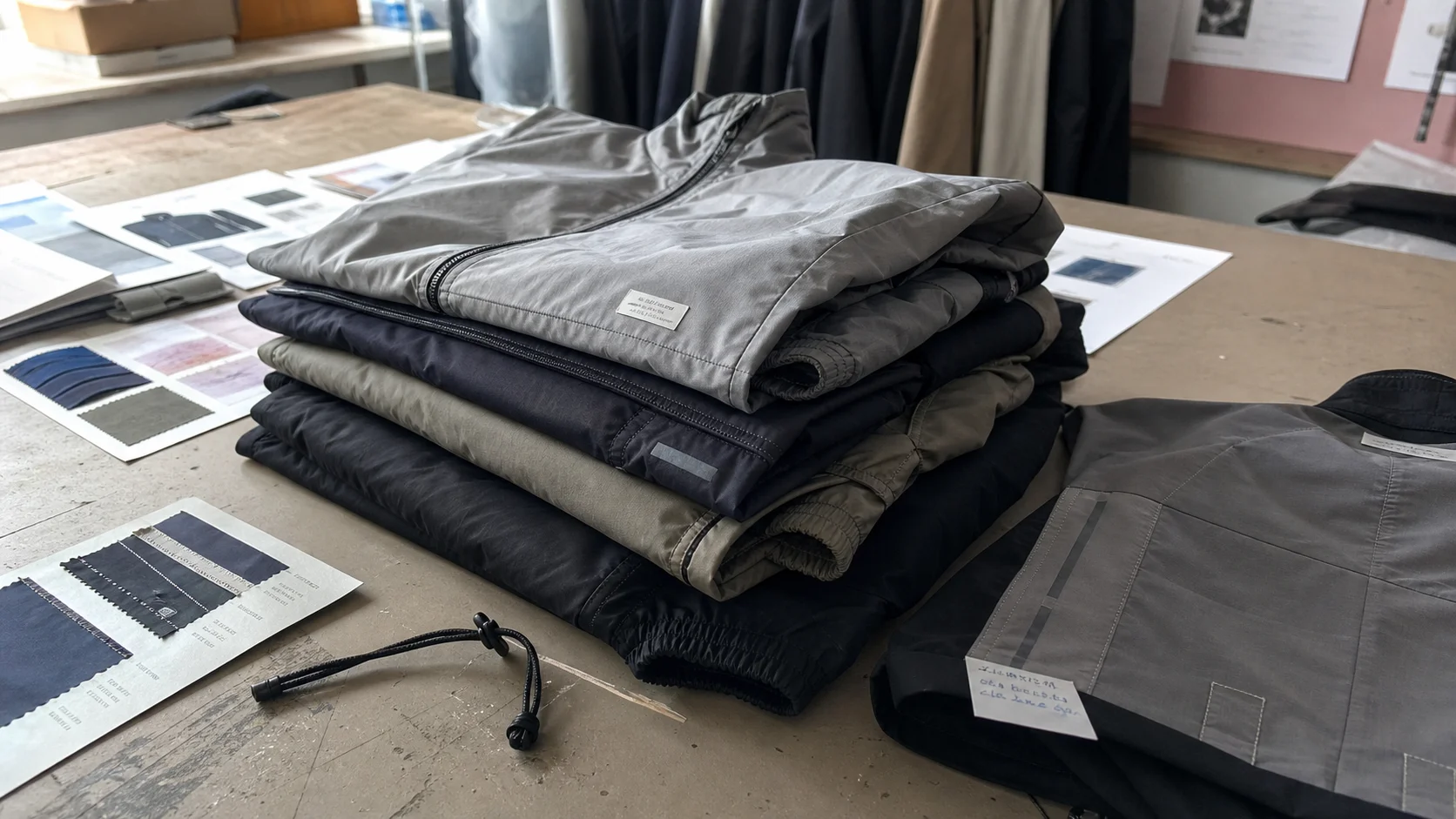
A restaurant-group buyer's outline for auditing vendors that produce heat transfer branded jackets, with attention to artwork files, fabric compatibility,...
Restaurant groups buying heat transfer jackets need more than a supplier that can press a logo onto fabric. The real task is to qualify a vendor that can deliver consistent decoration, stable sizing, clean branding, and repeatable lead times across multiple locations and replenishment cycles. A vendor audit brief gives buyers a structured way to test whether the factory can support branded outerwear without turning every reorder into a correction project.
This matters most when the jacket is part of a larger staff uniform program. Heat transfer decoration can look sharp on fleece, softshell, nylon, and poly-cotton blends, but only if the film, adhesive, base fabric, and application settings are matched correctly. Restaurant groups usually need controlled color, durable branding after laundering, and a dependable size curve that works for kitchen, front-of-house, and delivery teams. A strong audit brief filters out weak suppliers before sampling consumes time and budget.
Heat Transfer Jacket Vendor Audit Brief for Buyers - Decoration & Printing manufacturing guide
Heat transfer jacket programs fail for predictable reasons. A supplier may quote a low price on paper, then struggle with artwork placement, inconsistent press settings, or poor fabric compatibility. In restaurant use, the failure shows up quickly: logos peel at the edges, reflective marks crack after laundering, jacket panels shade differently from one batch to the next, or the fit varies enough that one location rejects a shipment while another accepts it.
A buyer audit is not a formality. It is a risk-control tool. For restaurant groups, the vendor must prove that it can handle repeat orders, seasonal add-ons, and store-level replacements without drifting from the approved standard. That means checking the production line, decoration method, testing routines, and communication discipline before the first order is approved.
The audit brief should be written for sourcing, merchandising, and operations stakeholders. Purchasing wants pricing and continuity. Brand teams want logo integrity and color control. Operators want easy care, comfort, and enough consistency to avoid staff complaints. A good brief makes those priorities visible in one document.
The vendor audit for heat transfer jackets should focus on six core areas: manufacturing capability, decoration capability, material control, sampling process, quality assurance, and service reliability. Each area answers a practical question. Can the vendor produce the garment cleanly? Can it apply the transfer without damaging the fabric? Can it repeat the result across multiple lots? Can it support reorder cycles under real restaurant timing?
The audit should also separate what is standard from what is custom. A vendor may be competent at basic polyester shells but weak on insulated liners, bonded fabrics, or brushed fleece. The same vendor may accept artwork for heat transfer but not understand how thin lines, small text, and gradient effects behave under heat. Buyers should not assume general apparel competence automatically transfers to decoration control.
Useful evidence includes production photos, in-line quality records, material traceability, test reports, sample records, and a clear escalation path. If the factory cannot document what it does, it is harder to trust the output on a multi-location uniform program.
Heat transfer jackets for restaurant groups are usually built on one of a few common fabric platforms. Polyesters are often preferred for outer shells because they handle decoration well and dry quickly. Softshell constructions can add weather resistance, though coatings and stretch content need testing before transfer application. Fleece and cotton blends can be comfortable, yet they introduce more variation in surface texture and may need different transfer settings. Nylon can work well for lightweight jackets, but it is more sensitive to heat and pressure during application.
Buyers should ask the vendor to define the exact fabric composition, weight, and finish. A generic answer such as “polyester jacket” is not enough. A 100 percent polyester shell behaves differently from a 94/6 poly-spandex blend, and both behave differently from a laminated softshell. Decoration method, press temperature, dwell time, and peel timing should all be matched to the base material.
Trim matters too. Zippers, rib cuffs, drawcords, reflective piping, and seam tape can affect decoration placement and pressing risk. Heat transfer applied too close to a seam, zipper coil, or embossed panel may fail sooner. A disciplined supplier will map the placement area and confirm minimum distances from structural features before sampling starts.
Decoration specs should include logo size, placement coordinates, color targets, finish type, and acceptable tolerance. Matte, gloss, and high-opacity finishes each create different visual effects. Restaurant groups often prefer a clean and controlled look, so the vendor should show whether the transfer finish matches the brand intent across light and dark fabrics.
Spec Area What Buyers Should Confirm Common Risk Shell fabric Fiber content, weight, coating, stretch Transfer failure on coated or heat-sensitive fabrics Lining Material, seam structure, breathability Warping or print bleed through thin layers Trim Zippers, cuffs, piping, reflective parts Placement interference during pressing Transfer film Type, opacity, hand feel, wash durability Cracking, peeling, edge lift Artwork File format, line weight, color proof Distortion, poor small-detail reproductionMOQ for heat transfer jacket programs varies widely by vendor and construction. For branded restaurant outerwear, buyers often see sample minimums from one piece to a few pieces per size, while production MOQs can range from 100 to 500 pieces per color or style. Some factories will quote lower minimums for stock blanks and simple one-color transfer decoration, yet that usually comes with less flexibility on fabric choice, color matching, or packaging customization.
Lead time depends on more than sewing capacity. It depends on whether the base fabric is in stock, whether custom trims need to be sourced, how many color approvals are required, and whether the transfer artwork has already been finalized. A simple reorder of an approved style may move faster than a new jacket with a new placement map and revised logo size. Buyers should build the timeline around the slowest dependency, not the fastest promise.
The sample sequence should be explicit. A practical process is first tech-pack review, then material confirmation, then preproduction sample, then decoration strike-off or test press, and finally size-set approval if multiple sizes are involved. Restaurant groups often skip one of these steps to save time and then pay for it later in rejected inventory. For multi-unit accounts, sample discipline is not optional.
Buyers should also ask whether the vendor keeps approved strike-offs and sample references. That supports future reorder consistency. If the original logo orientation, transfer texture, or garment shade was approved months earlier, the vendor needs a retained reference point to reduce drift.
Heat transfer defects are often subtle at first. A jacket can look acceptable in a short visual check and still fail after washing or repeated wear. That is why the audit brief should include both in-process controls and post-production inspection expectations. Buyers should not rely on final carton inspection alone.
For decoration, the main risks are edge lift, incomplete adhesion, color inconsistency, and loss of fine detail. Dark fabrics can create visibility issues if the transfer has insufficient opacity. Stretch fabrics can stress the transfer during wear, especially at elbows, shoulders, or chest placements. If the logo sits on a textured surface, small letters may break up or appear uneven after pressing.
For the garment itself, buyers should check seam strength, zipper function, needle damage near decoration zones, and color variation between panels. Any jacket intended for restaurant use should also be checked for comfort in movement. Staff need to bend, lift, carry, and work around hot equipment. A stiff or overheated transfer area can become a user complaint even when it passes a basic visual audit.
Inspection plans should include AQL levels, but the more useful question is where defects are likely to occur. Ask the vendor to identify risk points on the jacket. Those often include chest placement near pockets, sleeve placement near seams, and large back graphics that require even heat distribution. If the supplier cannot explain those risks clearly, the production process is probably less controlled than the quote suggests.
Buyers should treat decoration quality and garment quality as separate controls. A clean print on a weak jacket is still a bad purchase.
A practical vendor audit should turn subjective impressions into a simple scorecard. That keeps the discussion focused on proof instead of sales language. For restaurant groups, the decision usually comes down to whether the vendor can protect brand consistency across multiple stores and repeated replenishment cycles. Price matters, but only after reliability is established.
A scoring system can use weighted criteria. Decoration accuracy and durability should carry more weight than decorative presentation in the sample room. Lead-time reliability should carry more weight than generic claims about production scale. If the vendor is strong on pricing but weak on QC traceability, the apparent saving is likely to disappear in rework, replacement freight, or store-level complaints.
A useful framework is to score each category from 1 to 5 and require evidence for any score above 3. This approach avoids inflated ratings based on confidence alone. Buyers should also require a clear corrective action process. If a sample misses placement by 5 millimeters or the finish does not match the approved standard, what happens next, who approves the revision, and how long does it take?
Category Weight What Good Looks Like Fabric control 20% Clear composition, stable supply, consistent hand feel Decoration capability 25% Accurate placement, durable adhesion, clean logo edges Sampling process 15% Documented approvals, retained references, clear revisions Production reliability 20% Repeatable output, realistic lead times, stable communication Inspection and packing 20% Count accuracy, labeling control, export-ready packingGood audit questions are specific. Broad questions produce broad answers. For a heat transfer jacket program, buyers should ask the vendor to walk through the exact decoration method, the material compatibility, and the approval sequence for a new logo. If the supplier cannot answer in practical terms, that is a signal to slow down.
Buyers should also verify whether the vendor understands restaurant use. Uniform jackets for restaurants are not the same as fashion outerwear. They need practical durability, easy care, and branding that stays readable after repeated laundering. The best suppliers will discuss stain-prone environments, movement requirements, and replacement planning instead of only talking about visual impact.
Suppliers that offer only one decoration method may not be the best fit for every program. Heat transfer works well for many logos and short-run branding projects. Direct embroidery may be more durable for certain placements. Screen print may be cheaper on some styles, while woven patches may be better for heavier outerwear. A disciplined buyer compares options instead of defaulting to the cheapest decoration format.
For buyers building a wider sourcing program, it helps to review the supplier’s service scope, company background, and direct contact path before issuing a formal audit brief. These pages can support that process:
If the vendor cannot connect its service claims to a clear sample and production process, the audit should pause. A better supplier will respond with technical detail, not marketing language. That is especially important in Decoration & Printing categories where finish quality is visible, measurable, and easy to compare across samples.
For restaurant groups, the safest purchase is not the lowest quote. It is the jacket program with the fewest failure points. That means stable fabric sourcing, a decoration method suited to the material, a realistic sample and approval path, and a factory that can repeat the same result after the first order ships.
Heat transfer can be an excellent choice when the artwork is relatively clean, the fabric is compatible, and the vendor has disciplined press control. It becomes risky when buyers push it onto the wrong substrate, skip sample approvals, or accept vague quality promises. The right vendor audit brief reduces those risks before they reach operations.
Strong sourcing teams look for clear evidence: controlled specifications, documented approvals, sensible MOQs, and a production plan that matches the actual restaurant calendar. If a supplier can meet those conditions, it is worth moving forward. If not, the quote is not a solution. It is a future problem.
Get a free quote from Fabrikn — your trusted B2B clothing manufacturer with 10+ years of experience. MOQ as low as 200 pieces.
Get a Free Quote →It is a buyer document that checks whether a supplier can produce branded jackets with reliable decoration quality, repeatable sizing, and practical lead times. For restaurant groups, it helps verify that the vendor can support uniform programs without inconsistent logo application or reorder issues.
Sampling can be as low as one to three pieces per size or colorway, while production MOQs often fall between 100 and 500 pieces. Exact minimums depend on fabric type, decoration method, and whether the style uses stock materials or custom components.
Polyester shells are often the most manageable, followed by some poly blends and compatible softshells. Heavy coatings, high stretch content, and heat-sensitive finishes increase risk. The vendor should confirm compatibility with test samples before bulk production.
At minimum, the buyer should approve the artwork proof, fabric and trim specification, preproduction sample, transfer finish, placement position, and size set if needed. Skipping any of those steps increases the risk of rework and inconsistent replenishment.
Common risks include edge lift, poor adhesion, logo distortion, placement errors, color variation, and garment defects such as weak seams or faulty zippers. Packing errors and incorrect size labeling also create avoidable problems in chain distribution.
It depends on the logo, fabric, budget, and wear conditions. Heat transfer can deliver a clean, modern look with good detail on compatible fabrics. Embroidery may last longer on some outerwear, but it can add weight and stiffness. The decision should be based on testing, not assumption.