
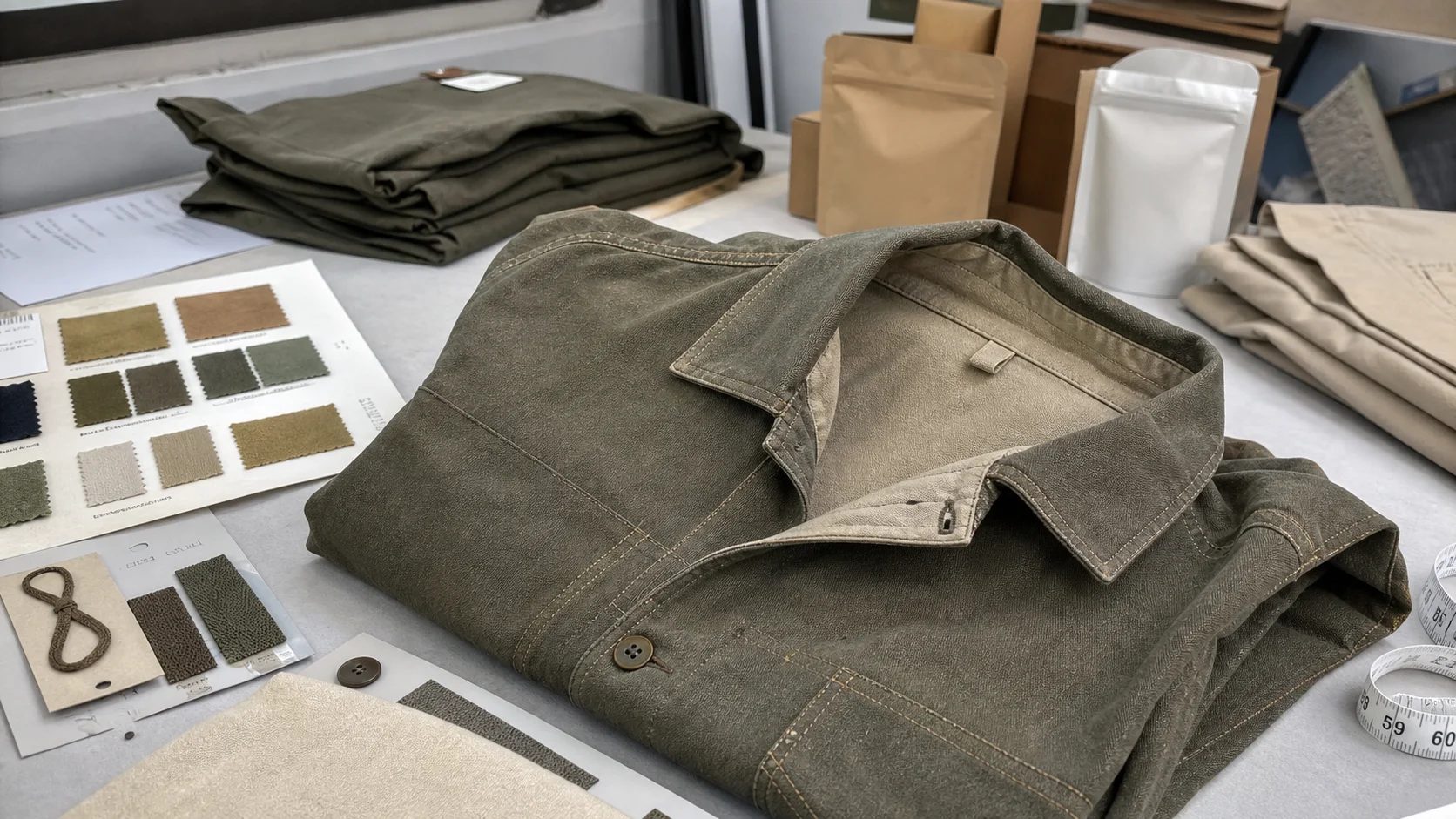
A product-specific SEO outline for reviewing wholesale hemp utility coat MOQ pricing, fabric specs, durability needs, and ordering decisions for commercial...
Hemp Utility Coat MOQ Pricing for Cleaning Crews - Sustainable Fashion manufacturing guide
Hemp utility coats sit in a practical space between uniform outerwear, workwear, and sustainable fashion. For cleaning crews, the garment has to do more than look responsible on a procurement report. It must tolerate movement, chemical exposure, frequent laundering, storage in vans or lockers, and repeated daily wear. A coat that cannot handle those conditions becomes an expensive sustainability claim rather than a useful uniform item.
Hemp is attractive because it is a durable bast fiber with a naturally textured handfeel and a stronger sustainability story than many conventional fibers. In utility coat form, it is often blended with organic cotton, recycled cotton, or conventional cotton to improve softness, reduce stiffness, and make sewing easier. Pure hemp can work, but it is not always the best default for cleaning uniforms. It may feel firm at first, wrinkle visibly, and cost more than blended options.
The best wholesale hemp utility coat for cleaning crews is usually a balanced garment: strong enough for daily use, simple enough to produce consistently, and priced within a realistic uniform budget. Buyers should focus on fabric weight, pocket placement, wash performance, shrinkage control, and reorder stability before chasing the lowest quote.
Direct purchasing judgment: for cleaning crews, a hemp-cotton blend is usually a safer commercial choice than 100% hemp unless the brand or company specifically wants a premium sustainability statement and can absorb higher unit costs.
Cleaning companies also need to think about staff turnover. Uniform programs work best when replacement sizes are available without forcing a new development cycle. If a coat is too customized, future replenishment can become slow and costly. A slightly simpler coat with stable fabric and repeatable trims often delivers better long-term value than a highly designed garment with fragile sourcing inputs.
For companies developing a uniform line or sustainable workwear capsule, it is worth reviewing manufacturing support early. Fabrikn’s apparel manufacturing services page is a useful starting point for understanding how product development, sourcing, sampling, and production support can fit together.
MOQ means minimum order quantity. In wholesale apparel, it is the lowest quantity a supplier is willing to produce for a style, color, fabric, or size set. For hemp utility coats, MOQ can be affected by fabric mill requirements, dyeing minimums, trim minimums, factory line efficiency, and the complexity of the coat pattern.
A buyer may ask for 100 coats, but the fabric supplier may require enough greige or dyed fabric for 300 coats. Another supplier may accept 100 pieces only if the buyer uses available stock fabric and standard trims. This is why MOQ should not be treated as a single number until the fabric, color, size range, and construction are defined.
Cleaning crew buyers should separate MOQ into several layers:
Style MOQ: the total minimum number of coats for one design.
Color MOQ: the minimum number required per colorway.
Size MOQ: the minimum quantity needed per size or size ratio.
Fabric MOQ: the mill or fabric supplier’s minimum yardage requirement.
Trim MOQ: minimums for buttons, snaps, zippers, woven labels, care labels, and packaging.
This matters because a 300-piece MOQ can quickly become less flexible than it appears. If the buyer wants navy, black, and natural undyed hemp, the supplier may quote 300 pieces per color, not 300 pieces total. If the cleaning company needs XS through 5XL, the factory may also ask for a practical size distribution so cutting and sewing remain efficient.
Uniform buyers should ask suppliers to state MOQ in writing by style, color, and fabric. A quote that says “MOQ 300 pcs” without detail leaves room for cost changes later.
MOQ varies by supplier type, fabric availability, and customization level. The following ranges are typical reference points for planning, not guaranteed numbers. Buyers should use them to judge whether a quote is realistic.
Order Type Typical MOQ Range Best Fit Purchasing Tradeoff Stock hemp-blend coat with minor branding 50–150 pieces Small cleaning teams, trial programs, local operators Lower risk, but limited fabric, color, pocket, and fit control Custom coat using available stock fabric 150–300 pieces Growing cleaning companies and regional uniform programs Better branding and fit, but fabric continuity may be uncertain Custom hemp-cotton coat with dyed fabric 300–600 pieces Mid-size crews, franchise groups, B2B sustainable workwear buyers Stronger control over color and specs, but higher upfront commitment Fully custom hemp coat with special trims 500–1,000+ pieces Large cleaning networks or private-label workwear collections Best product control, but slowest and least flexible routeSmall cleaning crews often look for 30 to 80 pieces. That quantity can be difficult for a custom hemp coat unless the supplier has stock fabric and an existing pattern. A low MOQ is possible, but the unit price will usually rise because the supplier cannot spread pattern work, sample development, cutting setup, and production management across many garments.
For a small buyer, the better route may be a stock or semi-custom utility coat with embroidery, heat transfer branding, or a woven label. For a larger crew, custom pattern work becomes more sensible because fit, pocket layout, and durability improvements can justify development cost.
A buyer ordering 500 pieces should not automatically accept the same construction used for a 100-piece trial. At higher volumes, it is reasonable to negotiate better fabric testing, reinforced stress points, more consistent packaging, and clearer replacement size planning.
Wholesale pricing for hemp utility coats depends on material cost, labor time, order volume, finishing, packaging, and compliance expectations. Hemp is rarely the cheapest option in workwear. It can still make sense when the coat is positioned as durable, lower-impact, and brand-aligned with sustainability values.
As a cautious planning range, a simple wholesale hemp-blend utility coat may sit around the mid-teens to mid-thirties in USD per piece at higher quantities, while more structured or fully custom versions can move above that. Small runs, heavy fabrics, lined construction, premium trims, special washes, and extended sizing can push costs higher. Freight, duties, testing, and development charges may not be included in the quoted unit price.
Cost Driver Lower-Cost Choice Higher-Cost Choice Buyer Judgment Fabric Hemp-cotton stock fabric Custom-dyed 100% hemp or certified blend Choose stock fabric for trials; choose custom fabric for brand programs Construction Unlined chore-style coat Lined coat with multiple panels and reinforcement Cleaning crews usually need washable durability more than heavy structure Trims Standard buttons or snaps Custom metal hardware, branded snaps, premium zippers Standard trims reduce reorder risk and inspection problems Branding Small embroidery or label Multiple placements and custom packaging Keep branding visible but replaceable for employee turnover Testing Basic measurements and visual checks Fabric composition, shrinkage, colorfastness, and seam testing Testing adds cost but prevents expensive uniform failuresBuyers should also watch the difference between FOB, EXW, landed, and delivered pricing. A coat that looks cheaper at factory level may become more expensive after inland transport, export handling, ocean or air freight, import duty, customs brokerage, and final delivery. Cleaning companies that need predictable budgets should request a landed estimate, even if the first quote is given on FOB terms.
The biggest pricing mistake is comparing quotes without matching specifications. A 280 gsm hemp-cotton twill coat with reinforced pockets is not the same product as a 200 gsm plain weave coat with basic stitching. Low quotes often remove value from places a buyer does not see immediately: thinner pocket bags, weaker thread, cheaper snaps, poor fusing, no shrinkage allowance, or minimal quality control.
Cleaning crews need garments that can handle bending, lifting, reaching, and repeated laundering. A utility coat should not be designed like a delicate fashion jacket. It should be built like a washable work layer.
Common options include 55% hemp and 45% organic cotton, 30% hemp and 70% cotton, 100% hemp, or hemp blended with recycled cotton. Higher hemp content can increase texture, strength, and sustainability appeal, but it may also increase stiffness and cost. More cotton usually improves softness and can make the coat easier to wear from day one.
A practical cleaning crew coat often works well in a hemp-cotton twill or canvas between roughly 220 gsm and 320 gsm. Lighter weights improve breathability and comfort indoors. Heavier weights improve durability and structure but may feel too warm for active cleaners working in heated buildings.
Navy, charcoal, black, olive, and natural beige are common choices. Dark colors hide marks better, but they must be checked for crocking and colorfastness. Natural undyed hemp has sustainability appeal, yet it may show stains quickly in cleaning environments.
Buyers should request test results or at least supplier confirmation for colorfastness to washing and rubbing. Cleaning chemicals, disinfectants, and bleach exposure can affect fabric color. No supplier should promise perfect resistance to all chemicals unless the fabric is specifically tested for that use case.
Standard trims are usually safer than heavily customized hardware. Buttons, snaps, zippers, drawcords, labels, and pocket reinforcements all affect cost and delivery. Metal snaps can look durable but may create problems if plating is poor or if snap attachment is inconsistent. Zippers add convenience, though they also increase repair risk compared with buttons or snaps.
For cleaning crews, trims should be smooth, secure, and easy to launder. Avoid decorative hardware that can catch on carts, cabinets, door handles, or equipment. If staff work around client property, the coat should not have sharp metal edges or loose parts that can scratch surfaces.
Utility coats often include chest pockets, lower patch pockets, internal pockets, pen slots, and tool loops. More pockets are not always better. Overbuilt pocket layouts increase sewing time and create more failure points. Cleaning staff may need space for gloves, checklists, keys, small tools, and a phone, but bulky pocket contents can interfere with movement.
Useful construction details include bar tacks at pocket corners, reinforced side seams, secure cuff openings, and a back vent or action pleat if the coat is worn during active work. Buyers should also decide whether the coat is a true work layer or a presentational layer worn before and after cleaning tasks. That decision changes the ideal fabric weight and pocket design.
Skipping sampling is a poor way to save money on hemp utility coats. Hemp fabrics can shrink, soften, twist, or crease differently after washing. Fit also changes once a coat uses real bulk fabric rather than a substitute sample cloth.
A typical approval route includes several steps:
Tech pack review: confirm measurements, construction, fabric, trims, labeling, and packaging.
Proto sample: check design proportion, pocket placement, general fit, and construction logic.
Fit sample: adjust size grading, sleeve length, shoulder mobility, and body ease.
Pre-production sample: approve the garment using bulk fabric, bulk trims, labels, and final construction.
Size set sample: review key sizes across the range, especially if ordering XS to 5XL.
Wash review: measure shrinkage, twisting, color change, and handfeel after laundering.
Cleaning crew buyers should test samples in realistic conditions. That does not mean making unsupported claims about chemical resistance. It means washing the sample according to the intended care label, checking pocket stress, reviewing comfort during movement, and confirming the coat still looks acceptable after drying.
Approval comments should be precise. “Make it better” is not useful. “Increase sleeve opening by 1.5 cm,” “move lower pocket 2 cm upward,” or “change pocket bag to self-fabric reinforcement” gives the supplier a workable instruction. Written approvals also protect both sides if there is a dispute during bulk inspection.
For buyers who need help moving from concept to production documentation, the Fabrikn contact page is the practical place to start a sourcing discussion.
Lead time for hemp utility coats depends on fabric availability, sample rounds, dyeing, trim sourcing, production capacity, inspection, and shipping method. A simple stock-based order can move quickly. A custom hemp coat with dyed fabric and several sample rounds can take much longer.
Stage Typical Planning Range Main Dependency Tech pack and quotation 3–10 business days Clarity of specs, fabric choice, and size breakdown Proto or fit sample 1–3 weeks Pattern complexity and trim availability Fabric sourcing or dyeing 2–6 weeks Stock fabric versus custom mill order Pre-production sample 1–2 weeks Bulk fabric and trim readiness Bulk production 3–8 weeks MOQ, factory capacity, construction complexity Inspection and shipping 1–6 weeks Inspection schedule and air versus ocean freightA cautious custom production calendar often lands between 8 and 16 weeks after clear approval, with longer timelines possible when fabric is developed from scratch. Tight timelines can be managed, but rush production increases risk. Factories may compress sewing time, skip proper rest periods after fabric washing, or limit inspection windows.
Cleaning companies should avoid ordering coats right before a contract launch, franchise rollout, or seasonal hiring push. Uniforms need buffer time. Size exchanges, late staff additions, and logo placement corrections are common enough that the first order should not be planned to arrive on the exact day it is needed.
Hemp utility coats need inspection beyond a quick visual review. The garment may look acceptable in a folded carton but fail after two washes or a week of use. Quality control should focus on fit, sewing strength, fabric stability, shade consistency, trims, and packaging accuracy.
Shade variation between panels, especially on dark dyed hemp blends.
High shrinkage after washing, causing tight sleeves or short body length.
Pocket corners tearing because bar tacks are missing or weak.
Uneven collars, twisting seams, or mismatched sleeve lengths.
Loose snaps, broken buttons, or zippers that catch during use.
Incorrect size labels, care labels, or carton assortments.
Embroidery puckering on hemp fabric due to poor backing or thread tension.
Inspection should include measurement checks across several sizes. The tolerance should be agreed before production. For coats, a common tolerance may be around plus or minus 1 cm for smaller points and 1.5 to 2 cm for larger body measurements, depending on the specification. Tolerances must be realistic for the fabric and construction.
Buyers should also confirm needle damage, seam slippage, and fabric flaws. Hemp blends can show slubs and natural texture. Some irregularity may be acceptable and even part of the fabric character. Large yarn faults, holes, stains, oil marks, and obvious panel mismatches should not be accepted as natural texture.
Packaging checks matter for crew distribution. If a cleaning company has multiple sites, each carton should be clearly marked by style, color, size, and quantity. Mixed cartons can save space but create headaches during rollout. Individual polybags may protect garments, but buyers with sustainability targets may prefer recycled polybags, paper bands, or bulk packing. Each option has tradeoffs in protection, presentation, and waste.
The right MOQ strategy depends on crew size, replacement needs, budget, and brand positioning. A 40-person cleaning crew does not need the same sourcing plan as a national facility services group. The smaller buyer should protect cash flow and avoid over-customization. The larger buyer should use volume to improve specifications, testing, and consistency.
Small crews should look for stock or semi-custom hemp utility coats. The goal is to test fit, fabric comfort, and staff acceptance without locking money into excess inventory. A 50 to 150 piece order may be enough to cover current staff, spare sizes, and short-term hiring. Buyers should avoid too many colors or special trims because each variation can raise MOQ and cost.
The tradeoff is limited uniqueness. A stock coat may not have the exact pocket setup or fit profile desired. That is acceptable if the garment performs well and the branding is clean. Small buyers should prioritize reliability over originality.
Mid-size companies can consider a custom hemp-cotton utility coat if they can order around 300 to 600 pieces. At this level, pocket placement, fit adjustments, and label customization become more practical. It is also sensible to create a size curve based on actual staff data rather than guessing equal quantities across sizes.
Mid-size buyers should negotiate reorder terms before placing the first order. Ask whether the same fabric will be available in six months. Ask whether trims are standard or custom. Ask whether the factory can produce smaller replenishment runs after the first bulk order. Replenishment planning often determines whether a uniform program remains smooth after launch.
Large buyers can justify full development, but they also face more operational risk. A poor size curve or delayed shipment can affect hundreds of staff. Large orders should include pre-production samples, size set approval, fabric testing, inline inspection, and final random inspection. The buyer should also consider staged deliveries by region or site.
For companies building a long-term sustainable uniform platform, supplier capability matters as much as unit price. Review communication quality, sample discipline, documentation, and production transparency. A low-cost supplier that cannot manage revisions or replacements may become expensive after rollout.
It can also help to understand the sourcing partner behind the program. Buyers can review Fabrikn’s background through the about us page when evaluating whether the company’s apparel development approach fits their sourcing needs.
Hemp is often marketed as sustainable, but buyers should ask for evidence rather than relying on broad claims. Useful documentation may include fabric composition records, certification details where applicable, dyeing information, restricted substance compliance, and care instructions that support longer garment life.
Certifications can increase cost and MOQ. Organic, recycled, low-impact dye, and social compliance requirements may narrow the supplier base. That does not mean buyers should ignore them. It means sustainability claims should be matched to budget, timeline, and order scale.
Cleaning companies should also consider garment longevity as part of sustainability. A coat that lasts two years is usually a better responsible purchase than a cheaper coat replaced every few months. Durability, repairability, and reorder consistency are not marketing extras. They are central to sustainable uniform sourcing.
Care labeling should be realistic. If cleaning staff or company laundries use hot washes, tumble drying, or industrial detergents, the fabric and label must reflect that reality. A delicate cold-wash-only coat may not suit a workwear environment, even if it looks good during sampling.
Buyers should compare hemp utility coat quotes line by line. A good quote should include fabric composition, fabric weight, MOQ, price by quantity tier, sample cost, sample lead time, bulk lead time, payment terms, packaging method, and shipping terms. If these points are missing, the quote is not ready for decision-making.
Quote Item What to Ask Why It Matters Fabric What is the exact hemp blend and gsm? Prevents unfair price comparison between different materials MOQ Is MOQ per style, color, or total order? Avoids surprise increases after development starts Sampling How many sample rounds are included? Controls development cost and approval timing Trims Are buttons, snaps, labels, and packaging standard or custom? Custom trims can delay production and raise replenishment risk Testing Is shrinkage, colorfastness, or composition testing included? Workwear failures often appear after washing Shipping Is the quote FOB, EXW, CIF, DDP, or delivered? Unit price alone does not show total landed costPrice negotiation should be tied to real levers. Increasing quantity, simplifying trims, using available fabric, reducing colorways, or accepting standard packaging can lower cost. Asking for a lower price without changing the product usually pressures the supplier to cut quality somewhere.
The best procurement outcome is not the cheapest coat. It is the coat that arrives on time, fits the crew, survives laundering, supports the company’s sustainability position, and can be reordered without rebuilding the whole program.
Wholesale hemp utility coat MOQ pricing for cleaning crews is a balance of sustainability, durability, and operational discipline. Hemp has a credible place in responsible workwear, but it needs the right blend, construction, and sourcing plan. Buyers should expect higher complexity than basic polyester or cotton uniforms and should budget for proper sampling.
For small crews, stock or semi-custom coats are usually the best starting point. For mid-size and large cleaning companies, custom hemp-cotton utility coats can make sense when order volume supports better fit, stronger trims, and controlled replenishment. Across all order sizes, the buyer should protect the program with clear specs, realistic MOQ expectations, sample approvals, wash testing, and final inspection.
Practical sourcing verdict: choose hemp utility coats when sustainability and durability both matter, but do not force a custom program below the MOQ where pricing, quality control, and replenishment become unstable.
Get a free quote from Fabrikn — your trusted B2B clothing manufacturer with 10+ years of experience. MOQ as low as 200 pieces.
Get a Free Quote →A typical MOQ may range from 50 to 150 pieces for stock or semi-custom coats, 150 to 300 pieces for custom coats using available fabric, and 300 to 600 pieces or more for custom dyed hemp-blend coats. Fully custom programs with special trims can require 500 to 1,000 pieces or more.
Not always. 100% hemp has a strong sustainability story and good durability potential, but it can feel stiff and cost more. A hemp-cotton blend is often more practical for cleaning crews because it improves comfort, washability, and production consistency.
Pricing depends on fabric, quantity, construction, trims, testing, and shipping terms. Simple hemp-blend utility coats may fall in a moderate wholesale range at higher quantities, while small runs or fully custom coats can cost substantially more. Buyers should compare quotes only when specs are matched.
A hemp-cotton twill or canvas around 220 gsm to 320 gsm is a practical planning range. Lighter fabric is better for indoor comfort and movement, while heavier fabric improves structure and abrasion resistance. The right choice depends on climate, job tasks, and laundering method.
A custom hemp utility coat program often needs 8 to 16 weeks after clear specification and sample approval. Stock-based orders can be faster. Custom dyeing, multiple sample rounds, testing, factory capacity, and shipping method can extend the timeline.
Key inspection points include measurements, shade consistency, shrinkage, pocket strength, seam quality, snap or button security, label accuracy, embroidery quality, and carton assortments. Cleaning crew coats should also be reviewed after laundering whenever possible.
Yes, but the best route is usually stock or semi-custom production. Very low custom MOQs can carry high unit prices and limited fabric options. Small buyers should keep the design simple, use available fabrics, and avoid too many colorways.
They can be suitable as general workwear, but buyers should not assume chemical resistance unless the fabric has been tested for the specific exposure. Bleach, disinfectants, and solvents may affect color and fiber performance. Care instructions and realistic use conditions should be reviewed before bulk approval.