
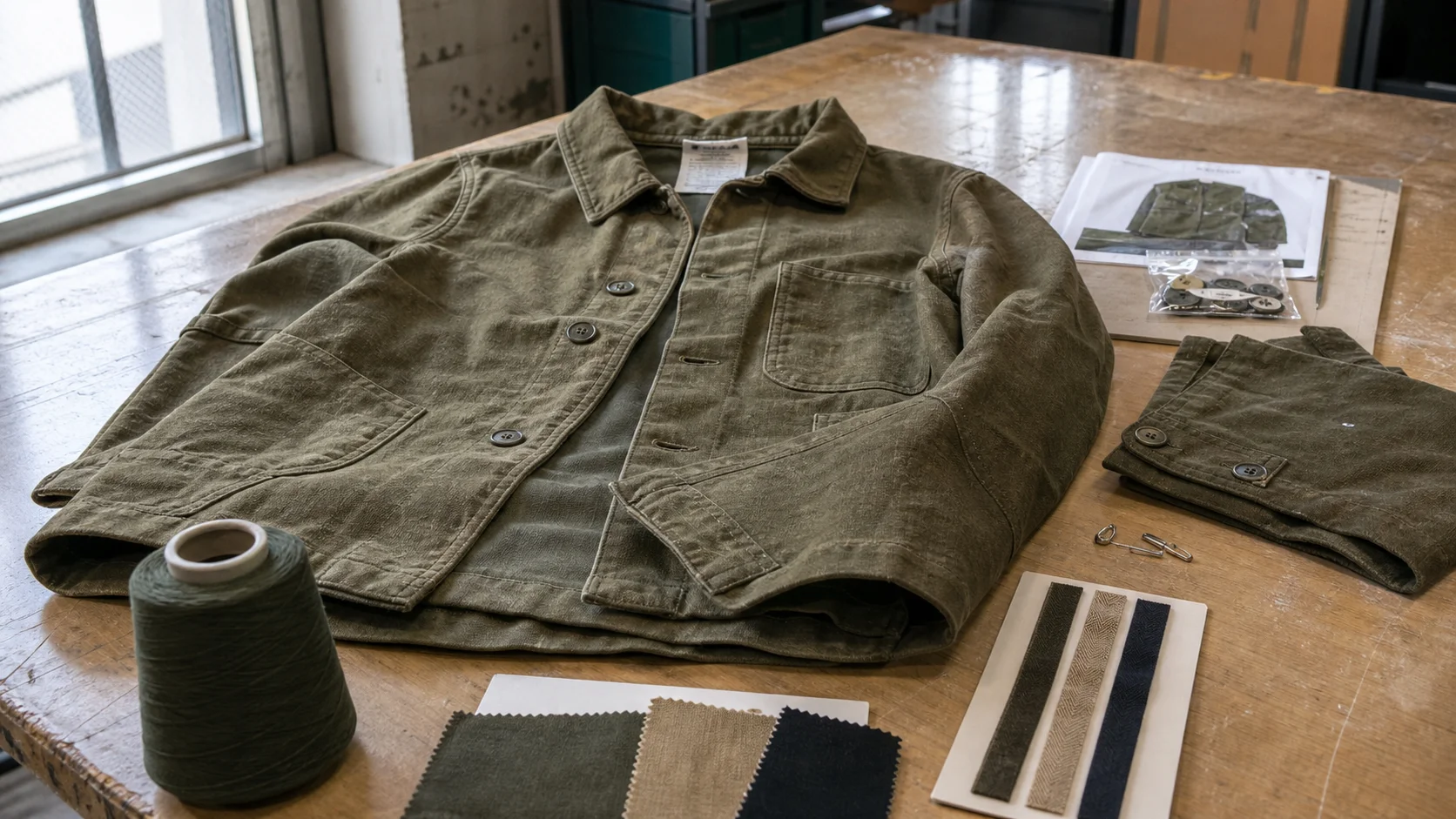
A product-specific SEO outline for corporate uniform buyers assessing reorder risks in hemp utility coats, from fabric shade continuity and trim...
Hemp Utility Coat Reorder Risk Review for Buyers - Sustainable Fashion manufacturing guide
Corporate uniform buyers are looking at hemp utility coats for good reasons. Hemp has a strong sustainability story, a durable hand feel, and a practical workwear identity that fits field teams, retail staff, hospitality crews, maintenance departments, campus operations, and outdoor-facing service roles. A hemp utility coat can look more responsible than a conventional polyester jacket while still carrying the functional details buyers expect: patch pockets, reinforced stress points, adjustable cuffs, branded trims, and enough structure to hold shape through repeat wear.
The reorder risk is where the buying decision becomes less simple. A first order can look successful after sample approval and a clean delivery. The bigger question is whether the same coat can be reordered six months, twelve months, or three years later without visible shade changes, fabric hand changes, trim substitutions, fit drift, or cost surprises. For corporate uniforms, reorder consistency often matters more than trend appeal. Employees hired later need to match the existing team. Replacement garments must sit naturally beside older stock. Procurement teams need a stable SKU, not a one-time seasonal capsule.
This review looks at hemp utility coat reorder risk from a buyer’s point of view. It covers material risks, MOQ pressure, sampling gates, production dependencies, inspection points, and commercial tradeoffs. The aim is not to make hemp sound risk-free. It is to help buyers decide whether hemp is suitable for a long-term uniform program and how to control the parts that commonly go wrong.
A hemp utility coat sits in a useful middle ground. It is more substantial than a shirt jacket, less technical than a padded outerwear piece, and more brandable than a basic work coat. For corporate uniform buyers, that balance can be attractive. The silhouette works across many body types, the pocketing can support job tasks, and the fabric can communicate a sustainability position without relying only on hangtag claims.
Hemp also has a naturally textured appearance. That can be an advantage for uniform programs where a slightly lived-in surface is acceptable. A hemp-cotton twill, hemp-organic cotton canvas, or hemp-lyocell blend can create a garment that feels durable but not overly stiff. In many programs, buyers choose blends rather than 100% hemp because blends are easier to source, easier to dye consistently, and often more comfortable for daily wear.
Common fabric directions include:
The practical judgment is this: hemp is a good candidate when the buyer values texture, durability, and sustainability messaging. It is less ideal when the program requires a perfectly flat technical surface, very tight shade matching across years, or rapid small-quantity replenishment without planning stock.
For brands evaluating manufacturing support, a good starting point is to review supplier capabilities and development scope through pages such as Fabrikn services. A hemp coat program needs more than cut-and-sew capacity. It needs sourcing discipline, lab-dip control, trim management, and repeatable measurement standards.
Reorder risk usually starts before the first bulk order is placed. Buyers often focus on the first delivery because it is the immediate deadline. The more important question is whether the product has been engineered as a repeatable uniform SKU. A garment can pass first-order inspection and still be poorly prepared for future reorders.
The highest-risk areas are fabric availability, dye lot consistency, trim continuity, pattern discipline, and documentation. If the first order uses a mill fabric that is not committed for repeat production, the next order may require a substitute cloth. If the buttons are selected from a seasonal trim card, they may be discontinued. If the pattern changes are handled casually between sample rounds, the approved fit may not be fully captured in the production spec.
Uniform buyers should treat the first order as the baseline for all future orders. That means keeping approved samples, wash-tested samples, fabric swatches, lab dip references, trim cards, graded measurement specs, and final packing instructions. A verbal agreement that the factory will “make the same again” is not enough. Reorder control depends on physical references and written specifications.
Purchasing judgment: a hemp utility coat should not be bought like a seasonal fashion jacket if it is intended for a corporate uniform program. The supplier should be asked to prove repeatability, not only sample quality.
Fabric is the largest reorder risk in hemp utility coats. Hemp fiber supply, yarn quality, weaving construction, finishing, and dyeing can all affect the final garment. Even when the composition stays the same, a reorder can look different if the yarn source, fabric weight, dye house, enzyme wash, or finishing recipe changes.
Buyers should define the fabric in more detail than “hemp cotton twill.” A workable fabric specification should include fiber composition, weave, weight, yarn count if available, finish, shrinkage tolerance, color standard, and performance requirements. For example, a spec might call for a 55% hemp, 45% organic cotton twill at 260 gsm, piece dyed, enzyme softened, with garment shrinkage after wash within an agreed tolerance. The exact numbers will depend on the program, but the principle is the same: the buyer needs a repeatable fabric identity.
Shade control deserves special attention. Hemp fabrics can show dye variation because the fiber texture and blend behavior are not always as predictable as standard cotton or polyester. Dark olive, charcoal, navy, khaki, and undyed natural shades are common for utility coats, but each has risk. Natural and undyed shades can vary by fiber batch. Dark shades can show crocking if dye fixation is weak. Earth tones can shift visibly when different dye lots are placed side by side.
Buyers should ask for lab dips before the first order and again before significant reorders. For repeat programs, the target should be an approved physical color standard, not a digital image. A spectrophotometer reading can support shade control, but the final approval should also consider visual appearance under relevant light conditions. Office lighting, retail lighting, and outdoor use can make the same shade appear different.
Fabric continuity can be handled in several ways:
The tradeoff is cost and flexibility. Reserving fabric improves continuity but increases inventory exposure. Buying fresh each season reduces holding cost but raises the chance of shade and hand-feel variation. For a corporate uniform program, the safer approach is usually to secure the fabric platform early, especially when the coat is a visible brand item.
A utility coat has more fit risk than a basic T-shirt because it includes structure, pockets, collars, sleeves, cuffs, and layering allowance. Corporate buyers also need to fit a wide employee population. A coat that looks sharp on one model may fail in daily uniform use if the shoulder is too narrow, the sleeve pitch restricts movement, or the hip sweep does not allow sitting and lifting.
The first risk is pattern drift. If the approved sample is adjusted during development but the final pattern, graded nest, and measurement spec are not updated accurately, the reorder can come back with small differences. A 1 cm change in sleeve length may be acceptable. A 1 cm shift in armhole depth or shoulder width can affect comfort across hundreds of employees.
The second risk is size curve misalignment. Initial orders often include a broad size range, while reorders are driven by employee turnover and replacement demand. If the original size curve was wrong, the buyer may be left with excess in slow-moving sizes and shortages in core sizes. For coats, sizes at the upper and lower ends can also carry higher production sensitivity because proportions are harder to grade cleanly.
A proper size set process should include:
Buyers should also decide whether the coat is intended to be worn over a shirt, sweatshirt, fleece, or only a light base layer. This affects chest width, sleeve width, armhole depth, and back length. A corporate uniform coat that cannot accommodate the real layering system will generate employee complaints even if the garment meets the flat measurement spec.
The safest reorder practice is to keep one approved pre-production sample and one approved bulk shipment sample sealed as references. The factory should not be allowed to “improve” the fit on a reorder unless the buyer approves a controlled revision. If a fit change is necessary, create a new version code or revision note so old and new stock can be managed properly.
Trim changes are one of the easiest ways for a reorder to look inconsistent. Buttons, snaps, zippers, drawcords, thread color, woven labels, care labels, patches, embroidery backing, and pocket reinforcements all need reorder control. A hemp utility coat may use natural-looking trims, but “natural” does not mean interchangeable.
Buttons made from corozo, recycled plastic, horn-look resin, or metal can vary by supplier and batch. Zipper tape can shift in shade. Snap finishes can oxidize differently. Even thread can create a visible difference on topstitching if the color, ticket size, or sheen changes. Utility coats often have prominent contrast stitching, so a small thread substitution can become highly visible.
Buyers should create a trim bill of materials that includes:
Corporate branding increases the stakes. A coat with a woven badge, embroidery, heat transfer, or leather alternative patch should be tested for wash durability, edge lift, colorfastness, and placement consistency. If the logo position shifts between orders, teams can look uneven in group settings. If embroidery tension is too tight on hemp fabric, puckering can appear around the logo.
The purchasing judgment is direct: do not let trims be chosen late in the process. Late trim selection often causes delays, substitutions, and inconsistent reorders. Approve trims early, keep physical standards, and ask the supplier whether the trim is a stock item, custom item, or seasonal item. Custom trims may carry better continuity but higher MOQ and longer lead time.
MOQ is one of the most important reorder issues for corporate uniform buyers. Hemp fabrics and sustainable trims may not be practical at very low quantities. A factory may accept a low initial order for relationship reasons, but reorders can become expensive if they fall below fabric, dyeing, or cutting minimums.
Typical MOQ ranges vary by supplier, country, fabric source, and customization level. For planning purposes, buyers often see ranges like these:
Program Type Typical MOQ Range Buyer Risk Stock fabric with simple branding 100-300 pieces per style/color Lower entry quantity, but fabric may not remain available for future reorders. Custom hemp blend fabric 300-800 pieces per style/color Better control, but higher upfront commitment and longer development time. Custom color with lab dips 300-1,000 pieces per color Shade control improves, but dye lot minimums can pressure reorder volume. Custom trims and labels 500-2,000 units depending on trim Trim inventory may outlast garment demand or become obsolete after branding changes. Large managed uniform program 1,000+ pieces annually Better pricing and planning leverage, but stronger need for inventory forecasting.These ranges are not universal quotes. They are practical planning bands. The key issue is that the garment MOQ is not the only MOQ. Fabric, dyeing, buttons, snaps, labels, packaging, and embroidery setup can each carry separate minimums. A buyer may want 120 replacement coats, while the fabric mill needs enough yardage for 400 pieces. That gap creates cost pressure.
There are four common ways to manage this problem. First, hold finished-goods safety stock. This is simple but ties up cash and carries sizing risk. Second, hold fabric or trims for later cutting. This gives flexibility but still requires inventory discipline. Third, group reorders into scheduled production windows, such as quarterly or twice yearly. This reduces cost but may slow replacement supply. Fourth, use a more standard fabric and trim platform that can support smaller replenishment runs.
The right choice depends on employee turnover, wear-out rate, storage capacity, and brand visibility. A coat issued to every employee in a large network should usually be planned with scheduled replenishment. A coat used by a small leadership or concierge team may need a more flexible design using accessible fabrics and trims.
Reorder samples should not be skipped just because the style has already been produced. They may be lighter-touch than first development samples, but they still protect the buyer from fabric changes, shade movement, trim substitutions, and pattern drift.
A practical reorder sample process includes several gates:
For repeat orders in the same season and same fabric lot, the buyer may not need every step. For reorders after a long gap, after supplier changes, or after fabric lot changes, the full process is safer. The cost of one extra sample round is usually smaller than the cost of receiving a bulk order that does not match previous employee uniforms.
Buyers should be careful with photo approvals. Photos are useful for construction review, pocket placement, label position, and general appearance. They are weak for shade, fabric hand, and subtle fit issues. Physical samples remain important for hemp garments because texture, stiffness, and wash behavior are central to the product.
If the coat includes branding, the reorder sample should include final logo execution. A plain garment sample does not prove embroidery quality, patch placement, or heat transfer adhesion. If the logo is applied after garment sewing, the decoration supplier becomes part of the reorder risk chain and should be controlled through the same approval process.
Lead time for hemp utility coats depends on more than sewing capacity. Fabric sourcing, lab dips, dyeing, trim production, sample rounds, inspection schedules, and freight method all affect delivery. Buyers who treat lead time as a single factory promise often run into problems when one upstream item slips.
A typical development-to-delivery timeline for a new custom hemp utility coat may run from 10 to 20 weeks, depending on complexity. A reorder using available fabric and trims may be shorter, often around 6 to 12 weeks. A reorder requiring new fabric production, custom dyeing, or custom trims can take longer. Seasonal congestion, holidays, testing delays, and buyer approval delays can extend the calendar.
Stage Typical Timing Risk Note Fabric sourcing and quotation 1-3 weeks Longer if the buyer needs certified hemp or a custom blend. Lab dips and color approval 1-3 weeks per round Multiple rounds may be needed for dark or earthy shades. Proto and fit samples 2-5 weeks per major round Pattern complexity and buyer feedback speed matter. Bulk fabric and trim preparation 3-8 weeks Custom fabric and trims can become the critical path. Cutting, sewing, finishing 2-5 weeks Depends on order volume, construction complexity, and factory loading. Inspection, packing, freight 1-6 weeks Air freight is faster but costly; sea freight needs earlier planning.Lead-time risk is often a planning issue, not a manufacturing surprise. Corporate buyers should create a uniform calendar based on employee onboarding cycles, seasonal needs, and expected replacement rates. If coats are needed before winter, reorders should not be placed when cold weather has already arrived. If new employees start in fixed monthly groups, inventory should be planned around those dates.
A supplier discussion through Fabrikn contact or a similar sourcing channel should include reorder timing, not only first-order delivery. Ask what happens when the buyer needs 150 replacement units outside the main production window. The answer will reveal whether the program is designed for ongoing uniform supply or just one bulk shipment.
Hemp utility coats carry inspection risks that are slightly different from basic uniforms. The fabric may have slubs, neps, and texture variation. Some of these are normal for hemp blends. Others can become defects if they are too prominent, poorly distributed, or inconsistent across panels. The buyer and supplier should agree on what is acceptable natural texture and what is rejectable fabric flaw.
Key inspection areas include:
Utility coats often fail inspection at stress points. Pocket corners need reinforcement if employees carry tools, phones, keys, radios, or notebooks. Bar tacks should be positioned cleanly and not cut into the fabric. Snaps should not pull out after light stress. Sleeve seams should allow movement without seam strain. These details matter because corporate uniforms are judged during actual work, not just on a hanger.
Measurement inspection should use realistic tolerances. Hemp fabrics can relax or shrink depending on finishing and washing. The tolerance chart should identify critical points such as chest, shoulder, sleeve length, armhole, bicep, back length, and sweep. Some buyers focus only on body length and chest, then miss sleeve rotation or shoulder restriction. That is a mistake for a coat used in active roles.
Packaging inspection also matters for corporate programs. A perfect garment packed into the wrong size carton or mislabeled by location can create operational headaches. If the order ships to multiple offices, stores, campuses, or warehouses, carton marking and size breakdowns should be checked before shipment.
A hemp utility coat can support a strong sustainable uniform story, but buyers need to understand the commercial tradeoffs. Hemp blends usually cost more than basic cotton or polyester uniforms. Custom colors, lower MOQs, certified fibers, and branded trims add further cost. The decision should be based on total program value, not only unit price.
The benefits are clear when the garment is visible, long-wearing, and tied to a company’s sustainability message. A well-developed hemp utility coat can reduce the need for frequent replacement if fabric strength and construction are suitable. It can also create a more premium staff appearance than a disposable uniform layer. For companies that speak publicly about responsible sourcing, the garment supports the message better than a generic synthetic jacket.
The risks are also real. Hemp may not deliver the same shade consistency as synthetic fabrics. Reorders may require higher planning quantities. Lead times can be longer. Fabric hand may vary between lots. If the buyer needs exact continuity across many years, a tightly controlled cotton-poly or recycled-poly platform may be easier to manage.
The strongest use case is a buyer who can forecast annual demand and commit to a managed program. The weakest use case is a buyer who wants small, urgent, unpredictable reorders in a custom color and expects each delivery to match perfectly. That expectation is not impossible, but it requires cost, planning, and supplier discipline.
Buyers should also consider whether the sustainability claim is documented. If the program depends on hemp content, organic cotton content, recycled content, or restricted chemical standards, ask what documentation is available. Certification requirements can affect supplier choice, MOQ, and lead time. Avoid designing a public sustainability story around claims that cannot be supported by transaction certificates, material records, or credible supplier documentation.
For buyers comparing supplier fit and company background, an internal reference such as Fabrikn about us can help frame whether the sourcing partner’s positioning matches the program’s needs. The point is not just who can make a coat. It is who can manage a repeatable responsible uniform item.
Before placing a hemp utility coat reorder, buyers should run a structured risk review. This does not need to be complicated. It does need to be disciplined. The review should compare the requested reorder against the original approved standard and identify any changes before production begins.
Review Area Buyer Question Action if Risk Is Found Fabric Is the same composition, weight, weave, and finish available? Request swatches, lab dips, and wash test results before approval. Shade Will the new lot match existing team garments closely enough? Compare against sealed standard and previous bulk sample. Fit Is the approved pattern and graded spec unchanged? Approve a reorder fit sample and confirm tolerance chart. Trims Are buttons, snaps, zippers, labels, and thread still available? Approve substitutions physically before bulk production. Branding Is the logo method, placement, and color unchanged? Review a branded sample, not only a blank garment. MOQ Does the reorder quantity meet fabric and trim minimums? Consider scheduled replenishment or safety stock. Lead Time Can the production calendar meet employee issue dates? Confirm critical path items and approval deadlines. Inspection Are inspection standards clear for hemp texture and construction? Define acceptable variation and critical defects before shipment.A buyer should also review the reorder quantity by size. Do not simply repeat the original size curve unless the usage data supports it. Uniform programs often reveal real size demand only after the first issue. Replacement orders may need more medium, large, XL, or extended sizes than originally expected. Inventory data should guide the second and third order.
It is also wise to set a product lifecycle plan. If the company expects the coat to remain in use for three to five years, the buyer should ask how long the fabric and trims can be supported. If the answer is uncertain, consider buying extra fabric, approving a backup fabric, or designing the coat with trims that can be sourced reliably over time.
A hemp utility coat reorder becomes easier when the first specification is built for repeat production. The specification should not be limited to a sketch and measurement chart. It should function as a production control document.
A practical specification package should include:
The spec should also identify what cannot change without buyer approval. Fabric source, composition, weight, color, trim type, logo placement, and pattern are usually controlled items. If a supplier needs to substitute any of these, approval should happen before bulk production, not after delivery.
Hemp utility coats can work well for corporate uniform buyers when the product is planned as a managed repeat program. The material supports a sustainable fashion category, the utility silhouette has broad workplace relevance, and the garment can create a more considered brand appearance than low-cost outerwear. The best results come from treating the coat as a long-term SKU with controlled fabric, trims, pattern, and replenishment timing.
The main risks are not mysterious. Fabric lots may change. Shade may move. Trims may disappear. MOQ may make small reorders expensive. Lead times may stretch when custom dyeing or sustainable materials are involved. Inspection standards may become unclear if hemp’s natural texture is not defined. Each of these risks can be reduced, but none should be ignored.
For buyers, the strongest decision is to match the product ambition to the operating reality. If the company wants a durable, visible, sustainability-led uniform coat and can forecast demand, hemp is worth serious consideration. If the company needs tiny emergency replenishment orders with exact shade continuity and no inventory commitment, a hemp utility coat may require more structure than the buyer is prepared to manage.
The practical route is clear: specify tightly, approve physically, plan reorders early, and inspect against a known standard. That is the difference between a good first order and a reliable corporate uniform program.
Get a free quote from Fabrikn — your trusted B2B clothing manufacturer with 10+ years of experience. MOQ as low as 200 pieces.
Get a Free Quote →Hemp can be a good fabric for corporate uniform coats when durability, natural texture, and sustainability positioning are important. Blended hemp fabrics are often more practical than 100% hemp because they can improve comfort, dye consistency, and cost control.
Fabric continuity is usually the biggest risk. A reorder may vary in shade, hand feel, weight, or shrinkage if the fabric source, dye lot, or finishing process changes. Buyers should keep approved physical standards and request lab dips or fabric swatches before reorders.
Typical MOQs may range from 100-300 pieces for stock fabric programs and 300-1,000 pieces or more for custom hemp fabric, custom colors, or branded trims. Exact quantities depend on the supplier, fabric mill, trim choices, and order complexity.
A reorder using available fabric and trims may take around 6-12 weeks. Reorders requiring new fabric production, custom dyeing, custom trims, or extensive sample approval can take longer. Buyer approval speed also affects the calendar.
Buyers should approve a reorder sample when fabric lots, trims, branding, or production timing have changed. For repeat orders from the same fabric lot and same production setup, a lighter approval process may be enough, but skipping review entirely increases risk.
Exact matching across multiple years is difficult with many natural-fiber fabrics, including hemp blends. Good sourcing control can reduce variation, but buyers should define acceptable shade tolerance and plan inventory so old and new lots are not mixed carelessly.
Important inspections include shade matching, fabric defects, seam strength, pocket reinforcement, trim attachment, logo placement, measurements, shrinkage, and colorfastness to rubbing. Dark colors and heavily used pocket areas need particular attention.
Buyers can reduce risk by building a complete specification package, approving physical fabric and trim standards, confirming MOQ rules, saving sealed production samples, and agreeing on a replenishment calendar. Reorder planning should begin during first-order development, not after stock runs low.