
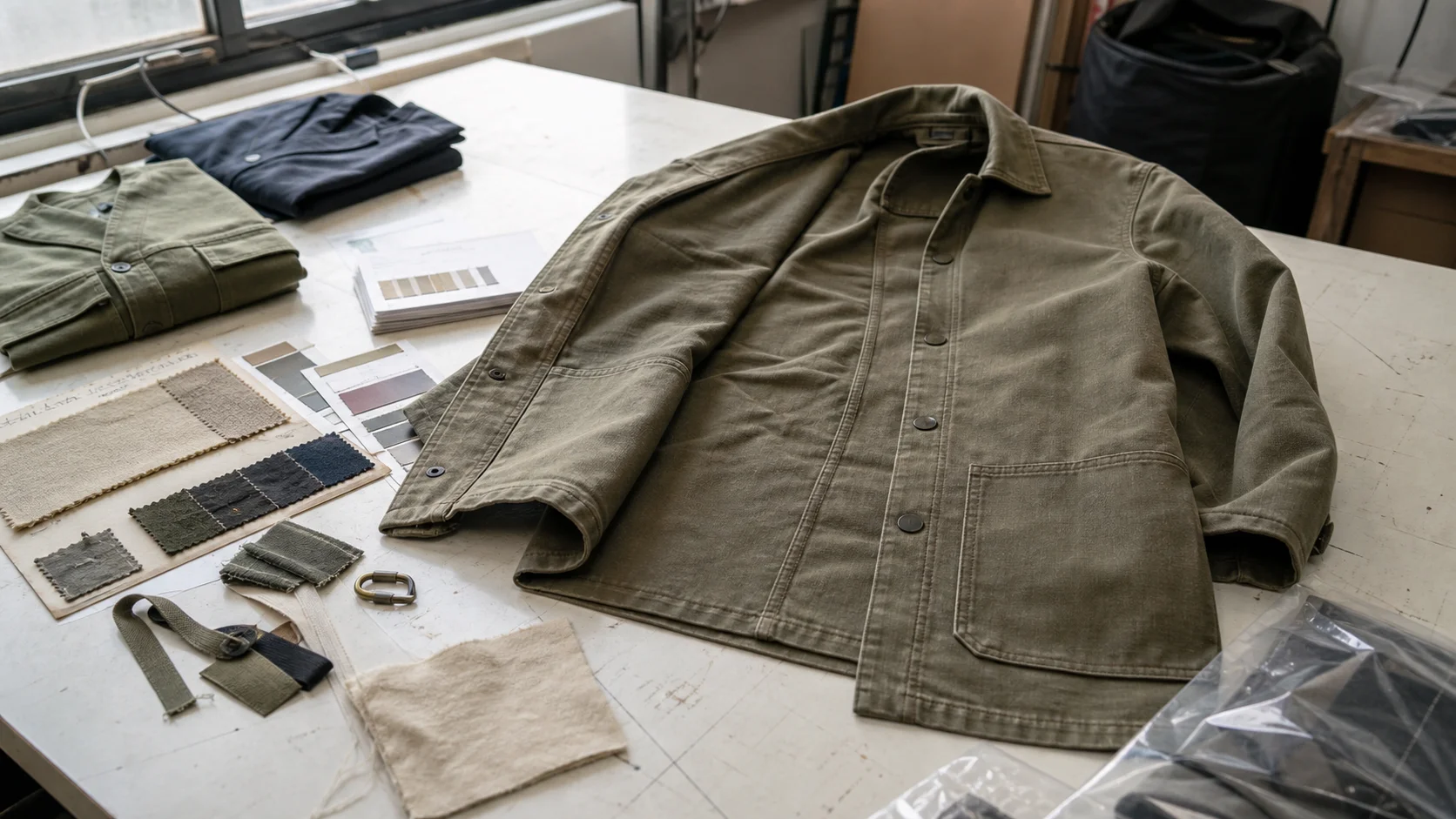
A procurement-focused outline for sourcing hemp utility coats for cleaning crews with a supplier shrinkage control plan covering fabric testing, garment...
Buying hemp utility coats for cleaning crews is not just a fabric choice. It is a control problem. Hemp behaves differently from cotton, polyester, and blends, and the first wash can change the fit enough to affect comfort, appearance, and replacement costs. For a cleaning crew uniform, that matters more than it does for a fashion-only outer layer. The coat has to keep its shape through repeated laundering, survive detergent and heat, and still leave room for movement during long shifts.
A good shrinkage plan starts before the first sample is cut. It defines the target fabric, the finishing route, the acceptable shrinkage window, and the inspection method. It also sets clear expectations with the supplier about testing, wash instructions, and what happens if the bulk lot does not match the approved sample. Buyers who skip those steps usually pay for it later in returns, size complaints, and inconsistent reorders.
This article breaks down what a practical shrinkage control plan should include when sourcing from a hemp utility coat supplier, with a specific focus on cleaning crews and other workwear programs that need repeatable sizing. If you are building a new program, the goal is not to eliminate shrinkage completely. The goal is to make shrinkage predictable, measurable, and acceptable for the end use.
Hemp Utility Coat Shrinkage Plan for Buyers - Sustainable Fashion manufacturing guide
Cleaning crews move, bend, lift, and wash workwear frequently. A coat that shrinks too much becomes tight in the shoulders, short in the sleeves, or narrow through the body after a few laundry cycles. That creates two problems. First, the garment no longer fits as intended. Second, the customer starts to treat the size chart as unreliable, which can undermine the whole program.
For outer workwear, buyers often focus on abrasion resistance and pocket layout. Those matter, yet shrinkage can cancel them out if the coat does not retain its dimensions. A 3% to 5% shrinkage shift in chest width or sleeve length may sound small on paper. In practice, it can be the difference between a coat that layers over a uniform and one that restricts movement.
Cleaning crews also wash garments more often than many other user groups. Frequent laundering exposes the weaknesses in fabric prep, stitching density, seam allowance, and trim choice. A coat that looks stable after one wash may still fail in the field after five or ten industrial cycles. Buyers should think in terms of retained shape across repeated care, not just initial appearance.
For workwear programs, shrinkage is a sizing issue, a comfort issue, and a cost issue at the same time. Treat it as a spec item, not as a post-production complaint.
Hemp fiber has a strong reputation for durability, breathability, and a dry hand feel. It also has a natural tendency to change dimension if the fabric is not properly prepared. The amount of movement depends on several variables: yarn construction, weave density, finishing method, blend ratio, and the wash conditions used by the end customer.
Pure hemp fabrics usually require more careful pre-shrinking and finishing than blends. Hemp-cotton blends may feel more familiar to buyers because cotton processing is widely understood, but the final result still depends on the exact ratio. Hemp-polyester blends can improve dimensional stability, yet they may reduce the fully natural hand buyers want from sustainable workwear. There is no universal answer. The right choice depends on the durability target, image target, and laundering route.
Most buyers should ask for shrinkage test data under the expected care condition. If cleaning crews will launder coats in commercial facilities, the supplier should not test only a gentle home wash. Buyers need results that reflect the real use case. Heat, agitation, dryer settings, and finishing chemistry all change the outcome.
There is no single standard for hemp utility coats, but a practical target for a controlled program is often in the range of 2% to 5% after the first wash, with tighter targets possible when the fabric has been well stabilized. A stricter target may be achievable on blended fabrics or heavily finished cloth. Buyers should be careful with aggressive claims. If a supplier promises near-zero shrinkage without showing test data, that claim deserves scrutiny.
The better approach is to state an acceptable range by measurement point. Sleeve length, body length, chest width, and collar opening may not all move at the same rate. The spec should describe each critical point individually rather than relying on a general statement like "low shrinkage."
A workable shrinkage control plan is a sequence of controls, not a single finishing step. Buyers should expect the supplier to define how the fabric is stabilized, how samples are approved, how bulk is checked, and how final packing instructions are aligned with the care label.
The plan should identify whether the fabric is pre-washed, enzyme treated, compacted, sanforized, calendared, or otherwise stabilized before cutting. Each method affects dimensional behavior in a different way. Pre-washing may improve softness and reduce later surprise, while compacting or similar mechanical methods can improve repeatability. The buyer should ask what method is used and what shrinkage range it is intended to control.
The supplier should work from a garment spec sheet that names the exact measurement points and the tolerance for each one. For a utility coat, these usually include chest, shoulder, sleeve length, back length, hem opening, and cuff width. If pocket placement or placket alignment matters to the end user, those points should be included too. A shrinking coat can distort the visual balance of the garment even when it technically fits.
The plan should define the test standard and laundering condition. That means stating the wash temperature, detergent type if relevant, dry cycle, and number of cycles. A one-wash test may be useful for initial screening, but a two- or three-cycle test gives a more realistic view for workwear. Buyers should align the test with the worst realistic care condition, not the easiest one.
Small sample results do not guarantee bulk performance. A supplier should test fabric lots before cutting and confirm that the bulk markers match the approved sample. If the fabric lot changes, the buyer should be notified. This matters because different dye lots, loom runs, or finishing batches can shift shrinkage behavior.
The shrinkage plan and the care label must match. If the garment is designed for industrial laundering, the label should not suggest a home-care route that underestimates real conditions. A mismatch between label guidance and real use can create avoidable complaints.
The fabric is only one part of the shrinkage picture. Trim and construction can either absorb movement or make it more visible. Buyers should specify the full build, not just the fiber content.
Thread can be an overlooked source of problem shrinkage. If the shell fabric is stable but the thread contracts more aggressively, seams can pucker and measurements can shift. Buyers should ask the supplier what sewing thread is used and whether it has been tested in the same laundering condition as the garment shell.
Construction also matters. A narrow seam allowance gives the factory less room to manage movement. A clean, durable utility coat usually needs enough margin to handle shrinkage without seam failure. Buyers who focus only on visual neatness sometimes approve a build that is too fragile for repeated washing.
MOQ is a practical issue in hemp workwear because fabric development, finishing, and testing all carry setup cost. Buyers should expect MOQs to vary widely by fabric type, color, and customization level. A rough planning range for a custom hemp utility coat may start around 100 to 300 pieces for a basic private-label program, then climb higher when there are custom fabrics, special trims, or multiple size runs. Larger runs are often needed when the supplier must order custom-dyed fabric or source a specific hemp blend.
Sample approval should be structured. One fit sample is not enough when shrinkage is a known risk. A better process is to approve the pre-production sample, then test that sample after laundering, then compare the post-wash measurements against the spec. If the garment is meant for cleaning crews, the buyer should also check ease of movement with layered clothing underneath.
If the program is commercial and ongoing, it helps to ask for a size-run sample as well. Shrinkage can affect small, medium, and extra-large differently because garment proportions change with scale. A single size sample can hide fit issues elsewhere in the run.
Buyers who need sourcing support at this stage can use a structured service model rather than managing everything ad hoc. A supplier overview at /about-us/ can help assess whether the factory has the discipline to handle repeatable workwear programs, while a direct inquiry through /contact-us/ is the right move when you need pricing, lead times, or test support tied to a specific program.
Testing is where many shrinkage plans fail. The issue is not that testing is skipped entirely. The issue is that the wrong test is treated as proof of stability. A garment can pass one brief cycle and still fail after the end user applies the real laundering routine.
Buyers should request a shrinkage test report that shows pre-wash and post-wash measurements, the number of cycles, and the care condition used. If the factory only reports fabric shrinkage but not finished-garment shrinkage, the result is incomplete. Garment construction can amplify or reduce the fabric result.
It is a mistake to treat the first approved sample as a fixed reference without protecting the bulk process. Production change control matters. A new fabric lot, a different subcontracted washing process, or a shift in sewing thread can all change shrinkage behavior. The supplier should commit to informing the buyer before any such change is introduced.
A useful inspection approach is to identify the garment dimensions that are most sensitive to customer complaints. For cleaning crews, sleeve length and body length usually matter most because those measurements affect comfort and practical movement. Chest width matters next, especially if the coat is worn over uniforms or protective layers. Buyers should prioritize inspection resources around those points rather than checking only low-risk areas.
Good production controls start with fabric consistency. The supplier should cut all components from the same stabilized fabric standard and avoid mixing lots unless the buyer has approved that approach. If different lots must be used, the buyer should require lot segregation and final dimensional checks by lot.
Relaxation time is often overlooked. Some hemp fabrics need time to settle after finishing and before cutting. Cutting too early can produce dimension drift after the fabric relaxes further. Buyers should ask the supplier how long the fabric is rested before cutting and whether that process is part of the standard operating procedure.
Pressing and final finishing should not be treated as cosmetic only. Heat and steam can alter dimensions, especially in natural-fiber blends. A factory that presses aggressively to improve appearance may unintentionally pull a coat out of spec. The final press setting should be validated against the approved sample, not chosen on the day of production.
For repeat orders, the buyer should keep a record of approved fabric source, finishing method, sample measurements, and wash test data. That creates a reference point for the next run. Without it, each reorder becomes a fresh negotiation. That is inefficient and risky for any program that serves cleaning crews across multiple sites or contract cycles.
A practical shrinkage plan can be reduced to a short checklist. Use it before signing off on the order.
Item Buyer Requirement Why It Matters Fiber content Exact hemp blend ratio stated Affects shrinkage, hand feel, and wash stability Fabric finishing Pre-shrunk or stabilized with named method Controls dimensional change after washing Measurement spec Critical points listed with tolerances Prevents vague approval standards Wash testing Tested under real use conditions Ensures results match cleaning crew laundering Sample approval Pre-production and post-wash review completed Reduces bulk surprises Bulk control Fabric lot verification and change notice Helps keep reorders consistent Care label Matches the intended washing route Reduces misuse and claimsBuyers should also confirm the lead time drivers. Hemp fabric sourcing, special finishing, sample rounds, and third-party inspection all add time. A simple program may move quickly, but custom dyeing, tighter shrinkage targets, or a new construction method can extend the schedule. A realistic order plan leaves space for sample correction before bulk commitments are made.
There is always a tradeoff between shrinkage control, natural hand feel, and cost. Stronger stabilization can improve dimensional stability, yet it may change the texture of the fabric and push the garment away from the soft, natural look many sustainable buyers want. A heavy finish can also raise unit cost. The correct answer depends on the end user.
For cleaning crews, durability and repeatability usually outrank fashion softness. That means a buyer may accept a slightly firmer hand if it results in better size retention and fewer complaints. The opposite choice can make sense for a retail-facing sustainable lifestyle product, but not for uniforms that must hold up under scheduled laundering.
Another tradeoff is minimum order size. Smaller MOQs are useful for pilot programs, yet they can limit the supplier’s ability to optimize fabric runs and finishing. Larger orders usually create better consistency, but they require more confidence in sizing and color. Buyers should decide early whether this is a pilot order, a staff uniform rollout, or a full program that needs replenishment for months or years.
Quality control is not free either. More testing, more sample rounds, and tighter inspection all increase the front-end cost. That cost is usually justified when the garment will be issued in volume and washed often. It is harder to justify if the coat is a one-off promotional item. The sourcing decision should reflect the actual usage pattern, not an idealized one.
A hemp utility coat for cleaning crews should be purchased like a controlled workwear item, not like a generic casual jacket. If the supplier cannot show a dimensional stability plan, the risk is too high for a repeat program. If the supplier can show test data, controlled finishing, and a disciplined approval process, hemp becomes a credible option for sustainable uniforms.
The strongest programs usually follow a simple rule: approve the garment only after the fabric, construction, and laundering route have all been tested together. That is the cleanest way to avoid surprise shrinkage. It is also the best way to keep reorders predictable, which is what most buyers actually need.
If your team is still comparing vendors, ask each supplier the same three questions: What shrinkage range do you guarantee by measurement point? What wash method was used to verify it? What happens if a bulk lot drifts outside the approved range? The clarity of the answers often tells you more than the brochure does.
Get a free quote from Fabrikn — your trusted B2B clothing manufacturer with 10+ years of experience. MOQ as low as 200 pieces.
Get a Free Quote →For workwear, a practical target is often around 2% to 5% after the first wash, but the acceptable range depends on the blend, finish, and laundering route. Buyers should set targets by measurement point rather than relying on a single overall figure.
Yes. If the coats will be laundered in commercial facilities, the test should match that use as closely as possible. A gentle home-wash test does not provide reliable evidence for a workwear program.
Not automatically. Hemp can perform well, but the result depends on finishing and blend ratio. A stabilized hemp blend may be more consistent than an untreated cotton fabric, while a poorly finished hemp fabric can shrink more than expected.
The most common mistake is approving a sample without washing it first. The second mistake is assuming fabric shrinkage and garment shrinkage are the same thing. They are related, but not identical.
Two rounds are often the minimum for a controlled program: one to confirm fit and one to confirm post-wash measurements. More rounds may be needed if the fabric, trim, or construction changes during development.
That claim should be treated with caution. Natural-fiber garments usually move somewhat after washing. A credible supplier will define a tolerable range, show the test method, and explain the controls used to stay within that range.
For buyers building a sustainable workwear program, the safest path is straightforward: set the shrinkage spec early, test under real laundering conditions, and require the supplier to keep the same fabric and finishing standard through bulk production and reorders. If that discipline is in place, hemp utility coats can be a practical choice for cleaning crews without turning sizing into a recurring problem.