
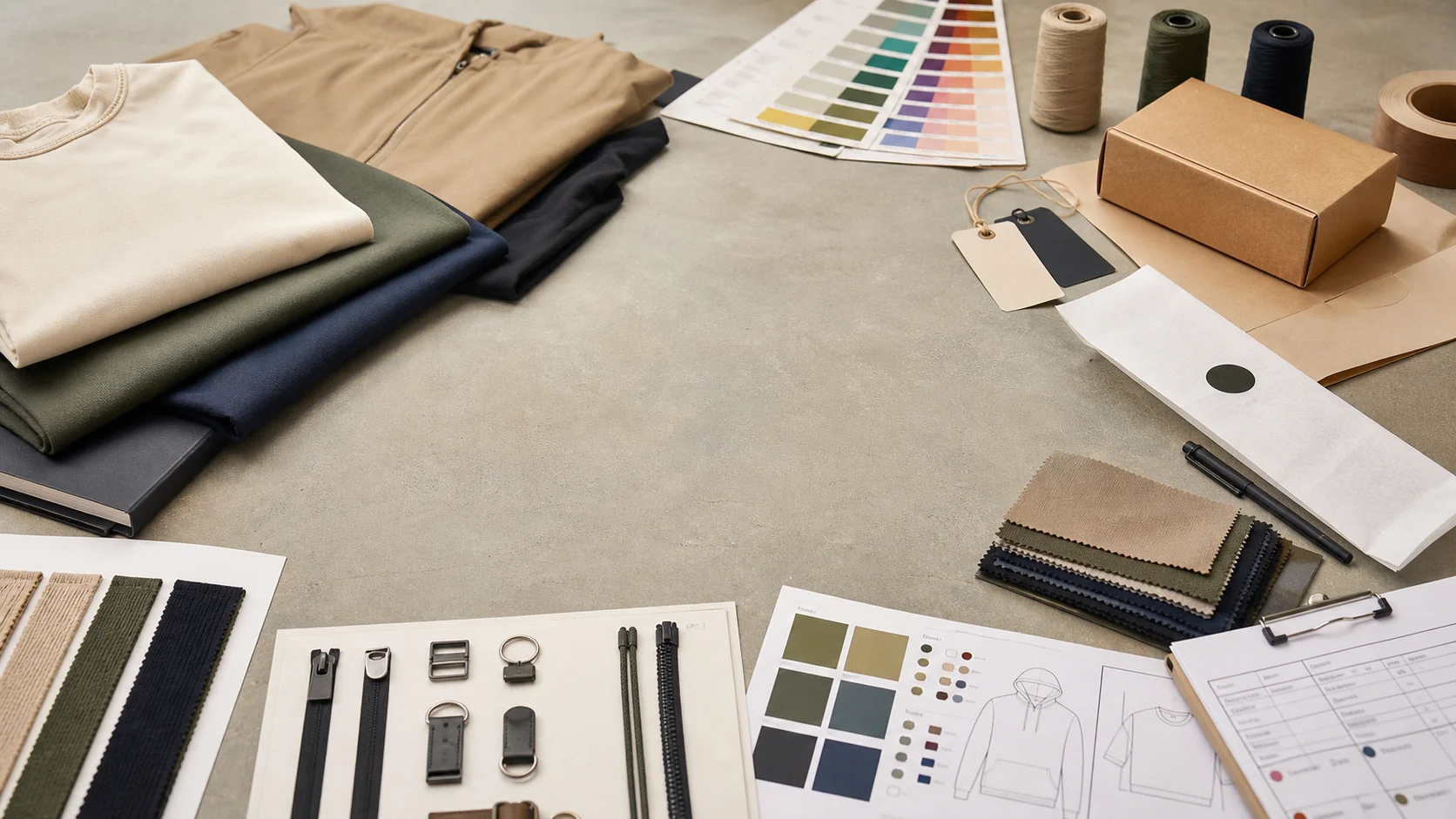
Long Does Clothing Sampling Take compared by sample evidence, fabric or trim specs, MOQ, AQL terms, cost lines, delivery timing, and rework responsibility.
Fast answer: Long Does Clothing Sampling Take: Tech Pack, Sample Gate, MOQ, and QC Terms should be judged by production evidence, not by a generic sourcing promise. The buyer needs sample proof, cost breakdowns, QC checkpoints, and delivery buffers in writing.
Ask for recent sample photos, measurement tolerances, fabric or print test assumptions, decoration test notes, packing examples, and a named inspection checkpoint. These details show whether the team can repeat an approved sample at bulk volume.
Separate garment cost, decoration, labels, packaging, sampling, testing, freight, and rush charges. Clear cost lines make it easier to reduce colorways, adjust size depth, or reserve more time for sampling.
Planning a launch? One question matters fast: how long does clothing sampling take? The honest answer depends on the manufacturer, factory capacity, fabric availability, and how quickly the supplier can move from tech pack to production-ready approval. In Guangzhou, Dhaka, Ho Chi Minh City, or Istanbul, a preliminary sample built from GOTS-certified 150 GSM organic cotton or GRS-certified recycled polyester may cost $2.50-4.00 per unit at a 500 MOQ, yet factories will not start without OEKO-TEX Standard 100, WRAP, and BSCI paperwork aligned with your tech pack callouts. Sometimes it takes a few days. And sometimes it takes several weeks, especially for custom, wholesale, or bulk programs.
A basic T-shirt sample in Dhaka can move from tech pack to courier in 3 days when the fabric mill in Gazipur has delivered the GOTS-certified cotton knit already dyed in Pantone 19-4052, a computerized layer spreader fans it into 12 piles, and a Gerber cutter slices the pieces before 6 Chinese Juki DDL-8700 sewing machines stitch the seams. A tailored blazer in Istanbul—where hand-basting, buttonhole marking on a Durkopp Adler 767, and shoulder pad taping are still done by artisans—can take 8 weeks because the factory waits for custom Italian wool, lining approvals, and multi-round fit camps with two fit models. I have watched both happen, and the gap has little to do with factory size alone. The real answer to how long does clothing sampling take lies inside fabric booking, pattern readiness, fit complexity, quality checks, and how many people are allowed to say yes.
On paper, large factories look faster. Often, they are not. When I visited a 500-worker plant in southern China (Guangzhou), the sample room was sharing cutters, folders, a laser-guided buttonhole machine, and one overbooked technician with bulk production running automatic Nikko spreaders and ultrasonic welders. A 70-person specialist workshop in Porto, by contrast, had a dedicated sample team, a Lectra AccuMark pattern room, and could cut, sew, and revise within 4 to 6 days because the sample room was not tied to the production line and the Italian-brand steam press waited for just that sample batch.
The first sample is rarely the final sample. That's the part buyers underestimate. A brand may ask for one prototype, but the factory is usually building a chain of decisions: pattern confirmation from a 3D CAD session, fit check with a tailor in Istanbul or Ho Chi Minh City, trim approval with a button card that matches the Die-cut poly bag, wash test in a third-party lab in Seoul, and buyer sign-off via a shared Fit Approval Sheet. Each round adds 2 to 7 days, sometimes 2 weeks if the design is new or the buyer has a committee of four approvers scattered across time zones. Even detail changes such as switching from matte to high-sheen zippers require another 48-hour wipe test on the slider.
Speed has a price. Rush fees of 15% to 30% are common, and courier costs can add $40 to $180 per parcel when samples are bouncing between factory, office, and fit model. I have seen brands save $25 on a sample fee and lose $250 in revisions. Air freight, customs inspections, and new trims arriving late from Istanbul or Dhaka can extend real lead time to 18-22 business days, even after the stitching is done. That trade-off shows why the real question isn't just speed; it's how long clothing sampling takes in actual operations, with real fabrics and real people making real decisions.
The WTO trade data shows textile and apparel supply chains are deeply international, which means one missing approval in one country can stall a sample in another. I have seen a knit top held for 9 days because the buyer had not confirmed the rib composition—even though the sewing itself took less than half a day—while the supplier in Ho Chi Minh City waited for WRAP-certified trims from a vendor in Guangzhou.
Most buyers think the clock starts when the first sample is sewn. But it does not. The clock starts with tech pack review, and that alone can take 1 to 3 days if the measurements, stitching details, and artwork callouts are complete. If the pack is messy, the factory spends another 1 to 2 days chasing clarifications before pattern making even begins. I have seen a 12-line hoodie spec turn into a 19-email thread because one cuff measurement was missing by 0.5 cm. In Ho Chi Minh City’s spec room, the AccuMark pattern engineers added another 2 days to finalize notches and seam allowances when the buyer changed from a flatlock to a serger finish.
Pattern making usually takes 2 to 7 days. A simple jersey tee can be blocked in a day if the factory already has a base block and the Lectra table is tuned to the right ease. And a fitted dress, a tailored shirt, or anything with princess seams can take longer, especially if grading between sizes is unclear. The first prototype typically adds 3 to 10 days. Then the fit sample, salesperson sample, or revised prototype can add another 3 to 14 days depending on how many corrections come back from the buyer or if the washing lab demands a second enzyme wash test.
Size set samples, pre-production samples, and final approvals often stretch the process to 1 to 3 weeks more. This is where many brands lose patience, then blame the factory for a timeline that was never realistic. In practice, a clean development cycle often means 2 to 4 rounds, and 5 or more rounds are common in tailored or performance categories. Add an 18-22 business day queue for external wash and shrinkage tests in ISO-accredited labs, and you can see how the pre-production window becomes a month-long effort in Guangzhou or Porto before a final buzzer sounds.
Complex products add time fast. Outerwear needs zipper and lining checks with waterproofing membranes, bonded seams inspected under ultraviolet light, and cavity insulation layers stuffed by hand or robot. Swimwear needs stretch recovery and elasticity verification on a Testronic dynamometer and often a second round of gluing for silicone grip bands. Denim needs wash testing, shrinkage checks, and hardware confirmation. Knits need careful recovery measurement after washing on a 500-cycle laundering machine. A basic tee may be ready in 3 to 7 days, while a tailored jacket can need 3 to 6 weeks. Repeat orders move faster because blocks, fit history, and size specs already exist. And for brands using private label clothing services, that shortens the development path by several days or even a full week due to pre-approved trims and materials.
Data from ISO standards and factory quality systems shows why stages matter: every handoff creates a new chance for error. Sampling isn’t one task. It is a sequence where the tech pack, material approval, pattern making, prototype sewing, and fit evaluation follow like a relay.
Fabric delays beat sewing delays almost every time. In Asia, especially China, Vietnam, and Bangladesh, the stitching side can move quickly, sometimes in 24 to 72 hours for a simple sample on a Juki 9000 series or Yamato overlock. But if the mill has not reserved the right fabric—say, an OEKO-TEX Standard 100 certified 230 GSM fleece from Guangzhou or a GOTS-certified sateen from Dhaka—the garment waits. In Europe, I often see the opposite: communication is cleaner and sample comments come back faster, yet raw material lead times can stretch because mills are booked 2 to 6 weeks ahead with limited yarn-dyeing capacity.
The thing nobody tells you: a factory with 500 workers may move slower on samples than a 70-person specialist studio because the bigger plant's sample room shares cutters with bulk orders and every machine is pulled into production. The smaller shop can breathe on one style at a time, and that focus often shaves days off the calendar.
A strong brief makes the supplier's job narrower and the quote more reliable. For how long does clothing sampling take? real factory timelines, include the target customer, sales channel, expected order quantity, size range, decoration needs, packaging requirements, and delivery market. Then call out the details most likely to affect the result, especially calendar buffer, sample owner, and revision limit.
The brief should also explain what cannot change. Some brands care most about hand feel, some about price, some about launch timing, and some about retail compliance. When those priorities are not written down, suppliers tend to optimize for whatever is easiest to quote. Clear priorities help the factory make better tradeoffs before the first sample is cut or printed.
Ask the supplier to respond with assumptions, not just a price. A useful reply states MOQ, sample route, production capacity, inspection plan, packing method, and freight handoff. If the answer is vague, the project may still work, but it needs a tighter pre-production stage before money and calendar pressure build up.
The best time to catch problems is before the pre-production sample is approved. Check measurements, color, placement, material behavior, shrinkage, construction, labels, and packaging in the same review instead of approving each item in isolation. Many bulk issues are not caused by one dramatic mistake; they come from several small unchecked assumptions.
For how long does clothing sampling take? real factory timelines, pay special attention to sign-off date, launch channel, and freight handoff. These details often look minor in an email but become expensive once cutting, printing, sewing, packing, or shipping begins. A simple checklist with owner, due date, and approval status keeps the brand team and factory aligned.
Bulk production should not start until the supplier can explain how the approved sample becomes a repeatable production standard. That means reference sample storage, line instructions, inline checks, final inspection, and defect handling. A factory that can describe this process clearly is usually safer than one that only promises speed.
Price differences are useful only when the quotes cover the same work. Compare sample cost, material source, trims, decoration, packaging, testing, inspection, and freight assumptions. A low unit price can become expensive if it excludes items the brand needs before launch.
Timeline promises deserve the same scrutiny. Ask what happens if the first sample needs revision, whether materials are in stock, when the production slot is reserved, and how export packing is handled. The most reliable supplier is often the one that gives a realistic calendar instead of the fastest optimistic answer.
Before making the final decision, write down the specification, approval owner, delivery expectation, and the one or two risks that would cause the most trouble if missed. For how long does clothing sampling take? real factory timelines, this usually means checking calendar buffer, sample owner, revision limit, and the support process after the order is placed.
This last review does not need to be complicated. It simply makes the decision easier to repeat, easier to explain, and easier to verify when the finished product or jewelry arrives.
One useful way to pressure-test the decision is to ask what would happen if the order had to be repeated in six months. The answer should still be clear: the same calendar buffer, the same sample owner, the same acceptance standard, and the same communication path. If a second order would depend on memory or guesswork, the first order is not documented well enough yet.
Another useful check is to separate preference from requirement. Preference is the look, wording, or finish the brand likes. Requirement is the measurement, tolerance, certificate, material, or delivery condition that cannot fail. Good buying decisions keep both visible, so the final choice is not pushed around by the last email, the cheapest quote, or the prettiest sample photo.
Finally, ask who owns each approval. A project with one accountable owner for sample review, one owner for final content or artwork, and one owner for delivery sign-off usually moves faster than a project where every decision is shared loosely across a team. Clear ownership reduces delays and makes the finished result easier to judge.