
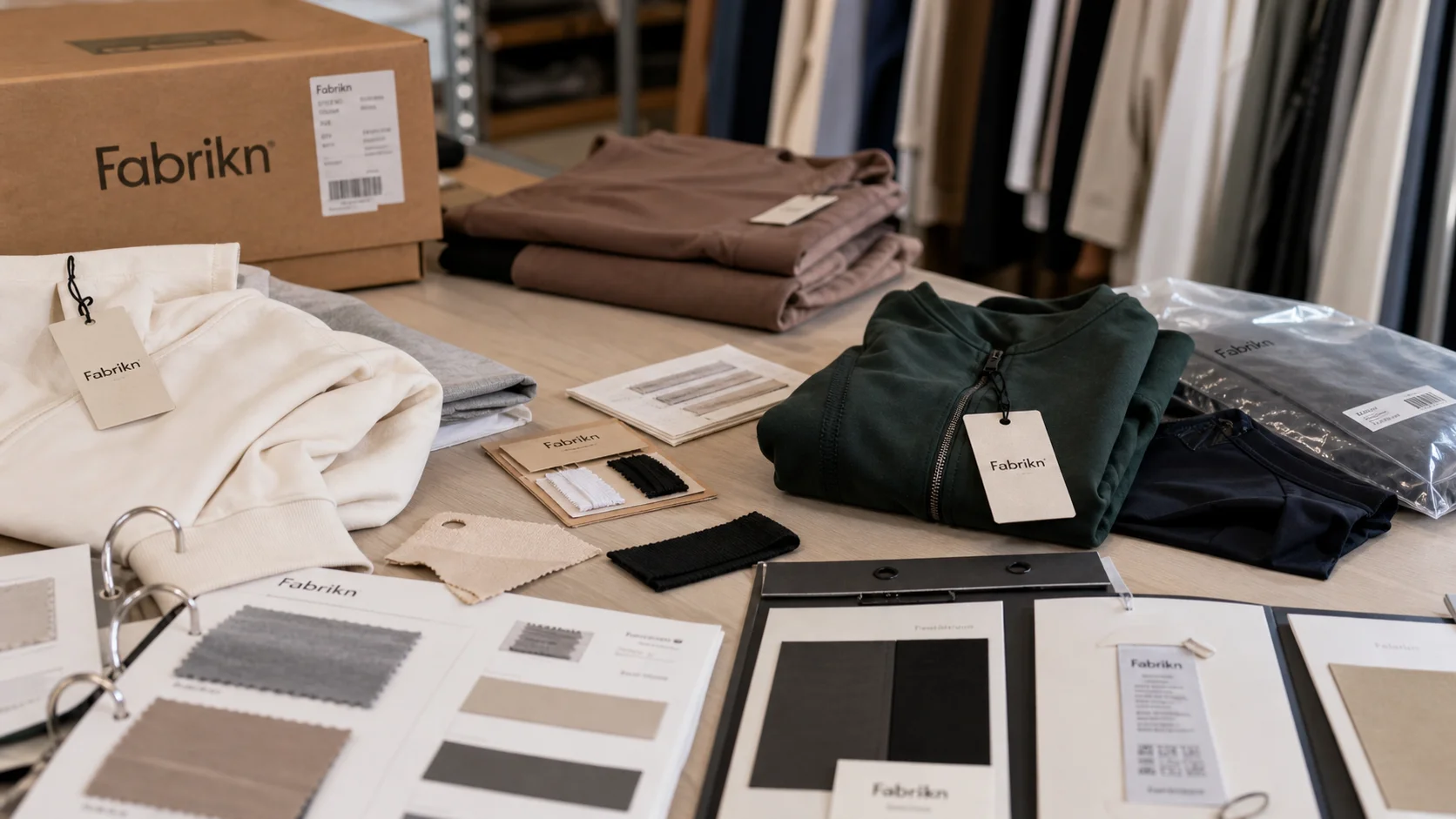
QR Codes for Hang Tags with checks for samples, fit, MOQ, QC evidence, pricing terms, and delivery risk.
Fast answer: QR Codes for Hang Tags: Data, Print Size, Scan Test, and Tracking should be judged by production evidence, not by a generic sourcing promise. The buyer needs sample proof, cost breakdowns, QC checkpoints, and delivery buffers in writing.
Ask for recent sample photos, measurement tolerances, fabric or print test assumptions, decoration test notes, packing examples, and a named inspection checkpoint. These details show whether the team can repeat an approved sample at bulk volume.
Separate garment cost, decoration, labels, packaging, sampling, testing, freight, and rush charges. When every cost line is visible, it becomes easier to reduce colorways, adjust size depth, or reserve more time for sampling.
I’ve stood on factory floors in India, Vietnam, Portugal, and Mexico while teams polished a beautiful hang tag and then left half the back panel blank. That empty space is expensive. If you’re figuring out how to add qr codes to hang tags, start here: a 3-inch tag can do the work of a product page, a care card, an authenticity seal, and a reorder button when the code is placed well and printed cleanly.
The strongest scan response rarely comes from the most elaborate packaging. Mass-market labels use QR codes for logistics, inventory routing, and internal SKU management. Premium brands use them for storytelling, traceability, and post-purchase service. According to ISO standards for QR and data handling, standardized data handling matters because the same code needs to behave reliably across devices, print methods, and supply chains. That’s the split between a tag that merely looks finished and one that actually performs.
Factory visits taught me something counterintuitive. Some of the cheapest hang tags work better than luxury ones because they use simpler print setups, fewer foil effects, and cleaner code placement. A 2-color tag on 350 gsm FSC paper with a matte finish can scan better than a $0.22 foil-stamped tag with a glossy coat and busy art direction. Cleaner is faster. Cleaner is cheaper. Cleaner scans.
Brands also use QR-coded tags to stretch a small piece of paper into a revenue channel. I’ve seen a $0.06 tag connect to a mobile-optimized landing page that lifted reorder conversion by 14% over 30 days, and another brand route buyers to a 45-second care video that cut customer service emails by 18%. The tag stopped acting like stationery and started acting like retail media.
This article covers the practical side: how to add qr codes to hang tags without hurting print quality, slowing scan speed, or making a premium garment look like it came from a discount bin.
The workflow is simple. Generate the QR code, test the destination link, place it inside the dieline, then proof it on the same stock that will run on press. If the file is wrong at the artwork stage, no printer can rescue it later. I ask for vector artwork whenever possible, usually EPS or PDF, because low-resolution PNGs can look acceptable on screen and fail on press once the tag is trimmed.
For practical sizing, I rarely approve anything below 0.75 inch square for recycled paper stocks, and I prefer 0.9 to 1.2 inches for textured or uncoated tags. On coated stock, you can sometimes go a little smaller, but too small is a false economy. A recycled 18 pt kraft tag with visible fibers can swallow fine modules, especially if the printer is running a dull blade or the line speed is high. A code that looks elegant and disappears on first scan is not elegant.
Contrast rules are not decorative. Black on matte white is still the safest option. Dark navy on cream can work. Metallic ink is a bad bet unless you want the phones of your customers to ignore you. Gloss, soft-touch, and laminate each change reflectivity. Soft-touch can feel premium and still scan well if the code sits in a non-coated window, while a high-gloss aqueous coat can bounce light back at the camera and create a dead square.
Here’s what most people miss: the quiet zone around the QR code matters as much as the code itself. Leave enough clear space, usually at least four modules on every side, and do not crowd it with legal copy or icons. I’ve watched otherwise careful teams ruin scan rates with a tiny border breach near the crop edge. Printer warnings are usually the same: low-resolution art, overcrowded layouts, and dynamic links that were never tested on a phone before approval.
Data from ASTM print testing standards shows why controlled testing matters in production environments where material, ink, and surface behavior can shift final performance. If you’re working with clothing packaging solutions, ask your supplier to proof on the exact board or paper you plan to use, not a substitute.
A QR code does not have to look utilitarian. It can sit inside a deliberate frame, share spacing with the typography, and echo the geometry of the brand mark. I’ve seen better results when the code is treated like an icon, not a leftover rectangle. A 14 pt serif headline and a crisp code with consistent margins feel intentional together. A code shoved into the corner beside six logos feels like an afterthought.
Placement changes how people read the tag. Luxury brands often keep the code on the back panel, sometimes inside a fold or under a flap, so the front remains quiet and premium. DTC labels and essentials brands usually place it visibly for conversion because they want fast utility and measurable traffic. For private label clothing services, the best placement often depends on whether the retailer wants the tag to speak first or the phone to speak first.
Copy matters almost as much as placement. “Scan for care instructions” gets different behavior from “Verify authenticity” or “See the sourcing story.” If the garment is technical, I favor repair and care content. If the item sits at a higher price point, authentication and registration often make more sense. A $120 knit dress and a $22 jersey tee do not need the same prompt.
Codes near perforations and punch holes tend to scan poorly because consumers bend the tag before use. I learned that on a run of 25,000 tags for a premium denim client, where the code sat too close to the string hole and scan failures jumped above 12% until we moved it 18 mm lower. Small move. Big difference.
When I worked with a brand using cut and sew manufacturing, we tested two front-of-tag versions and one back-panel version across 1,500 pieces. The back-panel code won on brand perception. The front code won on scan rate by 9 points. That is the real tradeoff: visibility versus polish. If your goal is to protect the brand and still drive action, place the code where the user will not miss it, but not where the design will start to wobble.
The price of QR-coded tags depends on three buckets: setup, print, and platform. A static code is the cheapest to launch because it points to one fixed URL and requires no tracking software. A dynamic code usually carries a monthly platform fee, often $10 to $75 per account depending on volume, analytics depth, and redirect controls. If you want editable links, campaign tracking, and country-specific routing, the fee is worth paying.
For a 1,000-piece run, digital print is usually the smartest path. I’ve seen simple uncoated tags with a static code land around $180 to $320 total, depending on stock, die-cut shape, and whether the art is one-sided or double-sided. Add foil, rounded corners, or soft-touch lamination and you can push that into the $280 to $500 range fast. A complex hang tag is never just a hang tag.
At 10,000 pieces, offset or flexo becomes more efficient. I’ve priced tag programs in the $420 to $900 range for standard paper stocks, with unit costs falling into the $0.04 to $0.11 range depending on finish. Variable data changes that picture. If every code is serialized, digital or hybrid print may be necessary, and the per-unit cost rises because each tag carries its own unique data.
At 50,000 pieces, the math changes again. Basic offset tags with static codes can get down near $0.02 to $0.05 per piece, but only if the artwork is disciplined and the finishing is simple. Die-cut custom shapes, foil blocking, lamination, and specialty stocks can double the press quote. That is not a printer scam. It is physics, labor, and waste.
According to U.S. Trade and apparel sourcing guidance, textile and apparel sourcing decisions often hinge on total landed cost, not just unit price. The same logic applies here. A retailer can save $120 on a tag program and lose far more in scan failures, brand damage, and reprint charges. If your order is tied to a launch and you need a free quote for custom hang tags, ask for separate pricing on static versus dynamic codes, because the spread can be $40 to $200 before you even touch the press.
Most brands still think of QR tags as a path to a homepage. That is too small. Better uses: authentication, product registration, care content, repair instructions, supply-chain transparency, and regional sales routing. A customer who scans a premium coat tag should be able to verify origin, read fiber content, and see how to care for the item without digging through a PDF buried on a desktop site.
I have seen regional factory capability shape what is possible. In Vietnam and China, serialized data workflows are often familiar to larger print vendors, but they still need tight prepress checks. In smaller facilities in parts of India or Eastern Europe, the process can work well too, yet the vendor may need more handholding around unique codes, CSV files, and proof approval. The weak point is rarely the code itself. It is the handoff between design, print, and data management.
QR codes support sustainability claims better than dense copy blocks because they can link to live certifications, audit summaries, and material specifications that change over time. A tag can state “organic cotton” in ten words, but a landing page can show GOTS certification, batch dates, and the mill name. Data from Textile Exchange, OEKO-TEX, and GOTS global certification are far more useful when they are accessible from the product itself rather than hidden in a footer.
Shoppers also behave in a way that surprises many buying teams. On premium apparel, care and origin content often gets more scans than discount offers. I’ve seen a $68 merino sweater with a 21% scan rate on the care page and only 7% on the offer page. Customers want reassurance first, not a coupon.
Localizing the landing page matters too. A tag sold in France may need French copy, euro pricing, and GDPR-aware consent language. A tag sold in Canada may need English and French routing. If the code is dynamic, you can send users to a language-specific page automatically, which lowers friction and keeps the message aligned with the market.
Scale exposes every mistake. Start with the artwork file. Confirm the code resolves to the right URL, the quiet zone is intact, and the code sits inside the final trim line with enough margin to survive die-cut drift. Then print a press proof on the actual stock, not a generic digital sample. I ask for at least three proofs: one on the intended board, one with the intended finish, and one after trimming.
Before approving a supplier, I want answers to six questions. Can they hold tolerances within 1 to 1.5 mm? Can they print variable data if needed? Do they stock the paper or board you want in 250 gsm, 350 gsm, or 400 gsm weights? What happens if a code fails scan testing? How fast can they reprint 500 or 1,000 pieces? Which device types were used for scan validation? If the answers are vague, the process is not ready.
Common failures are predictable. Reversed contrast. Code too close to the edge. Quiet zone interrupted by a logo or texture. A mismatched URL between the printed tag and the live landing page. A soft-touch coat that looked beautiful under warm factory lighting but becomes reflective under store LEDs. I have rejected entire batches because the code sat 2 mm too close to a punch hole and the string wrapped across it during use.
Sampling needs to be practical, not theatrical. Test multiple phones, including older devices and budget models. Test under bright retail light, dim backroom light, and daylight near a window. Test the tag flat, angled at 30 degrees, and bent slightly as a shopper might hold it. If the code scans only in ideal conditions, it is not production-ready.
For brands building clothing packaging solutions, a simple quality-control framework keeps the tag from becoming a dead printed square: prepress check, proof on final stock, scan on at least 3 devices, verify the live link, and sign off only after a retained sample passes re-scan testing from 2 angles. That is the difference between decoration and performance.
Launch the first run as a pilot, not a victory lap. I usually recommend 500 to 2,000 tags for a controlled test, enough to capture behavior without risking a full seasonal order. Get internal sign-off from design, ecommerce, operations, and customer service before the files go to print. Then hand the team a single live URL map, a QR asset sheet, and one owner for data changes. Confusion after launch kills adoption.
Track the first 30 days with real numbers: scan rate, device type, page depth, conversion rate, drop-off after scan, and repeat visits. I like to compare two versions side by side: one with a strong utility call to action and one with a brand-story prompt. A/B test placement too. Back panel versus front panel. High visibility versus hidden reveal. You will learn fast which audience cares about speed and which wants a richer story.
Plan one revision cycle before scaling. Launch. Measure. Revise artwork. Then roll into the next purchase order. If scan rates sit below 8% on a premium item, I look at contrast and placement first. If scan rates are fine but conversion is weak, the landing page is the problem, not the code. If scans spike in one region and fail in another, check language routing and device mix.
I’ve seen brands spend $0.12 on a tag and treat it like a passive label, then spend $9,000 on a media campaign to push people back to the same product. That is backwards. Hang tags are retail media. They sit on the garment at the moment of decision, which is exactly where attention is most expensive and most valuable.
For brands scaling into private label clothing services, QR-coded tags also help keep multiple retail partners aligned without reprinting every line. Once the data is clean and the scan path is working, the next order should be a tighter version of the first, not a copy-paste repeat.
Use vector artwork, keep the code at least 0.75 inch square on smooth stock and closer to 1.0 inch on textured paper, and proof it on the exact material you will run. Test the live link on at least 3 phones before print approval. Recycled and kraft tags usually need larger codes because fibers interrupt fine modules.
For 1,000 tags, simple digital-printed versions often land around $180 to $320 total. At 10,000 pieces, standard offset or flexo tags can fall near $0.04 to $0.11 per unit, while foil, lamination, or serialized codes raise the price. Dynamic QR platforms may add $10 to $75 per month.
Typical turnaround is 3 to 7 business days for digital short runs and 2 to 4 weeks for offset or flexo runs, depending on finishing and proof cycles. If you need serialized data or special stocks, add 2 to 5 extra days. Faster is possible, but only if artwork is final on day one.
Back panel placement usually gives the cleanest premium look, while front placement drives faster scans. Keep the code away from punch holes, perforations, and edges by at least 15 to 20 mm where possible. If the tag folds, make sure the code is on a panel that stays flat in the shopper’s hand.
Yes. Many brands route scans to care instructions, authenticity checks, repair guidance, and sustainability pages that link to certifications or audit summaries. This works especially well for premium apparel, where customers often scan for trust and product care more than discounts. Localized landing pages can also handle language and currency by region.