
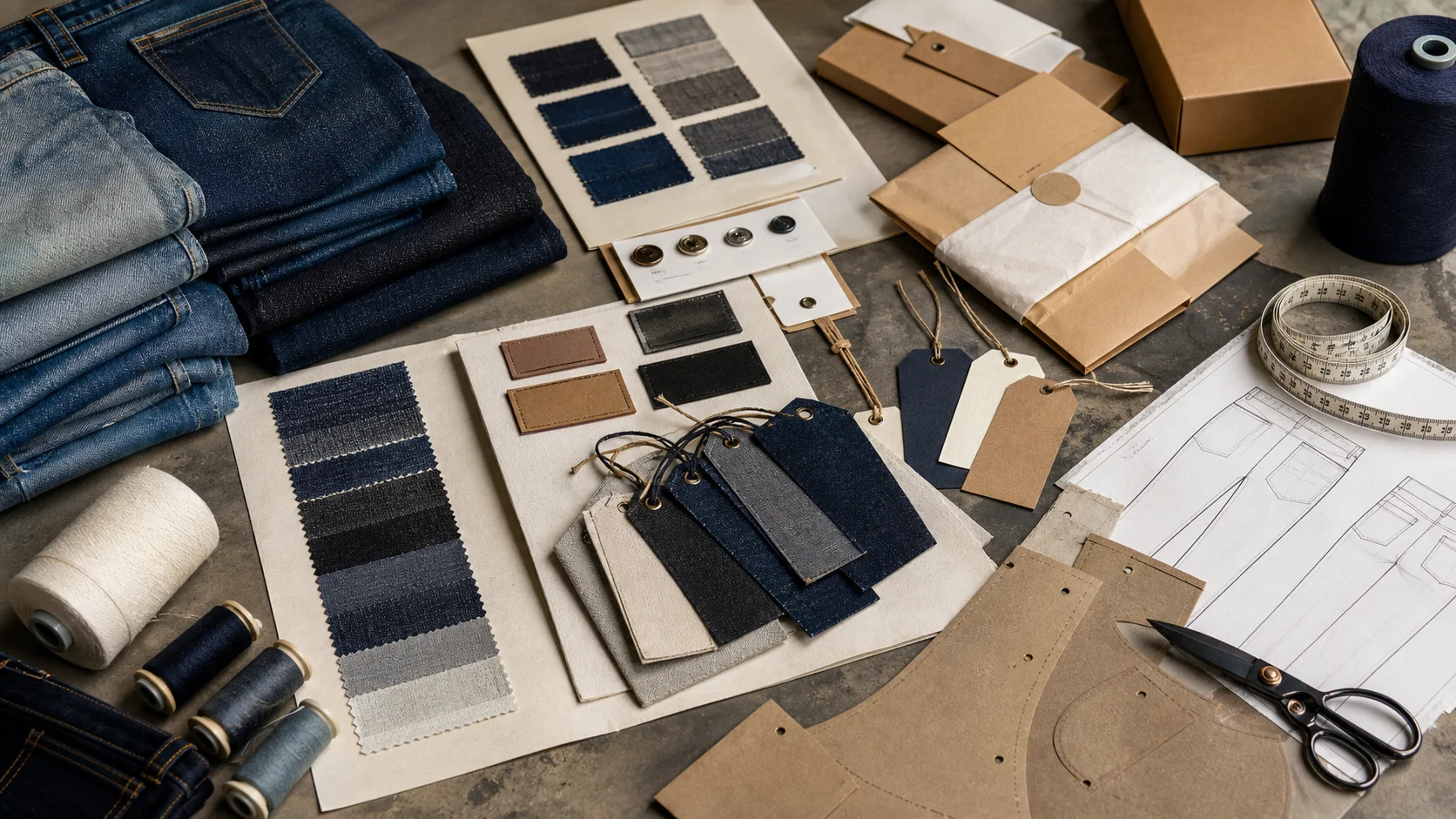
Add QR Codes to Clothing Hang Tags compared by sample evidence, fabric or trim specs, MOQ, AQL terms, cost lines, delivery timing, and rework responsibility.
Fast answer: Add QR Codes to Clothing Hang Tags: Material, Print, MOQ, and QC Terms should be judged by production evidence, not by a generic sourcing promise. The buyer needs sample proof, cost breakdowns, QC checkpoints, and delivery buffers in writing.
Ask for recent sample photos, measurement tolerances, fabric or print test assumptions, decoration test notes, packing examples, and a named inspection checkpoint. These details show whether the team can repeat an approved sample at bulk volume.
Separate garment cost, decoration, labels, packaging, sampling, testing, freight, and rush charges. Clear cost lines make it easier to reduce colorways, adjust size depth, or reserve more time for sampling.
A hang tag can be tiny, but the decision behind it is not. When figuring out how to add QR codes to clothing hang tags, brands need to think about what happens after the scan, not just how the tag looks. On factory visits in Vietnam and Portugal, I saw one brand use a QR code to cut fit-related returns, while another used it to prove origin, care, and resale value. Same tool. Different wins.
The shift is not about decoration. Brands want post-purchase engagement they can actually measure. According to ISO standards for QR code readability, scan performance depends on print quality, which is exactly why hang tags have become a serious channel rather than a gimmick. For broader sustainability context, see Textile Exchange and OEKO-TEX.
In stores, shoppers do not scan because a tag exists. They scan when the value is immediate. I watched a mid-market denim brand test 1,000 units across two cities, and the scan rate doubled from 6.4% to 12.8% when the landing page opened in under 2 seconds and offered size guidance before marketing copy. Utility beats vanity.
Retail conditions are harsher than most teams expect. Under 3,000 lux store lighting, glossy tags reflected enough glare to cut successful scans by almost a third in one test run. Matte stock, a 6 mm quiet zone, and a 20-25 mm code improved performance fast. The difference showed up in the numbers, not the mood board.
Here is the part people miss: the cheapest hang tags often become the most expensive once misprints, low scan rates, and reorders are counted. I have seen a $0.04 tag trigger a $1,500 reprint because the URL was wrong on 18,000 pieces. Paper is cheap. Errors are not.
Premium labels use QR codes to tell a better story. They link to factory provenance, artisanal finishing, traceability, and authenticity checks. In Italy and Japan, I saw luxury teams pair QR tags with serialized product pages because high-priced buyers expect proof, not poetry. A $350 knit can justify a scan if it answers where, how, and by whom.
Mass-market labels use QR codes as a service layer. Care instructions, returns, warranty registration, and size exchange flows carry more value at scale than a glossy brand film. A basics label selling 50,000 units cannot afford 5,000 avoidable customer-service emails about wash temperature or shrinkage. That is where a QR tag earns its keep.
If the tag connects to custom clothing packaging solutions, it should support the whole purchase journey, not sit there like decoration. I have visited enough factories to know that the brands getting this right treat the tag as a tool with a job, a URL, and a measurable result. A good manufacturer or supplier will also review the production steps and quality checkpoints before print approval.
The design fails when teams treat the code like an afterthought. If you are learning how to add QR codes to clothing hang tags, the workflow should start before artwork, before typography, before embossing samples arrive. I define the destination URL, the campaign goal, and the analytics plan first, because a QR code without a purpose is just a square box stealing premium paper.
One code should do one job. If the brand needs product registration, use a registration page. If the brand needs care guidance, send shoppers to a mobile page with three or four direct actions, not a homepage full of distractions. Dynamic QR codes are useful when links may change, tracking matters, or regions need different landing pages. Static codes are fine when the destination will stay fixed for 12 months or longer.
Short URLs help the code stay cleaner. So does a simple page structure. I worked with a label producing 8,000 woven tops a month, and the team cut scan errors by 19% after replacing a long tracking string with a shorter dynamic redirect. The art team lost nothing. The shoppers gained speed. That kind of change matters whether you are working with a factory in China or a local supplier with a tighter MOQ.
Placement matters more than most designers admit. Keep the code away from folds, die-cut corners, and punch holes. A code printed 4 mm from an edge may look tidy on screen and fail on press because trimming tolerance moves the safe zone by another 1-2 mm. That is how good artwork gets ruined.
Contrast should be blunt, not clever. Black on white works because phones read it quickly. Dark navy on warm gray can work too, but only if the contrast ratio stays high and the finish is matte. I have seen glossy hang tags scan poorly under fluorescent retail lighting, while a soft-touch matte stock handled the same artwork with fewer failed reads.
Keep the layout disciplined. If the tag carries a product name, size, price, fiber content, sustainability copy, and one QR code, it is already busy. Add a second QR code and the result becomes visual noise. One code. One destination. No ornament for its own sake.
Multiple codes on one tag split attention and depress scan rates. I have watched teams argue for separate codes for care, authenticity, social media, and promotions, then wonder why none of them performs well. A single code can branch after the landing page loads, which is cleaner for design and better for data.
For brands building private label ranges, the QR destination should fit the business model. A private label tee may need product registration and reorder prompts, while a premium capsule can link to fit notes and origin data. That is the logic I have seen inside private label clothing services projects where every square millimeter has to justify itself. The same approach helps a custom wholesale program stay on schedule and protect quality.
One more practical rule. Do not crowd the scan area with tiny icons, social handles, or claims. If the code is 22 mm wide, leave breathing room around it. Brands that resist clutter tend to get cleaner scans and fewer production headaches.
File prep is where good intentions survive or die. I have seen polished mockups fail on press because someone exported the QR code as a low-resolution image and compressed it twice. Export as vector when possible. Keep the quiet space intact. Proof at actual size, not the size that looks elegant in a deck.
Vector files keep edges sharp, which matters because QR modules depend on crisp boundaries. Raster files can work if they are high resolution, usually 300 dpi or higher at final size, but they are less forgiving when resized. Shrink a raster file too far and the module edges soften. The phone does not care about your mood board. It cares about contrast and geometry.
Before approval, I ask for a swatch run and a scan test under at least two lighting conditions. Daylight near a window. Store light or a fluorescent bay. Then I test at 15 cm, 25 cm, and 40 cm. A code that only scans at 12 cm is not a retail code. It is a design accident.
Digital printing is ideal for short runs, samples, and variable-data jobs where each tag may carry a different link or serial number. Offset printing tends to win on larger fixed runs because the cost per tag falls once the plates are set. In one batch I reviewed, 2,000 digital tags cost more per unit than 20,000 offset tags, but the digital run still made sense because the URLs needed flexibility.
Special finishes can undermine reliability. Foil on top of the code, heavy varnish, or embossed elements crossing the modules will hurt readability fast. Keep metallics away from the code field. If foil is part of the brand system, place it on the outer frame and leave the data zone plain.
Regional factory capabilities vary. Some plants in China and Turkey handle variable data in-house with decent speed, while others need separate prepress steps and stricter QC handoffs. That is why I always ask who generates the code, who checks it, and who signs off before the files hit press. The wrong assumption adds 3 to 5 days very quickly.
For cut-and-sew programs, especially when the hang tag sits beside stitched trims and size labels, I coordinate with cut and sew manufacturing teams early. A clean QR tag is only clean if the whole production chain respects it.
One more note on file prep. If the code is dynamic, store the destination in a spreadsheet or database with version control. A broken redirect after launch is harder to fix than a typo in the design stage. I have seen one switched link create 400 broken scans in 2 days.
Pricing changes fast with volume. A small run of 500 tags may cost $0.10-0.28 each for simple stock and a single static code, while 10,000 tags can fall closer to $0.03-0.08 depending on paper, finish, and print method. I have seen brands celebrate the low quote, then pay twice when they need a reprint.
Short runs carry setup costs more heavily. Digital printing can be efficient for 500-2,000 pieces because the press setup is lighter and variable data is easier to manage. Offset becomes smarter at larger volumes, especially 20,000 pieces and up, when the artwork stays fixed. If the QR destination may change every season, build that into the quote from day one.
Luxury labels usually absorb a higher unit cost more easily. A $120 outerwear style can hide a $0.06 tag increase. A $14 basic cannot. I have watched a budget brand lose margin on 200,000 units because no one tracked that extra few cents across the season.
A standard hang tag might take 7-10 working days after artwork approval. QR-enabled tags can still move in that window if the code is static and the art is clean. Add dynamic links, sample approval, or database checks, and the timeline often stretches by 3-7 additional days. If the team wants multilingual landing pages, add another 2-4 days for review.
For babywear, the stakes are even tighter because care, safety, and compliance details need careful handling. I have seen brands shorten returns by pairing QR tags with size and fabric guidance, a tactic that fits neatly inside custom baby clothing manufacturing programs where trust matters from the first wear.
The hidden costs are what blow budgets. Artwork revisions. Code regeneration. Press proofs. Replacement inventory after a URL changes. A broken-link audit may sound small, but once customer service starts fielding complaints, the labor cost grows faster than the print cost ever did.
According to World Trade Organization trade guidance, global trade remains sensitive to small friction points, and apparel buyers feel that friction in lead times and coordination. That is exactly why I never recommend choosing the cheapest quote without asking about testing, setup, and reprint policy.
Cheap is rarely cheap. The winning quote is the one that includes scan verification, clear ownership, and a plan for replacement stock if the code or link changes after approval.
Regional production changes the equation fast. Domestic suppliers usually move faster on revisions, but their unit costs can be higher. Offshore factory production may offer lower tag prices and broader print capacity, yet it often needs longer lead times for corrections, especially when variable data or region-specific landing pages are involved. I have seen a 2-day design revision become a 12-day delay simply because the proof cycle crossed time zones.
Nearshore partners can be a sweet spot for brands shipping to North America or Europe. They often cut coordination risk without the premium of fully domestic production. Offshore production can still be the right choice for runs of 25,000 units or more, if the files are locked early and the proofing checklist is strict. The manufacturer is not the problem. The handoff is.
Some suppliers handle the digital side beautifully but need tighter visual QC. Others print cleanly yet struggle with database integration. I have visited plants that could produce perfect tags with a 99% scan success rate and still attach the wrong landing page because no one owned the link table. That failure is invisible until the customer scans it.
Premium labels may use QR codes for authenticity checks, artisan stories, aftercare, or resale registration. Basics need direct service: wash temperature, fit advice, reorder pages, and returns. The same square code can do both jobs, but the destination should match the product tier and the buyer’s patience.
Multilingual markets raise another issue. A UK, German, and French shopper do not need the same landing page. Region-specific pages usually improve scan-to-conversion rates because they reduce friction. If a shopper lands on a page in the wrong language, bounce rates rise fast, sometimes above 50% in my test samples.
The right partner matters as much as the right print method. For brands building larger assortments, I often map the tag system alongside wholesale custom clothing packaging solutions so the QR tag, carton, and insert work together instead of fighting for attention. That is especially useful in bulk programs where production schedules and quality expectations must stay aligned.
Ask for the same QR sample in two regions before full production. A code that works in one market may fail elsewhere if the landing page blocks certain browsers, loads slowly on mobile data, or redirects through a chain that is too long.
Quality control is where the budget is protected. I have watched brands skip it because the code looked fine on screen, then spend four times more correcting a 1,000-unit mistake. A QR tag should be tested like a label claim, not admired like a mockup. The scanner does not forgive optimism.
Test at three stages: artwork, press proof, and finished tag. Then test again at packing, because abrasion, gloss, and trimming can change the result. I use different phone models, including older devices, because not every shopper carries the newest handset. Scan at 15 cm, 25 cm, and 40 cm. Record speed, landing-page load time, and broken-link errors.
Common failures are boring and expensive. Low contrast. Reflective coating. URLs that wrap badly. Tracking links that exceed reasonable length. Tags that crease near the hole. The fix is usually simple, but only if someone notices before cartons are sealed.
I ask for a sign-off chain with named owners from design, sourcing, packaging, and e-commerce. No anonymous approval. No vague email trail. Each person should confirm the URL, the landing page, the code size, the finish, and the scan result on the first article sample. That is the only way to stop drift.
For production runs of 5,000 pieces or more, keep a control sample from the approved lot and scan it again before shipment. If the tag is for a structured private label program, this kind of control protects both margins and credibility, which is why it belongs inside custom private label clothing services planning from the start.
The thing nobody tells you: a perfect code printed on bad stock can still fail when the tag is bent during packing. So I inspect creasing around the hole, stack pressure in cartons, and whether the string or fastener covers any part of the code once the tag is attached. Small detail. Big consequence.
Start with one product category or one region. Do not launch across the full line on day one. A pilot of 500 to 2,000 units is enough to learn whether the print holds, whether shoppers scan, and whether the landing page performs. I want a scan rate target, a completion rate target, and a clear reduction target for care or authenticity questions.
Measure three numbers: scan rate, landing-page completion rate, and customer-service deflection. If scan rate sits below 5%, the code may be too small, too hidden, or too unnecessary. If completion rate is weak, the destination is the problem. If service questions do not fall, the code may be giving information too late in the journey.
Brands working on structured production calendars should brief suppliers with artwork files, target URL, print specs, scan test requirements, and final approval deadlines. This is especially useful when the QR program is tied to cut and sew manufacturing, where trim timing and fabric approval can already stretch the schedule.
I recommend sending the brief 10 to 14 days before the print slot. Include the final code version, the approved stock, the finish, the exact size, and who owns the landing page after launch. If the supplier can run a proof within 48 hours, great. If not, build in the extra 3 days now instead of during a crisis later.
Brands that treat QR tags as a data channel, not decoration, get more value from every hang tag. The code becomes a measurable bridge between product, shopper, and post-purchase service. Start with one clean pilot, keep the metrics honest, and let the results decide how far the rollout goes.
Use a high-contrast code, keep a clear quiet zone, and place it away from folds, holes, and edges. A code around 20-25 mm wide usually scans well at 15-40 cm if the stock is matte and the destination page loads fast.
For small runs, QR-enabled tags often cost about $0.10-0.28 each, depending on stock and print method. Larger runs can drop to roughly $0.03-0.08 per tag, but dynamic links, proofing, and reprints can add hidden costs.
Static QR tags can fit into a standard 7-10 working day print cycle after artwork approval. Dynamic codes, sample revisions, and database checks often add 3-7 days, especially when the supplier needs extra prepress steps.
Vector files are best because they keep edges crisp at any size. If raster is the only option, use at least 300 dpi at final size and proof the code at actual dimensions before mass production.
Yes, but the destination should change. Premium lines usually send shoppers to authenticity, storytelling, or resale pages, while basic lines work better with care instructions, size help, and returns. One code can serve both, but not with the same content.