
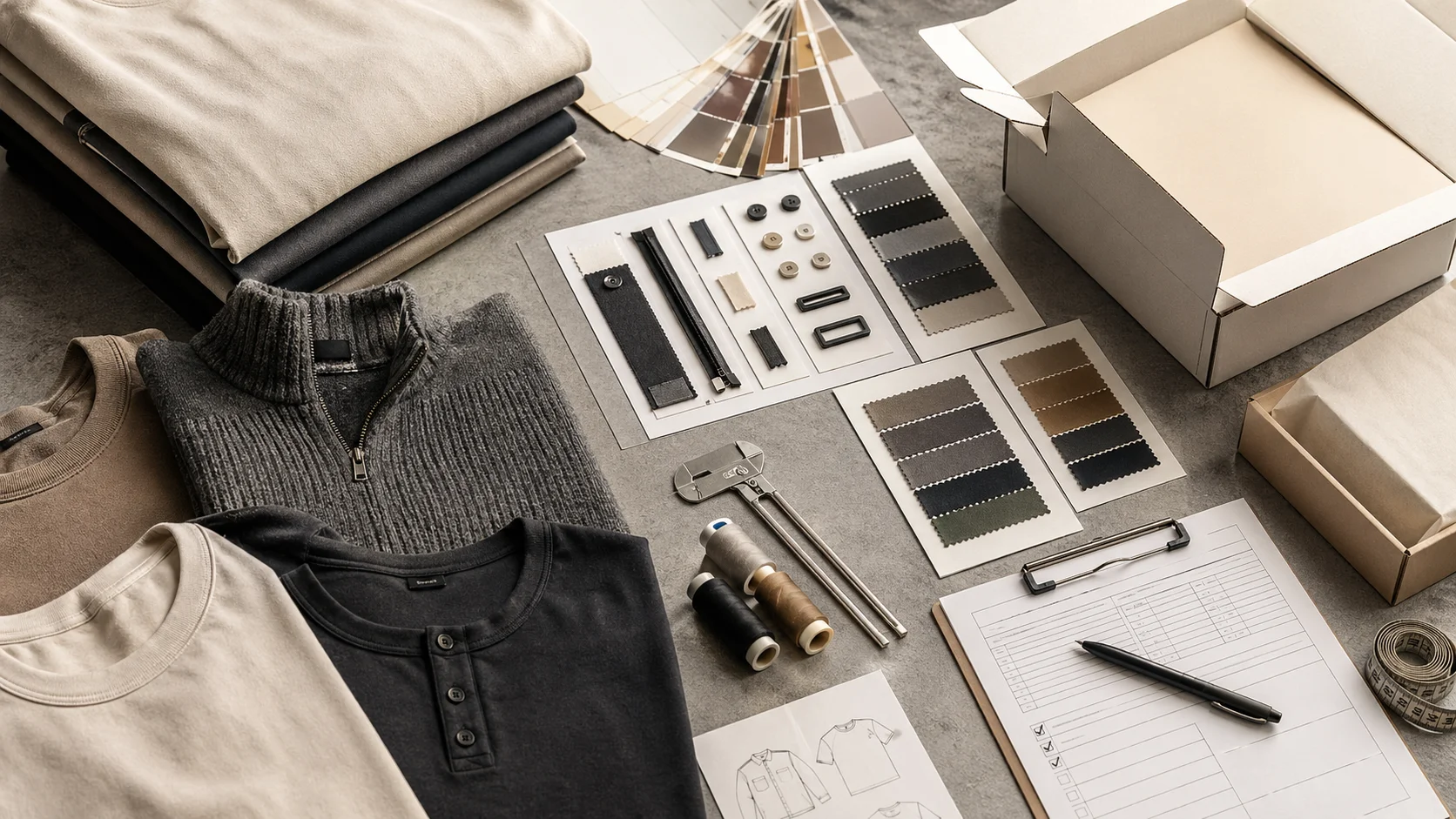
Align Sizing Standards with A Clothing Manufacturer compared by sample evidence, fabric or trim specs, MOQ, AQL terms, cost lines, delivery timing, and...
Fast answer: Align Sizing Standards with A Clothing Manufacturer: Sample Evidence, MOQ, Capacity, and Rework Terms should be judged by production evidence, not by a generic sourcing promise. The buyer needs sample proof, cost breakdowns, QC checkpoints, and delivery buffers in writing.
Ask for recent sample photos, measurement tolerances, fabric or print test assumptions, decoration test notes, packing examples, and a named inspection checkpoint. These details show whether the team can repeat an approved sample at bulk volume.
Separate garment cost, decoration, labels, packaging, sampling, testing, freight, and rush charges. Clear cost lines make it easier to reduce colorways, adjust size depth, or reserve more time for sampling.
Getting sizing right is one of the most important parts of building a successful clothing brand. A garment may look perfect in a sample room, but if the sizing is inconsistent once production begins, customers notice immediately. Returns increase, reviews drop, and brand trust weakens. That is why learning how to align sizing standards with a clothing manufacturer is essential for any business that wants reliable quality, fewer costly mistakes, and a better customer experience.
For brands working with a clothing manufacturer, sizing alignment is not just a technical task. It is a business process that connects product development, quality control, customer expectations, and long-term brand consistency. The best results happen when both sides understand the same standards, use the same measurement points, and document everything clearly from the start.
Sizing is one of the clearest ways customers judge whether a brand is professional and trustworthy. If a shirt labeled medium fits like a small, or a pair of pants varies from one batch to the next, customers quickly lose confidence. Even when the fabric and construction are strong, poor size consistency can damage sales and brand reputation.
For a clothing manufacturer, sizing standards help control three critical areas:
Fit consistency: Every product size should match the same intended body shape and garment proportion.
Production efficiency: Clear standards reduce rework, sample revisions, and delays.
Customer satisfaction: Better sizing means fewer returns and more repeat purchases.
Many brands assume sizing is simply a matter of S, M, L, or numeric labels. In reality, sizing is a system that includes body measurements, garment measurements, grading rules, and acceptable tolerances. Aligning those pieces with your manufacturer is the foundation of a scalable apparel business.
The first step in how to align sizing standards with a clothing manufacturer is to define what your sizing actually means. Do not rely on vague assumptions or “industry standard” labels unless you know exactly how they apply to your category and target market.
Start by identifying the following:
Target customer profile: Age range, body type, gender, market region, and fit preference.
Product category: T-shirts, hoodies, denim, dresses, activewear, outerwear, and so on.
Fit intent: Slim, regular, relaxed, oversized, tailored, or performance fit.
Market standards: US, EU, UK, Asian, or custom sizing systems.
A brand targeting the American market may use different sizing expectations than one selling in Europe or Asia. Even within the same market, a fitted women’s blouse and a relaxed unisex hoodie will not share the same size logic. The clearer your sizing framework is at the beginning, the easier it will be to communicate with your manufacturer.
If you are still developing your brand or planning a production partnership, reviewing a manufacturer’s capabilities early can help. You can learn more about apparel production support on our services page.
Every clothing manufacturer has its own workflow, tools, and interpretation of measurements. Some factories work from a basic spec sheet, while others require detailed technical packages and graded measurement tables. Before finalizing your size standards, ask the manufacturer how they measure garments and which points they use for each category.
Important questions to ask include:
How do you measure chest, waist, hip, sleeve length, rise, and inseam?
Do you measure garments flat or on a body form?
What tolerances do you allow for each measurement point?
How do you handle measurement differences between fabric types?
What grading system do you use for each size range?
These answers matter because different factories may interpret the same measurement slightly differently. For example, one manufacturer may measure a shirt chest 1 inch below the armhole, while another measures 2 inches below. That small difference can create a major fit mismatch if not standardized.
Alignment improves significantly when both sides agree on a measurement method before sampling begins. It is much easier to prevent sizing problems than to fix them after bulk production.
A tech pack is one of the most effective tools for aligning sizing standards with a clothing manufacturer. It serves as the blueprint for your garment and should include all the information needed to produce the item accurately.
Your tech pack should typically include:
Flat sketches of the garment
Construction details
Measurement points
Size chart and grade rules
Fabric and trim specifications
Stitching and finishing requirements
Tolerance ranges
The spec sheet should identify each point of measurement clearly. For example, instead of saying “body width,” use a precise term such as “chest width measured 1 inch below armhole, flat.” Precision reduces misunderstanding and helps the manufacturer produce consistent results.
It is also useful to note whether measurements are for the finished garment or body measurements. This distinction is critical. Body measurements and garment measurements are not the same, and confusing them can lead to major fit issues.
If you need support turning a concept into production-ready documentation, reach out through our contact page.
Fit samples are one of the most important tools in size alignment. A sample allows you to test how a garment looks, feels, and fits before committing to bulk production. However, one sample is not always enough, especially for brands with multiple sizes or complex silhouettes.
A good sample process may include:
Proto sample: The first basic version used to check shape and construction.
Fit sample: A sample used to evaluate fit on a target model or fit form.
Size set sample: Multiple sizes made to confirm grading consistency.
Pre-production sample: The final version approved before bulk manufacturing.
Using size set samples helps verify whether the pattern behaves consistently across your full size range. A medium may fit well, but if the small and extra-large are not graded properly, your brand will still face fit problems in the market.
When reviewing samples, do not only look at the overall appearance. Check the actual measurements against your spec sheet and compare the garment across all sample sizes. This is where many sizing issues are discovered early enough to correct them.
A fit model should represent the actual customer your brand wants to serve. If the model’s body type does not match your target market, the sample may look better or worse than how it will fit real customers. This can create false confidence or unnecessary revisions.
When selecting a fit model, consider:
Height, weight, and body proportions
Posture and shoulder shape
Demographic fit for your audience
Whether the model reflects your desired fit category
For example, if your brand sells relaxed streetwear, a fit model with a very slim frame may not represent the intended silhouette. On the other hand, if you are producing tailored womenswear, using an oversized fit model may give misleading results. The goal is not just to fit a body, but to fit the right body.
No production process is perfectly identical every time. Fabric shrinkage, cutting differences, sewing tension, and finishing processes can all create slight variations. That is why tolerances are essential.
Tolerance refers to the acceptable range above or below your target measurement. For example, a chest measurement of 20 inches may have a tolerance of plus or minus 0.25 inches or 0.5 inches, depending on the category and quality requirements.
Useful tolerance guidelines should be agreed upon with your clothing manufacturer before production starts. Consider these points:
Which measurements require tighter control?
Are woven garments allowed different tolerances than knits?
Do trims, washing, or dye processes affect the final fit?
What happens if a production batch falls outside tolerance?
Clear tolerance rules protect both sides. They help manufacturers understand what is acceptable and help brands avoid disputes over minor deviations that do not affect customer fit.
Grading is the process of increasing or decreasing a base size into a full size run. A good grade rule ensures that the garment maintains its intended proportions across all sizes. Poor grading often causes size inconsistency, especially in areas like shoulders, armholes, rises, and neck openings.
When building grading rules, define how each measurement changes from one size to the next. For example:
Chest increases by a fixed amount per size
Sleeve length changes proportionally
Waist and hip increments follow body shape differences
Length adjustments maintain design balance
Some garments need simple grading, while others require advanced pattern adjustments. A cropped top, a tailored blazer, and a jogger pant will each need different logic. That is why your manufacturer should understand not just the numbers, but the design intention behind them.
The more specific your grade rules are, the less room there is for interpretation. This becomes especially important when producing across multiple seasons or repeating best-selling styles.
Most sizing issues come from communication gaps rather than lack of skill. A manufacturer may produce exactly what they understood, but if your instructions were unclear, the result can still be wrong. Regular communication reduces the risk of expensive mistakes.
Best practices for communication include:
Use written confirmations for every major fit decision
Send annotated comments directly on the sample
Track revisions in one master document
Hold review calls after each sample round
Clarify changes before bulk approval
It also helps to avoid informal language when discussing measurements. Words like “slightly smaller” or “a bit longer” can be interpreted in different ways. Use numbers, measurement points, and visual references whenever possible.
Good communication builds trust between brand and factory. Over time, that trust leads to faster development, fewer corrections, and more dependable sizing outcomes.
Even after the sample is approved, sizing must still be checked during production. Quality control is the final safeguard that ensures the bulk order matches the approved standard.
QC should include measurement checks at key stages:
Incoming fabric inspection
Cutting accuracy verification
In-line sewing checks
Final garment measurement review
Do not assume that a perfect sample guarantees perfect bulk production. Changes in fabric lots, machine settings, or production speed can alter the final fit. Measuring a representative number of finished garments helps identify issues before shipment.
It is also wise to review shrinkage behavior if the garment will be washed, dyed, or heat processed. Some fabrics change significantly after finishing, and those changes must be built into the size standard from the beginning.
When brands learn how to align sizing standards with a clothing manufacturer, they often make a few common mistakes. Avoiding them can save time, money, and customer frustration.
Assuming all manufacturers use the same measurement points: They do not.
Using body measurements as garment measurements: These are different and should not be mixed.
Skipping size set samples: This can hide grading problems until production is complete.
Ignoring fabric behavior: Stretch, shrinkage, and drape all affect fit.
Failing to document changes: Verbal updates can be lost or misunderstood.
Not testing in the target market: Local fit expectations can differ by region and customer segment.
Another major mistake is updating the design without updating the size chart. If the silhouette changes, the measurements may need to change too. Small adjustments in neckline, shoulder width, or length can have a big effect on how the garment fits.
Aligning sizing standards takes experience, precision, and a manufacturing partner that understands both technical details and brand goals. Fabrikn works with B2B clothing brands to support product development, production consistency, and clear communication across every stage of the process.
Our approach focuses on making sure sizing expectations are documented, measurable, and repeatable. From tech pack support to sample review and bulk production alignment, the goal is to help brands create garments that fit the way they intend.
If you want to learn more about Fabrikn and how we work with apparel businesses, visit our about us page. If you are ready to discuss a project, our contact page is the best place to start.
Knowing how to align sizing standards with a clothing manufacturer is essential for building a reliable apparel brand. Sizing affects everything from sample approval and production efficiency to customer satisfaction and repeat sales. The most successful brands treat sizing as a strategic part of product development, not an afterthought.
By defining your standards early, using detailed tech packs, testing with fit and size set samples, setting tolerances, and maintaining clear communication, you create a process that supports consistency at scale. A strong relationship with your manufacturer makes this even easier, because both sides can work from the same expectations and deliver a product that fits the market.
In the end, great sizing is not just about numbers. It is about protecting your brand reputation and creating garments that customers feel confident buying again and again.
Get a free quote from Fabrikn — your trusted B2B clothing manufacturer with 10+ years of experience. MOQ as low as 200 pieces.
Get a Free Quote →Sizing standard alignment means making sure the brand and manufacturer use the same measurements, grading rules, fit expectations, and tolerances for each garment size.
Sizing issues usually happen because of unclear specs, different measurement methods, fabric behavior, poor grading, or weak communication between the brand and manufacturer.
A size chart should include garment or body measurements for each size, plus clear notes on fit type, measurement points, and any important tolerances.
Yes, ideally every product should have a tech pack or a detailed spec sheet so the manufacturer can follow the same sizing instructions consistently.
Most brands review at least one fit sample and one pre-production sample, though complex styles may require additional size set samples.
Yes. An experienced clothing manufacturer can help refine sizing, suggest grading rules, and advise on tolerances based on garment type and production method.