
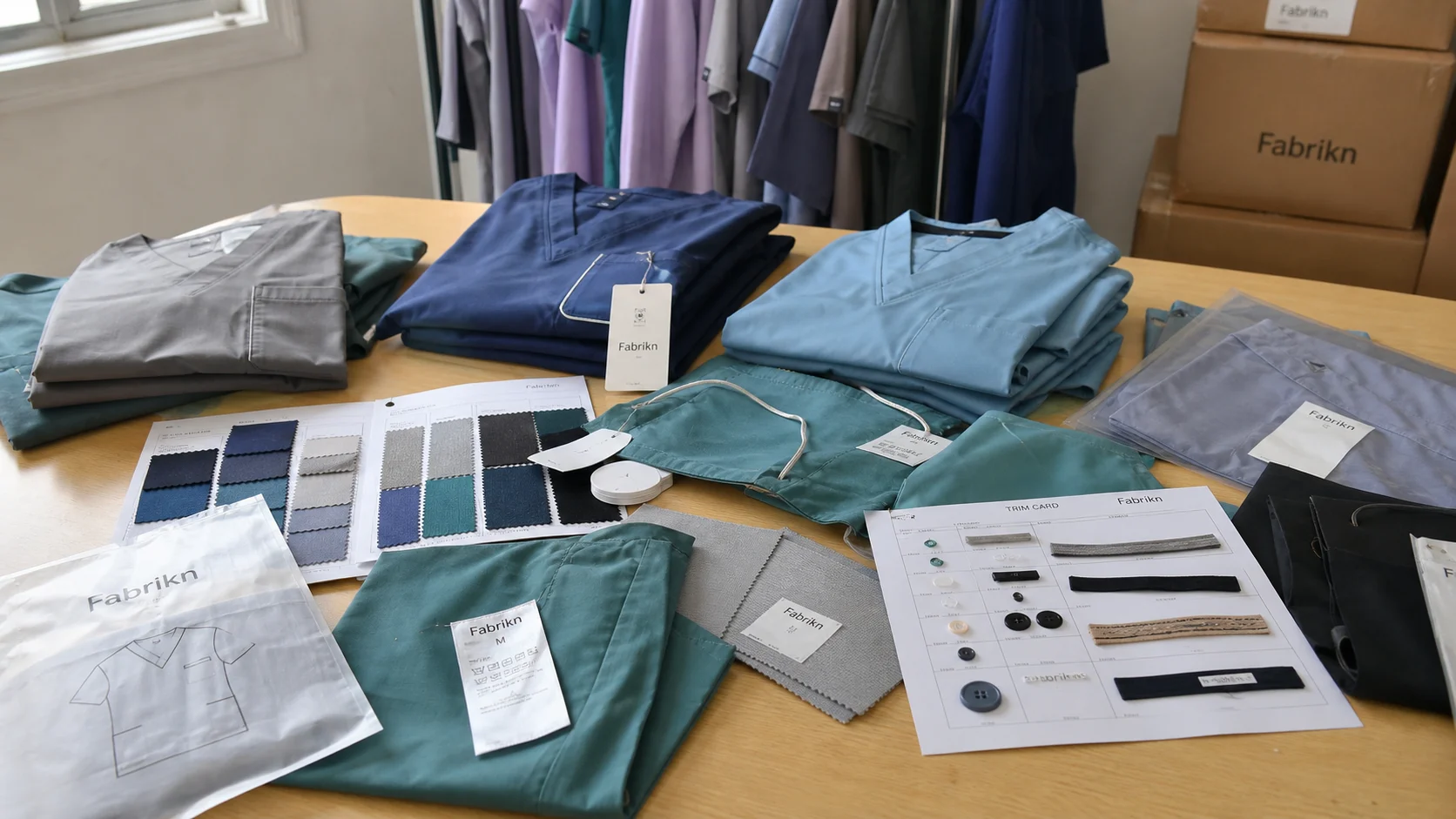
Branded Boxes for Clothing Ecommerce compared by sample evidence, fabric or trim specs, MOQ, AQL terms, cost lines, delivery timing, and rework responsibility.
Fast answer: Branded Boxes for Clothing Ecommerce: Tech Pack, Sample Gate, MOQ, and QC Terms should be judged by production evidence, not by a generic sourcing promise. The buyer needs sample proof, cost breakdowns, QC checkpoints, and delivery buffers in writing.
Ask for recent sample photos, measurement tolerances, fabric or print test assumptions, decoration test notes, packing examples, and a named inspection checkpoint. These details show whether the team can repeat an approved sample at bulk volume.
Separate garment cost, decoration, labels, packaging, sampling, testing, freight, and rush charges. Clear cost lines make it easier to reduce colorways, adjust size depth, or reserve more time for sampling.
If you are learning how to choose branded boxes for clothing ecommerce, begin with the box itself. A crushed carton can flatten the perceived value of a $48 knit tee before the customer even lifts the tissue. Fashion ecommerce return rates still hover around 20% to 30%, and repeat purchases rise when the first delivery feels deliberate instead of disposable. This is not a prettification exercise. It is a margin decision.
In apparel, packaging does more than keep fabric clean. It tells buyers whether the brand thinks in units or in experiences. A label can spend $2.20 on tissue, stickers, and a thank-you card, then ship everything in a thin mailer that buckles at the corners after 3 to 5 days in transit. The inside survives. The outside folds.
Factory audits make the weak points obvious. A box that looks premium on a warehouse table can still fail if the board is 300 gsm instead of 350 gsm, the glue bead runs unevenly, or the tuck closure pops open when stacked 12 high. On a visit in Vietnam, a supplier showed me two nearly identical mailers: one with 4-color print and soft-touch lamination, the other plain kraft. The glossy one scuffed faster in a humidity test at 70% RH and 32°C. Pretty was not durable.
Price point changes everything. Premium DTC labels selling $150 to $250 dresses often use rigid boxes at $1.80 to $4.50 each because the box is part of the perceived value. Mid-market brands selling $40 to $80 tops usually get more from a folding mailer at $0.45 to $1.10. Budget operators pushing $18 basics should not pretend a luxury carton will rescue a thin product story. It will not.
Many brands overinvest in garment presentation and underinvest in the outer box that has to survive the carrier network. Backwards. The parcel takes the beating — sorting belts, drop tests, rain at the depot. According to ISO packaging and transport test guidance, compression and drop performance should be validated before volume buying, not after complaints start landing.
Start with cost, then print method, material, size, and logistics impact. Miss those, and the prettiest box turns into dead weight. Nail them, and packaging supports lower damage rates, cleaner fulfillment, and a first impression you can actually measure.
Product mix matters more than mood boards when you are deciding how to choose branded boxes for clothing ecommerce. A store shipping 1 silk blouse per order does not need the same structure as a label sending 3 denim items, a hoodie, and a belt in one parcel. Average order value, SKU mix, and parcel size decide whether the box should be a rigid presentation piece, a folding carton, a mailer box, or a corrugated shipper.
Shirts and light knits are forgiving. A 280 to 350 gsm folding mailer can ship a folded tee for $0.55 to $0.95 landed in many sourcing programs. Denim is not forgiving. A 12 oz jean folded with a jacket weighs more, pushes dimensional weight higher, and presses hard on corners. Outerwear is its own animal; a puffer or coat often needs a larger corrugated structure, sometimes with inserts, because the fill ratio shifts once the item is compressed to fit a carton.
Luxury rigid boxes make sense when the box is part of the gift moment. Limited capsules, bridal wear, premium lingerie — that lane. They also make sense for custom bra manufacturing lines where product value is high enough that a $2.75 box does not feel indulgent. But a rigid box for a $22 tank top is theater. Freight goes up. Warehouse cube goes up. Conversion usually does not.
North America tends to favor strong corrugated structures because parcel rates punish size. Europe leans harder on recyclability and compactness, partly because brands ship into denser urban fulfillment networks with tighter space. Asia splits wider: premium labels in Japan and South Korea often want precision fit and beautiful print, while large-volume programs in China and Southeast Asia lean on efficient folding formats and low damage rates. Freight rates shape those habits more than taste ever does.
Bundle-heavy stores need consistency more than ornament. Sell sets, multi-buys, coordinated outfits? Then the inner fit matters. A box that works for a single blouse can fail the moment a second garment, a card, or a return label gets added. This is where private label clothing brands often stumble: the prototype fits one SKU perfectly, then merchandising adds a bundle and the whole thing breaks.
Think in packing density, not aesthetics alone. If your average order has 1.3 items, you need a different carton than a store averaging 2.8 items and 1.1 accessories. The box should support the shipping profile, not fight it. That is the practical core of how to choose branded boxes for clothing ecommerce without padding your shipping bill.
Board selection is where many packaging plans quietly die. Paperboard, corrugated, and rigid construction all behave differently once they hit a warehouse floor, a humid container, or a conveyor belt. For apparel, SBS paperboard gives excellent print quality and a clean premium feel, but it fits lighter retail presentation better than abusive transit. CCNB is cheaper and common in folded cartons, though the surface is less refined. E-flute corrugated has a thin profile with decent crush resistance. B-flute is thicker and tougher. Rigid chipboard delivers the strongest luxury feel, but it is heavy and costly.
In practice, SBS often shows up in smaller fashion boxes in the $0.70 to $1.30 range, CCNB at $0.35 to $0.75, E-flute mailers at $0.55 to $1.10, and B-flute shipper formats moving closer to $1.00 to $1.80 depending on print and size. Those ranges shift with MOQs of 500, 5,000, or 50,000 units, but the hierarchy stays put. Print quality rises as structural simplicity falls.
Finishes matter more than brands admit. Matte varnish, aqueous coating, and soft-touch film each protect differently. Matte and aqueous usually tolerate scuffing better during warehouse handling. Soft-touch looks expensive, yet it can mark up if cartons rub against each other for 2 to 3 weeks in long-haul storage. According to AATCC testing principles, abrasion and colorfastness should be checked in conditions that mirror actual use, not just on a clean sample bench.
Here’s what most people miss: a higher-gloss finish can show handling wear faster than matte or soft-touch on certain routes, especially where cartons travel through dry air, rough palletization, and repeated sorting. I saw that repeatedly on factory visits in Turkey and China. Day one looked sharp. Day ten looked tired.
Sustainability claims live or die here too. A recyclable board with heavy lamination, foil, and plasticized coatings may be harder to recover than a simpler carton with soy or water-based ink. For custom baby clothing manufacturing, many brands prefer understated paperboard with low-ink coverage because parents notice cleanliness and safety signals more than metallic shine. The material has to survive the journey, and it has to fit the waste system on the other end.
Branding is a cost center until it sticks in memory. Then it becomes an asset. The tradeoff is plain: more color, more coverage, more finishing, faster unit economics drift upward. Offset printing gives crisp detail and strong consistency at volume. Digital printing works for lower MOQs and frequent artwork changes. Flexographic printing is efficient for simpler graphics on corrugated, especially when brands need 5,000 to 50,000 identical units with fast repeat runs.
A one-color logo on kraft can hit harder than a full-bleed graphic if the layout is disciplined. Some brands spend $0.18 more per box on full coverage that customers barely remember, while a clean 1-color mark creates better recall because it stands out in a stack of parcels. Inside-print accents — a message under the lid, a small repeat pattern — often deliver enough surprise without inflating the outside print spec.
Setup fees are where budgets get ambushed. Offset can require plates, proofing, and more waste, so a run of 500 boxes may be irrational if the design changes every month. Digital dodges much of that setup pain and can shorten lead time by 3 to 7 days, but the per-unit price usually rises at scale. Flexo sits in the middle, with lower ink complexity and lower waste on long repeats.
Seasonal campaigns justify extra print spend when the campaign has a sell-through story. Holiday capsule, collab drop, limited-edition artist series — those can support $0.20 to $0.60 more per carton because the box itself becomes part of the collectible value. A replenishment box for basics should stay restrained. No one needs four spot colors to ship black leggings.
At a $20 price point, the box should be clean, light, and efficient: maybe a single-color logo, one internal message, and a standard mailer. At a $200 price point, there is room for heavier board, precise registration, and a more deliberate tactile finish. Luxury buyers forgive an unremarkable garment if the packaging feels precise. I’ve never seen packaging rescue a weak product.
For brands running cut-and-sew programs, especially those tied to cut and sew manufacturing, align packaging graphics with the production calendar. If fabric approvals take 4 weeks and sample development takes 2 more, the box should not be locked to an impossible date just because marketing wants a launch banner.
Budget work starts with four numbers: unit price, tooling, freight, and damage rate. Miss one and the estimate lies. A box at $0.58 that damages 3% of orders can cost more than a box at $0.92 that protects products properly. Add warehousing and dimensional weight, and the gap widens fast. Packaging gets treated as a purchase. It is a system.
Low, mid, and premium budgets buy very different outcomes. A low budget might cover 500 to 5,000 corrugated mailers at $0.35 to $0.80 each, usually one-color print, stock dimensions, minimal finishing. A mid budget might buy custom dielines, 1- to 2-color graphics, and better board at $0.75 to $1.60. Premium budgets often begin around $1.80 and climb past $4.00 for rigid presentation boxes, specialty coatings, and tighter tolerances.
Hidden costs show up after approval. Dimensional weight can add 8% to 20% to shipping charges if the box is oversized by even 15 to 25 mm in each direction. Cartonization inefficiency matters too. If your fulfillment team cannot pack 200 boxes per pallet layer because the carton footprint is awkward, storage bills rise and pick rates slow. Oversized inventory is another trap. Ordering 50,000 boxes to save $0.07 per unit can backfire if the assortment changes in 6 months.
I use a simple table-style comparison during sourcing meetings:
The practical difference is not just unit cost. A 500-unit run can take 3 to 4 weeks if the supplier already has the board and print window open. A 50,000-unit run may take 5 to 8 weeks, plus container booking time. If sales pace is uneven, that inventory sits. A brand can save $6,000 on cartons and lose $18,000 in storage and obsolescence.
For buyers asking how to choose branded boxes for clothing ecommerce on a realistic budget, choose the box that protects margin, not the box that flatters a spreadsheet. The cheapest carton is expensive if it warps your freight profile or drives replacements.
How to choose branded boxes for clothing ecommerce with sustainability starts with proof, not slogans. My checklist is practical: recycled content, fiber sourcing, ink choice, coating choice, and recyclability after use. A box claiming 80% recycled content should show supplier paperwork, not a marketing line. FSC certification helps verify fiber sourcing, but it does not automatically make a box recyclable if the finish is heavily plasticized or foil-heavy.
Minimal branding can still feel premium. A well-made kraft mailer with precise fold lines, crisp logo placement, and a clean interior print can beat a busy carton covered in “eco” language and three different textures. Buyers trust the modest box more because it feels honest. Fancy claims, poor execution. Customers notice.
Tradeoffs are real. Compostable coatings can complicate recycling streams if local facilities do not accept them. Recycled board can be slightly less bright or smooth, which matters if you want a luxury look, but it often performs well for shipping strength. Data from Textile Exchange and OEKO-TEX show that material choice should fit the end market, not a generic claim sheet.
Regional waste systems differ sharply. A box that recycles well in Germany may face different sorting rules in parts of the United States or Southeast Asia. For destination-market guidance, U.S. exporters often start with Trade.gov resources and then verify local packaging recovery rules. So a claim like “recyclable” should be tied to the destination market, the board grade, and the coating. For a 10-country ecommerce rollout, I would not assume one packaging spec fits all. It rarely does.
The most defensible approach is simple. Use fewer inks, avoid unnecessary plastic inserts, and request documentation for recycled fiber percentage, FSC chain-of-custody, and any finishing compounds. Buyers do not need virtue theater. They need a carton they can explain to a factory auditor in 90 seconds. If you are comparing a manufacturer, factory, or supplier in China, ask for the same proof from each one so quality stays comparable across bids.
Prototype approval is where expensive errors get caught cheaply. I ask for crush resistance, print registration, adhesive strength, drop testing, scuff testing, and humidity exposure before any volume commitment. A sample that sits beautifully on a desk is not proof. A carton should be tested in fulfillment conditions, on a real pack line, by someone wearing gloves and moving fast.
Ask suppliers direct questions. What is the MOQ, and how does it change by print method? What is the lead time for dielines, proofs, and production? What are the tolerances on size, board caliper, and color variation? How many cartons per pallet, and what is the master carton configuration? A good supplier answers with numbers, not adjectives.
I also compare factories by consistency, communication speed, and defect rates. A plant that answers in 6 hours and rejects a bad sample is often safer than one that promises overnight delivery and misses the second proof. In my visits, the best teams are dull in a useful way. They measure. They log. They repeat the same checks 100 times.
Testing should be ugly. Drop the packed box from 80 cm on six faces. Leave sample cartons in 70% humidity for 48 hours. Stack them 10 high for 24 hours. Rub the printed surface against another carton 20 times. If the closure opens or the print ghosts, do not approve it. Those failures become customer reviews later.
For brands that sell technically constructed apparel, including lingerie and fitted basics, packaging should be checked alongside product engineering. The same discipline that supports custom baby clothing manufacturing standards for safety and consistency applies here, just with different stress points. If the packaging fails in a warehouse, the garment story never gets a fair chance.
The supplier checklist is the bridge between design and scale. If a factory cannot explain board grade, print tolerances, and transit testing clearly, it is not ready for your volume. That is a quality issue, not just a sourcing inconvenience.
Start with a seven-point decision list: define product mix, set a realistic budget, choose material, select print method, approve dimensions, test samples, and lock supplier terms. That sequence sounds basic because it is basic. Most packaging failures happen when brands skip one step and hope design enthusiasm fills the gap.
I recommend an internal approval flow with merchandising, operations, and finance in the room at the same time. Merchandising protects brand feel. Operations guards pack-out speed and damage rates. Finance checks freight, storage, and working capital. If one department approves the carton in isolation, the final decision is usually too pretty, too large, or too expensive.
Pilot one box size before rolling out across the line. A 30-day test with 1,000 to 3,000 orders can reveal whether the box nests well, survives carrier handling, and fits the actual SKU mix. If your brand ships both bras and outerwear, do not assume one format works for everything. Split the program into use cases and scale only after data confirms the fit.
Negotiate MOQs with phased orders where possible. A first run of 5,000 units, followed by 10,000 after sell-through, often reduces risk better than jumping straight to 50,000. Ask for price breaks at logical thresholds, but do not let a smaller unit price force oversized inventory. Cash flow matters. So does warehouse space.
The box has one job before all others. It must earn its freight cost. If it does not protect the garment, support the brand, and fit the shipment profile, it is decoration that travels badly. Too many fashion businesses learn that after the returns spike.
Match the box to the heaviest or bulkiest item you ship most often, then check the average order mix. If 70% of orders are tees and 30% include denim or outerwear, a flexible mailer or corrugated shipper usually outperforms a rigid box. Test at least 3 SKU combinations before approving volume.
At 500 units, custom apparel boxes often run about $1.40 to $3.50 each. At 5,000 units, many brands land in the $0.65 to $1.90 range, while 50,000-unit runs can drop to $0.28 to $1.20 depending on board, print, and finish.
Prototype approval can take 7 to 14 days if dielines and proofs move quickly. Production is often 3 to 8 weeks depending on print method, MOQ, and freight booking. Add extra time for revisions, special coatings, or seasonal artwork changes.
Look for recycled content, FSC chain-of-custody, water-based or soy inks, and coatings that do not block recyclability. Ask for documentation from the supplier, not just a claim on a sample. A simpler box with fewer finishes is often easier to recover after use.
You can, but it usually costs more in freight and storage than a tailored program. One size may work for 2 to 3 categories, yet bundles, outerwear, and small accessories often need different internal fit. Brands that test 2 or 3 sizes usually reduce damage and dimensional weight.