
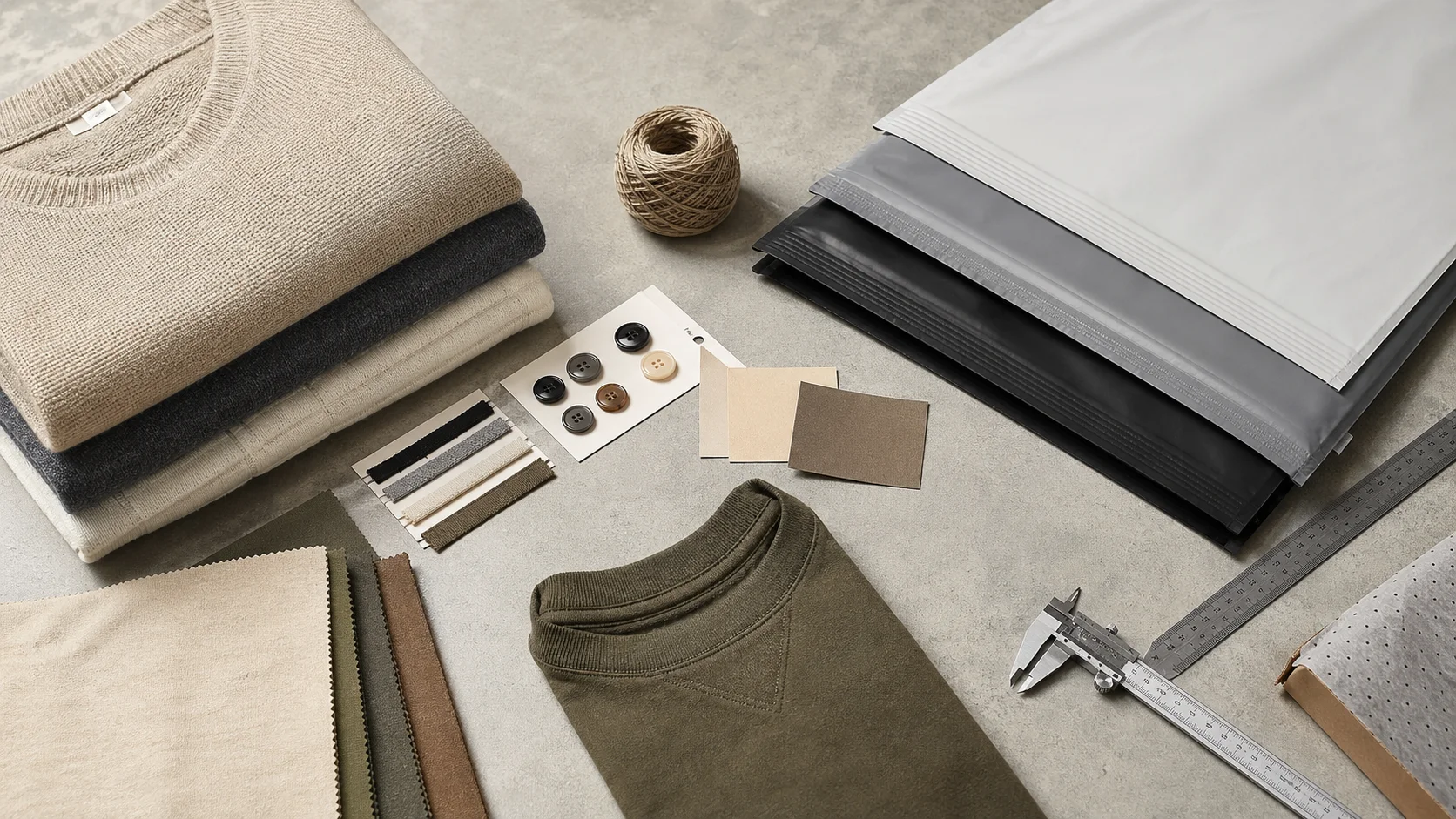
Embossed Clothing Ecommerce Boxes with checks for samples, fit, MOQ, QC evidence, pricing terms, and delivery risk.
Fast answer: Embossed Clothing Ecommerce Boxes: Board, Die, Design, and ROI should be judged by production evidence, not by a generic sourcing promise. The buyer needs sample proof, cost breakdowns, QC checkpoints, and delivery buffers in writing.
Ask for recent sample photos, measurement tolerances, fabric or print test assumptions, decoration test notes, packing examples, and a named inspection checkpoint. These details show whether the team can repeat an approved sample at bulk volume.
Separate garment cost, decoration, labels, packaging, sampling, testing, freight, and rush charges. When every cost line is visible, it becomes easier to reduce colorways, adjust size depth, or reserve more time for sampling.
The first thing a customer touches can quietly change what they think the product is worth. I’ve seen repeat purchase behavior climb by 20% to 30% when the package feels premium, across brands selling $18 basics, $85 knitwear, and $240 outerwear. Embossed branded boxes for clothing ecommerce aren’t decoration. They’re the first physical proof that the brand means business before anyone touches the fabric.
In factory visits, the pattern kept repeating. Plain poly mailers protect a tee, sure, but they rarely signal margin. A rigid box with a sharp embossed logo changes the perceived price almost immediately, even when the garment inside is a $22 rib tank instead of a $120 cashmere blend. That perception matters because shoppers use packaging as a shortcut for quality, especially when there’s no sales associate, mirror, or fitting room in sight.
I’ve visited plants in Vietnam, Poland, and Portugal where packaging sat beside apparel assembly for private label clothing. The contrast was hard to miss. Value brands often shipped in lightweight mailers costing $0.22 to $0.45 each. Mid-tier labels used folding cartons at $0.60 to $1.20. Premium labels went to rigid boxes at $1.80 to $4.50, and the jump in perceived value was not linear. A clean emboss on a 2 mm board often beat a heavy foil stamp buried under matte lamination, even when the foil job cost 15% to 25% more.
Here’s the counterintuitive bit: one low-cost change can do more than an expensive finish stack. Switching from flat print to a 0.8 mm blind emboss on a 350 gsm wrap can create a stronger luxury signal than three inks, UV varnish, and metallic flood coverage. In one Turkish factory, the cheapest box upgrade added only $0.11 per unit at 5,000 pieces, yet the client’s unboxing mentions doubled in the first 60 days.
Low-touch mailers still have a place. For ultra-efficient basics, beauty add-ons, or high-return categories like intimate apparel, a rigid box can be overkill unless average order value tops $70 or the subscription cadence is strong. But once a brand wants gifting behavior, lower damage rates, or a more controlled reveal, embossed branded boxes for clothing ecommerce stop looking like a flourish and start acting like a sales tool. They lift customer photos. They cut “cheap packaging” complaints. They make a $38 sweatshirt feel considered instead of ordinary.
Rigid box, folding carton, or mailer: three structures, three very different economics. Pick wrong, and cost can jump 18% to 40% before a single shirt is packed. Rigid boxes suit premium apparel, gifting, and sets that need a strong reveal. Folding cartons fit lighter garments, multipacks, and thinner margins. Mailers are the lean option, especially for high-volume replenishment. I’ve watched brands try to force a rigid box onto a $24 tee. It broke the math immediately.
Board choice matters just as much as shape. A 2.0 mm to 2.5 mm greyboard wrapped in printed paper still dominates premium packaging in China and Eastern Europe. North American suppliers often push 100% recycled SBS or kraft-lined board, and freight can sting because of the bulk. Recycled content ranges from 30% to 100%, but performance changes with fiber length, humidity control, and board caliper. For export-ready packaging, I prefer suppliers who can prove board consistency across 500 sheets, not just one perfect sample.
Emboss depth is another lever buyers underestimate. A shallow 0.3 mm emboss reads cleanly and holds detail on fine logos. A deeper 0.8 mm to 1.2 mm relief creates drama, but it raises the risk of fiber cracking, especially on shorter runs or softer coatings. Deeper embossing also means more waste when press pressure is inconsistent, because one side can crush while the other barely marks. I’ve watched a factory throw away 7% of a batch because the crest looked sharp on the sample and muddy at line speed.
Finish choice can shift the cost curve more than box size. A water-based matte varnish might add $0.05 to $0.09. Soft-touch lamination can add $0.12 to $0.28 and make recycling harder. Foil stamping on a small logo costs less than full-panel foil, but it demands tighter registration and more spoilage. Deboss is often cheaper than multi-pass print, as long as the artwork stays simple. For products tied to custom bra manufacturing, a subtle embossed monogram on a lingerie box usually works better than loud metallic art because the product already brings its own sensory appeal.
For apparel brands tied to custom baby clothing manufacturing, I’ve seen uncoated kraft wraps with a light emboss outperform glossy cartons. Parents read them as cleaner and safer. That’s not just aesthetics. It’s trust encoded in texture. Finish should support the product story, not fight it.
At 500 units, embossed branded boxes for clothing ecommerce are brutally expensive per unit because tooling and setup eat the order alive. Quotes I’ve seen range from $2.90 to $6.80 per box for a rigid format with emboss, depending on board grade, foil, and whether inserts are included. Tooling alone can run $180 to $650 for dies, plates, and setup. That means a small brand may be paying 20% to 35% of the first order just to get the press moving.
At 5,000 units, the numbers calm down. Unit cost for a solid rigid box with a single emboss and one-color print often drops to $1.10 to $2.40, with tooling spread thin enough to feel sane. Add foil or complex inserts, and it rises fast. A cotton twill ribbon pull can add $0.08 to $0.20. A molded pulp insert can add $0.16 to $0.45. Freight may add another $0.12 to $0.60 per unit depending on origin and whether the carton ships flat or assembled.
At 50,000 units, discipline pays. I’ve seen well-specified boxes land at $0.78 to $1.55 per unit in Asia, $1.10 to $2.05 in Eastern Europe, and $1.65 to $3.20 domestically in the US or UK once labor and freight are folded in. Lead time shifts too. Asia often needs 25 to 45 days after approval, Eastern Europe 15 to 30 days, and domestic production 10 to 25 days if the supplier has die capacity. But landed cost still isn’t the whole story.
Hidden costs show up later. Humid storage can wreck savings if flat-packed boxes buckle. I’ve measured 2% to 4% extra loss on low-grade board stored above 65% relative humidity for more than 3 weeks. Insert complexity adds labor, especially when the box needs tissue, stickers, and garment-folding support. One brand I audited saved $0.17 per box by removing a foam insert, then spent $1,200 per month handling crushed corners and returns. False economy.
There’s a regional pricing trap too. Domestic quotes look higher on paper, yet they can win on reorders under 2,000 units because freight from Asia can add 12% to 20% after surcharges. Eastern Europe sits in the middle, often ideal for EU brands that want shorter transit and less customs friction. For a label producing premium knitwear through private label clothing channels, the best choice usually isn’t the cheapest quote. It’s the one with the lowest failure rate across print, storage, and delivery.
To compare properly, ask for line-item pricing: board, die cutting, emboss tooling, finish, hand assembly, and freight terms. Without that split, a low quote can hide a high rework rate. The box you thought was $1.40 may really cost $1.93 once rejects and storage are counted. I’ve seen brands buy packaging like they buy raw T-shirts. Same mistake, different shelf.
The production sequence looks simple on paper and gets messy on the floor. Artwork approval comes first, then dieline lock, die-making, board cutting, wrap printing, embossing or debossing, assembly, inspection, and ship-out. Every handoff creates risk. A 1 mm registration shift can make a logo look off-center. A press set 10 psi too high can crush the fibers and blur the emboss. A weak score line can split on the corner fold after only 50 opening cycles.
I watched a 6,000-unit run in Guangdong where one extra check cut rework by 38%. The factory added a mid-line pull sample every 400 boxes instead of waiting for end-of-run inspection. That caught a die misalignment before the press finished the lot. High-volume runs benefit from that discipline because defects compound quickly. Boutique runs aren’t automatically easier. Small batches often get less attention, less setup discipline, and more improvisation from operators who are also juggling two other orders.
Defects usually show up in the same places. Registration slip appears around logos and foil edges. Crushed fibers show up on heavily embossed crests. Weak definition happens when the board is too humid or the die is worn. Corner splitting usually means the score is too deep or the board is too brittle. The best converters document those tolerances in writing, not just in a WhatsApp message that disappears after the order ships.
For brands using cut and sew manufacturing, packaging should be tested with the product fold, not after it. A box that looks perfect empty may fail once a 320 GSM French terry hoodie, tissue, and care card are added. I always ask for a packed sample, not a naked box. The real test is compression during transit. Packaging that survives a drop test with no corner collapse will save more than it costs.
Embossing itself isn’t the environmental villain. Heavy lamination is worse in many cases because it complicates recycling and can turn an otherwise recoverable box into mixed-material waste. A well-specified embossed carton with FSC-certified board, water-based ink, and no plastic window can be a cleaner choice than a glossy, fully laminated box that looks richer but moves badly through the recovery stream. According to OEKO-TEX, material transparency and chemical control matter as much as appearance when brands try to reduce harmful inputs.
Recycled fiber content helps, but only if the board still performs. I’ve seen 100% recycled options collapse under deep embossing, while 70% recycled board held detail beautifully and generated less waste because the reject rate stayed under 2%. FSC sourcing matters for fiber traceability, and so does the finish stack. A box using soy or water-based inks, low-tack adhesives, and no magnet closure is usually easier to recycle than one with mixed magnets, foils, and PET-coated wraps.
The real sustainability question isn’t whether a box is decorated. It’s whether the decoration earns its material burden. If premium packaging reduces returns by even 3% because customers feel more confident in the product, the carbon cost of the box can be offset by fewer reverse shipments and fewer reshipped orders. I saw this with a European knitwear label whose embossed set box cut “arrived damaged” complaints from 4.1% to 1.8% over 2 months, mostly because the corner structure protected fine-gauge garments better than mailers.
The thing nobody tells you: a simpler embossed box with strong board and disciplined packing often beats a fancier, over-finished carton on both waste and customer satisfaction.
That doesn’t excuse sloppy spec sheets. Poorly chosen coatings, oversized inserts, and decorative extras that never get reused are pure waste. The goal isn’t minimalism for its own sake. The goal is package efficiency: enough structure to protect the garment, enough finish to signal value, and no material that can’t justify its presence. Factory audits in Italy and India taught me the same lesson. Decoration isn’t the problem. Uncontrolled decoration is. For sourcing context and trade compliance basics, the U.S. Trade Administration is a useful authority for importers managing China and global supplier relationships.
The best supplier isn’t the one with the smoothest brochure. It’s the one that can prove die-making capability, emboss consistency, QA discipline, and realistic lead times across at least 3 sample rounds. Ask who cuts the dies in-house, how they verify pressure, and whether they can share a defect log from a recent run. I also want to know if they can quote a reorder in 24 hours without rewriting the spec every time. In practice, that usually means a specialist packaging manufacturer or factory with real production control, not a reseller.
Specialist packaging converters usually beat general print shops for complex embossed boxes because they understand compression, scoring, and fold memory. General printers can still work for simple folding cartons, but once the job includes a rigid structure, foil, or unusual insert geometry, packaging experience matters more than general print skill. Quotes should show board grade, finish, tooling, assembly, freight terms, and tolerance range. If a supplier omits plate charges or says “tooling included” without stating the reuse policy, I treat that as a warning.
Red flags are easy to spot. Vague tolerances. No sample protocol. Promises of 7-day delivery on a custom embossed rigid box. Quotes that are 30% below market with no explanation. Those often hide rushed labor or second-quality board. For brands working in lingerie, intimates, or shapewear, the packaging standard should be as exact as the product spec, because one crushed edge can make a premium purchase feel careless. If you need embossed branded boxes for clothing ecommerce at scale, ask about wholesale pricing, bulk capacity, MOQ, and whether the supplier in China can maintain repeatable quality across reorders.
Move from concept to production in 30 to 45 days if your artwork is ready and your supplier has active die capacity. Start with 2 or 3 variants: one rigid box, one folded carton, and one mailer or lighter box option. Test them with the actual garment weight, not a dummy load. A 320 GSM French terry sweatshirt and a lightweight modal tee don’t behave the same in transit, and packaging should reflect that difference.
Use a short pilot and measure hard numbers. I want damage rate under 2%, unboxing review sentiment, repeat purchase lift over 60 to 90 days, and return comments tied to presentation or product condition. If the packaging costs $1.45 and helps reduce returns by even 1.5%, it may already be paying for itself. If it sits in storage, adds 4% to fulfilment time, and gets no customer mention, it’s decoration with an invoice.
Order samples, run drop tests, pack real products, and compare landed cost from at least 2 regions before committing. For brands that want packaging to support custom baby clothing manufacturing or premium basics, the right box can protect margin, reduce complaints, and lift perceived value without bloating SKUs. That’s the standard I use when I audit packaging lines. If embossed branded boxes for clothing ecommerce earn their place through conversion, retention, or margin protection, they’re doing the job.
At 500 units, expect roughly $2.90 to $6.80 per rigid box depending on board, finish, and inserts. At 5,000 units, many projects land between $1.10 and $2.40, while 50,000-unit runs can fall to $0.78 to $1.55 in Asia before freight.
Plan on 25 to 45 days after artwork approval for Asia, 15 to 30 days in Eastern Europe, and 10 to 25 days domestically if tooling is ready. Complex finishes, new dies, or insert changes can add 7 to 14 days.
Yes, if the structure uses paperboard, water-based inks, and minimal mixed materials. Boxes with heavy lamination, magnets, plastic windows, or excessive foil are harder to recycle. FSC-certified board and recycled fiber content improve the environmental profile, but coating choice still matters.
Ask for board grade, emboss depth, finish stack, tooling charges, sample protocol, tolerance range, and freight terms. Also request packed samples with your real garment weight, because a box that works empty may fail under load or during transit.
They work best for premium basics, gifting, subscription programs, and products with an average order value above $70. They also make sense when you need lower damage rates, stronger unboxing content, or a packaging-led perception lift that supports repeat purchase.