
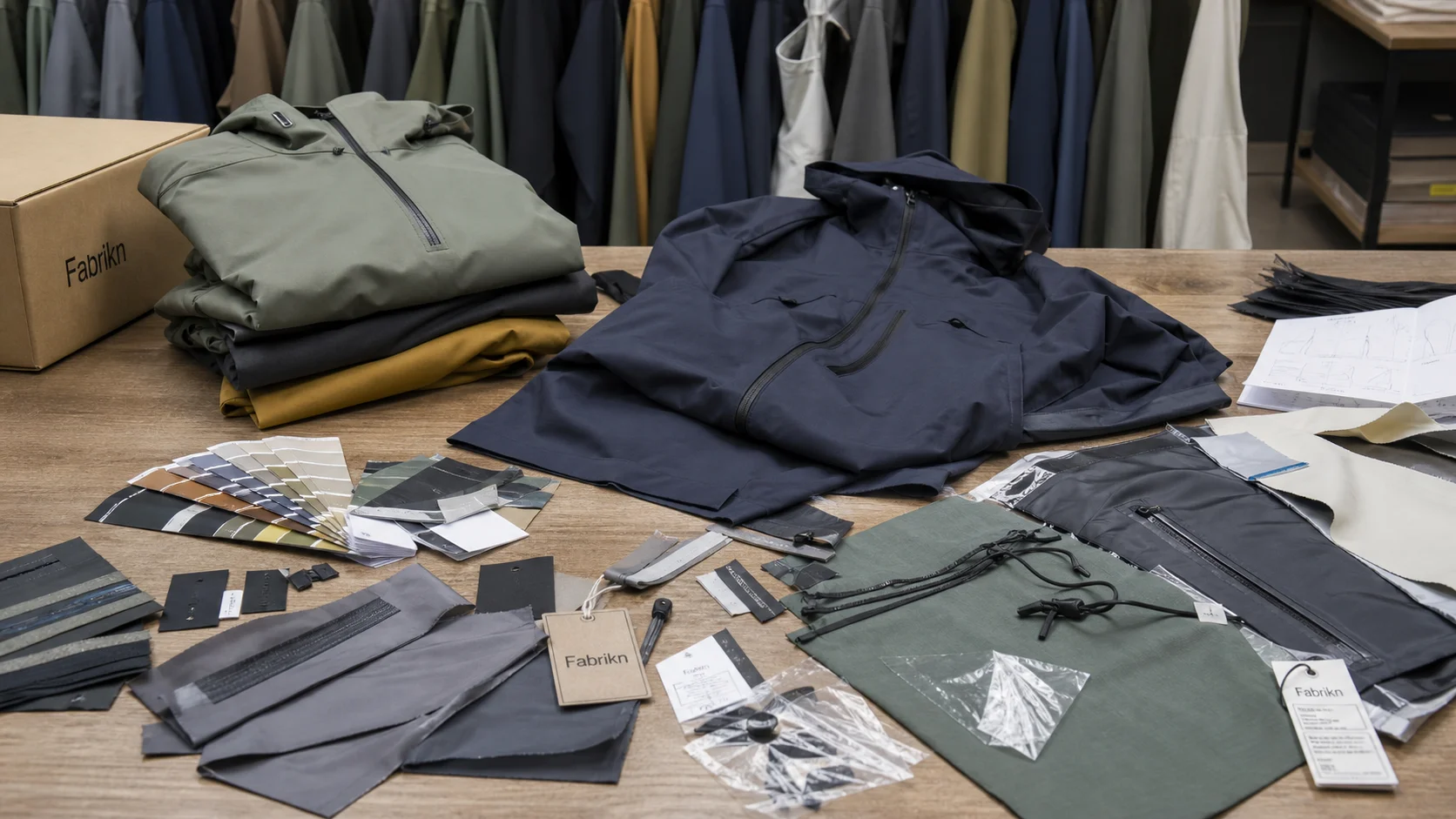
Hang Tag Quote Checklist with checks for samples, fit, MOQ, QC evidence, pricing terms, and delivery risk.
Fast answer: Hang Tag Quote Checklist: Paper Stock, Print Finish, Attachment, and MOQ should be judged by production evidence, not by a generic sourcing promise. The buyer needs sample proof, cost breakdowns, QC checkpoints, and delivery buffers in writing.
Ask for recent sample photos, measurement tolerances, fabric or print test assumptions, decoration test notes, packing examples, and a named inspection checkpoint. These details show whether the team can repeat an approved sample at bulk volume.
Separate garment cost, decoration, labels, packaging, sampling, testing, freight, and rush charges. When every cost line is visible, it becomes easier to reduce colorways, adjust size depth, or reserve more time for sampling.
A hang tag can make a $20 tee feel considered or a $600 coat feel oddly unfinished. If you are learning how to choose hang tag material for fashion brands, start with the customer touchpoint, not the print quote. I’ve seen that split in fitting rooms, in warehouse returns, and in resale listings where buyers zoom in before they trust a brand. The tag is not an afterthought. It is a signal, a compliance tool, and sometimes the last piece of packaging a customer touches before deciding whether the product is worth keeping. During showroom walks in Guangzhou, Dhaka, and Ho Chi Minh City, I’ve seen swing tags double as the final proof point when retailers check WRAP and BSCI paperwork and when inspectors in Istanbul spot-check OEKO-TEX Standard 100 compliance sheets.
Across 200-plus factory visits in 8 countries, I’ve watched hang tags survive, and fail, under harsher conditions than any studio mockup suggests. Packed in cartons of 24. Rubbed against polybags for 3-6 weeks in transit. Handled by retail staff 5-10 times on the shop floor. Bent again in fitting rooms. A material that looks elegant on a sample table can curl, crack, or smudge once humidity rises to 70% and the cartons sit on a dock. I’ve documented vendors in Guangzhou switching from a Heidelberg Speedmaster 102 to an offset-fed Komori GLX to get tighter registration before foil stamping, and yet the same tag cracked because the stock itself wasn’t compatible with the hot-foil press. The combination of fiber mix, adhesive, and die-cut often tells you more about durability than the ink color.
The best-performing tags usually balance three things: stiffness, tear resistance, and print clarity. A 350-400 GSM uncoated board often resists edge curl better than a glossy 500 GSM stock, especially when the garment is heavy and the tag is attached with cotton string or a plastic fastener. I’ve also seen thinner 250-300 GSM stocks outperform heavier boards because they flex instead of splitting at the punch hole. Denim. Outerwear. Handbags. That’s where the tugging happens.
Retailers notice the failure points long before customers do. A tag that flakes foil, sheds paper dust, or absorbs too much ink looks cheap after 48 hours on a rack. In resale, that becomes part of the product story. A garment with a clean, intact tag signals careful handling. A damaged tag makes buyers suspect returns, defects, or poor storage. For brands selling through marketplaces, that can affect conversion and returns in ways a print quote never reveals. The material choice is a business decision tied to luxury signaling, return rates, and sustainability claims.
Heavier stock is not always better. A 450 GSM board with a soft-touch coating and deep embossing can crack faster than a 320 GSM recycled board if the fiber mix is brittle or the die-cut is too tight. I’ve watched brands order 100,000 tags that looked expensive on press sheets, only to reprint 12% because the lamination bubbled at the fold line. Waste. Money. Carbon penalty from unnecessary freight.
Luxury houses sometimes accept that risk because the visual cue matters more than logistics. Smaller brands usually cannot. If you are using private label clothing, the tag has to hold up across factory packing, domestic distribution, and store-level handling without adding 7-10 days of delay from rework. The smartest tags I’ve seen are not the heaviest. They are the ones that look rich, survive abrasion, and still separate cleanly from the garment when the customer is done with it.
The right hang tag for a $20 tee is not the right hang tag for a $600 coat, even if both sit on the same retail rack. I’ve worked with brands that tried to use one material across every category, then wondered why their basics felt overdesigned and their luxury pieces felt undercooked. If you are thinking through how to choose hang tag material for fashion brands, the category comes first, then the price point, then the channel. That order matters.
Fast fashion usually needs a 250-300 GSM coated or semi-coated board that prints fast, stacks flat, and stays consistent across 5,000-20,000 piece runs. Contemporary labels often do better with 300-350 GSM uncoated or lightly textured stock because it reads more tactile, especially in store lighting. Luxury tags can push into 400 GSM textured boards, but only when the finish is restrained. Bridal often wants a softer visual language, while outerwear needs durability because the tag survives shipping and repeated hanging. Activewear and accessories need abrasion resistance more than drama.
For basics and tees, sharp photography-driven branding usually calls for coated stock that holds rich blacks and crisp barcodes. For a natural brand, uncoated paper feels honest and less slippery in hand. Premium denim? Textured boards with a subtle tooth often beat glossy finishes because they make the garment feel more substantial before the customer even tries it on. That first touch matters. A $20 tee can carry a clean, simple 280 GSM tag. A $600 coat can justify a 400 GSM board with a blind emboss, but only if the coating does not crack at the fold.
Outdoor apparel is a different beast. Tags are exposed to warehouses, hangers, and wet weather during freight transfer. I’ve seen paper fuzz and edge fray on 300 GSM stock after only 2 weeks in humid storage. For that reason, many brands use tougher boards or a light aqueous coating for water resistance, especially on multi-store distribution orders of 10,000 units or more. If the product is being shipped cross-border, the tag should survive at least 2 handling cycles and 1 repack without losing legibility. Many suppliers in Ho Chi Minh City finish tags with a water-based varnish and trim them on a Gietz folder gluer to maintain straight edges after long runs.
Seasonal drops change the equation. Spring collections often travel in thinner cartons and sit in fewer warehouses, so you can use a lighter board and a matte finish without too much risk. Winter outerwear moves through heavier logistics, so I prefer a sturdier stock that won’t crush under 12-18 kg cartons. E-commerce adds another layer. The hang tag shows up in unboxing photos, returns, and resale listings, so edge quality matters more than it used to. If the brand also sells through boutiques, the tag must look good on a wall rack and in a shipping box.
I once worked with a brand that used delicate recycled paper tags on a line of knitwear, then lost 9% of tags to tearing during fulfillment. Their factory had done nothing wrong. The spec was wrong. On the other hand, I’ve seen brands overbuild tags for simple cotton basics and spend an extra $0.11-$0.18 per piece for no commercial gain. That kind of mismatch adds up fast, especially when paired with clothing packaging solutions that already consume most of the presentation budget.
Sustainability claims on hang tags are easy to print and hard to prove. I’ve seen brands stamp “eco-friendly” on a recycled board while attaching it with a polyester string and a laminated finish that made the tag unrecyclable in practice. Clean message? Not even close. If you want buyers and retailers to trust the claim, the material story has to be consistent from fiber to finish. That is a core part of how to choose hang tag material for fashion brands when the tag is doing double duty as marketing and compliance.
According to Textile Exchange, material sourcing claims now face more scrutiny from buyers, auditors, and consumers than they did even 5 years ago. On factory floors, I see the same pattern repeat: recycled content boards sourced through Guangzhou mills are certified GRS and pressed on a twin-wire press to lock in the texture, but the string comes from Ho Chi Minh City without any OEKO-TEX Standard 100 certification, and suddenly the hang tag fails a WRAP audit. A consistent supply chain—from Dhaka-based paper mills that can prove GOTS fiber content to Istanbul finishing houses that document BSCI-compliant labor practices—keeps buyers confident.
Certifications are not just marketing badges; they guide material decisions. GOTS assures you the cotton pulp in an uncoated board was processed without harsh chemicals, OEKO-TEX Standard 100 covers dyes and adhesives, WRAP and BSCI document responsible factory conditions, and GRS tracks the recycled content back to its source. When you specify adhesives or coatings, mention the machine (a UV-curing coating station or a Silverson mix) and process (aqueous varnish or cold foil) so the vendor can prove compatibility with the certification limits.
Cost, MOQ, and lead time are rarely negotiable. Most suppliers I trust in Guangzhou, Dhaka, and Ho Chi Minh City quote $2.50-4.00 per unit at a 500 MOQ for a 350 GSM board with a single-color foil and one die-cut. That price assumes standard delivery and excludes rush varnish or foil touch-ups. If you need a metallic foiling, embossing, or a reinforced hole, expect the per-unit cost to rise by $0.35-$0.60 depending on the complexity and the supplier’s machine (Heidelberg or KBA presses add precision at a higher price).
Turnaround is 18-22 business days from artwork approval for typical runs, which includes 3-4 days for plate-making, 8-10 days on press, and 5 days for finishing, inspection, and boxing. When brands cut corners by approving samples without checking die accuracy, they add 7-10 days of corrections, often triggered by tooling that only works on a Komori or Xerox digital die cutter. Working backward from your product launch date, map the tag timeline in production planning software so you avoid last-minute air freight, especially if your garments are already in Istanbul or Los Angeles distribution centers.
Before you greenlight a production run, run the tag through the same paces the garment will see. Key tests include:
Document these results on your spec sheet and share them with the supplier’s quality team in Guangzhou or Dhaka so future runs match the approved standard. If a test fails, adjust materials—switch from a brittle foil to an aqueous coating, or add a reinforcing patch around the hole—rather than relying on the printer to fix it after the fact.
A spec sheet is not just dimensions and colors. Include the following data so factories and buyers can speak the same language:
Include responsible parties for each step so when a supplier in Istanbul or Guangzhou receives the document, they know exactly what to inspect before shipping. Upload the file to your PLM system, and reference it in your SRM for future audits.
Before you proceed, do the following:
A clear spec and a solid factory partner keep the hang tag from being the weakest link in your customer experience. Work with a partner who understands not just art direction but also paper science, finishing machines, and global compliance from Guangzhou to Istanbul.