
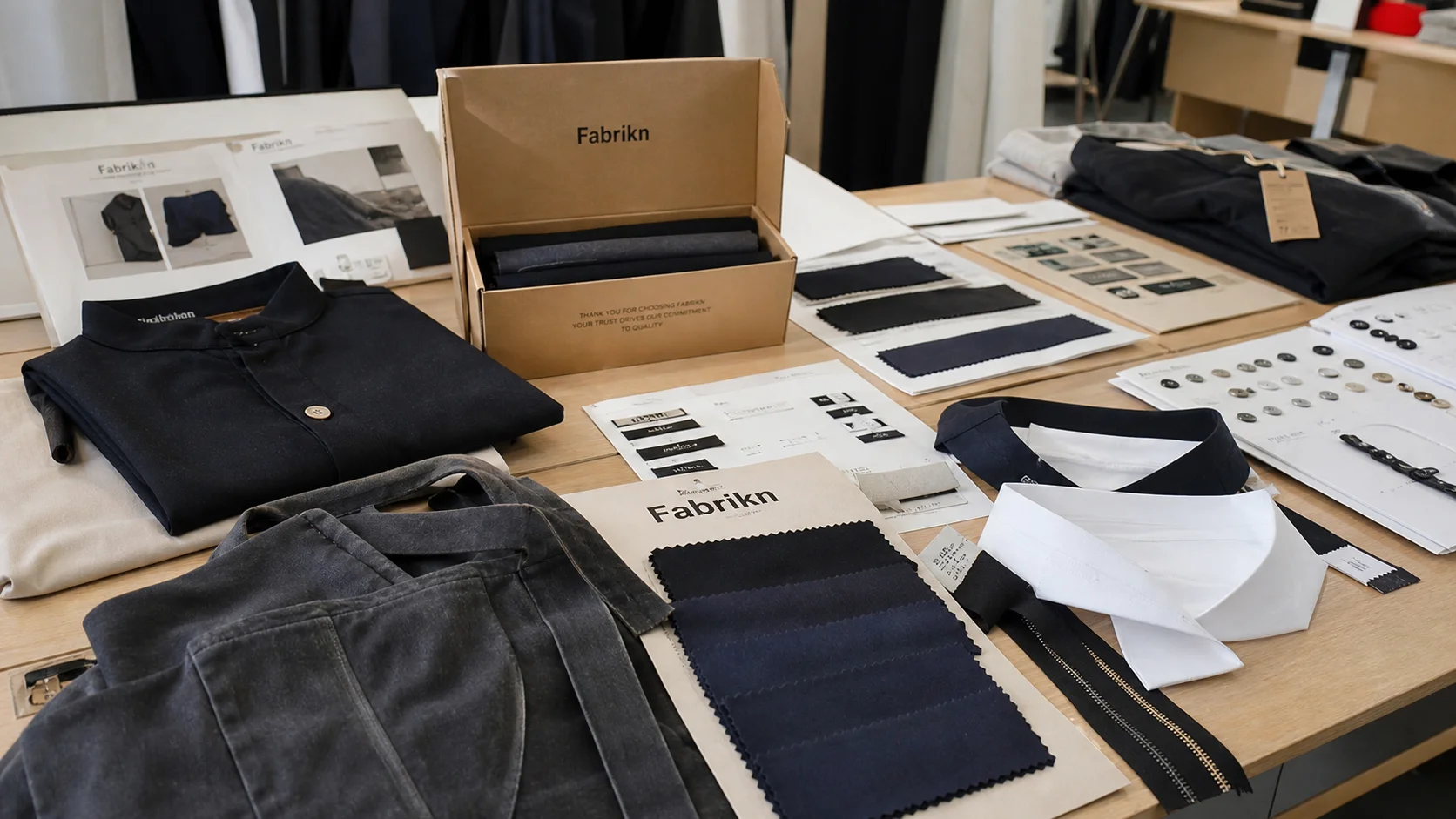
Fashion Tissue Paper in Asia with checks for samples, fit, MOQ, QC evidence, pricing terms, and delivery risk.
Fast answer: Fashion Tissue Paper in Asia: GSM, Ink, Specs, and Sourcing Risk should be judged by production evidence, not by a generic sourcing promise. The buyer needs sample proof, cost breakdowns, QC checkpoints, and delivery buffers in writing.
Ask for recent sample photos, measurement tolerances, fabric or print test assumptions, decoration test notes, packing examples, and a named inspection checkpoint. These details show whether the team can repeat an approved sample at bulk volume.
Separate garment cost, decoration, labels, packaging, sampling, testing, freight, and rush charges. When every cost line is visible, it becomes easier to reduce colorways, adjust size depth, or reserve more time for sampling.
In the race to look premium without inflating freight, tissue paper has become the quiet workhorse of packaging. For custom tissue paper for fashion brands asia, the appeal is simple: it adds polish, travels light, and doesn’t punish margin the way rigid inserts do. A 20-foot container already strains the budget; adding only 8-15 grams per unit is an easy decision by comparison.
Across Japan, Vietnam, India, and China, I keep seeing the same calculation. Brands spend $0.80-$1.50 on printed cartons and $1.20-$3.00 on hangtags, then treat tissue at $0.03-$0.08 per sheet like a rounding error. That’s backwards. Tissue is the first thing a customer touches, the layer that shapes the unboxing, the return impression, and the photo that ends up on Instagram or WeChat. It matters before the logo on the carton even enters the chat.
Many brands overspend on the outer box and underspend on the inner wrap, even though the wrap reaches the customer’s hands first. I saw one premium knitwear factory in Guangdong pack $140 sweaters in plain brown mailers and hide them in unbranded tissue to save $0.02. The customer didn’t see the outer carton until after the reveal. A strange place to economize.
Packaging also behaves differently as a percentage of COGS by tier. Mass-market apparel may hold packaging to 1.5%-2.5% of COGS. Premium labels often sit at 3%-5%. Luxury and gift-led wholesale accounts can reach 6%-9%, especially when paper, ribbon, and rigid components stack up. Tissue is one of the few places where a brand can sharpen presentation without pushing freight, carton cube, or breakage risk.
Sustainability complicates the choice, and that’s where discipline pays off. Recycled content helps. FSC sourcing helps. Soy inks help too. But overprinting, oversized sheets, and heavy coverage can burn through more ink and fiber than the brand story justifies. I’ve seen a 3-color full-bleed pattern look elegant on a sample table and reckless on a procurement sheet. In those cases, restraint is not cheap. It is intelligent.
Buyers need more than a logo file before asking for quotes. The first spec sheet should state GSM, sheet dimensions, sheet count per order, print sides, finish, and fold style. Common GSM ranges run from 17gsm to 30gsm. Delicate apparel often sits at 17-20gsm, while accessories and footwear can handle 22-30gsm. A sheet can be 50 x 70 cm, 75 x 50 cm, or fully custom, but the size should match the packing motion, not just the gift aesthetic.
Factory capability varies by market. China still wins for scale and speed, especially above MOQ 5,000 sheets and up to 500,000 sheets. India is stronger for flexible paper sourcing, specialty stock, and smaller print runs around 1,000-10,000 sheets. Vietnam and Thailand often excel in packaging assembly, folding, and carton coordination. I’ve seen a Vietnamese packing house in Ho Chi Minh City turn around 10,000 branded sheets in 12 days once artwork was approved, while a Guangzhou converter needed 18 days but delivered better color consistency.
Print method changes everything. One-color logos cost less and usually hold registration better. Full-bleed patterns need tighter control and can add 10%-20% to the quote. Metallic effects are tempting, but they complicate recyclability and often require more careful handling. Water-based inks are generally the cleaner choice for apparel tissue, though some conventional inks still win on sharpness and cost. If the product is silk, the sheet should be softer and more opaque; for denim or leather goods, tear resistance matters more than feel.
I’ve seen spec mistakes that cost real money. One brand wrapped socks in 28gsm paper that was too heavy for the item, which increased labor time by 14% because the packers had to refold every sheet. Another used 17gsm stock for belts and shoes, then logged a 3.2% damage claim rate because the tissue ripped during insertion. Neither mistake was dramatic. Both were expensive.
For a brand already scaling clothing assortments, tissue sits alongside other technical decisions like custom bra manufacturing or private label clothing. The packaging spec should fit the product category, not the mood board.
Price moves quickly with volume. For a simple one-color logo on 17-20gsm paper, I usually see small-batch orders of 1,000-3,000 sheets land around $0.06-$0.12 per sheet. At 5,000-10,000 sheets, that can fall to $0.03-$0.07. At 50,000 sheets and above, the price may reach $0.015-$0.04, depending on folding, packing, and shipping mode. A larger order does not only lower unit cost; it also reduces setup pain per piece.
Regional pricing behaves differently. China often adds lower per-sheet conversion cost, but plate fees and carton freight can shift the final number upward if the design has 2 or 3 print colors. India may quote slightly higher paper conversion on some grades, yet it can win on local paper sourcing and lower prepress charges. Vietnam and Malaysia sometimes sit in the middle on unit price, but export freight and packing efficiency can swing the landed cost by 8%-15%. In a recent comparison I reviewed, a 20,000-sheet run varied by $220-$480 in setup and plating alone.
What drives price is not mysterious. Paper grade, print colors, coating, folding format, carton size, shipping lane, and whether the order moves by air or sea all matter. A 2-color repeat motif on 22gsm paper with tissue folded into a 6-sheet stack costs more than a flat single-sheet pack because the factory handles the job twice. A metallic accent can add 12%-18% on top of the base quote. And if the carton dimensions are awkward, freight charges jump because more air moves across the route.
Compared with dust bags, kraft wrap, or branded stickers, tissue often wins on unit economics. A cotton dust bag can run $0.18-$0.60 each, kraft wrap can sit at $0.05-$0.14, and stickers may be cheap at $0.01-$0.03 but add almost no perceived value. Tissue gives a stronger premium signal than stickers and a lighter freight profile than bags. For many apparel categories, it is the best ratio of cost to presentation.
What most buyers miss is that the lowest quote can carry the highest defect rate. I’ve visited factories that promised $0.02 per sheet but shipped with 4%-6% print misalignment, forcing rework or tolerance of inconsistent folds. Other suppliers quoted slightly higher and held defects to under 1.5%, with steadier lead times and fewer disputes. In tissue, a cheap quote without tolerance language is not cheap. It is deferred pain.
Start by separating manufacturers from traders. A paper mill controls pulp and base stock. A converter prints, cuts, folds, and packs. A packaging trader can coordinate all of it, but the margin stack grows with every handoff. That matters because a mill-backed quote may save 5%-12% on raw material access, while a trader may speed communication but leave less room for corrective action if the color drifts or the fold is off by 3 mm.
When I compare suppliers in China, India, Vietnam, Indonesia, and Sri Lanka, I look at five numbers: MOQ, proof speed, color consistency, export experience, and defect tolerance. A serious supplier should return a digital proof in 24-48 hours, a physical sample in 5-7 days, and a production lead time of 2-4 weeks for standard runs. If a supplier cannot describe carton compression strength, paper origin, or repeat accuracy, I move on.
Red flags are usually plain. Vague paper origin. No certificate trail for recycled pulp. A supplier in Dhaka once promised WRAP compliance but had no audit report to back it up, so we walked. I care about machines too. Look for EKRA flexo presses, Mitsubishi gravure lines, or Bobst folding machines on the floor. Ask whether the supplier operates dedicated tissue cutters, guillotines, and stacking robots, or whether bulk orders spend hours in manual folding.
Also check the vendor’s logistics nerve. Guangzhou suppliers often ship by sea to Hong Kong or Shenzhen export hubs in 18-22 business days; factories in Ho Chi Minh City usually aim for 12-17 days to Long Binh port. Air freight from Istanbul through IST is faster but carries a premium, so reserve it for urgent capsule drops or VIP runs. Suppliers that can quote landed costs to Singapore, Kuala Lumpur, or Tokyo reduce the “what-if” in your supply plan.
References, audits, certifications—don’t skip them. Demand GOTS, OEKO-TEX Standard 100, WRAP, BSCI, or GRS certificates when the brand story depends on traceability. A compliant exporter in Malaysia once showed me a GRS chain-of-custody chart that ensured their recycled fiber actually tracked from a European mill to their converter. That transparency is more valuable than any prettily rendered mockup.
When a brand claims “organic” or “recycled,” the supply chain must back it up. Organic cotton fiber requires GOTS or Global Organic Textile Standard certification, which also covers fibers, manufacturing, and packaging for brands shipping to North America or the EU. OEKO-TEX Standard 100 ensures no banned chemicals remain in the fiber or the ink. GRS audits confirm the percentage of recycled content, while WRAP and BSCI protect worker conditions across the plant floor.
Material choices tie directly to cost and compliance. Specialty stock like bamboo fiber tissue runs $2.50-4.00 per unit at 500 MOQ in Dhaka, where pulping houses close to the Karnaphuli River process the cellulose. In Guangzhou and Ho Chi Minh City, standard virgin fiber may still be $1.90-3.00 per 100 sheets, but recycled fiber from certified partners in Zhejiang drops to $1.60-2.40. Paper machines like the Valmet Tissue Machine, Toscotec Advantage, or Voith PrimeLine set the paper’s brightness, smoothness, and opacity. Calendaring and soft nip rolls determine the final hand feel before the GSE inline sheeters cut the sheets.
Coatings and finishes matter too. A water-based satin coating on 22gsm stock resists smudging during packing runs in Istanbul or Kuala Lumpur. Embossing rolls can add texture, but they increase makeready time, so plan for 2-3 extra business days in the timeline. If you are applying foil, insist that the converter has an inline hot stamping station with servo control to avoid heat-damaged fiber.
The certification journey is not purely symbolic. A supplier with WRAP and BSCI audits can prove worker safety, while a GOTS or OEKO-TEX Standard 100 certificate ensures you can marketing those claims cleanly in-store and online. GRS certified converters demonstrate that recycled content is measured, and that the chain of custody preserves the percentage from bale to sheet. Brands seeking zero-waste stories can also request mill waste logs, energy usage from boilers, and water discharge documentation to supplement the certification packs.
A solid buying timeline keeps everyone calm. Here’s the cadence I use, based on sourcing in Guangzhou, Ho Chi Minh City, Dhaka, and Istanbul:
If you are cross-docking or replenishing seasonal capsules, build a 30- to 40-day cadence that folds in customs clearance and inland trucking. Don’t forget to add buffer weeks if the tissue needs to sit in-brand warehouses in Tokyo, Seoul, or Bangkok before fulfillment.
Gather the stakeholders—design, procurement, and operations—and align on the brief. Include finished dimensions, flutter tolerances, colorways, paper grade, certification needs, and desired MOQ. Identify the machine capabilities you prefer: a Toscotec TT Paper machine for even pressing, an automatic stacking line for 6-sheet bundles, or a dual-foil station for limited-edition drops.
Once the brief is ready, order a test run of 500-1,000 sheets. Pay for the proofing stamp, confirm the GOTS, OEKO-TEX Standard 100, WRAP, BSCI, or GRS paperwork, and check the cutters or folding punches fit your style. Compare the test order’s profits, freight, and rework versus the current packaging spend.
If the test performs, scale to 5,000-10,000 sheets with a delivery promise of 18-22 business days from Guangzhou or equivalent lead times from Dhaka, Ho Chi Minh City, or Istanbul. Always confirm the lead time and MOQ on the heat-sealing machine, folder gluer, or automatic stacker you are using, because some converters resume 2,000-sheet min batches in their off-season.
Do I need multiple certifications for custom tissue paper? Probably. GOTS or OEKO-TEX Standard 100 confirm fiber safety. GRS proves recycled content, while WRAP or BSCI show social compliance. Pick the combo your buyers expect and the auditors require.
What is a realistic MOQ to expect? Expect $2.50-4.00 per unit at 500 MOQ for specialty blends in Dhaka, but standard virgin fiber runs in Guangzhou or Ho Chi Minh City can dip to $0.90-2.20 per 100-sheet block with minimums around 2,000-5,000 sheets.
How long does custom tissue production take? Standard runs on qualified machines take 18-22 business days from Guangzhou, 12-17 days from Ho Chi Minh City, and 10-15 days from Istanbul when air freight is not required. Always add buffer for customs and local holidays.
Can I ask for a mix of coated and uncoated sheets in one order? Yes, but expect more handling time. Converters prefer grouping similar finishes because each coating unit (e.g., UV varnish, satin finish) requires machine cleaning. Plan for 2-3 extra days for multi-finish runs.
Should I prioritize local suppliers or the lowest quote? Balance the two. Guangzhou still leads for speed and scale, Dhaka for recycled blends, Ho Chi Minh City for responsive FMCG folding, and Istanbul for regional shipping into Europe and the Middle East. Lowest quote without certifications or machinery traceability often means rework.