
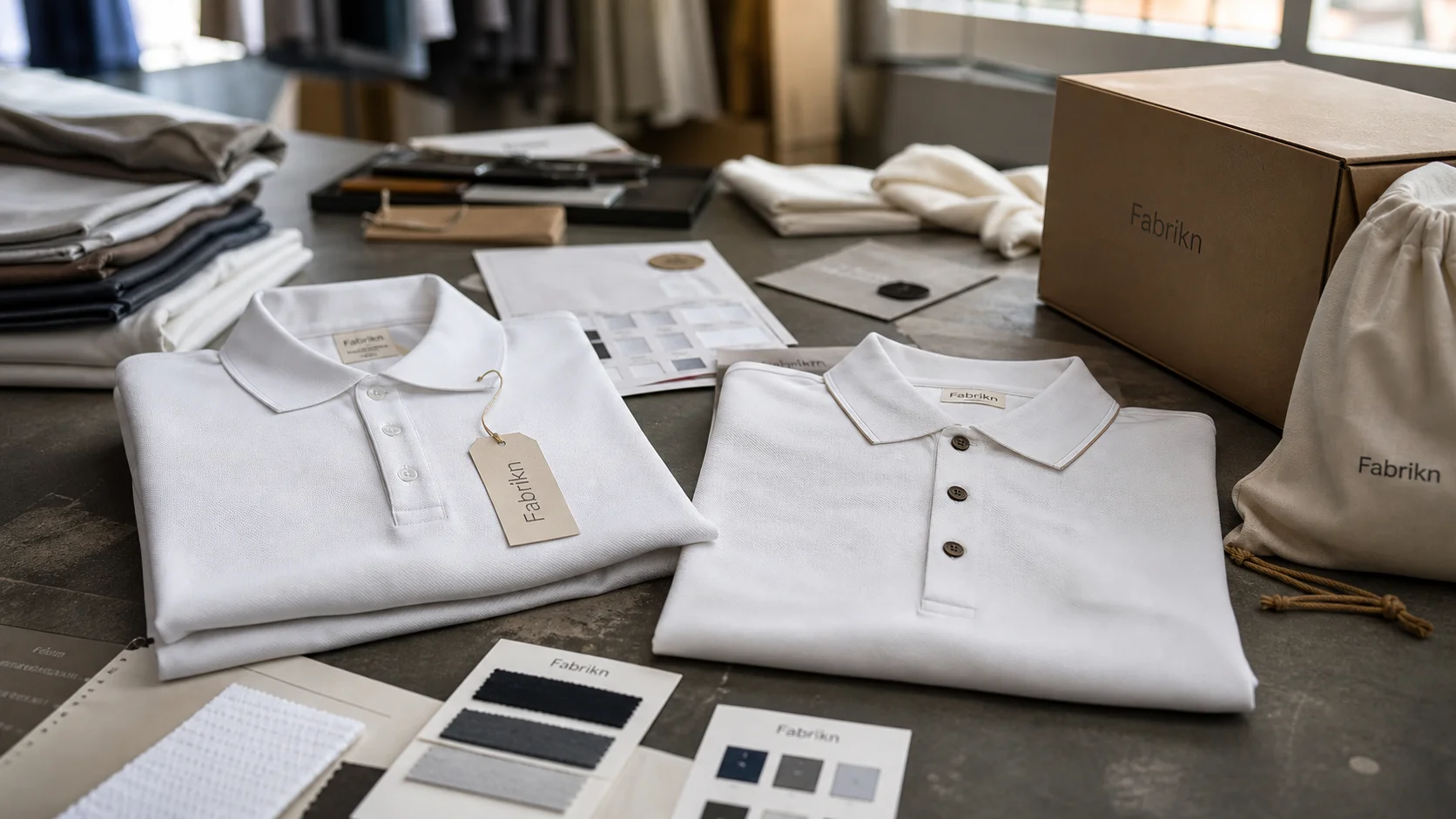
Packaging for A Clothing Startup compared by sample evidence, fabric or trim specs, MOQ, AQL terms, cost lines, delivery timing, and rework responsibility.
Fast answer: Packaging for A Clothing Startup: Material, Print, MOQ, and QC Terms should be judged by production evidence, not by a generic sourcing promise. The buyer needs sample proof, cost breakdowns, QC checkpoints, and delivery buffers in writing.
Ask for recent sample photos, measurement tolerances, fabric or print test assumptions, decoration test notes, packing examples, and a named inspection checkpoint. These details show whether the team can repeat an approved sample at bulk volume.
Separate garment cost, decoration, labels, packaging, sampling, testing, freight, and rush charges. Clear cost lines make it easier to reduce colorways, adjust size depth, or reserve more time for sampling.
I once watched a startup burn £1.18 per order on a rigid box, £0.22 on tissue, £0.09 on a sticker, and another £0.14 on an insert card before the garment even hit the carrier. The tee cost £7.60 to make and sold for £38, yet packaging pushed landed cost up by 18 percent. That trap in how to choose packaging for a clothing startup is sneaky: the box looks harmless on a quote sheet, then ripples into freight, labor, and returns.
£1 is never just £1. In a 500-piece run, a custom carton can land anywhere from £0.92 to £1.40 each; at 5,000 pieces, the same item might fall to £0.48 to £0.72 if you accept longer lead time and a higher MOQ. A startup with 4 SKUs can live with that. A startup with 18 SKUs, 3 colorways each, and two sales channels cannot. Every extra variant multiplies storage, picking time, and the odds of a size mix-up.
When I visited the Guangzhou packaging park, the converter on Huanshi Road quoted $2.50-4.00 per unit at 500 MOQ for a gloss-laminated rigid box, die-cut on a Bobst Mastercut 106 and hand-glued on a Heidelberg Diana folder-gluer. The same supplier could drop to £1.60 and 18-22 business days for the same box if the order rose to 2,500 units, the print returned to single-color, and the finishing shifted from aqueous to UV varnish. Those small lead-time choices morph into overtime costs once a brand insists on multiple finishes.
Direct-to-consumer brands need packaging that survives one or two carrier handoffs and still looks decent when the customer opens the door. Wholesale buyers care less about tissue and more about carton stacking strength, carton count, and pallet efficiency. Hybrid brands usually sit in the middle and end up paying for both worlds: DTC presentation plus wholesale compliance. I saw one hybrid outfit spend 12 percent of order value on packaging in month one, then slash it to 5 percent after dropping the insert stack and moving from rigid boxes to corrugated mailers made in Ho Chi Minh City, where a flexo printer, rotary die cutter, and solventless lamination line produced mailers that passed both WRAP and BSCI audits.
During factory visits in China and Portugal, the most luxurious-looking packaging often had the weakest business case. A glossy magnetic box can add 40 to 90 seconds of assembly per order. Multiply that by 1,000 orders and you are looking at 11 to 25 labor hours. At 10,000, it becomes a staffing decision. Yeah, unboxing can build loyalty. Only if the packaging survives transit, stays under carrier weight thresholds, and does not force ugly inventory splits. That tension matters more than aesthetics.
Tees, denim, outerwear, swimwear, and accessories do not share the same packaging brief. A 180 GSM jersey tee can travel safely in a poly mailer or slim box, while 14 oz denim usually needs a sturdier folded presentation and a carton that resists corner crush. Outerwear brings bulk and trapped air, so a 3 cm depth change can alter the shipping rate. Swimwear often ships light, yet it is frequently paired with care cards or hygiene seals. Accessories such as caps, belts, and socks waste the most packaging because brands overpack them for no freight gain.
Fold type matters more than most founders expect. A standard retail fold can cut carton depth by 20 to 30 percent compared with a loose fold, and that hits DIM weight directly. Tissue adds presentation, but one sheet too many can shove a package from a letterbox format into a parcel band. Polybags protect against moisture and dust, hanger loops make retail easier, and inserts stop creasing on premium knits. Each piece changes cost and labor. In my factory notes, the packaging line for a 12-piece boxer short order ran two minutes faster once the hanger card disappeared.
Regional norms differ too. In Asia—Dhaka, Ho Chi Minh City, parts of Guangzhou—a simple polybag plus carton is still standard because speed and moisture control matter. In Europe, paper-based packaging, printed cartons, and tighter size discipline show up more often, especially for brands selling into Germany and the Nordics. North American fulfillment often tolerates bigger boxes, but the carrier bill punishes that leniency. A startup selling the same hoodie in London, Berlin, and Chicago may need three packaging specifications, not one.
Heads-up: better factories often recommend simpler packaging because they know where defects and transit damage actually happen. If a supplier pushes a cleaner fold, a stronger mailer, or one fewer insert, I listen. That advice usually saves 5 to 12 percent on packaging labor and cuts complaints.
For brands building clothing packaging solutions, product behavior should drive every decision. I have seen a French terry 320 GSM sweatshirt ship safely in a recycled mailer, while a delicate satin blouse needed a flat box, acid-free tissue, and a moisture barrier. Same brand. Different logic. That is why how to choose packaging for a clothing startup starts with fabric, shape, and route, not with a glossy mood board.
DTC, wholesale, and marketplaces demand different packaging economics. DTC packaging usually begins with a mailer bag or corrugated box, a tissue sheet, one sticker, and sometimes an insert. Wholesale asks for master cartons, barcodes, carton markings, and stacking strength. Marketplaces such as Amazon or Zalando can add prep rules that force bag suffocation warnings, scannable labels, or carton-size compliance. If the packaging cannot satisfy those rules, fulfillment delays show up fast.
At 500 units, a compostable mailer may cost £0.32 to £0.55, a corrugated mailer £0.58 to £0.95, tissue £0.04 to £0.09 per sheet, stickers £0.02 to £0.06, and a printed insert £0.10 to £0.28. At 5,000 units, those numbers often fall by 20 to 40 percent. At 20,000 units, a mailer can drop again, but freight weight and storage become the hidden tax. A heavier box may add £0.18 to £0.40 per shipment in carrier cost if it tips the parcel into the next weight band.
Lead time shifts too. Stock mailers can arrive in 7 to 14 days. Custom printed boxes usually need 20 to 40 days. Compostable films may need 30 to 45 days if the supplier is sourcing specialty resin. Minimum order quantities for packaging often sit at 500 to 1,000 units for stock options, 2,000 to 5,000 for custom print, and 10,000 plus for custom shapes or special finishes. Garment MOQs are a separate headache. A brand might produce 250 pieces of a style but need 2,500 mailers because packaging is ordered by size and print run, not by SKU.
Damage risk is the other half of the equation. In my audits, plain thin poly mailers were cheapest, and also the worst for crease complaints on knits and moisture risk on cross-border routes. A corrugated mailer cost more, yet it reduced visible damage on outerwear and structured tops. For a startup shipping 1,000 units per month, saving £0.20 on packaging can feel smart until 3 percent of orders arrive dented and 1 percent come back. Then the “cheap” option turns expensive.
Founders asking cut and sew manufacturing teams about packaging should bring channel-specific numbers, not mood boards. Sharp data on average weights, carton cube, shipping lanes, and damage rate go further than a pretty render.
A strong brief makes the supplier's job narrower and the quote more reliable. For choose packaging for clothing startup, include the target customer, sales channel, expected order quantity, size range, decoration needs, packaging requirements, and delivery market. Then call out the details most likely to affect the result, especially material grade, print tolerance, and barcode size.
The brief should also explain what cannot change. Some brands care most about hand feel, some about price, some about launch timing, and some about retail compliance. When those priorities are not written down, suppliers tend to optimize for whatever is easiest to quote. Clear priorities help the factory make better tradeoffs before the first sample is cut or printed.
Ask the supplier to respond with assumptions, not just a price. A useful reply states MOQ, sample route, production capacity, inspection plan, packing method, and freight handoff. If the answer is vague, the project may still work, but it needs a tighter pre-production stage before money and calendar pressure build up.
The best time to catch problems is before the pre-production sample is approved. Check measurements, color, placement, material behavior, shrinkage, construction, labels, and packaging in the same review instead of approving each item in isolation. Many bulk issues are not caused by one dramatic mistake; they come from several small unchecked assumptions.
For choose packaging for clothing startup, pay special attention to folding method, pack-out sequence, and retail compliance. These details often look minor in an email but become expensive once cutting, printing, sewing, packing, or shipping begins. A simple checklist with owner, due date, and approval status keeps the brand team and factory aligned.
Bulk production should not start until the supplier can explain how the approved sample becomes a repeatable production standard. That means reference sample storage, line instructions, inline checks, final inspection, and defect handling. A factory that can describe this process clearly is usually safer than one that only promises speed.
Price differences are useful only when the quotes cover the same work. Compare sample cost, material source, trims, decoration, packaging, testing, inspection, and freight assumptions. A low unit price can become expensive if it excludes items the brand needs before launch.
Timeline promises deserve the same scrutiny. Ask what happens if the first sample needs revision, whether materials are in stock, when the production slot is reserved, and how export packing is handled. The most reliable supplier is often the one that gives a realistic calendar instead of the fastest optimistic answer.
Before making the final decision, write down the specification, approval owner, delivery expectation, and the one or two risks that would cause the most trouble if missed. For choose packaging for clothing startup, this usually means checking material grade, print tolerance, barcode size, and the support process after the order is placed.
This last review does not need to be complicated. It simply makes the decision easier to repeat, easier to explain, and easier to verify when the finished product or jewelry arrives.
One useful way to pressure-test the decision is to ask what would happen if the order had to be repeated in six months. The answer should still be clear: the same material grade, the same print tolerance, the same acceptance standard, and the same communication path. If a second order would depend on memory or guesswork, the first order is not documented well enough yet.
Another useful check is to separate preference from requirement. Preference is the look, wording, or finish the brand likes. Requirement is the measurement, tolerance, certificate, material, or delivery condition that cannot fail. Good buying decisions keep both visible, so the final choice is not pushed around by the last email, the cheapest quote, or the prettiest sample photo.
Finally, ask who owns each approval. A project with one accountable owner for sample review, one owner for final content or artwork, and one owner for delivery sign-off usually moves faster than a project where every decision is shared loosely across a team. Clear ownership reduces delays and makes the finished result easier to judge.