
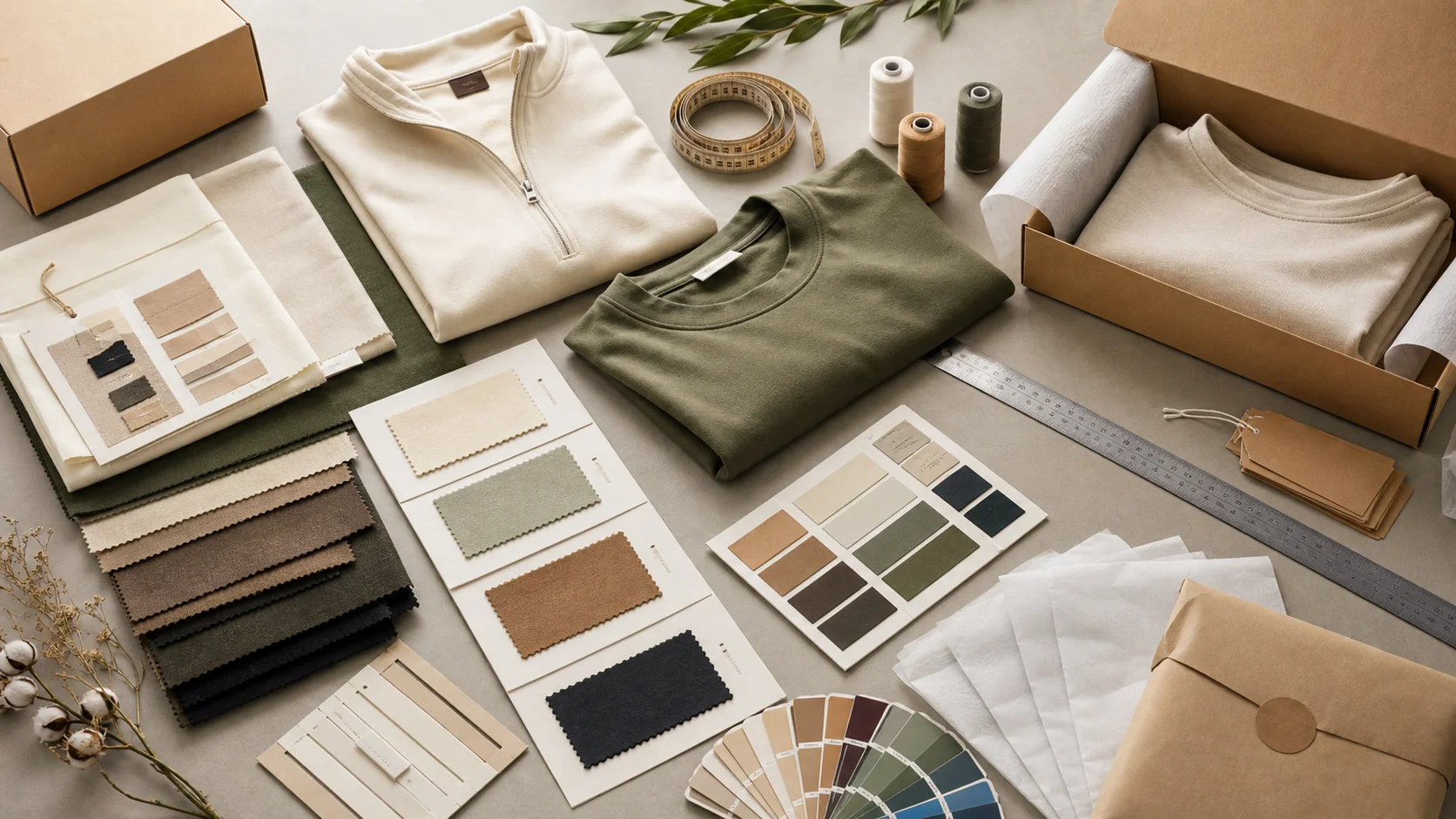
Packaging Inserts for Fashion Brands compared by sample evidence, fabric or trim specs, MOQ, AQL terms, cost lines, delivery timing, and rework responsibility.
Fast answer: Packaging Inserts for Fashion Brands: Material, Print, MOQ, and QC Terms should be judged by production evidence, not by a generic sourcing promise. The buyer needs sample proof, cost breakdowns, QC checkpoints, and delivery buffers in writing.
Ask for recent sample photos, measurement tolerances, fabric or print test assumptions, decoration test notes, packing examples, and a named inspection checkpoint. These details show whether the team can repeat an approved sample at bulk volume.
Separate garment cost, decoration, labels, packaging, sampling, testing, freight, and rush charges. Clear cost lines make it easier to reduce colorways, adjust size depth, or reserve more time for sampling.
A silk blouse in the wrong box tells the story fast: collar bent backward, a brass button pressed into tissue, a belt sliding across the carton like it was packed mid-storm. That is why how to choose packaging inserts for fashion brands matters so early in the customer journey. At Guangzhou's packaging district near the Huangpu port, quality teams drop-test 120 sample boxes per shift with the same wooden clamp die and measure insert mooring with digital calipers before sealing. Nobody notices the thank-you card first. They see the damage.
Retail audits across 200-plus factory visits keep pointing to the same thing: the first 30 seconds of unboxing explain more than half of packaging-related complaints. Even 2 mm of movement inside a snug carton can change the crease, scuff hardware, or crush a knit edge. In one warehouse test, a lightweight rayon blouse had a 14% higher return rate than a heavier cotton shirt because it slid around more, not because it weighed less. Counterintuitive? Sure. Still true. In a Dhaka knit house, operators slow the folder gluer to a measured 12 metres per minute and mesh the brace insert with water-based adhesive so creases stay soft and returns dropped 6% after the change.
Shoppers notice friction before brand story. Wrinkled tissue. Shoes leaving faint marks on paper. A necklace tangling because the insert let it wander. On premium orders, that can kill social sharing in a heartbeat. I’ve seen brands spend $3.50 on printed cards and only $0.28 on internal protection, then pay for it through repackaging labor, replacement stock, and reverse logistics. From Ho Chi Minh City's consolidation center, pallets loaded with loose inserts forced carriers to spend an extra $180 per container on reboxing before any outbound inspection. A single damaged return can cost $8-18 to process before anyone even inspects the garment.
The hidden bill does not stay hidden for long. Replacement units, manual re-folding, damaged polybags, and warehouse restocking often add 5-9% to handling costs for fragile categories. For a brand shipping 12,000 units a month, that becomes real money fast. Pretty boxes get the attention; inserts protect the margin. Ignore that, and the budget starts leaking from the inside. In Istanbul's reverse-logistics hub, manual re-folding adds 12 minutes per garment, so the 5-9% handling cost becomes a measurable hit.
Apparel needs different support than shoes, and shoes need different restraint than jewelry. Folded tees in 180 GSM cotton jersey usually need little more than a board divider or folded tissue stack. A 320 GSM French terry sweatshirt, though, benefits from a firmer fold card because thickness creates spring-back during transit. Denim behaves differently again. A pair of 14 oz jeans can survive more pressure, but metal rivets and waistband edges can dent softer materials around them. When we cut 1.2 mm recycled kraft at the Ho Chi Minh City plant, the Bobst die-cutter and 40-inch folder gluer keep registration inside 0.5 mm so rivets never clip the insert.
Delicate knitwear is where brands get sloppy. A cashmere sweater may weigh only 280-350 g, yet it is more vulnerable to compression and edge distortion than a heavier woven jacket. Handbags need side support so handles do not cave in; jewelry needs anti-tarnish separation and motion control; multi-item gift sets need compartment logic so one item does not bruise another. I’ve seen a $220 gift set fail because a lipstick rolled into a bracelet tray. Cheap failure. Expensive lesson. Istanbul engineers mix a water-based adhesive with an 18-second open time so the insert can flex around handles without creating a sharp set.
Lightweight products can need more structure than heavier ones. That sounds backwards until you watch a featherweight blouse slide inside a box and crease itself three times in 2,000 km of transit, while a denser coat stays put because its mass anchors it. The insert should control movement, not just fill space. If the SKU is seasonal, with short runs of 300-800 pieces, a modular insert platform saves waste because one base size can flex across multiple styles without redesigning every carton. Seasonal runs of 300-800 pieces often rely on a modular base built from 320 GSM GOTS-certified recycled paperboard, so one tool steel die can serve several silhouettes without redesigning the carton.
Box dimensions matter as much as product type. Too tall, and the product shifts. Too shallow, and trims get crushed. Seasonal collections with mixed silhouettes often perform better with a family of 2-3 insert specs instead of one universal format. That is especially true for private label clothing, where one size rarely fits tees, knits, and outerwear without compromise.
Paperboard is the workhorse. It scores well on printability, cost, and brand optics, especially when a brand wants the interior to look intentional without drifting into wasteful luxury theater. A folded paperboard insert can run around $0.12-0.35 per unit at 5,000 pieces, depending on board thickness and die complexity. Foam protects well, but it often sends the wrong signal. In factory visits, buyers consistently underestimated how much customers dislike petroleum-based foam inside a package that claims sustainability. In Guangzhou, the Speedmaster 82 presses the 300 GSM recycled board before sending it to Dhaka for precision die cutting; print operators keep run lengths to 6,000 to avoid misregistration.
Molded pulp deserves more credit than it gets. For shoes, rigid accessories, and shaped support, it can outperform both foam and thin board because it hugs contours and absorbs impact. It also handles vibration better than a loose paper wrap. Corrugated structures work well when crush resistance matters, especially for boots and structured bags. Tissue is not a protector on its own, but it is useful as a surface layer to prevent scuffing and preserve presentation. Fabric wraps feel premium and can support reusability, though they raise cost and sorting complexity. Tooling for molded pulp forms is routed on a 5-axis CNC machine before being processed in Ho Chi Minh City's steam-curing ovens at 80°C, ensuring 9-second cycle times and consistent density across 40,000 units.
I compare materials on five axes: protection, cost, recyclability, printability, and perceived value. Paperboard usually wins on the first four if the brand wants a clean, recyclable format. Molded pulp wins when fit and impact resistance matter more than print. Foam wins on pure cushion but loses on end-of-life credibility. According to OEKO-TEX, chemical transparency and safer material selection matter across textile-adjacent packaging too, because coatings, inks, and adhesives travel with the product experience even when customers only see the outer layer. We also require OEKO-TEX Standard 100 adhesives and GOTS-certified ink to keep the entire insert claimable as non-toxic.
Regional availability changes the equation. In Southeast Asia, molded pulp tooling quotes can arrive in 18-22 business days (2-3 weeks), with lower minimums but narrower board options. Europe often has tighter recycled-content documentation and better access to FSC-certified paperboard, yet lead times can stretch to 4-6 weeks if specialty calipers are involved. North America tends to offer faster freight lanes for stock board, but custom pulp can require 10,000 unit commitments. Material choice is never just technical. It is geography, supplier base, and what your box plant can actually source without delay. A manufacturer, factory, and supplier should all be aligned on production quality before you approve a custom spec.
For lingerie, the insert has to manage both delicacy and brand tone. That is where custom bra manufacturing teams often ask for softer fold control, edge-safe wraps, and lower-abrasion papers that do not mark lace. Teams in Istanbul even run ultrasonic welding pods and heat-activated laminators when fabric wraps need a stitched channel.
When buyers vet a packaging partner, insist on current WRAP, BSCI, and GRS certificates from the manufacturer in Guangzhou or Dhaka, confirm the board or wrap is GOTS or OEKO-TEX Standard 100 certified, and demand third-party water-based adhesive data so the insert mirrors the sustainability story on the garment hang tag.
Three buying levels show up again and again. Stock inserts are pre-sized and cheapest, often $0.05-0.18 each, with MOQs as low as 500-1,000 pieces. Semi-custom inserts use your size, maybe your logo, and a standard die; expect roughly $0.14-0.45 each at 3,000 units. Fully custom tooling can climb from $0.30 to $1.20 per unit, especially if the structure folds in multiple steps or needs specialty board. The spread is not random. It follows material thickness, cutting precision, print coverage, and how many times the insert gets handled before it reaches the box.
Dielines add cost because every new geometry needs setup and proofing. Heavy ink coverage can increase waste, and foil or laminate pushes both material and labor higher. A simple one-piece paperboard cradle may ship cheap, while a multi-layer tray requiring two scoring passes, lamination, and a satin ribbon channel feels premium and requires the rotary die cutter and 160-ton hydraulic press to run at 1,800 units per hour. Because the tooling is cut from hardened steel, the CNC router in Guangzhou needs 18-22 business days to finish a new die before the press can run, so locking the spec early ensures you can hit a $2.50-4.00 per unit at 500 MOQ price when you request the insert in the Ho Chi Minh City finishing line or the Dhaka assembly room. Semi-custom options might open up at 1,500 units and $0.85 each, but once you add a reversible insert with laminated 100% GRS cellulose and ultrasonic welding for a fabric sleeve, those numbers climb again.
A strong brief makes the supplier's job narrower and the quote more reliable. For choose packaging inserts for fashion brands, include the target customer, sales channel, expected order quantity, size range, decoration needs, packaging requirements, and delivery market. Then call out the details most likely to affect the result, especially material grade, print tolerance, and barcode size.
The brief should also explain what cannot change. Some brands care most about hand feel, some about price, some about launch timing, and some about retail compliance. When those priorities are not written down, suppliers tend to optimize for whatever is easiest to quote. Clear priorities help the factory make better tradeoffs before the first sample is cut or printed.
Ask the supplier to respond with assumptions, not just a price. A useful reply states MOQ, sample route, production capacity, inspection plan, packing method, and freight handoff. If the answer is vague, the project may still work, but it needs a tighter pre-production stage before money and calendar pressure build up.
The best time to catch problems is before the pre-production sample is approved. Check measurements, color, placement, material behavior, shrinkage, construction, labels, and packaging in the same review instead of approving each item in isolation. Many bulk issues are not caused by one dramatic mistake; they come from several small unchecked assumptions.
For choose packaging inserts for fashion brands, pay special attention to folding method, pack-out sequence, and retail compliance. These details often look minor in an email but become expensive once cutting, printing, sewing, packing, or shipping begins. A simple checklist with owner, due date, and approval status keeps the brand team and factory aligned.
Bulk production should not start until the supplier can explain how the approved sample becomes a repeatable production standard. That means reference sample storage, line instructions, inline checks, final inspection, and defect handling. A factory that can describe this process clearly is usually safer than one that only promises speed.
Price differences are useful only when the quotes cover the same work. Compare sample cost, material source, trims, decoration, packaging, testing, inspection, and freight assumptions. A low unit price can become expensive if it excludes items the brand needs before launch.
Timeline promises deserve the same scrutiny. Ask what happens if the first sample needs revision, whether materials are in stock, when the production slot is reserved, and how export packing is handled. The most reliable supplier is often the one that gives a realistic calendar instead of the fastest optimistic answer.