
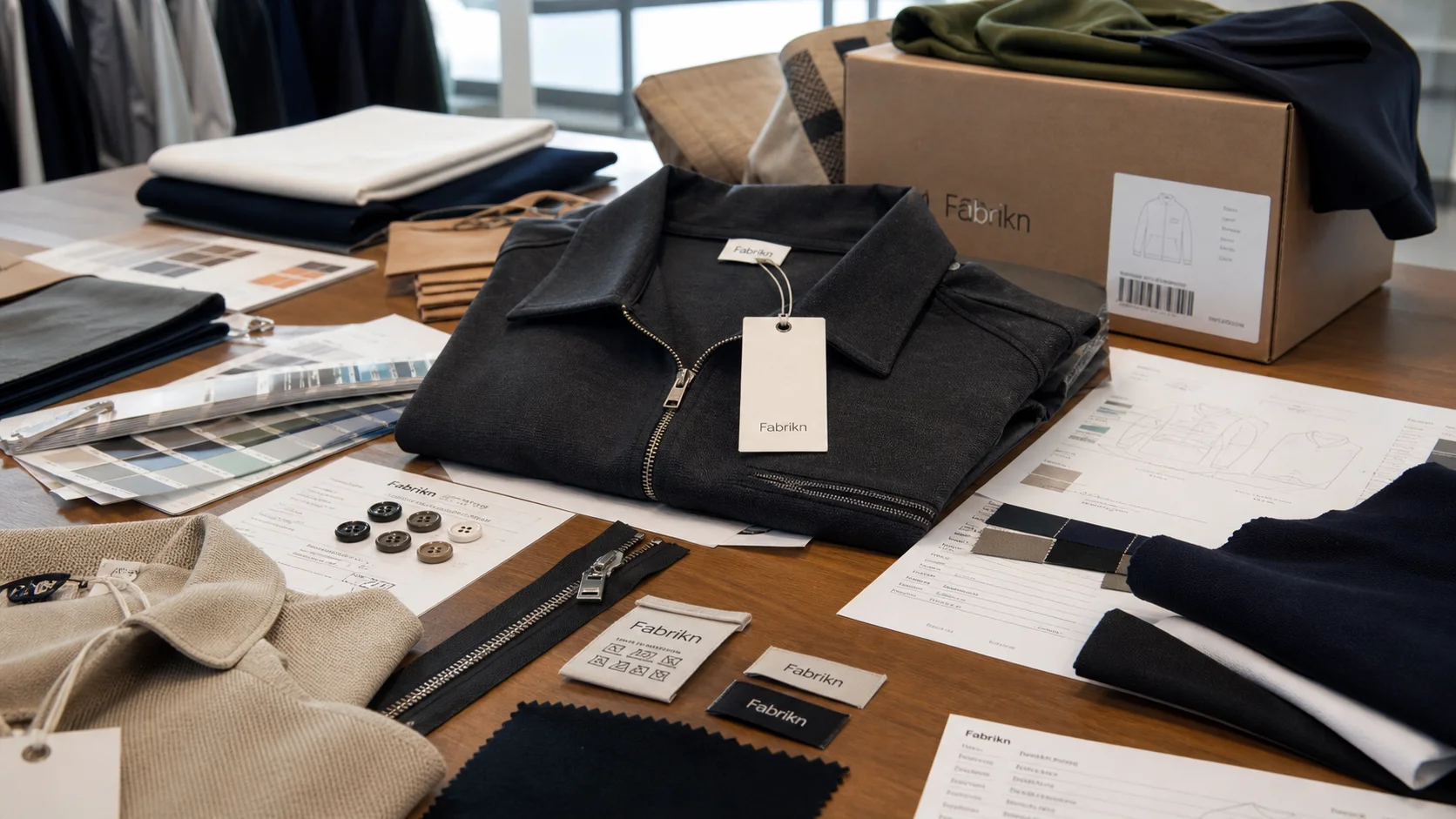
Apparel Swing Tag Material Selection with checks for samples, fit, MOQ, QC evidence, pricing terms, and delivery risk.
Fast answer: Apparel Swing Tag Material Selection: Paper, Texture, Durability, and MOQ should be judged by production evidence, not by a generic sourcing promise. The buyer needs sample proof, cost breakdowns, QC checkpoints, and delivery buffers in writing.
Ask for recent sample photos, measurement tolerances, fabric or print test assumptions, decoration test notes, packing examples, and a named inspection checkpoint. These details show whether the team can repeat an approved sample at bulk volume.
Separate garment cost, decoration, labels, packaging, sampling, testing, freight, and rush charges. When every cost line is visible, it becomes easier to reduce colorways, adjust size depth, or reserve more time for sampling.
A swing tag can survive the sample room and still fail on the sales floor in three days flat. Out of the factory, into shipping cartons, handled by packing teams, hung on rails, then twisted and bent by shoppers — that is the real test when learning how to choose swing tag material for apparel. I’ve watched a 12 pt tag sail through sign-off, then return from humid sea freight with cockled edges, softened corners, and scuffed ink from metal hangers.
Mass-market failures show up fast: bent corners, faded barcodes, a tag that looks tired before the garment has even sold. Premium stores see a different problem. A tag that feels wrong next to a $90 blouse or a $180 jacket drags the whole item down. Luxury is harsher still; even minor curling reads as neglect.
At factories in Vietnam and Portugal, I saw the same pattern repeat: crisp at 22°C and 45% humidity, then changed after three weeks in transit or two days in tropical storage. The garment may survive. The tag rarely gets that courtesy.
A swing tag is not just a price label. It carries SKU data, country of origin, sustainability claims, QR codes, and often the only tactile cue a customer gets before trying the garment. A flat, sharp tag can support a $12 tee. A flimsy one can make a $38 hoodie feel cheaper than its stitching deserves.
I’ve seen brands save $0.02 per tag and lose much more to reprints, complaints, and delayed launch approvals. If your team works on private label clothing services, tag selection belongs beside fabric approval, not after it.
Buyers need to look at the numbers: durability, print quality, recyclability, unit cost. A 350 gsm board usually holds up better than a 12 pt sheet in humid transport. Matte uncoated stock cuts glare, while laminated premium stock survives abrasion but makes recycling harder.
Brand tier changes the whole equation. A $12 tee can tolerate a $0.04 tag only if the rest of the margin stack is healthy. A $180 jacket can absorb a 5% increase in tag cost without anyone blinking, because the customer is paying for precision, not paper thrift. I’ve watched buyers sweat over a half-cent difference on commodity basics, then approve foil, embossing, and double-sided inserts on premium outerwear.
The tag budget should follow the ticket price, not the buyer’s nerves. Entry-level apparel usually does best with matte uncoated stock, light recycled board, or a clean kraft option at 250-350 gsm. Mid-market brands often split the difference with textured board, soft-touch coated paper, or recycled fiberboard that still prints well at 1,000 to 5,000 units. Premium brands move toward heavier stock, 400-600 gsm, tighter edge quality, and finishes like foil, deboss, or spot UV.
A $38 knitwear label can gain more shelf credibility from a thicker tag than from a louder logo. Material signals value faster than ink coverage does. Cheap stock can also raise total cost because it fails more often in transit and on the shop floor. One mid-tier brand saved $110 on a 10,000-piece paper run, then paid for two reprints after curl and barcode smudge complaints.
The final spend ended up 17% higher than if they had chosen a slightly heavier recycled board from the start. Factory arithmetic is brutal. Consumer perception shifts with material, too. Matte uncoated stock reads honest and restrained. Textured kraft feels earthy, though it can skew too casual for formalwear.
Recycled board can look premium if the finish is tight, but some buyers still file it mentally under budget basics. Coated paper handles photography and color blocks better, yet overprinted surfaces can feel glossy in a way that fights minimal branding. If your production crosses both apparel and packaging, compare tag materials alongside cut and sew manufacturing approvals, because the garment hand-feel and tag feel need to agree.
GSM, caliper, and coating are not jargon. They decide whether a tag survives, prints cleanly, and hangs straight. A 300 gsm sheet can feel substantial in hand, but if the caliper is too low, it buckles at the hole. Higher-caliper board resists folding better, while a coated face sharpens dot detail for photography and fine type.
In a bright store, legibility under LED lighting matters more than most design teams want to admit. Coated stock works best for high-color imagery, sharp logos, and dense information panels. Uncoated stock suits minimalist branding, muted palettes, and tactile, editorial aesthetics. Embossing and debossing want thicker boards, usually 350 gsm and up, because the pressure needs body.
Foil stamping looks expensive on premium paper, but it exposes weak substrate quality fast. Spot UV can create contrast, though it turns muddy if overused. I’ve seen brands in Italy and Bangladesh print the same artwork on three stocks and end up with three different retail stories. Recycled boards need careful testing because some absorb ink differently, which can push blacks toward charcoal or make reds look slightly brown under warm store light.
That isn’t a sustainability failure; it’s a print engineering issue. If your supplier promises exact Pantone matching on a highly absorbent board, ask for a press proof, not a verbal assurance. ISO standards for paper testing and print consistency vary by supplier, but the discipline should not. Data from ISO helps here because material performance is measurable, not subjective.
Durability always carries a tradeoff. A laminated tag may survive two months of transport and 200 shopper touches better than an uncoated tag, but that layer can make recycling harder and weaken environmental claims. If the tag is meant to be removed and discarded, don’t overbuild it. If it belongs to the product story, feel matters more.
In my experience, the sweet spot is often a 350-450 gsm board with controlled coating rather than a heavily plasticized finish. If you are still deciding how to choose swing tag material for apparel, start by matching print finish to the retail setting and the expected handling.
Paper, kraft, recycled board, PVC-free film, and fabric tags dominate apparel swing tags. Price, touch, and failure rate separate them. At 1,000 units, a basic paper tag might land around $0.05-$0.12 each, while a custom fabric tag can sit closer to $0.18-$0.45 depending on weave, finishing, and attachment.
At 20,000 units, the per-piece spread narrows, but setup and shipping can still move the total by 10%-20%. Buyers who compare only unit price miss the real bill. Paper is the quickest to source. Once artwork is approved, it can often move in five to ten business days, which makes it handy for seasonal replenishment and testing.
Kraft behaves similarly, though the color and fiber consistency can vary between mills. Recycled board usually gives stronger sustainability messaging and better stiffness, but some suppliers need seven to 14 extra days for procurement if the exact recycled blend is not in stock. PVC-free film takes longer, especially when a brand wants transparency, matte surfaces, or special punching. Fabric tags live in another category: durable, tactile, memorable, and often two to four weeks with larger minimums.
Humidity is the hard test. In Southeast Asia, paper tags can warp in 70%-85% humidity if cartons sit unsealed too long. Kraft can develop edge fray, though it often hides scuffing better than bright white stock. Recycled board behaves well if the fiber is balanced and the coating is light. PVC-free film resists moisture and abrasion, which makes it useful for swimwear or long-haul outerwear, but it can feel less premium unless the print finish is strong.
Fabric tags are the toughest under handling, yet not always the easiest to recycle depending on fiber blend and attachment method. Regional sourcing changes the outcome. Chinese suppliers often offer 3,000-piece minimums on standard board, while some European mills want 5,000 to 10,000 pieces for custom recycled stock. North American converters can run shorter lead times for domestic buyers, but freight costs can erase the gain on small orders.
According to trade.gov, cross-border lead times depend heavily on transport mode and documentation, which is why a cheaper quote can still arrive later and cost more. If your line needs flexibility, watch MOQ and the calendar, not just the sample. That is especially true for wholesale and bulk programs with tight production calendars.
Retailers, journalists, and consumers have learned to read past green ink. So have regulators. The claims that travel best are the ones you can prove: recycled content percentage, FSC chain-of-custody, and plastic-free construction. A tag that says “recycled” without a percentage tells me almost nothing.
A tag that says “70% post-consumer recycled fiber, FSC Mix, printed with soy-based inks” is much easier to defend. Paperwork should match the promise. Certifications are not interchangeable. FSC certification proves responsible forestry and chain-of-custody control.
Recycled content needs a defined percentage, often backed by supplier declarations or third-party documentation. Plastic-free claims must be checked against coatings, laminations, adhesives, and even reinforcements in the hole area. The brand story can collapse over a strip of film the size of a fingernail. If the supplier cannot show written evidence, the claim is marketing copy, not a verified statement.
There’s tension between sustainability and aesthetics. Raw recycled board can look honest, tactile, and modern. It can also look rough if the caliper varies or the fiber specks overwhelm the design. Some luxury brands avoid that look because they want immaculate white surfaces and precise foil.
Fair enough. I’ve seen both ends of the market. The best answer is not “always use recycled.” It is choosing the most defensible material that still fits the brand’s price point and visual system. For brands building a broader sourcing plan, it helps to review options alongside the product catalog so the tag choice fits the full range.
For additional guidance on sustainable textile sourcing, see Textile Exchange standards and materials guidance and OEKO-TEX certification resources. Those references can help align custom tag claims with wider apparel production documentation.
Tag pricing shifts faster than many buyers expect. Size, print complexity, finishing, and quantity all matter. A 50 x 90 mm single-color tag with a basic hole can cost $0.03-$0.06 at 20,000 units, while the same concept with foil, embossing, and rounded corners can move to $0.10-$0.22.
At 1,000 units, setup fees matter more than paper cost, and that’s where many first-time buyers get caught. Plate charges, die-cut tools, and packing method can add $80-$300 before the first tag is printed. At 5,000 units, unit economics improve, but not evenly across materials. A standard board tag might fall by 20%-35% from the 1,000-piece price, while specialty fabric or PVC-free film can drop less because the material and finishing stay fixed.
At 20,000 pieces, the biggest savings usually come from press efficiency and fewer setup repeats. Ordering multiple sizes or colorways? Ask for a combined run. One production schedule is cheaper than three. Turnaround lives or dies on proofing discipline. A supplier may quote seven days, then tack on five more if artwork needs revision or the board changes after sampling.
Rush orders tighten the lane. They push you toward in-stock paper, simpler inks, and fewer finishes. Approve physical proofs early, especially if the tag includes small type, sustainability copy, or QR codes. A misread barcode at proof stage is a nuisance. At bulk stage, it’s a launch delay. That is why a good factory quote should spell out production, packing, and delivery assumptions clearly.
Before placing the order, ask three things: What is the exact MOQ by material? What are the plate or die costs by size? Which stock has been tested with the intended ink system? Those questions save money because they force the supplier to show the real production path. If you want a quick starting point, you can get a free quote and compare the material options before season planning locks in.
Start with the brand goal, not the artwork. Value, sustainability, luxury, durability — which one is the tag supposed to carry? Once that’s clear, request three samples: one economical, one balanced, one premium. Compare them in hand, under store lighting, and next to the actual garment fabric.
A tag that suits 320 GSM French terry may not suit silk crepe, and a heavy outerwear board can overpower a lightweight tee. Match the material to the product, not the mood board. Then test for abrasion, humidity, fold memory, and color shift. I’d use a simple 48-hour humidity test at 65%-75% relative humidity, 20 repetitive bends on the hang hole, and a carton rub test against kraft packing paper.
Check whether the edges fray, whether the color drifts, and whether the hole elongates. If the tag fails there, it will fail in a warehouse. Don’t skip testing because the sample looks clean on a desk. Ask suppliers specific questions about coating type, board thickness, post-consumer recycled content, and whether the quoted finish changes recyclability.
Ask for chain-of-custody paperwork if FSC is claimed. Ask what happens if the chosen ink system bleeds on recycled stock. Ask whether the lead time is seven days or 21 days in peak season. Precision in the brief gets better answers than vague style language ever will.
The thing nobody tells you: the best tag is not the fanciest one. It is the one that survives freight, prints accurately, and supports the price point without forcing a reprint.
My recommendation framework is simple. For entry-level basics under $25 retail, choose sturdy paper or light recycled board with minimal finishing. For mid-market apparel between $25 and $90, use textured board or heavier recycled stock with one premium detail. For premium and luxury, move to thicker board, precise finishing, and tighter proofing.
If sustainability is central, choose the most local, verified option with documentation you can audit. That is how to choose swing tag material for apparel without paying twice for the same mistake. It also keeps how to choose swing tag material for apparel tied to the things that actually matter: quality, cost, MOQ, and brand signal.
Match the tag to the retail price and the product story. A $12 tee usually works with 250-350 gsm paper or recycled board, while a $180 jacket can justify 400-600 gsm stock, foil, or embossing. Keep the finishing consistent with the garment’s perceived value.
Basic paper tags often cost $0.03-$0.06 each at 20,000 units, while premium finishes can reach $0.10-$0.22 or more. At 1,000 units, setup fees can matter more than the substrate, adding $80-$300 in plate or die charges depending on complexity.
Standard paper or kraft tags can often be ready in five to ten business days after proof approval. Specialty materials, foil stamping, or fabric tags may take two to four weeks. Rush jobs usually reduce finish options and increase the risk of reprints.
Yes. A well-formed recycled board with controlled coating, tight die-cutting, and clean typography can look premium. The key is testing print sharpness and edge quality, because recycled fibers can absorb ink differently and change the final color.
Ask for exact gsm or caliper, minimum order quantity, proof turnaround, finishing details, and documentation for recycled content or FSC claims. Also confirm whether the material has been tested with your ink system and whether the quoted price includes die-cutting, packing, and freight.