
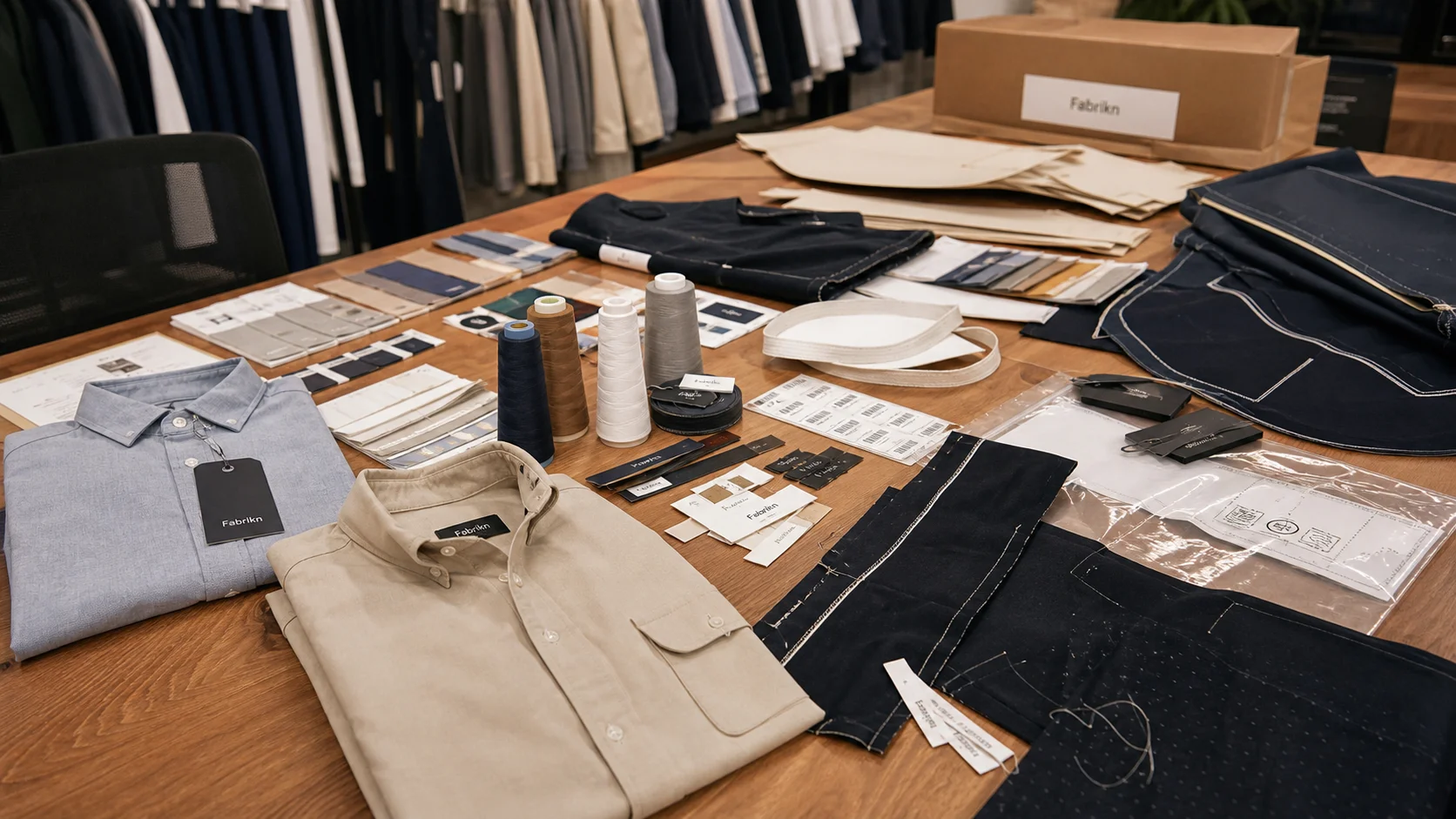
Premium Clothing Packaging for Startups with checks for samples, fit, MOQ, QC evidence, pricing terms, and delivery risk.
Fast answer: Premium Clothing Packaging for Startups: Layers, Finish, Cost, and MOQ should be judged by production evidence, not by a generic sourcing promise. The buyer needs sample proof, cost breakdowns, QC checkpoints, and delivery buffers in writing.
Ask for recent sample photos, measurement tolerances, fabric or print test assumptions, decoration test notes, packing examples, and a named inspection checkpoint. These details show whether the team can repeat an approved sample at bulk volume.
Separate garment cost, decoration, labels, packaging, sampling, testing, freight, and rush charges. When every cost line is visible, it becomes easier to reduce colorways, adjust size depth, or reserve more time for sampling.
A $120 sweatshirt can lose its swagger in twelve seconds. I watched it happen: French terry, 320 GSM, enzyme wash, clean fit—none of it mattered when the mailer arrived sagging, the corner crushed, the tissue thin enough to wrinkle at a glance, the logo crooked like the printer had given up halfway through. That is how to design premium clothing packaging for startups the wrong way: treat packaging like filler, and the customer will treat the product like one too.
Across factory visits in Guangzhou, Dhaka, Ho Chi Minh City, and Istanbul, the same pattern kept surfacing. Technically strong garments were getting dragged down by packaging that flexed at the seams or curled under humidity. Before a hand ever touched the fabric, the word “cheap” had already landed. At the Guangzhou folding-carton shop, a 12-color Bobst die cutter tied to a Kolbus folder-gluer lost registration the minute humidity rose above 65%, and in Istanbul a rotary screen press with a 60-inch drum delivered pearlized ink that blistered at 80% humidity during transit. Packaging sticks in memory because it gets handled first and thrown away last. For direct-to-consumer basics priced from $38 to $68, that first touch can carry a 10% to 15% premium. For capsule pieces at $150 to $400, it guards the expectation of craft.
Customers compare fast. A $24 tee in a sturdy corrugated mailer with sharp typography can feel more considered than a $95 blouse in a flimsy glossy box. I saw that in Manila, Guangzhou, and Istanbul, where labor costs vary but print control does not, and in northern Italy, where packaging budgets can balloon to $6.50 to $9.00 per unit before anyone checks whether the box survives transit. Smart suppliers in Poland and Vietnam often do better by using one structural format well instead of stacking three decorative tricks badly. Simple wins.
According to ISO packaging standards and performance guidance, packaging performance is not just aesthetics; it is repeatability, transport tolerance, and standardization. For verified sustainability expectations, brands can also reference OEKO-TEX material safety standards, and I make sure the boards and water-based adhesives are backed by certifications like GOTS, OEKO-TEX Standard 100, WRAP, BSCI, and GRS before signing off on a factory. That matters because premium perception cracks fast when 1 in 20 boxes arrives dented or the print drifts by 2 mm. I’ve seen brands spend $4.20 on a rigid setup and still lose the advantage because the lid fit varied from batch to batch. Premium packaging is not decoration. It is a costed brand asset that shapes perceived value, return behavior, and repeat purchase intent.
Start with positioning, not a menu of foils, ribbons, and magnetic closures. Begin with embellishment and you’ll overspend by 20% to 40% while missing the point. I’ve worked with startups trying to force luxury through metallic ink and soft-touch lamination. Nervous result. Premium signals only work when they support the product story already in motion. At the Ho Chi Minh City partner making GOTS-certified cotton basics, we mapped that story to a single colorway, ran it through a Heidelberg Speedmaster 74 with inline spectrophotometry, and locked the matte ink before touching any embossing or metallic foil.
Minimalist brands usually need an almost editorial package: one color, tight grid, matte stock, restrained logo lockup. Modern brands do better with structural clarity and one tactile accent, maybe blind debossing or an uncoated board cut from 380 GSM SBS stock and creased on a Guangzhou vacuum creaser. Heritage brands can go heavier on paper, deepen the color, and use a more formal typographic voice, often printed via an HP Indigo 12000 for variable data or foil stamped with a hot-air heated die. Sustainable brands should show honesty in the material itself—visible recycled fiber, fibrous uncoated stock, low-ink graphics, nothing fake-artisanal if it is being made by the hundred-thousand. I learned that while reviewing a private-label line through private label clothing services, where the garments were strong but the box drifted into faux-luxury clutter.
There’s a hierarchy here, and the order matters. Structure first. Color second. Texture third. Typography fourth. Tactile details—tab tuck, debossed logo, that sort of thing—come last. A $3.50 packaging unit can outshine a $7.00 one if the brand signal is coherent. I’ve seen a matte gray mailer with precise black type beat a rigid box loaded with gold foil, spot UV, and satin ribbon. Too many cues create noise. Customers do not read that as luxury. They read it as insecurity.
Mismatches are everywhere in supplier visits. The garment label says natural, calm, elevated, while the box screams loud white gloss and high-contrast print. Overprinting is another trap. Startups ask for the logo on every surface, then wonder why the package feels promotional instead of premium. If your promise is considered design, silence belongs in the design. For small batches of 500 to 2,000 pieces, that discipline matters even more. In a custom production run, the manufacturer and factory should both be aligned on the same visual language before samples move forward.
Material choice is where aspiration runs into freight, damage rates, and waste. Rigid boxes create a luxury cue quickly, but they add weight, eat storage space, and can raise shipping costs by 8% to 12% on parcel-heavy programs. Folding cartons sit in the middle. Corrugated mailers, especially those run on a BHS Corrugated line in Guangzhou with 350 GSM C-flute and robotic gluing, are practical, durable, and cheaper to transport, especially for DTC orders shipping 2 to 5 days after purchase. Tissue, dust bags, hangtags, and belly bands can fill the sensory gap only if they support the main structure, not if they are trying to carry the whole thing.
I’ve seen rigid boxes work beautifully for outerwear at $250 and up, where the package is part of the gift experience. They typically start with 450 GSM duplex board laminated with a 2-mil aqueous coating applied via a Comexi roll lamination line in Dhaka. For tees and knitwear at $40 to $80, a solid mailer with a sharp insert often feels more credible. Dust bags help with shoes, knits, and premium accessories, but they turn into dead weight if they’re oversized or stitched from polyester nobody will reuse; a GOTS-certified cotton canvas dust bag cut on a Ho Chi Minh City Gerber cutter and overlocked with a 1,200-stitch blind hemmer costs $1.20 extra but keeps returning customers. Belly bands are useful when you want a restrained mark without committing to full box print. One strong material, used precisely, beats five weak materials used anxiously.
Sustainability claims need proof, not poetry. Recycled content helps, but recycled does not automatically mean durable. FSC paper tells you the fiber source is responsibly managed. Water-based inks reduce solvent load. Plastic-free coatings can improve recyclability, though they sometimes sacrifice abrasion resistance. Compostability claims are the most abused; they only matter if the material matches local disposal infrastructure. Data from Textile Exchange shows buyers are rewarding verified material claims, not vague green language. For packaging materials, insist on GOTS, OEKO-TEX Standard 100, and GRS attestations when you are promising a recycled or organic experience. If you cannot document it, don’t print it.
Here’s what most people miss: the prettiest premium material can raise replacement rates if it fails in transit. I visited a Dhaka factory using soft-touch laminated boxes that looked expensive under showroom lights, then scuffed badly in humid storage and arrived with 6% to 8% cosmetic damage on some routes. Reprints. Relabeling. Lost time. A slightly less glamorous board with a better coating did the job and saved money over 10,000 units. Tactile quality has to survive the trip. Otherwise, it’s theater.
Balancing the package means balancing touch, weight, and shelf presence. If you sell through stores, it needs to stack cleanly and resist corner crush. If you ship direct, it needs to survive a 1.2-meter drop and still open neatly. In my experience, the sweet spot for many startup apparel brands is a corrugated mailer or folding carton paired with one premium touch, such as blind embossing or a textured uncoated finish. That combination often lands between $0.85 and $3.25 per unit at scale, with much less waste than a fully rigid build. For example, a Ho Chi Minh City supplier quotes custom corrugated mailers at $2.50-4.00 per unit at 500 MOQ with 18-22 business days lead time when using UV-cured water-based inks on a Kongsberg cutting table. For wholesale and bulk programs, ask the supplier to quote both custom and standard options so you can compare quality, MOQ, and unit economics side by side.
A realistic cost breakdown for a matte folding carton run in Guangzhou might look like this: $0.68 for 360 GSM SBS board purchased in 2,500-sheet packs from a DS Smith distributor, $0.30 for a 4-color offset print on a Heidelberg Speedmaster with UV-curing LED lamps, $0.25 for aqueous coating and die-cut using a Bobst die-cutter, $0.20 for gluing and jogging on a Kolbus folder-gluer line, $0.12 for packaging in an inner shipping tray, and $0.15 for inbound DHL air freight to the U.S., pushing the landed cost to roughly $1.70 per unit. That leaves room for premium touches like a blind deboss or a satin ribbon that adds another $0.30 to $0.50.
On the tissue and accessories side, Dhaka’s automatic Gerber plotter cuts GOTS-certified cotton tissue and a sewing line with blind stitchers attaches drawstrings for $0.40 per unit, while hangtags cut on an HP Indigo 8000 and finished with a matte aqueous coating add $0.18. When you assess quotes, always ask for a line-item sheet that shows materials, printing, finishing, tooling amortization, packaging, and freight. The tooling for a new box structure (steel rule for die, creasing) typically costs $420-$720 per form, so amortize that across your 5,000-unit run to keep the per-unit number honest.
Don’t forget the process controls: pre-press proofing, color matching by spectrophotometry, and a final 100% inspection using a QCM (quality control machine) at the supplier’s Guangzhou plant. The more precise the machines—Bobst die-cutters, Heidelberg presses, Kolbus gluers—the less variance you see between lots, so your $1.70 can stay $1.70 instead of creeping up due to rework. Finally, have the supplier quote charges for excess freight or oversize cartons so you are prepared when the gnarly realities of logistics hit.
Pick a region that matches your mix of material, lead time, and certificates. Guangzhou excels at folding cartons and mailers because it has an ecosystem of die-makers, foil stampers, and offset houses with fast turnarounds. Dhaka is strong on textiles like dust bags and ribbons, but the freight to North America takes 26-28 days, so plan accordingly. Ho Chi Minh City and Istanbul are reliable for corrugated mailers and rigid setups, respectively, thanks to modern Kolbus gluers and Heidelberg presses. Istanbul’s factories often run WRAP- and BSCI-compliant lines with automation that keeps labor costs predictable.
Always verify certifications. Ask for GOTS, OEKO-TEX Standard 100, WRAP, BSCI, and GRS certificates, and check that they are current. These audits ensure the factory operates ethically, uses registered chemicals, and tracks recycled or organic inputs. Bring a third-party lab report for the inks if you are promising skin-safe contact or low-odor unboxing. If the supplier uses adhesives from Henkel or H.B. Fuller, request the SDS (safety data sheet) and ensure it matches the OEKO-TEX Standard 100 claim.
Lean production choices help keep costs manageable. A Guangzhou supplier may run a Kongsberg cutting table for short runs, while the same structural die might be produced on a 120-ton sheet-fed press for longer runs. Ask for process maps: what sensors monitor glue weight? Which presses have spectrophotometers? Does the supplier use an inline creasing unit like the Bobst Expertfold to eliminate secondary operations? Those details tell you whether they are tracking quality in the same language you are.
Lead time is where good intentions go sideways. Tooling a new box die, aligning print plates, and curing coatings can take 18-22 business days in Guangzhou or Ho Chi Minh City once you approve the artwork. That timeline assumes you have sent a dieline with locked Pantone specs and that the supplier has a running queue on their Bobst, Heidelberg, or Kongsberg machines. The moment you slow down approval or ask for an extra color, the 18-22 days stretch to 26 or 30.
Mitigate delays by bundling samples. Ask for a full-size mock-up that includes the adhesive flaps, the lamination, and any dust bag or hangtag you plan to ship together. The supplier should be able to finish that mock-up on the XPS foam board, run it through a vacuum folder, and send it to you overnight from Guangzhou or Istanbul. If your packaging includes a ribbon handled by a Dhaka sewing line, include that in your sample kit so the texture is clear.
Reserve slot time on the machines. The most reputable factories publish production windows, like “sheet-fed offset run scheduled for the week of the 12th” or “Kolbus folding line open for the 400-gram mailers on June 1.” Confirm that your order is on the board so you aren’t pushed to the back and have to add air freight fees. Pre-paying for a small run on one of these slots often keeps the 18-22 business day promise intact.
Retention is as important as first impression. A well-made dust bag from Dhaka, woven with GOTS-certified cotton and printed with OEKO-TEX-approved inks, can stay in the customer’s closet and extend your brand memory beyond the unboxing. The same goes for a well-constructed mailer: if it includes a modular insert that can slide out and become a shipping label holder, the customer keeps it around and reuses it.
Reuse is often misunderstood as “recycle this now.” I prefer to think of it as a design brief that asks the packaging to do something again. That could be a reusable pouch that turns into storage for a capsule wardrobe, printed with a QR code that leads back to your product care page, or a magnetic closure box that homeowners keep for heirloom storage. Each of these touches must be designed for durability, so insist on board that resists 1.2-meter drops and adhesives that don’t yellow.
Brand memory is built through consistent cues. Keep the same typography, embossing, and tactile ribbon between your online unboxing and the retail counter in Istanbul or Guangzhou. Document the grain direction of the board, the pressure setting on the Kolbus folder-gluer, and the tension on the ribbon so the same feel can be reproduced next season.
Expect to budget between $0.85 and $3.25 per unit for mailers or folding cartons that carry one premium touch. That includes $0.68 for board, $0.30 for four-color printing, $0.25 for coating and die cutting, $0.20 for folding/gluing, and $0.12 for inner packaging. Custom corrugated mailers from Ho Chi Minh City run $2.50-4.00 per unit at 500 MOQ with 18-22 business days lead time. Add $0.30 to $0.50 more if you want blind embossing, satin ribbon, or GOTS-certified dust bags.
Plan for 18-22 business days once art is locked, tooling is paid, and the supplier’s schedule is clear. That includes die-making, plate approval, print runs, coating, and final inspection on presses such as Bobst, Heidelberg, or Kolbus. If you are working with Dhaka or Istanbul partners, factor in shipping, so you aren’t surprised by a longer door-to-door timeline.
Ask for GOTS, OEKO-TEX Standard 100, WRAP, BSCI, and GRS certificates, and make sure they cover the specific materials you are using—boards, inks, adhesives, textiles. Request the SDS for adhesives from Henkel or H.B. Fuller to confirm they match the OEKO-TEX claim, and work with labs that can validate recycled content so you can confidently carry the sustainability story.