
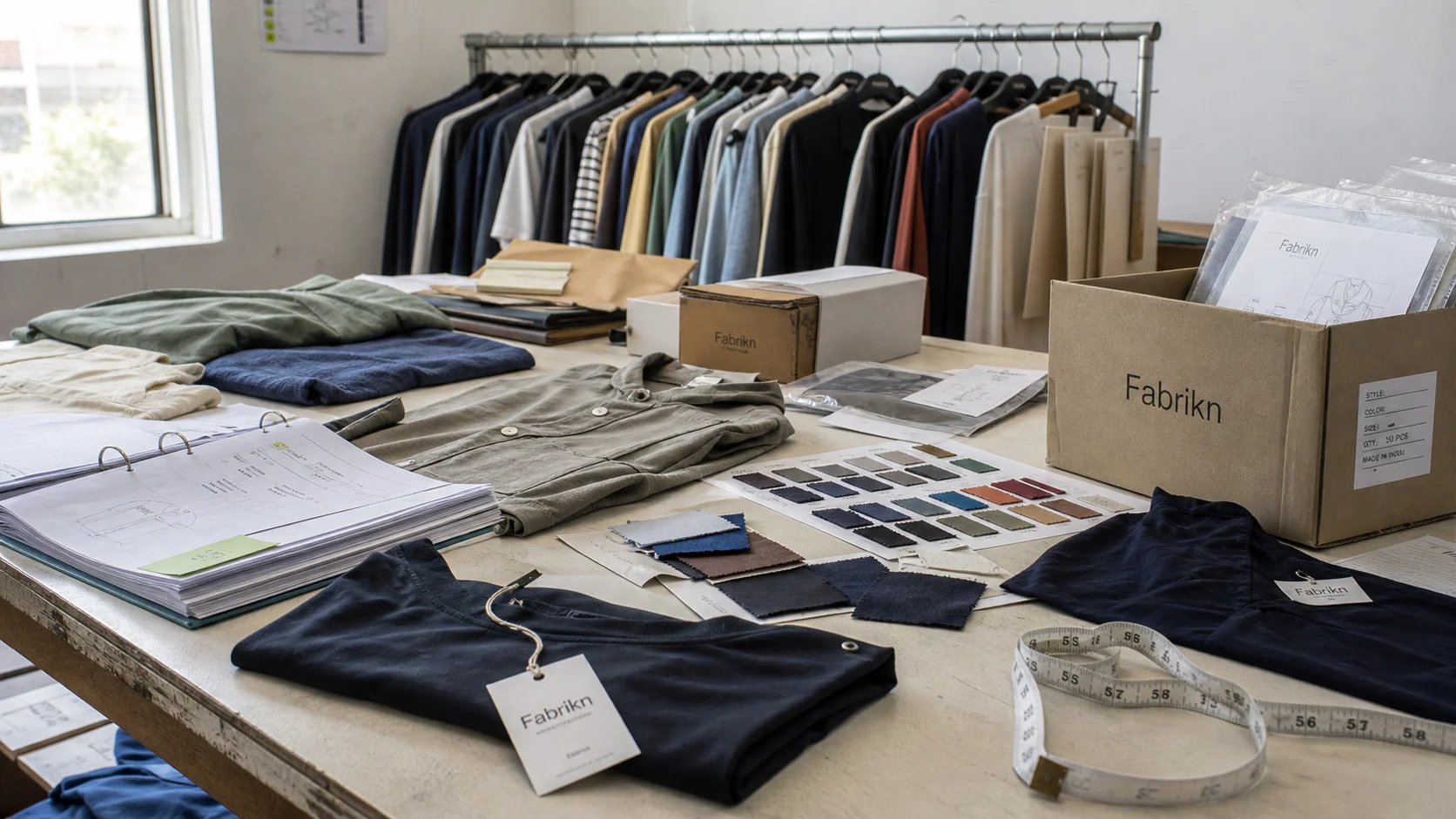
Evaluate Trade Show Suppliers Quickly compared by sample evidence, fabric or trim specs, MOQ, AQL terms, cost lines, delivery timing, and rework responsibility.
Fast answer: Evaluate Trade Show Suppliers Quickly: Tech Pack, Sample Gate, MOQ, and QC Terms should be judged by production evidence, not by a generic sourcing promise. The buyer needs sample proof, cost breakdowns, QC checkpoints, and delivery buffers in writing.
Ask for recent sample photos, measurement tolerances, fabric or print test assumptions, decoration test notes, packing examples, and a named inspection checkpoint. These details show whether the team can repeat an approved sample at bulk volume.
Separate garment cost, decoration, labels, packaging, sampling, testing, freight, and rush charges. Clear cost lines make it easier to reduce colorways, adjust size depth, or reserve more time for sampling.
Trade shows are one of the fastest ways to discover new suppliers, compare capabilities, and build relationships in a short amount of time. But they can also be overwhelming. Between crowded aisles, sales pitches, product samples, and limited scheduling windows, buyers often have to make judgment calls in minutes instead of weeks.
If you are trying to evaluate trade show suppliers quickly, the challenge is not just finding the right partner. It is filtering out the wrong ones fast enough to spend your time on the suppliers who can actually meet your needs. Whether you are sourcing apparel, promotional products, textiles, or manufacturing services, a structured evaluation process helps you avoid wasted conversations and poor-fit partnerships.
This guide explains how to evaluate suppliers quickly and confidently at a trade show without sacrificing quality. You will learn what to look for, what questions to ask, how to spot red flags, and how to compare suppliers after the event. If your business is sourcing clothing or private-label apparel, you can also explore Fabrikn’s services to better understand what a strong manufacturing partner should offer.
At a trade show, time is your most limited resource. You may only have five to ten minutes with each supplier before moving on to the next booth. That means you need a method that quickly answers three essential questions:
Fast evaluation matters because trade show environments can encourage superficial decision-making. A polished booth, a persuasive sales rep, or a trendy product display may look impressive, but none of those things guarantee capability. A systematic approach helps you focus on the facts that matter most.
Quick screening is especially important for procurement teams, brand owners, retailers, and startups working with limited budgets or launch deadlines. A good trade show strategy lets you identify shortlists fast, reducing follow-up time and helping your team move from discovery to due diligence more efficiently.
When evaluating trade show suppliers quickly, focus on the core indicators that reveal whether they can support your business. These include product fit, manufacturing capability, communication quality, compliance readiness, and consistency.
Start with the basics: does the supplier offer the type of product you need? For clothing and apparel buyers, this means checking whether they work with the right categories, such as activewear, uniforms, basics, fashion apparel, or customized garments. If their core offering does not align with your needs, they are not worth extensive time.
Even a supplier with a great sample may not be able to produce at your required scale. Ask about minimum order quantities, lead times, production capacity, and whether they manage cutting, sewing, finishing, packaging, and labeling in-house or through partners.
Look beyond one sample. Ask how they maintain quality across large production runs. A reliable supplier should be able to explain their quality control process, inspection stages, and how they handle defects or rework.
A supplier’s ability to answer questions clearly and directly at the trade show is often a strong indicator of how they will handle future communication. Pay attention to whether they understand your needs, answer without hesitation, and follow up with useful information.
If your business requires certifications, testing, or legal compliance, verify this early. Depending on your market, you may need documentation related to labor practices, fabric composition, country of origin, sustainability claims, safety standards, or product testing.
The best suppliers are not just order-takers. They can adapt to design changes, help you refine specifications, and recommend better options when needed. Fast evaluation should include a sense of whether the supplier is collaborative or rigid.
To evaluate trade show suppliers quickly, use a simple screening framework. This helps you avoid getting distracted by sales presentation and keeps your focus on the essentials.
Before attending the event, decide on your must-haves. These may include product type, budget range, order quantity, delivery window, sustainability standards, or manufacturing location. The clearer your criteria, the faster you can rule suppliers in or out.
When you approach a booth, observe quickly:
This first impression is not a final judgment, but it helps you decide whether the supplier deserves a deeper conversation.
Within the first few minutes, ask the supplier about:
These three answers reveal whether the supplier is aligned with your business size and sourcing goals.
Do not rely only on verbal claims. Ask for examples of past work, factory certifications, product data sheets, inspection reports, or references. A credible supplier should be able to provide evidence quickly.
Create a simple scorecard and rate each supplier on a scale of 1 to 5 for:
This makes comparison much easier after the show, especially if you speak with dozens of vendors.
The right questions can save you hours of follow-up. Ask short, direct questions that reveal practical information fast.
These questions are especially useful in clothing and apparel sourcing because product detail, sizing, fabric choice, and customization requirements can significantly affect quality and delivery. If you want to understand more about a manufacturing partner’s process and background, Fabrikn’s about us page is a helpful example of the kind of transparency buyers should look for.
Fast evaluation is not only about identifying good suppliers. It is also about spotting warning signs early. If you notice these red flags, you may want to remove the supplier from your shortlist immediately.
If the supplier cannot clearly explain their production process, pricing structure, or lead times, that may indicate inexperience, poor organization, or lack of transparency.
Be careful with suppliers who promise unusually low prices, extremely fast turnaround, or unlimited customization without explaining how they can deliver. If it sounds too good to be true, it usually is.
Suppliers that cannot provide samples, certifications, product specs, or basic business information may be difficult to verify later. No documentation often means more risk.
Even if the booth looks impressive, a poorly made sample is a major warning sign. Look at stitching, finishing, fabric quality, construction, labeling, and consistency.
If you do not know who will handle your account after the show, follow-up may be slow or confusing. You need a supplier with a defined communication structure.
Professional suppliers should be open to questions. If they become evasive or defensive when asked about capacity, quality, or compliance, that is often a sign to move on.
Once the event ends, the real evaluation begins. Because your memory will fade quickly, organize your notes within 24 hours while the conversations are still fresh.
Group suppliers into three categories:
This helps you avoid trying to follow up with too many prospects at once.
Compare suppliers using the same criteria you used at the show. Look at product fit, minimum order quantity, lead time, quality indicators, and responsiveness. The supplier with the best booth presentation is not always the best overall choice.
For your top candidates, ask for:
This follow-up stage is where you confirm whether the supplier’s trade show claims hold up under scrutiny. If you are ready to speak with a team directly, you can reach out through Fabrikn’s contact us page to see how a structured inquiry process works.
Suppliers who respond quickly and clearly after the show usually deserve more attention. Those who delay or provide incomplete information may be signaling future communication issues.
Even experienced buyers can make avoidable mistakes at trade shows. Watch out for these common errors.
Low price is attractive, but it should not be the only factor. A cheap supplier with inconsistent quality or poor communication can become expensive very quickly.
A large factory may be excellent for enterprise orders but unsuitable for a startup’s smaller volumes. Match the supplier to your current business stage.
Some suppliers can make a product but cannot deliver it within your schedule. Timing matters as much as cost.
Trade show conversations can be persuasive, but every important claim should be checked. If a supplier says they are certified, experienced, or scalable, ask for proof.
If you delay follow-up, you may lose momentum or forget important details. The best suppliers are often in high demand, so act quickly.
Make sure procurement, product, operations, and leadership are aligned on selection criteria. Fast evaluation works best when your team already agrees on priorities.
When you are evaluating clothing or apparel suppliers, speed matters, but so does clarity. Fabrikn focuses on helping B2B buyers understand capabilities, processes, and service scope quickly so they can make informed sourcing decisions without unnecessary back-and-forth.
If you are comparing trade show suppliers for apparel manufacturing, you want a partner who can explain services clearly, communicate production capability transparently, and support decision-making with practical information. That is why it helps to review a supplier’s service structure, company background, and contact responsiveness before moving forward.
To explore how a professional manufacturing partner presents its capabilities, review Fabrikn’s services, learn more through the about us page, or start a conversation via the contact us page.
Evaluating trade show suppliers quickly does not mean evaluating them carelessly. It means using a smart, repeatable process that helps you identify the best-fit suppliers in less time. By focusing on product fit, production capacity, quality consistency, communication, compliance, and response speed, you can make strong decisions even in a fast-paced event environment.
The key is preparation. Define your criteria before the show, ask focused questions, take structured notes, and follow up quickly with the most promising suppliers. With the right system, trade shows become a powerful sourcing tool instead of a chaotic guessing game.
For businesses sourcing apparel or looking for a dependable manufacturing partner, a fast evaluation process can help you find suppliers that are not only visible at the show, but genuinely capable of supporting your business growth.
Get a free quote from Fabrikn — your trusted B2B clothing manufacturer with 10+ years of experience. MOQ as low as 200 pieces.
Get a Free Quote →Use a simple framework: check product fit, capacity, quality, communication, compliance, and timeline. Ask direct questions, review samples, and score each supplier immediately after the conversation.
Start with product fit and business fit. If the supplier does not offer the right product category or cannot meet your order volume and timeline, it is usually not worth moving forward.
That depends on the event size and your sourcing goals, but it is better to evaluate a smaller number of strong-fit suppliers thoroughly than to speak with too many vendors superficially.
Ask what they specialize in, who their typical clients are, and what their minimum order quantity and lead time are. Those answers quickly reveal whether the supplier matches your needs.
Red flags include vague answers, poor sample quality, lack of documentation, overpromising, and no clear follow-up contact. These often indicate risk or poor reliability.
Ideally within 24 to 48 hours. Fast follow-up keeps the conversation fresh and helps you compare suppliers while the details are still clear.
No. A professional booth is a positive sign, but it should never replace due diligence. Always verify claims with documentation, samples, and follow-up questions.