
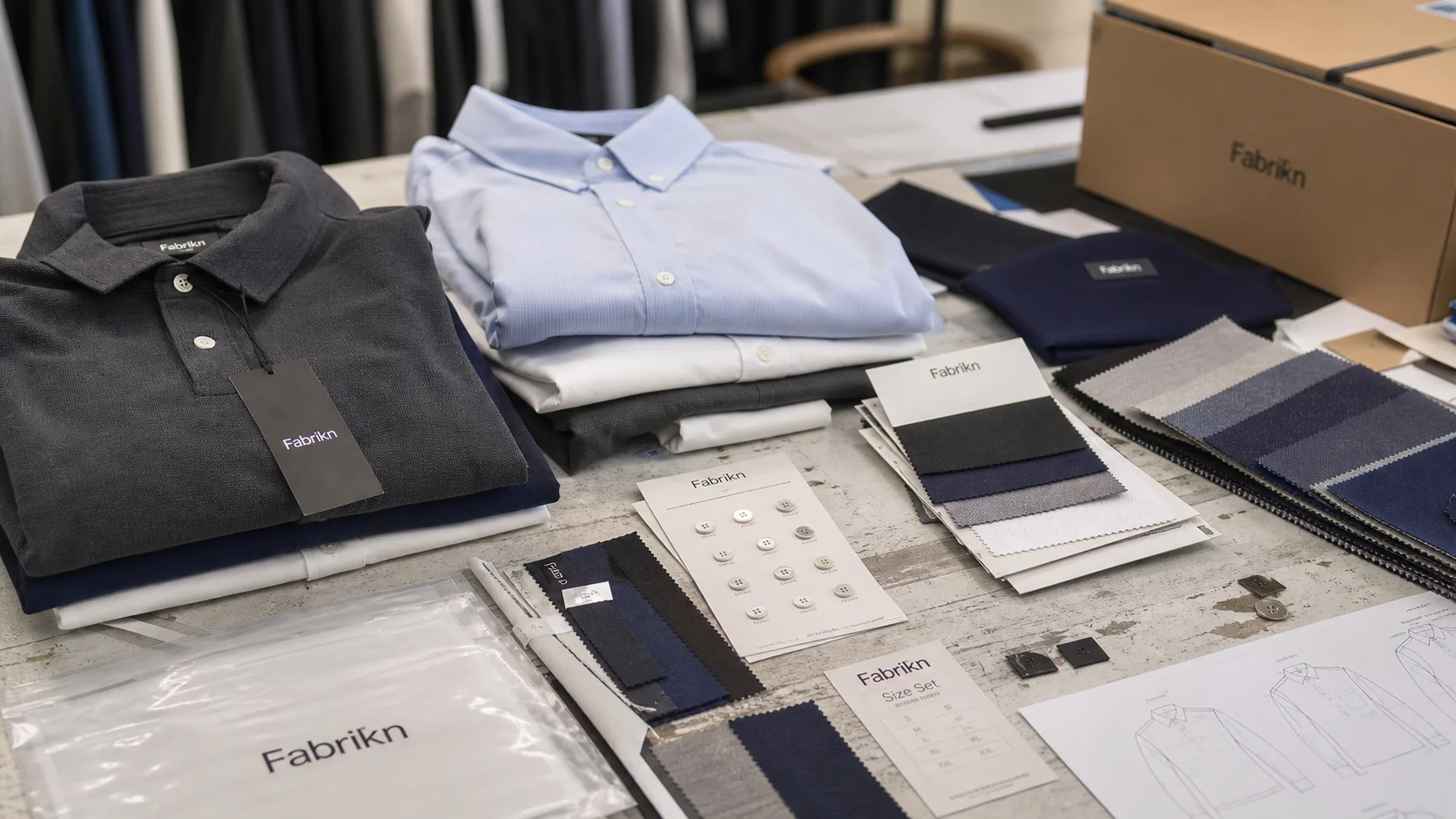
Find T-Shirt Supplier in China compared by sample evidence, fabric or trim specs, MOQ, AQL terms, cost lines, delivery timing, and rework responsibility.
Fast answer: Find T-Shirt Supplier in China: Sample Fit, Trim, AQL, and Delivery Risk should be judged by production evidence, not by a generic sourcing promise. The buyer needs sample proof, cost breakdowns, QC checkpoints, and delivery buffers in writing.
Ask for recent sample photos, measurement tolerances, fabric or print test assumptions, decoration test notes, packing examples, and a named inspection checkpoint. These details show whether the team can repeat an approved sample at bulk volume.
Separate garment cost, decoration, labels, packaging, sampling, testing, freight, and rush charges. Clear cost lines make it easier to reduce colorways, adjust size depth, or reserve more time for sampling.
The smartest T-shirt buys usually start with one question: why does China still win so many orders? If you are learning how to find t shirt supplier in china, the answer is simple enough. Knitting, dyeing, printing, trims, and bulk sewing can sit inside the same supply chain, which makes speed and coordination easier than in more fragmented markets.
In factory visits across Guangdong, Zhejiang, Fujian, and Jiangsu, the same pattern kept showing up: the cheapest quote was rarely the safest choice, while the best-run plants were often only 8% to 15% higher. That spread makes sense when you compare a basic 180 GSM combed cotton tee, a French terry 320 GSM oversized style, and a pigment-dyed boxy shirt, because each one pulls a different chain of mills, labs, and sewing teams.
According to WTO data, China remains one of the largest apparel exporters globally, which explains why fabric access and manufacturing depth still pull buyers in even after wages have climbed. Coastal hubs move faster, with sample turn times of 5 to 10 days and bulk production in 20 to 30 days for simple tees, helped by dense supplier networks and stronger logistics.
Inland zones can run 10% to 20% cheaper on labor, but the trade-off is usually longer lead times, tighter transport buffers, and more variance in finish quality when a factory depends on outside dye houses or print shops. A low-MOQ factory with glossy product photos can still outsource knitting, printing, embroidery, and even carton packing.
That looks convenient until something goes wrong, because accountability gets split across several subcontractors. I’ve stood in plants where the sales office was immaculate, the sample room was impressive, and the real production floor sat 30 minutes away in another building. If you are building private label clothing services into your business, that distance matters more than most buyers realize.
So the goal is not just to find a factory. Match your product type, order size, and compliance needs to the right supplier tier. A 500-piece promo tee, a 3,000-piece fashion drop, and a 20,000-piece replenishment program do not belong with the same vendor profile, even if the quotes look temptingly close.
First mistake: treating every supplier like a factory when you are learning how to find t shirt supplier in china. There are three models that matter: trading company, direct factory, and integrated manufacturer. A trading company coordinates the order, paperwork, fabric sourcing, trims, packaging, and export documents, but usually does not own every machine in the chain. A direct factory controls cutting, sewing, and often printing, though it may still buy fabric from mills. An integrated manufacturer owns more of the process, sometimes from yarn or knitting all the way to carton staging.
Pricing reflects that structure. Factories often quote a lower ex-works price, especially on repeat basics, while trading companies may add 5% to 12% for coordination. That fee can be worth it if you need 6 styles, 3 print methods, and multiple carton pack formats on a 500-piece test run. For a brand doing promotional apparel or mixed custom private-label programs, coordinating one PO across different SKUs can save weeks.
I’ve seen start-ups assume a factory is always the safer choice. Not so fast. A “factory” with no fabric control can be slower than a trading company with strong mill relationships, because the factory is waiting on external fabric booking while the trading company is already pushing the shipment plan forward.
In one case, a 1,200-piece order of ring-spun cotton tees took 18 days longer from a factory than from a trading house handling the same knit quality and the same 220 GSM fabric spec. For fashion labels with custom fits, choose partners with in-house pattern correction and sample development. For promotional programs, a trading company may be perfectly efficient.
For scale buyers who want tight repeatability, an integrated manufacturer with clear process ownership is usually the better bet. If your brief calls for cut and sew manufacturing, ask who actually owns the cutting room and who signs off on the pre-production sample. That one question can save a lot of regret.
The thing nobody tells you: the supplier with the biggest showroom is not always the supplier with the best production control. I have seen smaller teams with 80 workers outperform polished offices with 300 employees because the smaller operation owned every key step.
Before paying for samples, I send four checks in the first email: business license, production photos, machine list, and the address of the actual workshop. If the answers are vague, I move on. A serious supplier usually provides those details within 24 hours.
Alibaba, Made-in-China, 1688, Canton Fair, and niche sourcing agents each pull in a different kind of supplier. Alibaba tends to be easier for English-language communication and export-ready sales teams. 1688 often shows sharper domestic pricing, but the language barrier and domestic-only habits can slow a foreign buyer.
Trade shows reveal what the factory can actually produce, not just what it can photograph. Data from trade.gov on trade flows consistently shows how export-oriented regions cluster around coastal manufacturing zones, which is exactly where most platform-strong suppliers are concentrated. For buyers comparing wholesale and bulk options, that regional concentration can help you find a better-fit supplier faster.
Search filters matter more than most people admit. I filter by MOQ 300, 500, or 1,000 pieces, fabric weight like 160 GSM, 180 GSM, or 220 GSM, sample lead time under 10 days, and documented export markets served. If a supplier has test reports, a clear size chart, and at least two recent production photos showing the same tee style, that is a stronger signal than a high response rate.
Region matters too. Guangdong is strong in speed, printing, and broad product development. Zhejiang often excels in knitwear depth and quick reorder cycles. Fujian leans toward competitive basics and volume. Jiangsu can be useful for more consistent finishing and higher-spec cotton programs.
On visits to these regions, the best suppliers were rarely the ones promising the most; they were the ones saying exactly what they could not do. Platform-only sourcing is risky. Five stars do not replace compliance documents, lab tests, or a live video inspection of the sewing floor.
A supplier can score well on communication and still fail on fiber composition or colorfastness. That is why I treat online sourcing as the first screen, not the final answer, when learning how to find t shirt supplier in china.
The fastest way to spot a middleman is to ask for documents and watch the pace of the reply. I want a business license, export license if relevant, ISO certificates where applicable, social audit reports, and fabric test records. If the supplier hesitates on basic paperwork, I assume the same hesitation will show up when a shipment is late or a shade is off by half a step.
A real walk-through should follow the product, not the sales pitch. Start at fabric intake or yarn storage, then move to cutting, sewing, printing, finishing, packing, and carton staging. If the process jumps from sample room to showroom and never reaches production, that tells me enough.
In one 2,000-piece tee program, I found a plant that looked huge until I realized it had only 14 sewing machines in-house and was sending bulk sewing out to a subcontractor 12 kilometers away. Capacity is easy to fake in photos, but machine count, line balance, worker headcount, and weekly output are harder to fake.
A factory claiming 50,000 pieces per week should be able to show the line layout, operator allocation, and actual output history for at least 4 weeks. If they cannot, the number is marketing, not capacity. Be careful with outsourced decoration, because some suppliers outsource printing or embroidery, and that creates color variation, longer turnaround, and missed deadlines when the outside shop runs 3 to 7 days behind.
A tee with 4-color plastisol printing and a silicone wash may move through two vendors before packing, which complicates accountability fast. I use a mini scorecard during first contact:
That scorecard is boring. It works. A supplier who is precise in week one is more likely to be precise when your 8,000-piece reorder hits the floor. If you want a quick screen for production capability, cut and sew manufacturing experience is one of the best markers to ask about, because it usually reveals how much control the supplier has over fit, finishing, and repeatability.
Cost is never one number. It is a stack of choices. A base tee in 180 GSM combed cotton, a heavyweight 220 GSM tee, an organic cotton tee, and a garment-dyed tee can live in four different price bands even before packaging.
For a 500-piece run, simple white tees have landed at $2.50 to $4.00 per piece ex-works, while an organic cotton version with enzyme wash, woven label, and folded polybag can reach $5.20 to $8.00. Add discharge print, and the price moves again.
Fabric weight changes everything. So does yarn quality. Ring-spun cotton usually costs more than open-end cotton, but the handfeel and pilling resistance are better. A neck label versus a heat transfer label may save 8 to 15 cents per piece.
A one-color chest print costs far less than a 6-position print program. Packing style matters too. Individual tissue wrap, barcode stickers, and custom hangtags can add 20 to 45 cents per unit before freight. MOQ varies by supplier type and region.
Some small factories will take 300 to 500 pieces per style if you keep the fabric and trim simple. Larger export factories may want 1,000 to 3,000 pieces. In Guangdong, fast-turn teams are often more flexible on small runs. In parts of Jiangsu and Zhejiang, the minimum can be higher if the factory is built for volume and repeat orders.
For a 12-color fashion tee, I would expect a higher MOQ than for a standard blank shirt, no matter what the sales rep promises. Turnaround should be mapped in stages. Sample development may take 5 to 12 days. Lab dips can take 4 to 7 days. Fit approval can take another 2 to 5 days.
Bulk fabric booking may lock in 7 to 14 days, depending on the mill. Production for a simple tee is often 15 to 25 days, while a washed or garment-dyed style can take 25 to 35 days because the finish needs extra handling and QC. Shipping is separate, and even a “fast” bulk order is not fast if you miss the vessel cut-off by 48 hours.
Buyers often miss hidden costs. Screen setup fees can run $20 to $60 per color. Pattern changes may trigger a new sample charge. Freight can swing by 30% to 50% depending on season and port. Duty, inspection costs, repeat sample fees, and labeling corrections can add another layer of pain.
I have watched a brand save $0.18 on the quote and lose $1.10 fixing errors later. That is not savings. That is a bill with better branding. If you are comparing options, ask for comparable quotes on the same spec sheet, then compare fabric, print method, MOQ, and delivery window line by line.
If a supplier will not quote on a controlled spec, they are not quoting your product. They are quoting a guess. To move quickly, you can get a free quote once your measurements, fabric weight, and print count are locked.
Testing is not optional. For T shirts, the reports I care about most are shrinkage, colorfastness, pilling, seam strength, and fabric composition. If a supplier claims 95% cotton and 5% elastane, I want proof.
If they promise pre-shrunk fabric, I still want shrinkage data after wash. A tee that loses 7% length on the first wash is a customer complaint waiting to happen. Compliance changes by market.
In the U.S., CPSIA matters for youth products. In Europe, REACH and restricted substance checks matter. OEKO-TEX can help, but only if the certificate is current and matches the actual fabric source. According to OEKO-TEX, certification is product-specific, which means a logo on a supplier deck is not enough if the fabric batch changes.
That distinction catches a lot of buyers off guard. Sustainability claims deserve skepticism. Organic cotton should be traceable from certified source to garment. Recycled content should be backed by documentation, not just a recycled-looking hangtag.
Water-use claims should specify process, baseline, and comparison period. I’ve walked through spotless factories with weak paperwork and plain-looking facilities with excellent traceability logs. The clean floor did not guarantee compliance. The file cabinet did. For broader sustainability context, Textile Exchange standards and reporting are a useful benchmark for buyers comparing claims across mills and programs.
Contract terms protect margin. Spell out tolerances, defect thresholds, inspection rights, replacement clauses, and payment milestones tied to approvals. I prefer a structure that holds part of the balance until after final inspection. That creates pressure for accuracy before shipping, not after.
If a supplier refuses clear tolerances on shade variation or measurement tolerances, I treat that as a warning sign. Documentation should be checked twice: once before sample approval and once before bulk shipment.
For sustainable programs, ask for chain-of-custody records, mill invoices, and third-party test reports. Buyers who want verified material claims can use browse our product catalog as a reference point for building clearer spec sheets before they send inquiry emails.
Once I shortlist 5 to 8 suppliers, I ask each for a comparable quote on the same tech pack, then score them on price, communication, sample quality, compliance, and lead time. That matrix keeps ego out of the process. A supplier may be $0.22 cheaper, but if they need 3 sample rounds and 2 extra weeks, the lower quote is fake.
Negotiate with discipline. I focus on fabric substitutions, packaging simplification, and order consolidation, not on squeezing the factory into an impossible margin. If the factory can save money by switching from custom tissue paper to a standard polybag or by grouping two colorways into one fabric booking, I listen.
That is how you cut cost without inviting quality drift. My pre-production checklist is strict: tech pack review, size spec approval, trim confirmation, and bulk fabric sign-off. I also ask for one pre-production sample and one sealed approval sample.
Then I schedule an inline check during production and a final random inspection before shipment. Those three checkpoints catch most of the expensive mistakes. A shirt that passes only at the photo stage is not a shirt I want on a container.
For a first purchase order, I prefer one style, one fit block, and a controlled run. A 600-piece order across 2 colors is easier to manage than 4 styles at 150 pieces each, because the first structure tells you what the supplier can really repeat. Expand after the first shipment clears inspection, not before.
That sequence is slower on paper and faster in practice. If you are still refining how to find t shirt supplier in china, this is the stage where discipline matters most.
Repeat business changes the economics. After 2 or 3 successful orders, pricing usually stabilizes, samples move faster, and the supplier gives you better production priority. I have watched lead times fall by 20% simply because the buyer sent clean tech packs, approved samples within 48 hours, and forecasted the next 90 days instead of waiting until the last minute.
Suppliers want steady volume, not just one sharp PO. A brand that orders 1,000 pieces every 2 months with clear size data is far more attractive than a brand chasing a one-time bargain on 5,000 pieces and then disappearing. Coastal factories may react faster, while inland plants often reward buyers who plan 60 to 90 days ahead and keep specifications stable.
The buyers who win are usually the most disciplined, not the loudest. They answer comments quickly, mark revisions clearly, and accept that the factory remembers clarity more than hard bargaining. In my experience, suppliers remember the client who sent one clean spec sheet and one approval email far longer than the client who negotiated over every penny and changed the neckline three times.
That is the real sourcing advantage. Not luck. Not charm. Process. If you treat factory selection like a one-time hunt, you will keep paying for uncertainty.
If you treat it like a system, the numbers improve, the samples sharpen, and the shipment dates stop wobbling. For brands scaling from bulk test orders into repeat wholesale production, consistency is what turns a supplier into a real partner.
Start with 5 to 8 suppliers and ask for identical quotes on the same fabric, print method, and MOQ. For small brands, suppliers that accept 300 to 500 pieces per style are often the best fit, especially if you need quick sampling and fewer colorways.
A basic 180 GSM cotton tee can often land around $2.50 to $4.00 per piece ex-works at 500 pieces, depending on fabric quality, label method, and packaging. Organic cotton, garment dye, or multi-color printing can push that to $5.20 to $8.00 or more.
Sampling usually takes 5 to 12 days, while bulk production for a simple tee often takes 15 to 25 days. Washed or garment-dyed styles can take 25 to 35 days before shipping, and freight timing is separate from factory lead time.
You can use Made-in-China, 1688, Canton Fair, or a sourcing agent with factory access. Trade shows are especially useful because you can inspect fabric handfeel, stitching, and print quality in person, which platforms alone cannot show.
Only if the claims are backed by documents. Ask for organic certificates, recycled-content proof, mill invoices, and recent test reports that match the exact fabric batch. A clean factory floor means little if the paperwork cannot prove the material claim.