
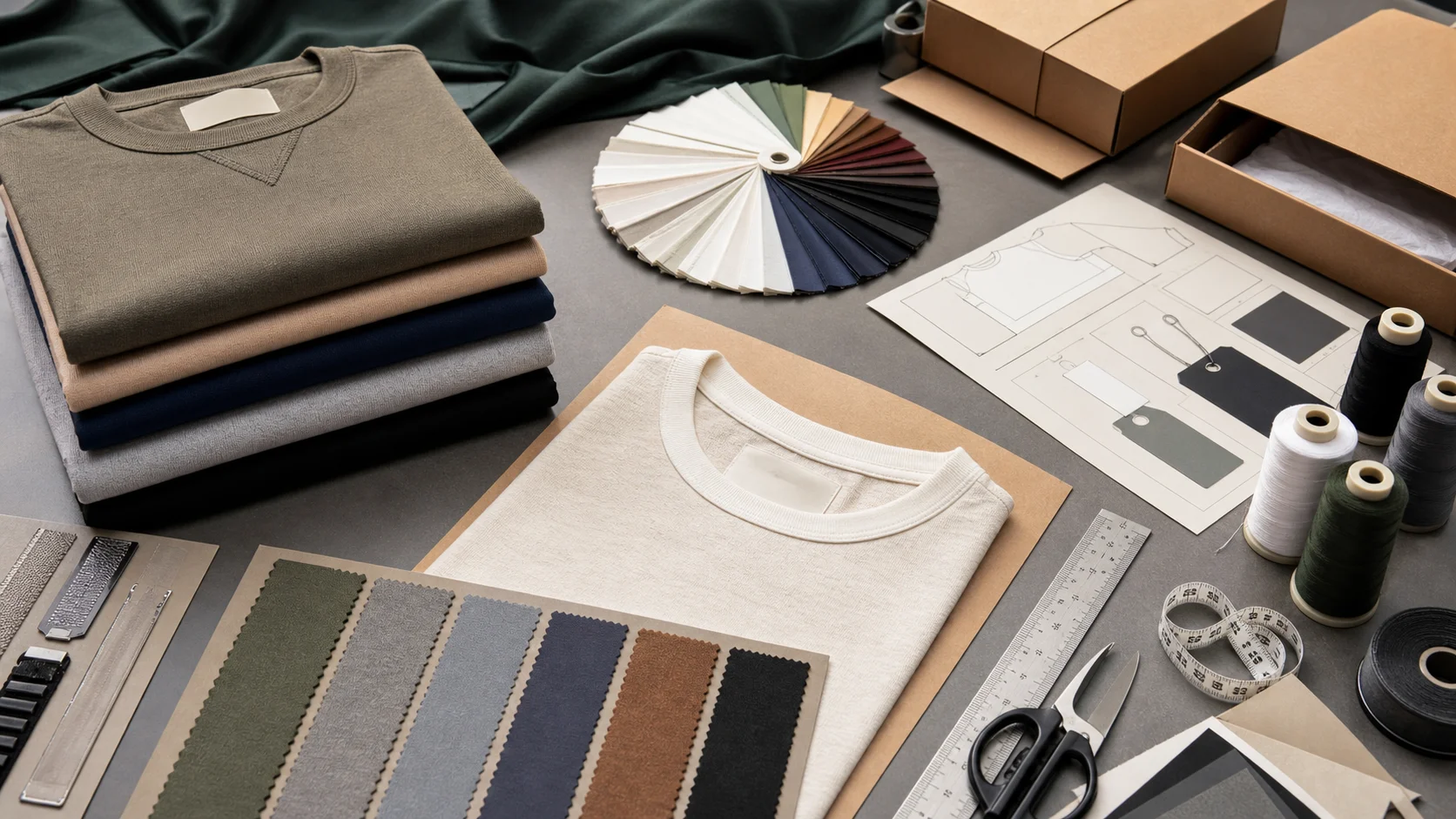
Premium Garment Unboxing with checks for samples, fit, MOQ, QC evidence, pricing terms, and delivery risk.
Fast answer: Premium Garment Unboxing: Packaging Layers, Inserts, Cost, and Brand Recall should be judged by production evidence, not by a generic sourcing promise. The buyer needs sample proof, cost breakdowns, QC checkpoints, and delivery buffers in writing.
Ask for recent sample photos, measurement tolerances, fabric or print test assumptions, decoration test notes, packing examples, and a named inspection checkpoint. These details show whether the team can repeat an approved sample at bulk volume.
Separate garment cost, decoration, labels, packaging, sampling, testing, freight, and rush charges. When every cost line is visible, it becomes easier to reduce colorways, adjust size depth, or reserve more time for sampling.
I’ve watched buyers judge a garment before they ever touch the fabric. On factory floors in Vietnam, Portugal, and Italy, the verdict usually lands in the first 10 seconds, and it starts with weight, sound, structure, and restraint. That’s where how to make packaging feel premium for clothing begins: not with a logo, but with the feeling in the hand.
A rigid lid that closes with a soft, controlled thud says one thing. A flimsy carton that crinkles in your hands says another. A mailer holding its shape at 200 grams per square meter signals order. A polybag with no air pockets, clean folds, and a crisp seam can look more expensive than a glossy box covered in six messages and three badges.
Retail psychology backs this up. Consumers make quality judgments almost instantly, before they’ve processed the branding. I’ve seen mid-market brands with a $3.20 packaging set outperform a $12 set because the cheaper one was simpler, stiffer, and printed with better discipline. The box cost less. The perception didn’t.
Luxury in Paris, Milan, and Seoul still leans on rigid presentation boxes, but the mid-market story looks different. In Los Angeles and Berlin, structured mailers with thick paper stock and one clean logo often beat ornate packs. In basics, an upgraded polybag with 50-75 micron thickness, a tidy fold, and a matte label can do more than a decorative sleeve ever will.
Overdesigned packaging backfires fast. If it looks fragile, busy, or wasteful, buyers read it as compensation rather than confidence. I’ve seen brands spend $1.80 extra per unit on layered ribbons, metallic stickers, and oversized inserts, then lose the premium effect because the pack looked like it was trying too hard. Fewer elements, done better, usually win.
And yes, that affects repeat purchase. Even a 5% lift in giftability or social sharing can justify packaging upgrades that add 40 cents to 90 cents per unit. The job is not to decorate. The job is to signal that the garment inside deserves attention.
Material density changes perception faster than graphics ever will. When I visited factories in Spain and China, the packs that felt most premium were rarely the most ornate. They were the ones with accurate folds, heavier board, and tight manufacturing tolerances. A 1200 gsm rigid board can feel more expensive than a 1500 gsm board if the latter is cut poorly or glued unevenly.
Paper weight matters because hands read resistance as quality. Folding cartons in the 350-500 gsm range work well for shirts and accessories. Rigid boxes usually start around 1000-1400 gsm board with wrapped paper. FSC-certified paper, heavy-duty tissue at 17-24 gsm, and woven cotton ribbons all contribute to a more deliberate tactile experience. Water-based coatings keep the surface clean without the plastic shine that cheapens a pack.
Here’s the practical comparison:
Soft-touch finishes can help, but only when they’re controlled. A velvet-like laminate on a rigid box feels refined. The same coating on thin board can feel artificial, almost oily. In the UK and Turkey, I saw brands use recycled board with a clean one-color print and a water-based matte varnish. The result looked more premium than a laminated box covered in full-bleed photos.
Here’s what most people miss: premium packaging often uses fewer components, but tighter tolerances. A lid with a 1-2 mm fit tolerance, a carton that closes square, and a tissue fold that lands exactly centered can outperform a package with ribbons, charms, and inserts that shift in transit. Accuracy reads as care.
If your brand already uses clothing packaging solutions, ask your supplier for samples in three board weights, not one. A manufacturer or factory that can show consistent production across options is usually the safer choice for custom wholesale and bulk orders. I’ve seen the difference between 300 gsm and 400 gsm board change consumer perception more than a new logo ever could.
Brand marks should behave like a confident whisper, not a billboard. Large repeated logos can feel defensive, especially on packs under 25 x 18 x 6 cm. A single mark placed with room around it often reads as more expensive because it suggests the brand doesn’t need to shout. I’ve seen that rule hold in both premium streetwear and understated womenswear.
Color is the next signal. Black, cream, charcoal, deep olive, muted clay, and warm grey often read as premium, but only if the print stays consistent across the run. One badly registered Pantone can make a $5 package look like a $0.50 one. According to standards guidance from ISO, repeatability and process control matter as much as design intent when the finished product must look uniform across thousands of units.
Finish choices shape the story. Matte lamination softens glare and usually costs less than heavy decorative work. Foil adds a precise flash when used on a logo or edge line. Embossing gives tactile depth, especially on rigid boxes. Spot UV creates contrast, but too much of it starts to look like a promo mailer from 2017. I prefer one hero finish, one accent, and one focal point. Anything beyond that risks clutter.
Factory visits taught me something blunt. The most premium packs are often the least eager to perform. A single foil logo on cream board can feel richer than a full set of metallic ink, gloss patches, and multiple die-cuts. At $0.15-$0.40 extra for foil blocking, one controlled accent usually delivers more perceived value than three decorative effects added together.
Print execution matters more than most brand teams expect. On a 5,000-unit run, a tiny shift in cut line or a haze of overspray can undo the whole design. In packaging for premium T-shirts, knitwear, or activewear, I’d rather see a clean 1-color print on recycled stock than a busy full-color build that fights with the garment’s own identity.
For brands selling through private label clothing services, packaging should reflect the price architecture of the line, not the mood board. A $28 tee cannot support the same visual noise as a $280 cashmere sweater. The pack has to match the margin, the audience, and the promise.
Layers matter because they create a sense of effort. A buyer opens the mailer, then sees tissue, then a card, then the garment. That sequence increases perceived care even when the actual packaging spend is only $0.25-$0.60 higher. The trick isn’t to add more. The trick is to order the reveal properly.
Tissue paper should feel deliberate. I look for 17 gsm or 20 gsm tissue with clean folds and print that doesn’t bleed. Sticker seals work best when they’re small, centered, and easy to peel without tearing the sheet. Care labels, return cards, and brand notes should follow the same typography rules as the main package. A weak font choice can cheapen everything around it.
Giftability grows when the details are calm. A neatly stacked insert can make a $45 blouse feel closer to a $95 tier. A branded hang tag on thick cardstock, maybe 450 gsm, can pull more weight than a sleeve full of slogans. In one factory in Cambodia, I watched a team add value with almost nothing: a folded tissue wrap, a monochrome thank-you card, and a perfectly aligned seal. The whole set cost under $0.18 per unit and looked far more expensive than its price.
Sound matters, too. The rustle of tissue is part of the experience. So is the opening resistance of a rigid lid or the slight pull needed to free a garment from snug packing. Those sensory cues tell the buyer that the product was handled carefully. A loose item rattling in a big box sends the opposite message immediately.
I’ve found that brands in the babywear category are especially sensitive to this logic. Parents notice quality and safety in the first touch, which is why teams using custom baby clothing manufacturing often invest in precise inserts and softer materials even for small orders of 300-500 units. The perceived effort carries into trust.
Small details matter more than most boards admit. A card placed 8 mm off-center looks careless. A seal that tears the tissue badly looks cheap. Precision is the real luxury signal.
Packaging economics are easier to manage once you segment by spend. Under $1 per unit, $1 to $3, and $3 to $8 each tell very different stories. The highest perceived value per dollar usually comes from paper quality, rigidity, and one tactile finish. Decorative extras often deliver less than brands expect.
Under $1, you can still create a premium impression. A structured mailer at $0.45-$0.80, a single-color print, and a well-cut tissue insert can do real work. This tier suits tees, underwear, and entry-level basics with MOQs around 1,000 to 3,000 units. The challenge is consistency, not cost. At this level, a 2 mm dimension error can make the pack look rushed.
The $1 to $3 bracket is where most brands get meaningful gains. A folding carton with 400 gsm board, matte varnish, and a small foil mark might land at $1.30-$2.40. Add a branded insert and you may reach $2.60. For dresses, knitwear, and premium knits, this range balances perceived quality and shipping efficiency. It also tends to work well with MOQs of 500 to 2,000 pieces.
The $3 to $8 bracket is luxury territory. Here you can use rigid boxes, wrapped board, embossed logos, ribbon pulls, and layered inserts. I’ve seen $4.90 boxes raise average order value because they made the product giftable. But the economics only work when the garments carry enough margin. A $38 shirt cannot absorb the same packaging ratio as a $180 coat.
Labor changes the picture by region. In Vietnam and India, lower hand-assembly costs can support more folding, tissue work, and manual inspection. In Portugal and Poland, the finish consistency is often stronger at scale, especially for short runs of 300-800 pieces. China still offers the broadest material and print options, though quality varies sharply by supplier tier.
According to trade data from trade.gov, apparel supply chains are highly sensitive to lead time and freight efficiency, which means packaging should be priced with both production and shipping in mind. A heavy rigid box may look beautiful, but if it adds 180 grams to each parcel, freight can erase the margin advantage quickly.
To calculate packaging ROI, I use three inputs: average order value, giftability lift, and social sharing potential. If a $1.40 upgrade raises repeat purchase by 2% and increases the odds of a shared unboxing by 10%, it can pay back faster than a cheaper, forgettable pack. For brands using private label clothing services, that math should sit beside the product cost sheet, not after it.
Sustainability and premium feel are not opposites. Wasteful packaging often creates distrust, especially in apparel where customers already know how much material it takes to ship a T-shirt. I’ve seen younger buyers react negatively to oversized boxes, excess plastic, and unnecessary fillers. Restraint reads as confidence. Excess reads as insecurity.
Mono-material packaging is easier to recycle and often easier to make look clean. Recycled board, paper-based mailers, and water-based inks deliver strong signals when the print coverage stays low and the structure is accurate. Compostable mailers can work, but only if they survive abrasion and moisture in the actual shipping lane. A material that fails in transit is not sustainable. It’s just fragile.
Factory observations are consistent on failure points. Weak adhesives, mixed materials, and boxes that arrive 10-15 mm oversized are classic signs of poor execution. Oversized packaging also increases void space, which drives freight cost up and makes the parcel look lazy. According to Textile Exchange and certification guidance from OEKO-TEX, material choices and chemical transparency both matter when apparel brands want packaging to support a credible quality story.
One reason premium sustainability works is because it avoids apology. Do not bury the buyer in claims. State the material plainly: recycled board, water-based coating, paper-based seal. Keep the language factual. Brands that sound preachy often sound uncertain.
When I review packaging for cut-and-sew brands, I care about how the product and pack meet at the seam. If the garment is finished cleanly through cut and sew manufacturing, the packaging should echo that discipline: simple, accurate, and built to last the shipping cycle without extra plastic. That’s how to make packaging feel premium for clothing without compromising the sustainability brief.
Start with the garment, then write the packaging brief. Define product type, shipping method, unboxing style, material budget, and brand cues. A folded jersey tee shipped flat needs a different system from a structured blazer or baby sleeper. The brief should also state MOQ, target landed cost, and lead time. Simple packaging can be produced in 2-3 weeks. Complex rigid builds with foil and inserts often need 5-7 weeks.
Technical specs prevent cheap-looking results. Ask for board thickness, print resolution, tolerance limits, adhesive strength, and crease precision. I usually want thickness in the 300-400 gsm range for cartons, fold tolerances within 1-2 mm, and print registration checked before mass production. For finishes, request the exact coating type and a sample board under the same lighting your customers will use.
Sampling should move in stages: white sample, printed sample, pre-production sample, final sign-off. Each stage catches a different failure. White samples test structure. Printed samples test color and finish. Pre-production samples test fit, glue, and folding. Final sign-off should only happen when the piece survives a drop test, a close test, and a visual inspection under natural light.
Choose a supplier that can explain process, not just quote price. A dependable factory or supplier in China, Portugal, or elsewhere should be able to show quality controls, production timelines, and how they handle custom revisions for wholesale and bulk orders. If the sample feels good but the production answer is vague, keep looking.
For teams asking how to make packaging feel premium for clothing at scale, the brief should include a reference image, die-line notes, Pantone targets, and packaging examples you want to avoid. That makes feedback faster and reduces rework. It also keeps the manufacturer aligned with the intended price point instead of improvising on the line.
If you need help getting the right balance of quality, MOQ, and custom development, start with a packaging partner that can support the full production cycle. Good packaging is not just designed. It is engineered, tested, and repeated reliably.
Use one structured element, one clean print color, and one tactile detail. A $0.45-$0.80 mailer with 20 gsm tissue and a centered sticker can outperform a more expensive but crowded design. Keep the pack rigid, tidy, and consistent.
Budget premium packaging usually runs under $1 per unit, mid-tier packaging sits around $1 to $3, and luxury packs often land between $3 and $8. Exact pricing depends on board grade, print method, finishes, labor, and order volume. MOQ 500 units usually costs more per piece than 2,000 units.
Simple mailers and sleeves can take 2-3 weeks after approval. Folding cartons with special finishes often need 3-5 weeks, while rigid boxes with inserts may take 5-7 weeks. Add extra time for sampling, especially if you need foil, embossing, or custom die-cuts.
Yes. Recycled board, water-based coatings, low-coverage printing, and paper-based inserts can feel premium if the structure is accurate and the folds are clean. Premium perception comes from restraint, precision, and consistency, not plastic-heavy decoration.
Layered tissue, a small thank-you card, a neat seal, and a box or mailer that opens with controlled resistance all help. A giftable pack usually has one focal point, no clutter, and typography that matches the brand tone. Even a $0.18 insert set can raise perceived value if it is aligned properly.